Hello everybody good afternoon I'm very happy to be here to see uh all of you to discuss that topic and I think that's of course it's a very important topic a very important issue that we could summarize this way so the prevalent forms of knowledge production and uses are inadequate to guarantee the perpetuation of a safe ecological space for our spaces so that's I think we need to make a connection between uh the Metabolic uh dis disorganization of the state of the plan planet and the knowledge problem and here we are going back to very
classical issues in the debate concerning economics and knowledge of course discussion that was dominated by freder from AEK and maybe you have heard about this Brad Delong piece he was making a review of James Scott seem like a state book so James Scot seem like a state you know very influential uh book about how the way State bureaucracy REI the real and it's the cause of Mis uh Mis Dynamics in terms of developments uh and uh in fact what Brad long was saying is that this book by the this Anarchist uh uh um Anthropologist was
in fact the victory the final victory of the Australian and they explained that within economics so at that we we are at the end end of the 20th century within economics even liberal kisian social Democrats Acknowledged that the austrians won victory in their intellectual debate with the central planners long ago and jam Scot sing like state marks the final stage because why because it shows the spread of what every economics will see as austrialian ideas into Political Science sociology and anthropology as well and uh the key argument which is in fact an argument by haek
that is made by Scott is that the necessarily seen schematic model of social organization And production animating the planning was inadequate as a set of instruction for creating a successful social order so this is the core of the Australian argument and in fact Brad Delong is U using that title seeing one intellectual Roots why because he is accusing Scott of not analoging enough the fact that in fact he was 100% an hakin which is not completely Fair because Hayek of course was very much more supportive of big Corporation and that was not the case of
Scott but still he had a point in the sense that the nature of dispersion of knowledge and the fact that knowledge is inarticulated impossible to articulate was the core of the Austrian argument and it's also the core of the argument of James Scott so that's how we ended the last century and I think that we have a new problem of knowledge the problem of knowledge in the anthropos is summarize a little bit earlier by William cap when He explained that the current transformation of the environment is no longer the expression of a growing Mastery of
the world in which we live but on the contrary the scene of a loss of this Mastery and this problem of Mastery is a problem of management policies and so on but also of knowledge I would say and the question that we need to to discuss is what are the kind of institution that we need to reshape human nature metabolism and how should We proceed process knowledge to invest buil and dismal in order to have an economy that is ADD equate to to to the biosphere and of course there are many way to think about
a different economy but I think that one key argument is that there are only two in the modern era only two instances of totalization that doesn't mean that there are no other way to organize the economy but the two main instances able to propose the global principles are the state the Bureaucracy and the market so Market finance and planning political mechanism are the two main instance es of totalization and of course you have hybridity you can have adaps addons but this Duality is is the core that need to be discussed so the structure that I
propose today will be mostly about discussing criticizing from the knowledge point of view the problem of green finance and I will it seems like If it was symetrical but it won't be really symmetrical I will make the two on the first part and one third of the last part which will be more about the possibility of ecological planning and here in the second part I'm relying more on a book that uh has been published last year so what is the pro promise of green Finance it's to have better capitalist this is from the net set
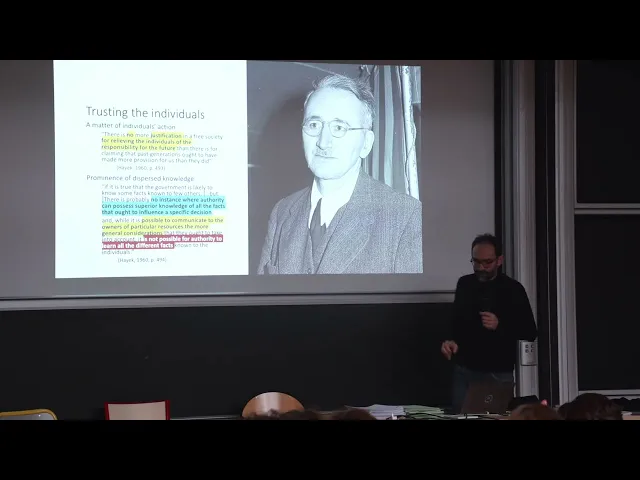
it's the Swiss Newspaper leading a business newspaper and explain that we can in invest in innovation solution for the future with a positive impact on nature so be Save the Planet be a better capitalist that would be the kind of motto of green finance and this argument in fact is an argument that is very hen in the sense that we can rely of on individual we can trust individuals to deal with the problem and haak was very was in fact discussing the ecological issue that was Not of course the core of this argument but there
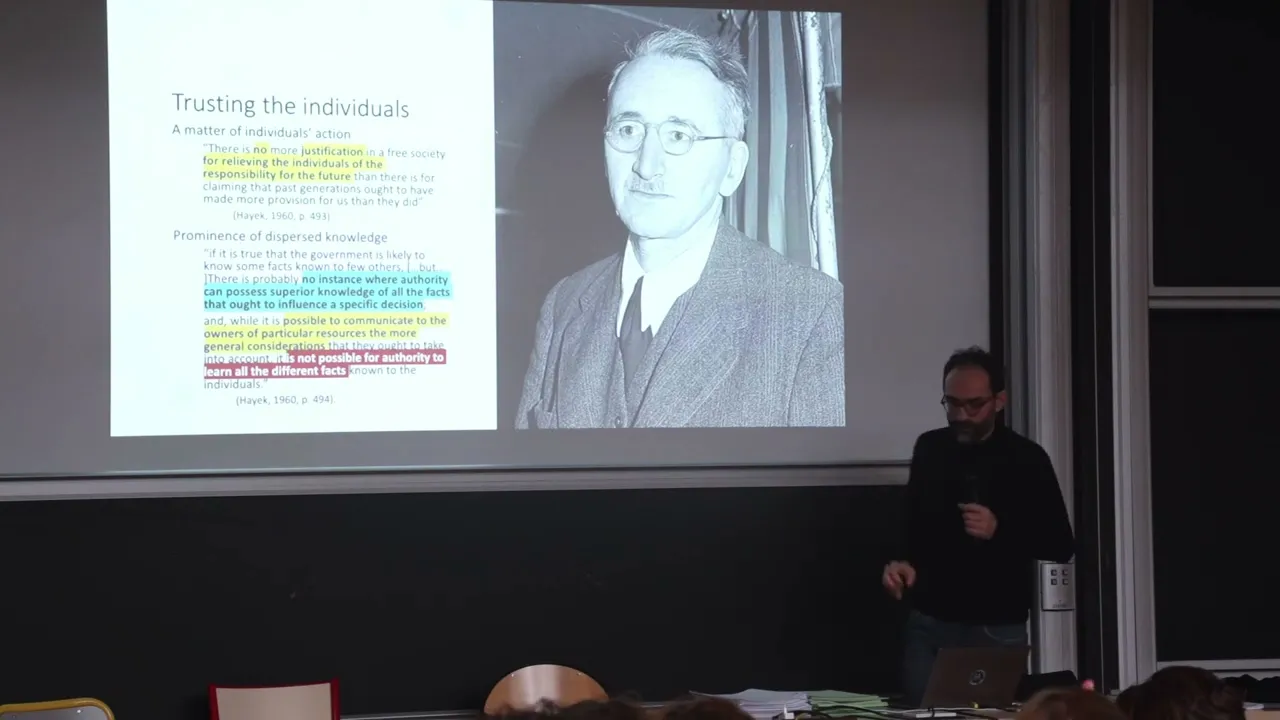
are few chapters where he's dealing with that and in particular he say that there is no more justification in a free Society for ring the individuals of the responsibility for the future than there is for claiming that past Generations have to have made more provision for us than they did so this is very important because he say that in order to deal with resource problem to the future of the ecological Dynamics we do not have to rely on anything else than relying on individuals he's very clear about that and why he's making that argument of
course because for him always there is a prominence of dispers knowledge and he acknowledged the fact that some kind of knowledge are only known by government is not completely caricaturing himself you know that you have science you know that you have bureaucracy you know that you have This kind of knowledge that is very difficult for the individual to get access to but what he says he says that there is no instance where Authority can possess super knowledge over the facts that to influence a specific decision so there is no instance where Authority know better there
are some instan where the authority knows something that the individual do not know but it's always possible to disperse to communicate that specific knowledge to the individuals so If there is knowledge that is only available at the central level it should be dispersed but the other way around it's not possible so in making this very strong Act of Fai about the asymmetry between the capacity to disp personalize and the capacity to centralize knowledge and this argument by a in fact was very influential in the past years and I will argue that we misread Mark carne
talk or many people misread Mark carne talk about this uh uh this uh Tragedy of theism so we know all of you I suppose already heard about this talk where explained that from a regulator perspective there is a problem uh uh specific with climate change in general that's not a problem there is a reassessment of value of course in financial Market you have reassessment of value that's the way it works but here we have a problem if we have a woell reassessment of Pro Prospects why because it could potentially destabilize Market spark a pro call
crystallization of losses and persistent tightening of financial conditions so in other words the problem for Marne is that we could have an Abrupt resolution of the tragedy of the Horizon which is a financial stability risk so we know that but what is less discussed before that the more we invest with foresight the less we regret in insight and the key argument of K in fact is to create the condition to invest with foresight basically that Say that implies that investors should be able to in invest correctly if they have the good information they should be
able to behave exactly like high suppose that they could be able to deal with the future and this is a crucial argument what is this risk we know that we have uh physical risk so the risk that some uh the value of financial assets will uh be dimin drastically because of uh climate and weather related events so just think about Los Angeles those days Or Valencia liability risk uh you could sue companies that are responsible for climate change and there will be there is already and there will be more and that could be uh some
fin risk and there is transition risk for company because you will have new regulation that will hurt business plans will ear the value of some assets so that's that's the kind of risk that need to be taken into account and what Mark says is that we have those risk but we need to disclose Those risk if they're correctly disclosed then no problem because which can be measured can be managed so Financial Market can manage those risk if they are aware of those risk this talk had a huge influence one of the consequence of that is
that Central bankers at least in Europe change some of their policies and you have this very good research by Jerome Daris that is discussing the detail of that and in particular we can observe that since the Late 2010 we have a very significant increase in the number of time the central Bankers in Europe will use uh will mention climate and we'll discuss that and we have a new instruments that were implemented we also document that and so that's something that is very present in thecb discussion it's we can measure that so there is a climate
turn if you want in Central Banking a green turn in Central Banking however we have that but we need to think about what it is really and what it is really in fact we I just take one example but I think that's the boldest move of the of the ECB this boldest move was in fact the that the ECB uh decided to account for climate change in its corporate bond purchases so it was uh uh buying bonds you know to to fulfill its mandatory uh uh mandate relative to financial stability but While it was buying
bonds it was taking into account climate risk so that's that's something very important and there is his underlying and I think is's right that in fact those bonds uh that that was very significant why because that marked the end of clim market neutrality as the organizing and unsurpassable principles why because those buyings were not based on risk based metrics but explicitly relies on extrinsic objectives that of climate Stabilization so that's that seems to be a very significant move on the part of zcb yet and that's here that I will begin to discuss that we have
a huge number of problem I will dig into all the problem that we have the first problem is that those very meaningful green bonds they are green we know who knows thecb don't know that's the key stuff the Cal Banks and that's Eric M that is saying that and I think that it's very important the central Bank has no competent staff for studying and choosing investment they do not know how to do that they don't have the bureaucracy they don't have access to the information which means that in fact when they are buying bonds that
are that are to be greens they are guessing what is green they are guessing based on past emissions of Corporations they are guessing about targets they guessing about transparency of those uh corporations but those GES they are Based on what they are based on publicly available information so basically that's private uh corporations uh notion agencies that are giving the information to the ECB so the ECB is making green decision but on the basis of private built information that it cannot control so the key point is that you do not have any kind of market-based green
Central Banking without green assets and those green assets are green only on the Basis of what is provided as information by uh other entities so it depends it's less more or less reliable depending on the dimension but it's not independent from Market actors so that's a first problem that we will go back the second thing that I just want to to stress the fact that DCB is moving but that's not the only one to move of course there has been a huge increase so a little bit less the past months maybe you realize that but
there Used to be a lot of excitement for ESG funding ESG investment so the idea of doing well by doing good so that was a promise of better capitalis that we have seen at the beginning you can invest in solution for the future while getting a nice return so you have this significant increase since 2019 up to 23 I think last year that shifted in fact with a global rise of ESG funds but they just as the ECB rely on also disclosure Dimension and I recommend for those of you working on this book which is
very fantastic very detailed very very good uh and they are discussing all the details of this uh antinomies of climate Finance but what they stress and I think is very important is that by seeking to create market conditions that are more informed about climate change the objective of disclosure is to reflect a neoliberal understanding of Market in fact they are trying to implement uh the Idea of mar fek of Market as an in onent information processor to deal with climate challenge so the idea is that if markets have the good information then they will be
able to deal with the the solution disclosure requirements aims to provide information to markets so that they can price risk and allocate capital urly in fact if you follow that closely that means that even discussion about carbon Market or carbon tax are Irrelevant if Market got the right information you do not need any kind of Regulation to do that and this is the Hardcore of the argument of marar I would say so a lot of things are going done here a lot of thing to impact a lot of factors are involved and there is this
paper just published by uh fitner and his cter that is detailing all the actors how they are implementing but what is very important is you have the Real things the real world stuff is here but most of the coration is taking place here in relation to es Credit Agencies in particular and investor driven governance Network so those this is climate Finance that's what we are talking about and that's what we want it's here but the connection between the two is far from obvious and the detail the reason why those channels are weak in in this
Pap that I recommend so alas why that doesn't work Very well the first argument is an argument that in fact you have a lot of green washing that's not surprising but that's not the the only one you have also a problem of WR prices and more generally a fallacy of green finance that I will detail so green washing so this is from a a paper from a former uh Master student uh for narol he was working I think last year he was last year in the program and and and he worked with other People that
looked at what was taking place in Mexico and in Mexico you had a lot of investment in the uh uh clean energy but in fact that clean energy was built with the support of the European Central Bank why because the European Central Bank was heavily supported this firm that is Iber DOA that was investing there by buying its Bond so it was buying a lot of bonds from that corporation which helped to F those investment but people on the Ground they were not happy they say that nicely but they are very unhappy why because in
fact fact you see how the land is cannot use that land anymore and there were there were there used to be a lot of problems concerning the legality of that those investment and so on and so forth but here of course the ECB is not aware of that the ECB is just looking at the carbon balance of that Corporation and it's helping it a lot because he has no clue to follow that More closely there are also people that are well connected and that say what's taking place and I think it was nice one year
ago that would be have been better to make the talk because now we know that all people from Black Rock just kick that out so it's not a surprise but they said that very clearly T frany was working at Black Rock it was in he was in fact the chief investment officer for sustainable investing at Black Rock During one year and a half and they explained that while working at Black Rock he was helping to popularize this idea that green investment ESG could be a way to deal with the major market failures that are taking
place due as climate change and the ecological crisis and he's making he saying that in fact those senior executive was exaggerating the impact and in fact they were knowingly misleading actively misleading people about the extent to which this Purpose in terms of investment could really affect underground so that's for Black Rock the us but in Europe that's not very much better you have this uh woman deser fixler that used to work for an affiliate of Dutch bank group uh she was HED there in 2020 and when she arrived she realized that those investment uh she
was sustainability officer that there was a big gap between their public ESG claims and the reality of their ESG Effort and in fact a number of their ESG statements were just we lacking any kind of of substance and some were just wrong and uh following the the publicization of that information there was uh an inquiry by the the police and something that was very uh impressive is that I think that yeah you can see that uh is that following the intervention of the police they of course revised their balance sheet and the result of that
that there Was 75% less than a year earlier green investment in their portfol so they were lying at 75% rate which is already meaningful but you can do better better than 7 five you can do 90 uh 98% of so this is a paper n uh from last September about green Bonds in the US so they are looking at all the green bonds that were uh uh that were emitted in the US since 2014 up to 2023 that's mainly Municipal B bonds and corporate bonds and what they are Looking at is there any meaningful difference
between the use of those funds in terms of impact on nature V usual funds that's this idea of additionality meaning that those bonds should participate in the funding on of beneficial uh environmentally beneficial projects and in fact the vast majority of green bonds proceed is used just to to to find not orinary Dept so you put that green because it's not specifically polluting but that's just green as it Was before it not green but that's the same kind of investment there is nothing specific in that only 2% of those Bonds were having a meaningful impact
so 2% of 100 100% of emission it's it's huge it's really I don't know to overstate that so of course that's the first problem with ESG and marginally green Finance is that there is no specifically reliable information that's not specific ly new so we can discuss a lot of that there was a report by IMF a couple of years Ago there are some progress with the issue of taxonomy in Europe so we can discuss that more but still the the Baseline is very very depressing the second problem is the problem of what we call we
could call the profit problem you could know where to invest you could be agree to invest in that and still you can lack investment that's the demonstration that has been made by Brett Christopher in this crucial book the price is wrong Means that in fact we saw that uh since now oil coal and gas are more expensive to produce electricity than uh is our uh re renewable energy we were hoping that we will have a very drastic and very rapid shift toward renewable energy there has been some shift of course but not very rapid on
the one hand and moreover as soon as subsidies are stopped there is no more rush so why is that taking place why environmental targets remain elusive in spite of the Fact that sustainable energy is cost competitive for already several years so this is the price of solar panel in Black Wind here and you see that it's well below coal gas and nuclear so around 2010 we had much more expensive renewable energy than other sources and since 2016 we had a change and this is what's taking place look at uh so it's at the World level
year- on-year growth in global electricity output by Source generation What you can see is that overall there is an increase of uh uh electricity output by overall but fossil fuels is above uh solar and wind and other sources so you have more capacity that are going to uh the uh Brown uh generation that to the green generation no that doesn't mean that there is no green generation capacity that are implemented there is a lot of green investment in electricity generation but that's still we still have an increase In brone capacity of electricity generation so why
why unless why we uh green electricity profitability why we have that it's because green electricity profitability is elusive that's the point of BR Christopher why unless externally forced will the electricity industry accept let alone actively Embrace a highly distributive transition that lower production cost so that's true there is less production cost but In the meantime that's so little if any of the resulting efficiency gains uring to the industry cost actor so basically you can have lower cost but if you not able to capture the rents occurring from those diminishing costs nobody will invest into that
and that's the C cor is argument there are more technical dimension of course of the argument part of that it's because you have a very significant upfront investment there is this problem of low entry barrier there Is this problem of cannibalization effect so as soon as you have a lot of investment you have a drop in prices which which make stop the capacity of the sector to invest more there are also issue of connection to the network so there are many things but the bottom of the core of the argument is this so going back
to our general argument the problem is not only that we do not have the good information about what is really done on the ground It's even if we know what is do done on the ground without some forms of coordination incentives to invest even with lower cost will not drive uh the green transition in the good direction and some people are saying that very clearly this is from Shell coo uh during uh uh 2022 earnings uh call with so with investor he explain okay I think on low carbon let me be I think categorically on
this that's very important we cannot but we cannot Justify going for a low return if we canot achieve the double digit returns in the business we need to question very hard whether we should continue we want to continue to go for lower and lower and lower carbon so we used to be for Trump but but it has to be profitable so that's that's the thing say maybe there is a general spirit that could be good but even a CEO from a big old Corporation cannot look at something else than the profit and you do not
have The same kind of profit with renewable than you have with fossil fuels so that say us something and we are going back to to our our friend from T fry from Black Rock there is no such a thing as doing well by doing good and here there is a logical problem with ESG either money if you want to if money flows to Green company the idea is that you have a green label in order to invite companies to invest so the idea is that they should have a better Funding condition that should be less
expensive to to fund their activities but of course from the point of view of the investors if you are proposing cheaper uh Capital that means that you will get a a lower return so so ESG investing only make the world better to the extent that it accepts to to lower returns to to investors so this idea that you can have both it's it's it's a logical fallacy because of course you can have both but if you have both it Means that the market is functioning already well and there is no need for ESG there is
already a correct processing of the instrument and in that case ESG is is pointless so this is the first dimension of the E logical finy of VG there is another uh I think important fallacy of PSG it's a fallacy of composition so you have some kind of gum so grum is the fact that indeed it's a little bit less expensive for company to Invest in green than to to in other activities so you have some benefits from company but if you think about that investors that are accepting this granum so so this low lower return
that means that in order to to to support sustainable impact if you think about the dynamic of that that means that those sectors have cumulatively less Capital than the brown sector that are getting a higher return so in terms of capitalist dynamics that means that the Brown sector is growing more rapidly than endogeneously than the the green sector so I think that's also something very important to to to have in mind is that if you are not able to reduce the profitability of the Bron sector it will will just get more powerful and uh have
bigger impact so alas for ESG and green Central Banking Green washing the profit problem the fact that there is a logical fallacy on relying of lower returns to get to Transform the the the the economy are the three Mains logical obstacles or tical obstacles to the development of green Finance which means that we should put green Finance in its place and that will be the kind of conclusion of that first part that I would like to make and I would like to make that argument relying on people that you probably know in particular uh Roman
Schwartzman that is part of the let's say EPO ecosystem and other people working uh in various Central banks so that was a report that was commissioned by the bank of international uh settlement and written within the bank bank the France and and what they say basically is that they say of course there are huge stake with climate they agree with car that of course there is a risk for financial stability and so and so forth however it's uh not sufficient to look at Central Bank to deal with the problem they arguing against Green monetary Dominance
if you want they said that integration of climate related risk into production regulation and into monetary policy will not suffice we need uh we need other way to to other policy tools and that's specifically problematic for central bank because there is a lot of pressure on them to play a new role uh however such a calls are excessive and unfair they do not have the tools to properly play a me for role in terms of transferring the uh the uh the Investment landscape to face the ecological challenge so I think this is a a very
nice argument very important argument that say that what is taking place in terms of funding the green beercation is not cannot be driven by central banks that are just paying uh directly on financial Market there is an argument that has been made by people a little bit surprisingly this is from Derek Brower He used to be us energy editor and two years ago one year and a half ago he explained that uh capitalism won't deliver the energy uh transition fast enough and this argument was already beyond that market cannot deal with that because it's too
much money too much coordination and there is a global South issue that needs to be taken to be taken into account that means that only big government can deal with that that was his Argument and you have finally uh Milton fredman and I think that is right I agree with fredman what fredman is saying is saying that there is no such a thing as corporate social responsibility the doctrine of social responsibility taken seriously L would extend the scope of the political mechanism to every human activity in a free Society there is one and only one
social responsibility of business is to increase its profit so that's very well Known but I think that in fact he giving the solution since we cannot rely on business to deal with a problem we need to go to the top which means that we need to extend the scope of the political mechanism we need to extend the scope of the political mechanism and this is in fact the argument that was already made a long time ago by William cap when he explained that the perit of private gains place a premium on the Minimization of private
cost so we cannot rely on private incentives to deal with externalities the more Reliance on an economic system plac on private incentives the more under purit of private gains the greater the danger that it will give rise to external unpaid social cost that's the same argument in fact as as fman I think you have uh an inability of Corporation to incorporate other dimension than their uh their bottom line so let's follow Frean advice and look how we could enlarge the political mechanism so that will be uh the second part of the my presentation and I
will be a little bit more rapid about that that's some elements that were develop in the book that we published with rasm last year so the argument that we are making is that the conditions for planning uh in the age of algorithm have changed so that's A first argument you have this argument that was made a long time ago in the 80s by uh Ernest mandal and he was very courageous because we were in the in the 80s and the 80s nobody believed anymore in terms in planning and he said that look at what's taking
place in real world excuse my sorry in real world capitalism in World capitalism you have more and more and more planning that's corporate planning that's private planning but that's Planning why because Corporation are extending their reach even beyond their own Frontiers that was the beginning of internationalization of value chains so he said in fact you have this extension of planning which create the material condition for public planning and this argument we are continues this argument with anab and Cil recap in the paper about corpor planning as uh in the last century looking at what Harvard
Business Review Is saying about that but that's something very important look at corporate planning and you will see that in fact they are planning you need to think about that the second argument is that in fact against Tek there was other people that were taking seriously the issue of knowledge and in particular this guy it's a a betal li betal Li and bet lime was a scholar here based in Paris he was specialized in in planning it was a theor theoretician but also he Was involved in many debate in Algeria in Cuba there is a
long exchange with chigara he he went also in India so he he was participating in a lot of debate and he was perfectly aware of the difficulty of planning he was not saying just plan just social the me of production everything will be okay he say no that's much more complicated why because you cannot rely only on gical formalism you can have econom proper you can have legal property on assets but That doesn't mean that you are able to to plan you need economic property and possession what is economic property and possession economic property is
durability to uh control the profit or the Surplus and to allocate that to investment and possession is the ability to regulate control the labor process to to manage the labor process technology the organization of work and effective planning depends on the reach that you can have on those two Dimensions if you Are just the legal ownership but in fact you are not able to control Financial flows or have a meaningful idea about how La process is taking place then there is no such a thing as planning so planning depends on information forces the determination of
the economic subject so the subject that is able to plan to have a productive project that is consistent depend on its ability to transmit information memorize it and process it 19795 so he was very Aware of those issue and of course that means that the advances made in the sphere of information techniques may have considerable practical consequences for the possibility of planning so this argument is very interesting because it's on the one hand a little bit like haek he acknowledged that planning depends on knowledge but on the other hand he explained that it's not high
historical it depends on the context in depends on development and of course Right now with information technology and so on so forth the debate has changed drastically so you have jackma jackma is the former head of Alibaba but you know in in China big Tech were dealt differently than from in the US so is much more sideline now but before this sideline it made this argument I think that uh thanks to artificial intelligence multiple intelligence our perception of the world will be elevated to a new level and that Moment it will be possible to plan
and to predict Market forces so as to L to have finally achieve a plan economy so he was explaining that we will have a plan economy and some people steps uh follow his steps and you have on the left people that are thinking about this idea of computerized planning that's people around Po and so he he W wrote a paper just so a couple of years ago explaining that yes using cont of each algorithm it's suppos it's way it's Possible to find a way to combine various techniques with pregiven resource to fulfill a plan so
we can combine we have the computing power we able to do an optimal computerized planning and even built an algorithm to to Pro propose a way to do do to do that so I'm sure that you're sure that people that were fond of haek were convinced by this argument of course they were not they they explain that you miss completely the point jackar and cockshot There is no such a thing as a knowledge that you can just take on the ground and centralize and so the knowledge of the market is not dispersed as bit and
pieces through through the economy uh that must be collected and computed it's contextual it's embedded in context and in fact from their own point of view it depends on exchangeable private property so the market process so they don't believe in in this idea of computerized uh uh cap planning so For them techn fism turns out to be unfeasible in principle so we are going back to haek not at all recognizing the argument of betal and we have in fact a third position and I think that's a very good position it has been developed by still
and what she said she's an Australian scholar and she said that data analytics by itself if divorce from theorganization of The Economic Institutions and from critical analysis Of technoscientific OB objectification those Z automatically equal soci socialist emancipatory or effective planning so that's that's I think that's bright that that's exactly what need to be said on the one hand it opens new possibility for planning but on the other hand it's not enough and planning is not just about calculation it's also about broader institutions that we need to to discuss in fact if you want to plan
Democratically you need to rely on a varieties various forms of uh knowledge so you have on the one hand so this is the uh socialist calculation debate redex you have the three position so I will be very rapid on that everybody knows the Socialist calculation debate or not really yeah so I will be very short just to be sure that everybody catch up so you had on the one hand uh planners that are neoc Classic they said that we can have a central planner that is just Gathering prices and coordinating the uh the economy that
way that will be longer so we have prices and we have centralization and we can make optimal things it could be close to the argument of comput computerz planning that I mentioned earlier on the other hand you have people like haak that that explain that you have price but knowledge is necessarily disperse and T it so you Cannot plan uh efficiently and you have have a third position that was a position of NE that said okay knowledge is dispersed but still you can plan you have some room for planning but that necessitate a political process
of deliberation and I think of course this position is is much smarter so the argument of auton and I think is also looks nice now uh it was an argument with haek an argument against AEK with AEK he Explained that he agree 100% with AEK concerning the dispersable nature of knowledge I am the sworn enemy of the illusion of complete knowledge and from this point of view I think Professor fayak should congratulate me and appreciate my unseason effort to destroy such Shim Kim so it's very clear but on the other hand cont he assumed that
there is an impossible dispersal of technical knowledge remember what I told you at the beginning that for haek you Have some knowledge that is that are embodied in bureaucracies in uh in the state because it's it neit some specific app parities to to gather but that knowledge can be dispersed to Ordinary People to make help them make decision so what is saying uh one of the follower of nirat John O'Neil it's that not true that's true that you cannot centralize all knowledge but that's also true that you cannot dis all knowledge and just make a
s experiment you cannot go in the Supermarket and be a rational ecological agent you have no no chance you're defeated or you buy nothing but beyond that you have no chance to be rational so I think this argument is very important there is an an impossible dispersal of technical knowledge which of course give room to the possibility of centralization so planning is a battlefield and that's what we'll say at the end uh auton Rat there is a democratic moment that is Necessary to by building the legitimacy for planning but also to allowing for deliberation between
possible scenarios scenarios that are U must be judged in value and that cannot be optimized but on the other hand there is a technical moment you cannot have a proper deliberation if you do not have some forms of assessment of possib feasibility feasibility is a key concept will say vasf so we need this assessment this scenario building in order to be Able to do that so at the end of the day the debate is a constant battle between the expert and the Man in the street between democracy and technocracy that's the fate of planning there
is no magic planning that's that's a tension so I'm moving toward the end of my presentation or I should do that at least um so so I will very briefly present uh three institutions that we discussed in the book on these three institution because we are discussing Other dimension that will not engage with we are discussing augmented democracy we are discussing the role of algorithm in order toate demand but I would just like to focus on three dimension ecological accounting matric calculation of Lifestyles and socialization of investment so the first thing I think it's very
obvious but I we we have to say that because that's not put at the very beginning of any serious discussion If you want to have any kind of consistent ecological policy if you want to have any forms of consistent ecological planning you just need to have proper accounting regarding the ecology if you do not know what is taking place you have no chance to be able to assess or to make rational decision on that point of view so building proper ecological accounting is crucial and that's not doing what is taking place now this is from
the fs and They explain that they will have better accounting at the firm level but look at the details at the details they will look at the value an organization creates for others when it affects the ability of the organization to create value for itself it's not very clear let's see here you account for interaction with nature and Society only when it's material to the organization ability to create value for itself so you are looking at the impact on the Environment if it could come back and affect your ability to make profit so this uh
this financial M materiality only is really not consistent from proper ecological planning there are other way to do that and of course it's problematic but we have you know musk and the other are just sending thousands of uh satellites in the sky but with that you have a new form of knowledge for Humanity knowledge knew things that it was not able to knew Before and one example that I think is very important is so you have Planet Labs which is connected to Google and Amazon that is doing some stuff in terms of measuring biodiversity so
there are some tools that are implemented right now there are also a French Corporation Kos that is specialized in energy data and they are making photography every day of every day they get the photography through the satellite Network every day in order to be able to Assess 200,000 industrial assets assets and they're doing that continuously and which means that they able to assess in real time production consumption and storage on global scale of energy so that's very important if you want to plan if you have an idea about what's going on to your uh the
ecological Dynamic at the world scale that's crucial of course and they are showing interesting things they show for instance that industrial plants are in Fact between three and 10 times depending on countries emitting more methan than they Ange so that's that's also closing a gap that we must do that so that's just an example but to say that we have new sources of knowledge we have in fact some are talking about a new era of progress so that's not very common sense but uh it's CERN born maybe some of you know him it's a sociologist
from uh Sweden and he make this argument by saying that we have new way to Understand what going g at the world scale and this is building a new human consciousness consciousness of first as a spy and we need to think about agency at that level especially concerning ecological planning so I will not enter into the detail but you can connect micro accounting at the film levels and macro accounting that's the kind of things that need to be done if you don't just want to to retain one word about that It's from a French accountant
Andre van Andi heal about the idea of a permanent inventory of nature we need a permanent inventory of nature a permanent inventory of nature doesn't mean that you know everything about nature but as much as we can in order to be able to assess our impact and to manage that second institution it's making scenarios we explained that ecological planning was in fact choosing planning was in fact choosing between various Phbl options and this is I think a very important point that could help clarify some confusion that we have nowadays between various way of talking about
planning it this is from the rapper pizan mafus that was a rapper that was presented to the French prime minister two two years ago and I like this table because it's making a comparison between the strategy in terms of carbon pricing incentives so subsidies and planning so carbon pricing is very nice you have Economic efficiencies it brings you money but low credibility it's it doesn't work very well we are not very able to assess to what extent it will help to transform the structure incentive is is fantastic because people are very happy to get some
money to buy new stuff but there is no direct link with the target it's not effective the only one that is consistent with quantitative targeting it's planning so I think that's very Important to acknowledge that even at the core of the macroon era what what what he said is this is the doctrine and uh how do you plan and I think that here we begin to have some discussion because they explain that planning emission trajectory should be made planned sector by sector and and by evaluating uh abatement cost and their future Trends and we can
do that using regulatory tools and also credit allocation mechanism they say that developing Countries but we can think in France also I so what is the problem here I think that everything is is almost okay but the problem is sector by sector if you build scenario you cannot do that sector by sector you need to think about interdependency between sectors you need LEF you need input output so that's what is crucial from my point of view we need some forms of intersectoral calculation to be able to plan choose between various Lifestyles planning ecological Planning in
fact planning about Lifestyles it's about and that should could be done only at intersectoral level and so here you have a photography of Banos because I think that is a real inventor of the input output database there is a small text of 1921 when he explain the two main principle interseal chaining and the low of minimum but the key argument is this this one what we need to decide what are the space of possible scenarios so we need a matric Calculation as a precondition to have a proper deliberative exercise about planning options and at that
moment we can connect ecological calculation with inat which is inal calculation with economic cost B calculation that's the only way to do that we have people working on that we have research doing that for instance you have this paper by jul just published in economic system research that is trying to make that connection Between integrated assessment model and input output analysis to try to think about scenarios so we have mod Tools in that direction and that's very important we need to to to analge the fact that what is beyond this technical stuff is in fact
the a proper way to deliberate about uh ecological planning finally last uh uh uh institution it's the socialization of investment the socialization of investment when we are talking about Planning we are planning about one specific thing and the specific thing that we are talking about is the fact that we need to decide about in inment socialization of investment it's of course a very widely discussed thing you have a kesian classic this is from uh report written by KES and others but the socialization of investment part was written by kanes for the liberal British party in
1978 and that moment what was Kan saying Is that we need a socialization of investment in order to secure an approximation of Full Employment but in this so there are two text this is from the treaties but this is from uh this is from the general theory and here he was more going into the detail about what kind of investment should be done so he was already in that but what is very important is that you cannot discuss socialization of investment only in terms of label you need necessarily To have a qualitative discussion in terms
of what kind of investment you are doing and K was already aware of that did didn't worked a lot of that of course but he was talking about a board of national investment to select overse coordinate and finance investment so he was aware of this issue in theine of course it's a bit different the objective is strong sustainability so that's a main difference the main constraint should be on the side of the Ecological footprint and that means also that we have something new we need to analyze the fact that we need to fund the this
Ling of some activities and in the meantime the infrastructure so that means that the issue of in employment is not a problem there are a lot of discussion in terms of diminishing labor time and so on and so forth to the global bation I'm not a proponent of that for what reason because we need more work in the short run we need a lot Of work to to dismantle the brown stuff and a lot of work to build the green stuff and we still need to consume what we need so that's a lot of work
in the short run the problem in fact do we have enough of how can we distribute that that effort and democracy of course is we discussed that already so we can think about how to socialize investment and historically there are many example of the socialization of Investment and you have uh for instance in Social Swedish social democracy you have a lot of socialization of investment but only at the FM level that was the miner plan that almost took control of private capital in Sweden but in a very decentralized way you do not have intersectoral coordination
on the contrary you have developmentalism many sort of it including South Korea France after World War II Soviet Union and so on and so forth so there are a lot of Discussion that we can have about that but what we need is something like that we need including worker participation our autonomy and cross sector calization but that's the scope that we need so what it is concretely socialization of investment this is a text from Michelle in 1991 and they explain that in fact we need to uh put between the needs and what is pro produced
not the filter of profitability but the filter of democracy of Deliberation and how we do that so we discussed we have priorities but then we can have institutions to do that and the institutions are the following one one institution is nationalization of strategic eight so that's basically France post War World War Two but that's also the case in China nowadays so you have developmental assets that you can mobilize as a state to uh to manage your your your economy credit policy crucial to credit policy because credit policy Allows you to have priorities but not to
go into the detail of the technology of the labor process where you can still have a vivid uh uh entrepreneurial activities public Asset Management so I will not discuss that technically but that's something very modern how you could have a kind of Black Rock public Black Rock to to intervene in the investment discussion and all of that could work with some varieties of ownership you could have public Ownership private ownership Co-op and so on and so forth but the key issue of course is that you need a high profit tax because if you have no
high profit tax you are not really socializing investment so you can have some profits but High profit tax is decisive to to to control the broad investment function conclusion so I have three minutes to a last idea there is no magic planning device to deal with entrop there is no magic Bullet to deal with a problem of knowledge in anop we have only bad and difficult options but we need to find the kind of balance to navigate that and I would propose to think about that using this idea of Roland Bart Roland Bart he wrote
gave at the College of France in 1976 1977 seven a course whose title was living together and the argument of rart is that he want idy what is idy is the Fact that everybody has his own Rhythm Of course that the idea that it's a fantasy of a lifestyle a lifestyle that you are neither alone nor suffering the pressure of the collective so you don't want to be alone you don't want to to to be pressured too much by the collectives so you can live alive according to your own Rhythm without being alone that's what
he's looking for and of course there is no perfect uh bullet for that so he's Revising various religious orders that are trying to balance that so that's very nice book but I think that I like the way you frame that you propos to have a kind of utop of socialism of the distance to have this kind of interplay between individuals that allow each to escape the dictate of aor so the rasm of the others we have this kind of debate right now on the left concerning planning part of the degross movement following for Instance coo
will insist that we must uh degrow in order to uh fight against socialization of productive forces what is saying coo and I think that's very true true is that in fact with what we inherited from capitalism there is no such a thing as the ability of workers to by their own uh uh Pro conduct their task autonomously they are subjective to this uh Capital productive forces and that's also true of course for nature that is due to the development of Productive forces is affected uh necessarily so if you want to have a completely different Lifestyles
you need to uh don't scale the production and two abundant part of the productive for developed by by by capital and on the other hand you have people on the like uh uh this mat tuber we in fact wrote very good paper on regulation School Theory and energy in the US in the 80s I recommend you the That part of his work but he's making the argument against sat that the problem is not gross it's the control over the investment function so we just need to have a to socialize the investment function and then we
will be able to plan well my answer will be both are wrong and right we need to there is no magic blet we need to navigate those two tensions that are very true on the one hand there is a reification of productive forces ined From Capital without doubt individuals nature is rified by the process of Technology buil by capital and we are inating from that but on the other hand we are Al benefiting from that huge power of socialization that we are inherited from Capital think about one second everything that is taking place in this
room in terms of Labor process that were gathered in order to allow us to be here how many millions of people were contributing to that several I Think so we are really relying on that but we can accept that only to the extent that we Master them I will say we subordinate them to democratically legitimate purposes but on the other hand we should also decide to limit those forces to limit the reach of planning to preserve some space of autonomy so we need to have some area of non-plan activities giving room for individuals autonomy and
nature non identity thank you very much for your Attention