Then hello everyone thank you for this very interesting and very comprehensive um Talk um Bea Mish and I are very happy to discuss your paper by yeah whoops how do I do this thanks yeah for giving a very quick summary and then yeah adding on some points because we found it rather difficult to add something to this very comprehensive overview that already included three different opinions and Yeah I will uh talk a bit about tradeoffs and um be I will talk about the core periphery um differentiated challenges and in the end U milush will give
a political overview about the current situation so yeah um so the goal of this paper was to provide an overview about the um yeah academic discussion about the role of of central banks and and financial Supervision in the face of ecological challenges and you identified Three different approaches or narratives within this discussion and yeah in in your paper you then nicely elaborated on the rational and the main policy proposals but also yeah the implications of this kind of views and what is crucial or like maybe the takeaway message that um it really depends on the
world view and on yeah the understanding of the economy itself um to yeah come to different conclusions about the role and um yeah finally it is all about Coordinating um institutions or the entire institutional setup um what kind of role central banks actually can yeah have so maybe I'll skip this is we already heard this in detail so yeah I thought I will um go a bit more into de into tradeoffs um about the proposals and I feel now in your talk you already elaborated more on many of those things that I will say um
but yeah in your paper um you mentioned yeah as a main tradeoff that often is put Forward to is yeah holding um the borrowing cost slow and price stability because this is like kind of classic within the mandates but of course it also depends on what kind of approach you would take and what kind of proposals um you would have to like discuss the the the tradeoffs um and yeah I thought it would be helpful to distinguish between the um two mandates but you already presented them in your um discussion in detail and um so
skip This too to have more time for the important part so um yeah a post kesian view on those mandates would maybe like or not under mandates but in inflation and and interest rates might be um interesting to then like yeah uh talk about tradeoffs of of the proposals so in a post canian view um inflation also inhibits this problem that um measuring inflation is is is a bit fuzzy because we don't really distinguish between money income and capital and uh On top of that inflation also uh inhibit inhibits uh conflict about income shares so
increasing interest rates um only yeah attacks on the consequences but not really tackles the real issues of or origins of of inflation and so inflation targeting is yeah very problematic in the view of post kesian and yeah and also it likes other socioeconomic goals while Financial stability within postan um economics um really puts an emphasis on the role of uh the lender of Last Resorts of of central banks because this is also very crucial to yeah the creation of money and um not only money is endogeneous but also the risk of that that loans def
um default so there's yeah less or like um supervision is less potential because it can only then identify it when it's already kind of too late um and so if we now look at the the proposals that the different approaches um bring um it would be interesting to Like assess step one by one and the the view of of those two um mandates and postan economics that we don't have the time but so one clearly then like one of the some of the proposals um were set to have a trade-off on price stability but then
again if we take different tools or a different institutional setup for um tackling inflation maybe this tradeoff is smaller than it was perceived in in in a different world view and the yeah other side the Financial stability mandate maybe also inhibit some trade-offs that was not so much mentioned but um yeah some of those uh proposals for instance excluding assets from assets purchase programs um could have an impact on the liquidity of those kind of assets and um yeah we were wondering if this is kind of then already um stranding Financial assets and then yeah
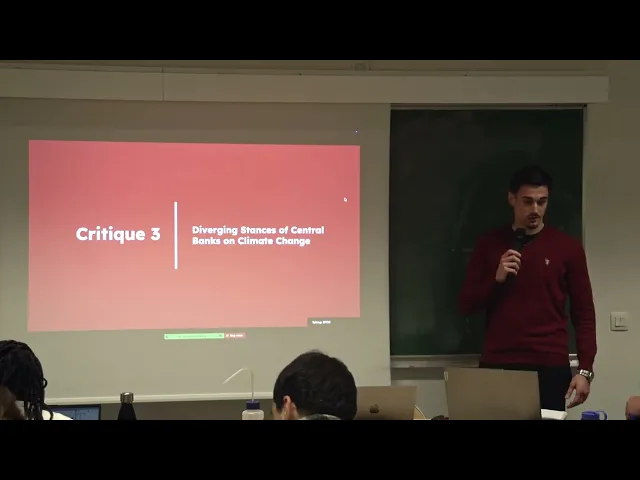
maybe could have like transition RIS from like the the yeah Central Bank transitioning and um yeah how then and this would then ultimately F question the willingness of a central bank to actually then in in in moment of Crisis to stick to this yeah more proactive ideas of of Greening Central Banking so I leave you actually with this question is there a trait of between Greening um Central Banking and Financial supervision and financial stability okay so just going to a second Critique that is less than a critique but more a call and spending on a
specific topic that in this paper it's not super approach but Professor zatzman actually goes in depth on it in different papers uh which is trying to elaborate on the differentiated challenges between the corn periphery central banks and financial supervisors um so I would like to start maybe like putting this idea that there's like a dual nature between the Peripheral central banks financial supervisors challenges and the global North or the core uh ones so in the first place when we think about the ecological transition and then both Nono and Professor mentioned a while ago so there's
this overarching constraints on how you can restructure central banks uh overall they usually are related to some ideas on specific World Views that can kind of like try to impose this autonomy of the Central Bank in a in a way that Kind of like put it puts it away from um a a certain government stirring of this transition or as well the contradiction between the idea of having a short-term price stability price stability need uh in opposition to a long-term Horizon of ecological change or also central banks now are facing new sources of inflation such
as the climate pH fossil inflation GRE inflation all of these uh new sources that come with this Challenge and then on the other hand uh for the Peripheral central banks you have this idea that is Bruno also mentioned extensively in his we have a master class of currency hierarchy just just now so um uh we have the International Financial subordination that imp imposes structural constraints on the autonomy of those central banks uh due to like a certain like a broad combination of factors that are related to their position in the international monetary and financial system
so the currenc Hierarchy then it's basically just summarizing a little bit this idea that different National currencies they're not equally capable of being at the international level uh what money traditionally needs to be which is a unit of account a means of payment and a store of value just briefly bring in a little bit of like what Bruno also presented how the peripheral country currencies are basically at the bottom of this hierarchy uh and then of course This idea that there are differentiate capacities being liquid uh imposes additional challenges for peripheral central banks so the
fact that currencies are not liquid in um makes their assets and Investments be broadly perceived as high-risk uh Investments which demands uh a higher premium of the sort of um peripheral I mean economies uh which obligates then the central banks or the political politic uh the monetary policy broadly to sustain High Interest rates to attract foreign Capital that Prof profit from these differentials between um core uh Prof core interest rates and peripheral interest rates uh and that leads as well to an increased V uh vulnerability to this uh Market volatilities to speculative attacks and also
the external policies and in particular as you mentioned the US uh domestic monetary policy that was also responsible for like several dead crisis In Lan America in particular so I guess here then my overall point is that we have this currency key and High Capital Mobility that together create this limited policy space for this central banks because they are in a constant need to react to this external changes and the pressures that they uh exert over the balance of payments their foreign exchange reserves and the overall interest rate as a monary policy instrument um and
that of course limits Their ability to implement um independent monetary policies that could promote this long-term development and economic stability and then part and then the literature basically um states that we cannot deal with this change in Central Bank as in this one size fit all as in the changes being like similar to all of them and then my question is like knowing that we need to uh address the imbalances on the international monetary Financial system uh and create this new International political economy of Central Banking how can we then conceptualize and implement this differentiated
roles between corent periphery central banks uh well in the context of a broader Global monetary policy coordination thank you so in this uh third uh rather discussion than uh critique I would like to uh shed the light uh a little bit more on uh political context uh to Understand some uh political questions and uh to understand what has been done uh why and uh what are some uh future projections uh related to combat uh this uh uh climate change challenges and uh here as you as you previously mentioned uh ngfs and uh a little bit
explained uh I just want to uh mention it again as uh I consider this uh we consider this institution and network very much important for combating this issue because uh it actually shows some um uh Best practices that uh are trying to to uh manage climate envir environmental risks u in the financial system and uh this uh this institution is uh established in uh Paris uh one one planet Summit uh in 2017 and interestingly uh here I would like to correlate it to to to the the past past events that happened uh namely in uh
200 in December 2024 it had 144 uh members as you just previously mentioned and uh just uh this this Friday uh US Federal Reserve announced uh it withdrawal from from these institutions and uh furthermore uh I will try to mention uh some fed stands and uh some some potential underlining reasons behind that the reason declared uh was that uh actually uh current Uh current scope of uh ngfs has been broaden that much that uh it it get out of the out line of uh of statutary mandate of Federal Reserve and uh furthermore uh we can
uh we can we can Also it is important to to mention e e ECB uh approach and uh as uh they uh European Central Bank acknowledged and U the importance of uh embedding uh these climate and environmental risks in their policies and uh this is shown in legal framework uh to be more more specific uh in article 127 you you also mentioned article 3 if I remember well uh in in the article 127 uh Treaty of functioning of the European Union it is mentioned that uh it is emphasized that Sustainable development uh should be um
should be uh uh pursued uh alongside also price stability and uh it this article connects as we can see with the article three as previously mentioned uh that highlights European Union's commitment to to environmental Environmental Protection alongside sustainable growth and uh yeah furthermore coming back to Fed stands uh you also mentioned again there's a lot of things that you have covered already In your presentation but uh okay this is a different uh different uh quote slightly different but still the idea is the same uh uh climate change is an important issue yeah fed acknowledged the
the the chairman of the FED PA acknowledged that uh climate change is indeed important issue but they are not going to deal with it like Congress is the one that should deal with it that's how how they perceive this issue and uh yeah I have stated some different uh Limited rules as uh previously just mentioned uh it goes uh outside of uh fed statutary mandate uh also Republicans ISM we have seen just yesterday that uh uh aside the US Federal Reserve withdrawal we have seen also that Trump signed a withdrawal from Paris agreement uh to
to combat climate change uh challenges and uh yeah also another uh another example can be influence of us fossil uh fossil uh fuel industry and they they are probably Lobbying over there and uh I would like also like to Shad light on uh some geopolitical uh considerations uh for example ngfs Secretariat is is based in um in uh Bank of France and the US can perceive this probably as uh they they they can they can uh experience some discomfort with this as uh we we we know that us is mainly leader in when in whatever
aliens uh we we see them uh and uh China also another thing is that China's active Participation with ngfs uh could be concern especially amidst the the US China tension uh finally uh again previously mentioned but uh uh us uh is already known as a major oil and uh oil and gas producer and uh the these industries these sectors uh energy sectors can uh uh strongly conflict uh conf the the the green Finance goals and objectives and uh ultimately uh I would like to conclude and uh to to ask uh whether it's feasible for central
banks To expand their mandates uh to incorporate green policies within the framework of cap capitalism and uh or does system uh inherently limit such Transformations thank you great I was Rush to write the question but good to have perfect so thanks so much to to the three of you for for this uh feedback and and questions uh I found them sincerely super super interesting and Very very broad also coming from very different perspective so uh yeah I'm trying to think how how to to cover this uh without without taking another hour so perhaps going uh
uh I was just checking a few notes uh that I took on on the first first one because I think that um actually the first and the third one actually can can be sort of connected a little bit because um I mean you say much more than these questions actually So what that's why I was wondering do I focus on the question or broadly more broadly but perhaps keeping question one and three in in mind um for me there's um this question of the of the mandates of uh of central banks um I would say
that it's it's not necessarily like the key issue where I would say like this is really what needs to be challenged and I know that a lot of the debates take place there uh and and it takes place there both because of you like Orthodox And heterodox perspective and you like we we can even see like in the case it was interesting when when for instance uh Argentina moved from you like the um the the McRee government to to uh uh to Alberto Fernandez and then to melee and you're like in their negotiation with the
IMF uh there's always this idea that uh and it was actually when MRE went to the IMF for a big for like the first like huge Loan in around 20 15 16 one of the of the requests of the AMF Like hey you need to change again the Carta Magna I think like the Mandate of the Central Bank you need to to explicitly say again it is independent so there's a lot of pressure on both sides and and there are some papers including by Simon dika when nly VA showing that in general developing countries tend
to have like a broader mandate um than than high income countries so the the thing for me with the mandates like of course I want the Central banks personally to have like a rather slightly broader than narrow mandates because my my own I would say political bias the way I see things but I think that it doesn't whatever the Mandate is it doesn't tell you how you're going to act what are you going to do precisely in different situations and you like for instance this question of Market neutrality that I mentioned it's interesting because uh
it's mentioned in a lot of places you know Like when you like whatever you do like in the Central Bank when I work five years for the the French Central Bank and you like they would be like oh but this is not Market neutral and so on and at some point one of my former director told me one day like okay you know what Market neutrality is defined nowhere like like you will not find a definition of market neutrality so that was quite interesting for me because this was like wow this is something like it's
a it's An operational stuff that was like pushed for mostly I guess in this case by by the bundes bank I mean I guess no I'm quite sure but you like where that insisted a lot on that but actually it was not defined so it's like there's a lot of room for doing a lot of things whatever the Mandate is so I think that's yeah it's uh you know like you you I think that there's with the current mandate where you say you like it's price stability it's uh Financial Stability you can support a little
bit the government more or less you could work on a lot of things one of the ideas I'm interested in I've never really worked on that yet and I don't know like how to approach it but it would be like a kind of coordination where the central banks it would be like disguised coordination to some extent where the Central Bank explicitly say at some point Point hey you know what I cannot deal with this for instance what would Have happened if at the beginning of the inflationary pressure we had in the postco and then war
in Ukraine situation what if the ECB had say like to these governments like hey you know what I'm going to increase interest rate if you don't do anything as Government like because at some point it's going to impact me but this is for you to do this job and this is not something that central banks do because like they decide given in their idea of Independence to say what how did they act for one year they say this is temporary this is temporary this is temporary that's all I said we're going to look through that
we're going to look through that and at some point during this year you had like more like the hawkish um you know like people at the ECB who wanted in any case to increase interest rate they wanted to get rid of all the the QE and so on so they're like pushing pushing pushing until they win This battle but there was a room I think for different form of coordination even within this mandate so so for me it's much more it goes back to like what are the institutional Arrangements what are who's putting pressure on
the Central Bank you know like are they feeling are we in a place like fiscal policy could take place without the Central Bank authorizing it like there could be more uh like at least and I'm not talking about question two here but at least in Core countries uh uh there is you like the ability to conduct more U more more active fiscal policies and you could you could do that with without the central bank the question would be like is the Central Bank going to within its mandate sort of like let you go give you
a hand or is it going to play like the opposite game basically and and this is where I would say like okay within the Mandate we can do a lot of things but then the the question is that a lot of trade off Are going to appear and for instance I think personally this is not you like a a super fancy scenario I have in mind and so on but here as I said there are two epe students who are going to work on the question of inflation transition and inflation and that's something I'm increasingly
working on so you know like hopefully I will I will have more more insight into this but for me like I want to see like a scenario of transition where uh prices you like where wages Sorry in the agricultural sector are increased for instance I want to see an increase in agricultural prices in wages in many sectors that's something I want to see and you could say that I want to see some inflationary pressure so basically how is the Central Bank going to deal with this Trad that's the main question like is the Central Bank
going to say well actually it's true that um you know like that's uh that's you know like we have Inflation but we're helping the government no but could it say within its mandate we're going to revisit a little bit the inflation Target which is what they've been doing over the past few years a little bit you like to say hey you know what we're going to revisit them because maybe 2% we shouldn't be too strict about it it could be a bit more during a certain time and you could say you like it will be
like I could be like you like a pure politician like a Pure like kind of like you like very you like um mainstream Central Banker saying like oh yeah actually the problem is that if we cut inflation right now we're going to cut the ability of if we increase interest rate right now and cut the ability to deliver a transition this is going to increase transition risk in the physical risk in the future and potential transition risk so the best way to deal with it is to let inflation go a bit up while not you
know like While preserving Financial stability over a long term like you could perfectly within the Mandate kind of like you know like navigate a little bit this trade-off you would have I'm not saying it's easy but you you you could definitely do them um um another another way you like another discussion within central banks like how how should you treat uh real estate prices right depending on how you count real estate prices today they are basically um not Really accounted for in inflation uh in inflation figures I mean part of it when you're an owner
like in your repayment I mean there's a little bit of of real estate prices that that can be like you like integrated a little bit into a measure of inflation but mostly they're not and this is super political but you don't need to you don't need to change everything in your mandate you know like you could deal with a trade-off a bit differently you could say Central Bank Hey I'm going to better and there are discussion at the ECB on that how should we account for the price of real estates because this is a huge
impact but then you know like you see a lot of mainstream economies saying oh yeah yeah people uh have wrong feelings they think there's inflation there's no inflations like no people really understand that real price you like retail prices their rent is going up and we're not measuring it as part of inflation so they're Really feeling things I don't think that you know people are have like wrong anticipation things like this and and then like you like the central banks can really like it cannot solve all these issues but I think like within the Mandate
it can also thereare say hey you know what we're going to measure it in a way that is going to be more socially acceptable they don't need to say it they can just do it saying it reflects better you know like really the cost of Life to have you like a better integration of um of a real estate because in the end you like this is very important and it could even you know like anchor future expectations blah blah blah future anticipations you know like you could really use the the mainstream language and change things
so I would say that uh that yeah there are a lot of trade-off that going to appear and for me it's like where where do central Bankers stand on that and today We know that you like Central Bankers it goes back to like who they are what kind of economic training they have uh I think even like more like political issues than that but I would say that they would tend to have like a rather like conservative conservative approach whenever the the tradeoff emerg but it should not be the case not always be the case
there are like ways to to to navigate that a little bit sorry if it's like not a super clear-cut response but I would say like if I want it to be super clear on that I would say in my opinion no needs to you like I'm fine with changing the to expand the Mandate but I wouldn't fight on that and yet is there a trade-off there are many trade-off um but their ways of navigating them of like smoothing them that will be like the short the short answer this one for me is like it's much
much more uh difficult I'm tempting to give the micro to Bruno he says no no but it's really it's really a very very different difficult one like how do we treat them differently this is something that I've not worked on actually because I work a lot on the question of corpor I mean I work a bit on the question of cor and periphery hierarchies I work on the question of central bank but not on merging them and and if I haven't worked on that it's because I don't know how to think about that I think
it is sort of Like a yeah a question that I'm really really um lost with when when it comes to like okay how do we because I think that the problem is that who is the authority that should be transnational I guess by by by definition what is the authority that the termines you know like the the yeah the different role of central banks fincial supervisor in this country so I have I have a hard time like just Conceptualizing the framework unless I'm become very very idealistic you like with there are some papers which I
like you like I think there was one in ripe review of international political economy recently about you like this idea of like how we could create a lot of um green special drawing Reserve special drawing rights sorry sdrs to fund the transition so on and having like a sympathy for that but I don't think that I think it's more on an Idealistic level when we talk about this this very BR proposal like in practice uh I guess it goes more to like U yeah to to to a question of like who who's going to help
you uh say you know that like you like it's fine as a Central Bank in the periphery um you shouldn't suffer so much from the ability to conduct independent monetary policy versus Focus focusing on your exchange rate and what is the author what are the Authorities doing that private investors are probably not going to help you there like it's not definitely their job um could it be somehow the job a little bit of like multilateral development Banks and IMF like would they have a role there I guess they would have a role in the way
in which you know like they would they would um negotiate with you but um but yeah it's uh I'm yeah I'm it's it's something that is like such that goes to much broader question that Was for instance my in one of my papers with with uh with Jeff fous on this question uh precisely one of our ideas was to say let's be a bit careful with with the proposal that that want to solve the issue through monetary Solutions like such as green SDR and so on because in the end these countries if they are so
vulnerable financially it's also I mean more or less I don't want to say all all peripheral countries are equally Vulnerable but if they are more vulnerable it's um it's also a big part because of the also because of their uh their lower rank somehow in the productive hierarchy their inability to add more value you know like it goes back basically to structuralists you know like in in Latin America for instance so it's it goes much Beyond monetary policy um but uh but yeah I would say you know like if I wanted to be on a
sort of ideas in between Idealistic and and realistic level and I could say like okay we know that you know like the IMF the World Bank the FED are not really doing that uh except in in specific cases for instance you like during the covid crisis the FED developed the swap lines with like friendly countries so like it's it's alleviated a little bit the financial pressure for some countries that it shows but you like could could the EU have a different view on that I know It's not going to happen today with the current uh
political uh Arrangement but um but could the EU you like try to develop like different deals with this country like go for like a different like for you like uh for different kind of swaps for instance as is China is doing with some Latin American countries and African countries could the EU do that as well with a different I would say uh priorities more terror toward ecological transition so maybe there are Proposals to be made like along these lines but um but otherwise yeah I feel that it's a very uh very hard question and I'm
sorry I'm not answering it better but yeah again thanks a lot and and I have my other notes here so maybe I'll get back to you when I when I read my notes [Applause] let's open the floor uh thank you for the presentation I am andreza from Brazil uh I would like To know your thoughts on adopting sectorial uh approach to address inflation for instance should other policies at the government level play a more important role in stabilizing specific sectors such as buffer stocks for manage food inflation uh what would be the limitations of this
approach and maybe if price stability is partially achieved uh through supply side uh interventions could this create a room to central banks to use interest rates Uh setting more strategically such as implementing differentiated differentiated lending rates based on environment impact of banks portfolio Etc um thank you I'm Yan from Germany um and I wanted to ask you that um I mean in lot of these approaches the the Central Bank uh what it can do to maybe Finance the green transition is is really framed around uh lending and credit so it's always uh like a classic
Bank that also at some point wants it to be paid back and maybe even get like a a little return and uh I think you you wrote a a different paper on that where you criticized the ecological macroeconomics and the idea of green investment uh if we should question that and if like in and green investment always yields this return that that can then be paid back to the to the central bank at some point uh and so uh do you think there is maybe some more uh room For Grants uh that are necessary or
like um non-borrowed funds for the green transition and not like non-borrowed funds so that don't need to be uh yeah paid back at some point uh hello I'm Isabella from Brazil and I was wondering uh have any concrete actions uh been done so far by the central banks beyond the central bank stress test if uh you can give some examples would be nice and also I wanted uh to ask you because U this thing of uh Not measuring the risks I think that in practice we do to call also the attention of policy makers which
can be uh ethically questioned uh and there is also like the capturing interest like uh there is this uh controversy of the task force on nature related Financial disclosures being uh like kept Ed by lobbying and yeah I was wondering your thoughts on that thank you so let's have first round of responses so thanks a lot um yeah the The first the first question uh I'm definitely on on the side of uh of thinking that you like that's that's the the recent episode of inflation uh should have dealt with uh primarily uh you like well
managed government intervention uh with like a buffer stock with like a price controls and so on so I really think that's um uh that's you know like well that like what for instance the work that Isabella verber did and even though perhaps now it's Easy to say oh maybe she hadn't like seen everything the question of like was it like she didn't never mentioned grid flation but whether it was a price wage spiral now it can be a bit criticized and so on but you like at the time I think she brought Great Value in
saying that the two teams some like the you know like the temporary team like this is temporary it will pass and kind of like like let's increase interest rate that both of them were were wrong and I Think that's like I really admire her for like bringing that back in 2021 I think um so I think that this is this is really it was the the way to go now could that could have central banks said okay you know like given that this is the governance then we're going to you like keep incre using interest
rate like quite strategically um yes and no because to to some extent you could say that before the covid crisis they were using it strategically Central Like interest rates were in some countries negative you like and I remember at the time like in 2019 sometimes going to conferences it was funny like like there was once I was a conference with someone from I think it's m&g like a big asset manager and like an investor there saying kind of like like this is like Finance 101 when you have like negative interest rates if you don't get
into thatb is not that oh you could have got into thatb it's like You're making a big big mistake like it was like fiscal policy not using something that was there not exactly to support the government but they had like a huge opportunity to massively borrow and and so I think that you like this relates a little bit to this question like what else could have they done you know kind of like go knock at the door of the treasure it's like please borrow now like it's so so for me like this question of strategy
would have uh yeah It was more really on on the fiscal policy side I'm not I don't want to say that Central Bank have done everything perfectly and so on but but to some extent I wouldn't yeah I wouldn't blame them for for this these specific issues now another another thing is that assuming that you have like um that you have Supply laid inflation as we had uh and you have this government intervention um you're going to have impact elsewhere right on for instance On public debt so um so it goes back to some extent
the question goes back to like how is the Central Bank going to deal with that uh you know like is at some points like are you working a scenario where investors say okay sure there's like an increase in public debt but we still believe in that or do they start losing confidence and if they start losing confidence how does the Central Bank react because it has a huge ability of course to to Influence the price of of public debt um and then you would have like other you know like other issues strategic issues um for
me again going back to to the question about you like the the the flexibility you have within your your your mandate you like it would be doable for a central bank to kind of like integrate climate Rel climate related risk within Sovereign Bonds in a way where kind of like you support a bit more government you like to say okay Sure you've been more in debt but actually this is for the transition so it for a good cause so I'm still accepting that you know like uh as very good collateral or you I can I
can like provide more loans you like this existed in the post war in France for instance Central Bank you like lending at better conditions to commercial banks that were investing Sovereign bonds so you you could still use this kind of this kind of strategy so I think there is some Room for that um but uh but part of the part of the room has not been exploited by by fiscal policy and and even when when inflation was high because like you know like I mean even sorry when interest rates were increased because um you know
like in real terms it's still uh it's still like very low uh very low um uh debts I mean thatt with very low real interest rate so you like there's a now there for those of you who follow a bit more like French news you may have Seen that you like uh there's this economist called fris Geral who is a bit outraged because uh uh every time someone uses it ID oh how much how much how which which percent of the budget is now uh used to pay in interest rate and he's saying like this
is the wrong way of looking at it because like if in the end this even if you're the total of interest rate has increased but in fact you got into a debt that is a negative in the end in real terms this is still a Good deal so it's just the wrong the wrong way of looking at it so there is still kind of like like opportunities out there for for fiscal policy to to exploit so I think it's um yeah it's more on the fiscal policy side on the the the second question um when
you say nonborrowed fund just to be to be clear like what are you referring to like more um [Music] um but from whom I mean From okay so that it's like it's uh it's like monetary financing to some extent yeah yeah um yeah for me it's like um I was just having a chat with some someone who's Rudy bugi you may know him he teached a little bit at EP about about that where there are some proposal made along these lines um about monetary financing there's also like for instance some French hsel C subo and
others who talk about I'm not sure I fully Understood but they talk about some sort of like NBT money that would be created by Central Bank I have to say it's a I I'm not fully clear on what they propos but um for me the the the thing is that if I look at it from a almost anthropological perspective I love David Graber I'm like yeah everything is possible money is a social convention we can do whatever we want right it's like there's a lot we can do now if I look it at it from
more of a political economy Perspective within the current regime of of you know like of let's call it financialized capitalism even it may not be the best term but let's look at it that way that you like we may want to get out of it but this is where we are we have to move strategically I really don't see the central saying like suddenly it's kind of like hey you know what money is a social convention I could create money and you like can use it for the the ecological transition and It's crazy because actually
central banks have been creating money uh to buy Financial Assets in time of Crisis and nobody's in trouble there you like it's kind of like this is fine you like in at the beginning of Co it was crazy like when the lockdown occurred in France um stock markets like when went down I think it was like but also in the many place like it was the biggest fall in one day in stock markets bigger than 2007 than 1987 than 1929 and for Instance in the case of the EU it was really funny because like you
had the ECB uh announcing we're going to we're going to issue seven I don't remember it was 700 billion first and then 600 billion I think was like we're going to issue 750 billion to buy assets for basically like to expand QE markets start reacting and just a few days later like you know what we're going to add 600 billion so 1.35 trillion created just like this Right to buy Financial assets and that's fine because we're in the you like this is that's fine I mean from you like investor don't care you know like capitalism
keeps working and so on but if you start doing it for the purpose of ecological transition to fund like households or governments you're just like how could I put it you're you're just like breaking the pillar of the system you like it it makes me think about Paper like the political aspect of Full Employment it's perfectly doable but you're just like destroying the very ability of the capitalist himself or herself to kind of like to justify his position in the system so it's kind of like you're changing the whole system and that's that's the issue
I have with with the people who make like concrete proposal about monetary financing grants where I'm like I see it I I like broadening my mental you know like views And so on but this is you like implementing elements of something that is like completely non- capitalist into a capitalist system so I just have a hard time like I really don't want to say I'm not interested in that because I am but I I have a very hard time uh saying like how realistic it is versus how idealistic it is and yeah that's that's where
I'm I would be a bit uh you know like I I would not if tomorrow I don't Know I was an adviser to the governor of B the France I wouldn't him like Hey just create the that's fine like I I would I wouldn't I wouldn't do it I would be afraid of all the consequences of doing that basically but I'm in favoring of a society where this exist it's and and then on the the third uh question um yeah the on the concrete actions there are very few concrete actions uh so the ECB has
making been making a few uh a few of them you like For instance in the collateral I very briefly mentioned it but for the collateral framework now they give priority to to Greener assets than than like fossil base assets um for the the corporates uh for you know like the part of the QE of quantitative eing that was about corporates most of them was about Sovereign bonds but so small part was for corporate bonds and they also like tilted it to like Greener uh issuers I don't remember the criteria we they used I think one
of them was uh the the current emission by sector I think like a a ratio of emission by Euro of turnover something like this but then they had like also what was the the the trend of the firm to see like okay maybe you're the best in your sector and you've been improving so we you're going you like the tilting will be favorable to you but that was a bit you like the the corporate purchases are a small part of all this and also they announced that Just when interest rate were already started to increase
they were kind of like reducing this C this QE so they started doing like it's I don't think it's really a game Cher um then do we have like I I think in in China they had like a few um a few credit lines that are you know like sort of like uh I don't I don't know if it's TLT T is like the targeting long-term refining operation so for instance the ECB had done that with um with bank for smmes You like they give you loans at lower at lower interest rate with the the
idea that to invest that inmes the is that in the case of ECB there were like no no way of really of um of verifying that so it was a bit weird but I think China has been doing a a little bit with Green Loans trying to to get favorable loans to to banks that invest in transition I don't know if they're still doing it how it works and most of the action have been taking on like the so-call pillar Three so like about disclosure so it's also like it's also something that I find a
bit uh when I was working for a central bank that I would find a bit frustrating which was that many Central Bank you like like I feel that they use also a little bit this this risk assessments as a way also of of delaying concrete actions of like oh it's super difficult ah it turns out we have underestimated risk we're going to do use another model we're going to do it Better we're going to use like now they're doing it you know like uh for instance they use like stronger damage function so now physical risk
are getting higher in the ngfs scenario and so on it's like okay but what does it mean and no one is really thinking about that because like you like most of them are like measuring risk so so I think this is a bit annoying and and then yeah the question of um of lobbies that you you you mention um yeah for me it's it's Of course it's strong it exist and for me there's like something that a bit more I mention it very briefly when I say in that beginning like or formally Central Bank say
oh we care about that because uh you know like there are risk and so on so now we we have identified this risk and so but for me like they wouldn't have really moved forward uh if the private sector was not you like kind of like interested in that and I think that there's a lot of influence I Wouldn't say this like a a hidden Lobby or things like this but I would say that like Central Bankers tend to be very proom market and they would go toward the Direction when they see that you like
black rock is creating a new you know like green product and and you know like in for instance in the case of biodiversity nature I saw that very clearly because when I was at the French Central Bank I started working on saying hey we need to go beyond climates and Like no one was interested was like what is that and when the TNA D was the task force for nature related Financial disclosure was created I really saw kind of like you like Central Bankers saying like hey actually you like it could make sense it could
be interesting but no one told me you're going to do it because tnfd does it because like they're independent you like they're really and and even if you have lunch with you like a private Banker things like this it's Very controlled so you cannot you cannot accuse them of being like sold to the to the private Bankers but in practice I think that you like the private Finance has a huge influence on you know like what what is the Horizon of possibilities of the central Banker so I think it's uh it's something that explains quite
a lot and and it will be interesting now to see like there there was this Coalition of asset managers uh how is it called G FSN I don't remember Like Coalition of like big asset managers you like committing to invest in environmental issues at large and now there has been a big backlash against ESG now many of these I of this I think blackr actually withdrew from this Coalition uh and I would be quite interesting in seeing like I wouldn't be surprised if central banks kind of like like also slow down because because I see
that private Finance is not on board but uh so yeah I think they they are Influenced perhaps more ideologically than than by Lobby I wouldn't I wouldn't say by Lobby Silva from France uh I was thinking uh lastek there was je CL not not here but SB University the subject was inflation uh and uh I think uh there is another subject uh for central bank which is uh Financial stability which is mentioned and even him say that uh and they were also UNP for last week that They not not to together maybe okay but uh
there was um like maybe a huge bubble so the there is even in I I think U maybe somebody would say no I misunderstood but uh that um it will burst uh that that the thing the problem of financial stability is there and I think all all time and it's never solved uh I mean uh uh there is this possibility to use what it did in Co in uh 2008 as uh Buying assets or or creating money or bonds for government to to kind of uh just ease the situation but uh I think that uh
is is never solved I mean things can happen again again and we don't know uh what what will happen next time how bad how bad it will be so um I I I wonder uh how um how we can reposition uh the the responsibility that uh Central Bank have because uh I think this is uh I I'm I think they they Go um I I don't know what who has the responsibility sitation I mean uh is this the government or or the Central Bank um um well what what and it's very linked also I think
to um to many other the thing I mean we want to make the system to continue people uh being able to spec at uh by um in uh uh buildings and all things and uh and all all all I think in your presentation we see that all things goes together and uh it's just I I Wonder what kind of how how to link uh politic and economy again because I think it's the main question because um well just uh well I I can we direct things toward uh um just a green Society or whatever you
call it because I think that we if we don't have this question not responsibility maybe one I'm sorry Zara from Germany um it's also a bit of a big picture question maybe um with like the current backlash against climate policies and Also perhaps the crumbling of even this risk view of green monetary policy I was wondering whether you see this risk view within cental Banks as a sort of precondition for the rest of the debate to even take place or what what would you say can for instance this third perspective that I would also find
most interesting happen even if within central banks there isn't even a clear case for having this risk-based treatment of climate policies like yeah Basically where do you see the discussion standing should it maybe from a strategic perspective shift towards defending the risk-based approach or is it worthwhile to go beyond that uh hi I'm Samuel from Germany and uh I have a question regarding uh the issue of uncertainty in Risk modeling and in uh stress tests and to what degree maybe alternative preferably hdox models could have maybe an advantage or a better approach or is there
a way uh In which they could incorporate this issue uh yeah better or would you say that's um just an Universal limitation uh and yeah and also too tied to the risk B based approach um yeah that's my question hi I'm arur from the Netherlands and I was interested uh by your few on like finding the wiggle room within the uh current existing mandate already and I was thinking would you be able to go as far as saying it is in the ecb's Interest to uh Finance the green transition because if you say that price
stability in the long run is the goal of the ECB and currently one of the the ways in which inflation can happen is through energy shocks as we saw with the uh invasion of Ukraine and the Renewable Energy System would be sort of insulated from uh these type of oil shocks uh would you be able to sort of change the narrative and say that this would fall Within the price stability in the long run mandate so thanks for the this additional round of of question uh on the first one about the this idea of uh
bubbl I think yeah that's uh there's definitely part of the of the responsibility I think and lies with Central Bank you like I was just answering to the to the colleague just behind you I don't remember his name sorry but about you like this idea of Monetary creation where you like like huge monetary creation creation to save financial markets on Havoc but you create like you know like price High you create more moral hazards so it's uh I think it's there now the question like will it be like will there be like an even broader
like an even like larger and even more like painful crisis in the end um I'm I'm not so sure in the sense that um I think it depends on whether a little bit on whether you Think that there's a fundamental value of things or not and and I personally I don't think that there's a fundamental value you like I work a little bit in finance I Remember by the time I arrived and and a few years later with like the the it was my first job and it was right at beginning of the financial crisis
you like the ratio like the pr price equity ratio and so on they had changed a lot you know like like sometimes like it's five then it's like 20 like it's a it's Depending on you like the past few years so like is there like a price where at some point everyone says no this is too much now there's going to be a crisis or is it something that like it's socially constructed and for me where it bursts but it's it's purely me as a citizen speaking it's not at all like academic or whatever is
that it's it's socially and that like that the the impact of maintaining that if there's no crisis it's like more and more inequality Between asset owners Capital owners and the rest and and I think that it is like socially unsustainable basically and we reing that you mentioned the the question of real estate you like real estate in in big cities like they become completely disconnected from you know like Yeah from workers of the of these big cities and is this going to generate a crisis necessarily I don't know but I think it generate like a
lot of discontent a lot Of you know like willingness to to go against the system and so on and for also for good reason but that can you like that can lead you to to uh yeah crazy elected politicians also so yeah I'm I'm unsure about you like in the end whether there will be a like the the biggest crisis ever or whether like yeah the central bank will be there we'll be there we'll be there and and to save to save things but but yeah to some extent you like connecting politics and Economics I
would say that by saving the financial system it's kind of like it moves toward Politics the problem but it's just my you like my my own view on that um and and maybe you know like it's a yeah you like it's there could also be a crisis but for me it's always a big question what would have happened 2008 um if um if lemon borders are you know like if fiscal and monetary authorities had not enabled Lem man Brothers to go bankrupt Would would have had still a global financial crisis just six months later or
would we we have had something more like the covid where like like a huge disconnect between like you like the So-Cal real economy and financial markets performance that's you like it's I'm sure that many poan have much more interesting things to say about that than me but for me it's like it's it's really a huge question and yeah uh then Sarah's question about the yeah the the Backlash that's a big question for me you like until recently I was kind of like yeah this risk-based approach I don't like it and when I was working in
the central bank as trying to push things forward but we have to acknowledge that yet there it's Central Bankers themselves who have like sort of like shape this debate and contribute it and made emerge so yes I am concerned that it completely disappears and even many heterodox Scholars have started to Work on on the question of central banks because there was more openness there than with fiscal authorities treasuries and you like kind of like hey yeah you like there's this opportunity it's a way of bringing different question about Mony monetary money endogen about you like
different models which we links to the next question so so yeah what if this disappear can we still have you like view number two view number three or does it become completely somehow Useless because we would be talking about you know like things on which central banks would not even longer be working on on so so yeah I am I am quite concerned about the next step of the ngfs which was already quite weakened I think because it grew a lot which was good everyone wanted to be part of it but as it grew um
it also lost a little bit its ability to say hey let's work on that and with like many many central banks and financial supervisor Vision Authorities who join and then were kind of like like pulling things a bit backward Whenever there was a a new idea so yeah let's see let's see what happens but uh but I am concerned and yeah I would say that that's you know like at my level of course I would keep working on that but uh yeah I don't know how much traction it would get uh yeah so I don't
know um yeah on the Sam's question about the uncertainty in the stress test I Think it could have help indeed uh um there's still nevertheless I would say that the you know like the whole ecological sfc modeling world it's also still in its infancy again it's a field that you like in 2015 there was one sorry my thesis there was I think one like working paper by yanisa fermos and Maran nikoli uh where they were like discussing it conceptually and I don't remember if there was anything else on Ecological sfc so it's like really really
young so I wouldn't I would say that we shouldn't you like we need more time to have more you like there are quite a few models emerging now like a lot of I don't know like you may know like drew Jackson who work with Tim Jackson he's working on new model there Yan is the f is devel in Define um monasterolo has model many people have like are you like building like sfc Or sfc compatible uh kind of model um but I would say that some sources of uncertainty remain and also some difficulties um you
know like to to capture depending on what your scenario is because if you want to have just a different view of you like the interaction between the energy sector and the financial system and to have your balance sheets and you know like account and so so yeah it it makes sense but if you want to to have like a Broader if your scenario is about you like a reversal of uh you know like of north south relation about like China becoming a new leader uh in green technologies and so on like at some point it
still escapes the model a little bit and that's that's an experience I made for instance working a little bit with Jean FR Mercure and heor poit with this Remi which I think could be called like a pan compatible model I would say and it's super interesting They have a lot of things to look on stranded assets and so on um which actually relate to to one of the points made um uh by mikos right about the and I don't know if I'm pronouncing your name right so uh which was about the like the US perhaps
not wanted to work that much on these things because they're exposed also to you like to stranded assets and this you like we could really see that with the model and so on but at some point you have to make Assumptions for the future about who's going to develop the new technology where and at which cost and it goes back to like and and I would go even further what is the worldview supporting that do we do are we going to build this like let's say it's electric vehicle with like lithium batteries okay fine and
then is it to build like SUV individual SUVs of two tons per capita like when each each person with one SUV or is it more for public transportation so we Still have these big questions that that remain and um just today I saw that the I which is sort of the I apcc of biodiversity uh is launching um I think a group and they have a a conference soon about how can models in general it's not about her models but how can models better integrate different worldviews different you know like conception different scenarios that today
they tend to ignore a little bit so so it's say that many sources of Uncertainty are still there but yes it would have helped a lot to to start with something else and yeah and that's something that that was very I mean the experience that from the Central Bank uh the the big difficulty to propose alternative I'm not a modeler myself but I was close enough to many modelers and I I'm I would say knowledgeable enough of some pan models to like to to that I was able to sort of like make the case for
that and I would see like that it Was the door was really closed there now it's opening a little bit I think but it's it tends to be closed um and um last question is yeah this interest of of ECB in you like potential basically if I understood correct ECB could say hey you know what I'm going to work on transition because you know like it's it's going to be good for us in ter of like Financial stability right yeah um yeah that that's definitely something that that could be done and and maybe It's a
matter of time assuming that you like central banks keep working on that but um there was something that I think was a bit missing when it comes to environmental issues was precisely this coordination Financial stability and price stability because there is a stream of research now within Main stream makeon about you like the tradeoff between Financial stability and price stability so you have some work on that but when it comes to environmental Issues to climate change um I don't think it's been used uh so so it's it's central banks could definitely start working on that
with always one big question which is the time Horizon and I mentioned Mark car speech which was sort of like the kickoff of this whole field and I don't love this speech but think that it has like a few interest very interesting and Powerful points and one of them is really about this time Horizon of you know like of not only Central banks or policy makers in general but like in the case of central banks it's difficult for you to call for financial stability over the long term uh I Tred to do that from at
my first year among the France for instance I had work on a report called the green Swan with people from the bank for international settlement and so on and that's kind of like the argument the argument we use to say like it is of Interest um playing with the Mandate Again a little bit to say we don't change the Mandate but no one said that the Mandate was only three years for instance so we need to have a longterm longer term Horizon so it's more about the practice how we use the mandates um so I
think that there there is a case to do that but um I wouldn't you know like yeah I don't expect that to be a yeah Big Game Changer I would say that it's definitely the way to go if you work within a central bank and you want To make things uh you know like change a little bit at your level this is definitely an argument you can use but I don't think that you like at the institutional level the central bank would shift in its entire policies because of that unfortunately [Applause]