hello everyone okay so we will be the discussions for this seminar it will take about 15 minutes uh my name is Nicola this is Aron sumin uh this would be the content and just to for an introduction the thes say was that a valid and a democratic ecological planning project is possible if we consider the technical possibilities and some boundaries like the N the non identity of Nature and uh individual subjectivities and in this discussion we will go further on some of the elements and present some critics and examples and we will finish with some
questions so first on Hax ecological fallacy which is kind of the basis of the green finance that was presented uh in the seminar uh he he has four Arguments for the environment and and in the paper there is the limits are presented and I will just go further on some of them so the first argument is that basically the agents have um are directed through negative feedbacks on nature and basically the diment is that we the market is enough basically and but it doesn't consider that there there is pos positive feedback loops for for example
self reinforcing uh The Dru uh natural disasters and uh so and the F the second argument is that nature is considered as any form of capital because it can be substituted the third one is that uh there's some EP epistemic eological optimism where the resources is considered to be basically you have a lot of resources so it's not a problem and then you can substitute but we can see that this this statement is kind of risky uh to to have and the last one is uh we saw it in the presentation of dispers knowledge is
more effective than centralization but in a lot of cases it's not really the case because for example we were not rational agents so yeah yes uh on the second uh third argument basically uh H says that Society will need to anticipate the this the exhausting resources so that the first and the second the first and the second argument can work uh but he doesn't say how so you figure that maybe the government will need to intervene uh and he says that we would need an act of Fate so so that uh you know you would
be able to substitute uh natural resources are find new resources and I find that uh kind of Ry when you see the the state of the environment the situation right now it's I don't I'm not sure it worked out in the end and it's going to work out and this is at the basis of like the solo growth model and the the critique to the limits to growth report where you know and like nature can be substituted easily and in the end like in no classical economics you don't have a natural component for the factor
the factors of production so the economy can work without resources but in fact it's not really the case just I think hickel in a paper he showed that the world uh GDP to the material footprint uh the materal footprint was increasing faster than the GDP today so even though this theory of this not icle the can uh say that you don't need natural resources in fact it's not really the case we we do need natural resources and continuing on this act of Fate you just have B this is a famous one is H The Backs
so capture storage and this is uh present in a lot of scenarios at the ipcc but it's kind of unrealistic because if you see on this the third Point like you would need 15,000 facilities or something like that and plantations the size of two or three times the size of India not sure where you can find that and it's posed question to the other planetary boundaries also would you respect those boundaries if you do this um and basically these these um facilities for capturing CO2 they are just capturing some of Co the CO2 but uh
as we saw in this seminar with uh the robustness if you remember uh like they're capturing the CO2 and then they are selling these qu this credit quotas so in fact I'm not sure it's really working out and maybe we will need some planning okay I will be talking more on uh the ecological planning aspect um I want to say we unfortunately you couldn't gain access to your book which goes into a lot more detail but the working paper it was a really interesting read very thought provoking very ambitious uh proposal um that covers many
different points and I think my comments will be on some points that weren't necessarily the core of the presentation but I think are really interesting nonetheless um although in the theoretical aspect and especially in your critique of uh haek and market-based conceptualization of nature you do acknowledge um the depth of and complexity of uh nature I feel like my impression nonetheless in the Practical proposals um where that nature is still treated in a sense of a passive object rather than an active agent so there's a big emphasis on capturing nature and maintaining this permanent stock
Al bite always in complete um with a focus on anthropocentric uh tools such as human knowledge governance and planning structures and you do acknowledge as I said uh the the complexity of Nature and how this is uh limiting planning capabilities um I uh I this this would continue to my point on how um to what extent ecological planning could actually capture nature to a point where decision- making could be um consequential so um if you go to the to the furthest extent on this complexity you can take on like a critical realist approach with bascar
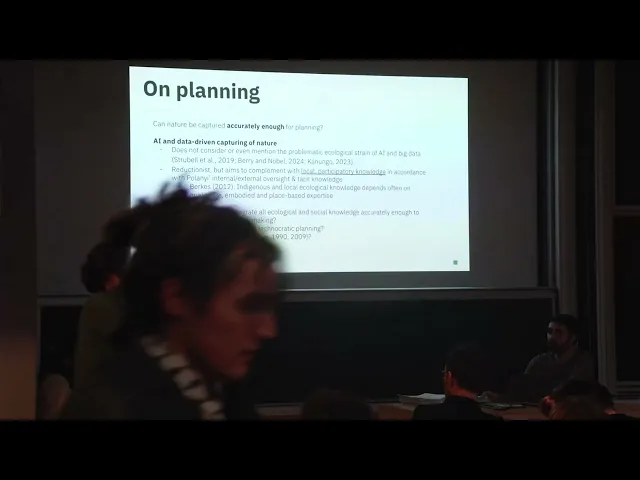
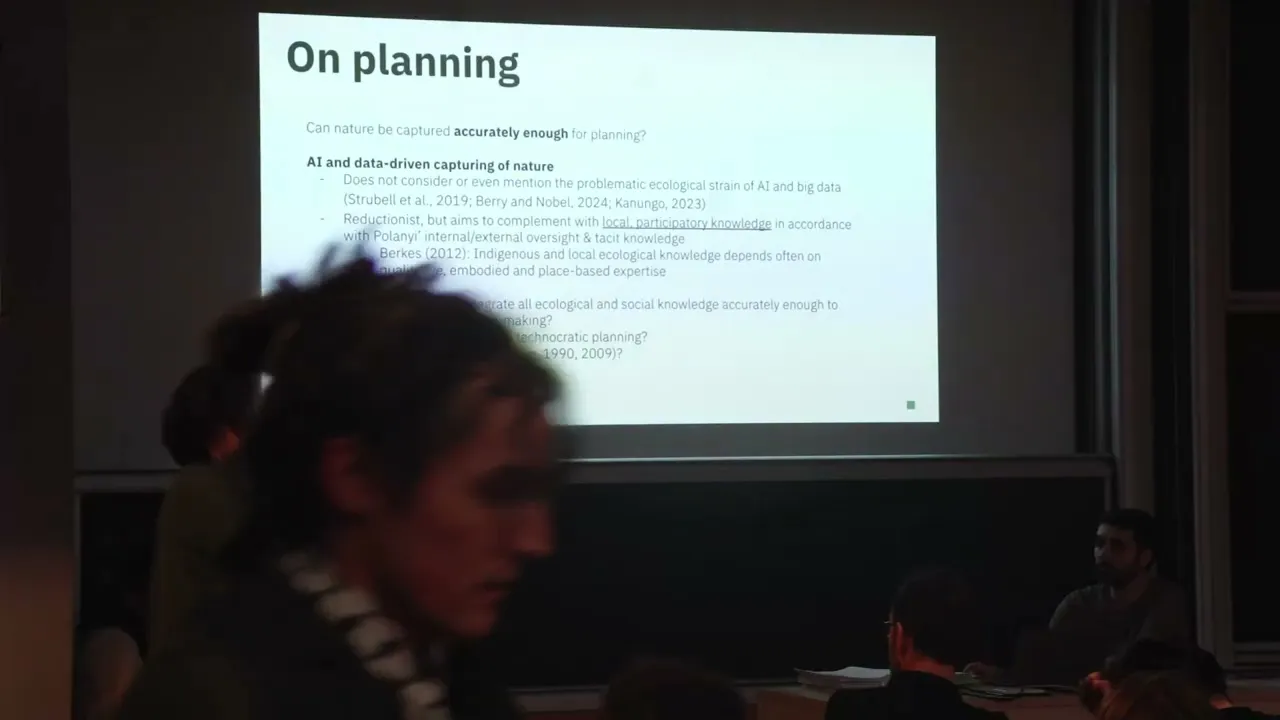
on uh nature being uh exis existing Beyond uh our human discourse and therefore never truly being able to be planned on or controlled um if you go to the next slide please um so can nature be captured accurately enough for planning for planning to for decision-making to even be warranted um and with the AI and data driven capturing of nature I will critique that it doesn't consider the um or even mention the problematic ecological strain of data so 200,000 satellites for example and uh collecting these images and connecting them and analyzing them um is is
is a factor that should be considered in this proposal um you acknowledge that it is reductionist and you uh complement it with local participatory knowledge which is unfortunately something that wasn't really a point in the presentation that I found really interesting in accordance with Pani and uh tacet knowledge about how we can't um through the data and through our collection of imagery and everything that we could try to do quantifying nature it would still need to be complemented with uh qualitative and local knowledge of of uh of those environments um and I question to what
and can centralized planning integrate all the psychological and social knowledge both quantitative from from things like big data um that now seems a possibility and also social knowledge um that is very experience-based um uh just like balani talks about which is a critique on centralization um and and promoting decentralization um and here I would ask if it's a risk of maybe falling into a bit of a top- Down technocratic planning and also I'm really curious um because I felt like reading your proposals on governance and the different uh postgrowth commissions and the layers and the
checks and balances it fits quite in line with Ostrom and uh polycentric proposals but you propose a very or you frame it as a central proposal that feeds down and up and with the federal structure that everything that can go all the way down should go all the way down um so I wonder I feel like you don't disagree I'm wondering if there's a reason okay um I would I would want to see in in which ways you would disagree with maybe ostrom's proposals on on uh environmental resource management and polycentric governance next slide and
uh I would my last point would be on the extent to which ecological planning could maybe be an opportunity to recouple society with nature and uh acknowledge co-evolution as well um as I was mentioning it seems uh more of like a passive object in nature and not necessarily questioning the the relation that Society has uh with nature and here I'm I'm drawing a lot of on norgard um and coaltion being uh the reciprocal and interactive process where two or more systems influence each other's Evolution um so it takes it draws from deep ecology with ecosystems
being co-equal and also acknowledging their co-evolutionary nature with uh human economies or human systems um and this would need to be considered I feel in in planning in having co-evolutionary planning that is flexible robust in this uh acknowledgement rather than necessarily top down intervention not to say that the government's proposal is truly top down but um yeah and I connect this with nor God as well with his book from 1994 that talks about how um the push from Science and Technology to maybe grasp nature um has led not only to environmental degradation but also to
cultural um disintegration so in in our in our sense of nature um and I feel that that would be quite interesting to link especially with your emphasis on participatory knowledge and participatory input and uh very very Democratic fundamentals in the governance system with maturana and Varela uh two Chilean um biologist philosophers or philosophical biologists that introduced the term on structural coupling of organisms and their environment so as to present nature not only as constraining because we talk a lot about the planetary boundaries so the constraints that we must fit into but acknowledging nature as well
as guiding and articulating in this relationship um so when you talk about um how we would question or or acknowledge our lifestyle and and our activities with with um the environment it's with algorithmic calculation of needs so cyber Soviets and having information fed onto um into better understanding the maybe the the um the resource usage of our of our uh consumption at least that's how the way it's framed in the short paragraph in the working paper and Matrix calculation of Lifestyle but I I wonder if um this could maybe be complemented a bit further into
how we could really rethink um the the the the lifestyles of society yeah um my section also kind of Builds on the working paper uh to explore two aspects within the broader theme of um expanding knowledge and agency in ecological planning um the first aspect is a kind of feminist commentary on this paper um Carew work and social reproduction play a critical role in sustaining both um human and ecological systems and this includes of course Community Care um child care and like domestic work uh which is often disproportionately performed by um women and is often
um excluded from traditional economic domains and remains unpaid or underpaid um the work of Gibson Graham and McKinnon and co-authors also points out that care in economic planning often tends to be systemat systematically undervalued um and that the gender division of labor is often reinforced by economic policies and why does um this matter for ecological planning is because care work is ultimately ultimately deeply inter intertwined with ecological sustainability and its undervaluation peret U Ates hierarchies and inequalities that limit the potential for sustainable outcomes and we can think of this um kind of in the context
of the fact that um women in many parts of the world are disproportionately affected by climate change because of their roles um in resource management and care and we also um talk a lot about in The Working paper about the technical and the institutional aspects of ecological planning um but perhaps what may tend to get overlooked um is the ethical dimension of economic decision making and what exactly are the ethical coordinates that we would like to consider and this can be many things but um some things that um McKennon and colleagues tend to explore is
the concept of surviving will um Surplus distribution and the caring for Commons um and the second aspect um that I want to touch on Builds on the concept of capital centrism and the limits of knowledge Centric planning um so in the working paper the argument sort of Builds on the premise that high market-based epistemology is um adequate for addressing ecological crises and that planning is a necessary counterforce to market failures in environmental government governance and this is valid critique and it can be argued that maybe this approach ultimately um reproduces potentially a capital Centric view
um and what some authors argue is that most economic discourses um operate within what is called a capital Centric frame where capitalism is the primary organizing force of economic life and alternatives are either marginalized or presented as subordinate and how this applies to this context is in the sense that framing of planning no matter how Democratic is the primary alternative to Mark Market um primary alternative to markets and it can then maybe um reinforce a binary and in doing so Overlook kind of the diverse economies that already exist outside this dichotomy um a diverse economies
approach highlights that e eological transitions are already taking place at through multiple economic modes many of which neither depend on capitalist markets nor require large scale centralized planning and this of course at a much smaller scale includes Community Land Trust and environmental cooperatives um indigenous knowledge systems that sustain biodiversity through place-based governance um and commons-based economic models uh the diverse economies perspective also challenges the idea that information and CH knowledge structures will resolve the planning problem um and this is because ultimately economic transformation is also about power and about agency and this line of thinking
emphasizes the importance of Economic subjectivity and the idea that people and communities are not passive recipients of um economic knowledge but active agents who shape economies um and thinking of the economy kind of as a lived reality and not just a system to be planned or managed and this also opens up a conversation um about how economic agency and what it really means to kind of of build ecological resilience through participatory and place-based economic networks um and this is kind of where our discussion ends and we have a couple of questions um to open it
up if okay I can just read them out um the first one is ecological measures have been postponed because of um for example of beex and neoclassical economists like Nord house stating that we could survive easily with some more degrees on Earth um also recently Trump removed the us from the US from the Paris agreement um are you still optimistic in terms of our chances to achieve the bifurcation worldwide before it is too late um my questions would be how how can ecological planning conduce to a co-evolutionary structural recoupling of society and nature so on
my point on uh maybe rethinking the relationship of society with nature when we're already restructuring through ecological planning and the second point is can centralized planning integrate all ecological and social Knowledge from either data and participatory local knowledge to Warrant consequential decision- making and must the internal oversight um as per Po and your reading of reef um be centralized the first one was Nicola's question um and the last question is how can ecological planning incorporate the ethics of care and recognize the interdependence of ecological and social reproduction [Applause] questions five 10 minutes max I will
like five minutes because I think I already said what I know it's difficult to say no thanks a lot for the discussion for all the references I I noted them and I would be happy if you could send send me your slides because I didn't was able to not everything and I think that are good good things to to look more more carefully uh so I will try to focus on those three uh no maybe saying something a bit more I think that part of the there are some elements of discussion that are not really
objection from my point of view in the sense that I just didn't dig into that in the paper or I missed that in the paper but it's a little bit in the book and so there is no proper disagreement also of course not saying something is always important uh one thing that is clear is concerning the digital footprint and the fact that the technical view of raying everything on algorithm and so on is not sustainable so we need to manage ecologically our uh information uh Technologies which means that we need to discriminate between the users
we need to decide to use it for something and not use for other things because there there are some choices that need to be done at that level and that's not completely unknown in fact during the pandemic Netflix had an agreement with the European commission and it agreed to diminish the use of the bond Bond width in order to allow uh remote working to function so we can have this kind of decision we need to discuss about that but some forms of allocation of computing power is necessary from a ecological point of view including for
eological planning however I think that part of what we should use uh it is specifically to better assess our relationship with nature and to better uh deal with that and I will go back to to this element the second thing that of course need to be done much more uh carefully is the disc between the various dimension of work which are productive work in the traditional sense in the factories films and and so forth but also productive and reproductive work outside of the traditional economic sphere and it's not very developed here but it should be
developed more it's a little bit more in the book concerning the role of Public Services for instance in order to socialize part of that reproductive work or to have some luxury goods that could help to to plan more enjoyful life without impacting more the planetary boundary so I on that I agree and I should have say more probably but there is no discussion strong discussion I would say however uh there are some discussion on the three question that you rais so the first question is about the beercation so it's too late or not too late
so both it's too late in the sense that discretion are advancing and they are irreducible and they are we will live with the legacy of those losses and it's not too late in the sense that uh human capability to act and to on society to exist even if it's an horrible way and so and so forth it's far from disappearing we in fact the catastrophe is already here and we we need to face it but the catastrophe is not the end of the world there are a lot of things between the two and we are
living in this space between the two so that would be my brief answer to to that question maybe some of you know the thesis of history of Walter Benjamin I think it's something very nice to to to read to think about what's taking place now it's an angel that is looking to the past and the past is the flow of RS of the defe of the destruction so we are facing that flow of RS in the past but we are pushed forward by what's taking place and we are still here so that's that's the case
so the second question regard it's a little bit difficult to to discuss that very rapidly but that concerns society and nature the autonomy of nature the agency of nature so so I I'm on the side of Sato on that point so that's book four of uh chapter four of the book that I presented so it's the idea that you have autonomy of nature you have uh nature exist independent of human beings however the metabolism social metabolism depends uh on the reflectivities of human being and you do not have such a thing as the reflexivity of
nature which do not means that uh reflexivity means only anthrop an anthropocentric view of that metabolism we need to go beyond the an anthropocentric view of the metabolism but this metabolism is conceived necessarily through the anop po sphere in the sense of in society so we as Society need to to to to think about this that's our task to think about that relation with nature so I will be a little bit more Nuance Vis to what you are saying I think the agency of humanity is not symmetric to the Agy of nature there is an
ageny of nature but the Agy of humanity can deal with the metabolism with nature the around it's not it's not really it's not really true so that has important consequences in particular related to this idea of an age of the emergence of a consciousness of the Spy is something that we need to look forward that's something that we need as a colle collective culture I'm much more on that side than on the side of trying to build a universal culture thinking about our own relationship with nature that resolving those cultural issues only at the local
level that doesn't mean that there is no space for local level but we need this Global level as a conscious level at the cultural level and that's key for ecological political economy uh and the third question which is about how ecological planning corporate ethics of care and recognize the independence of ecological and social reproduction so I I told you a little bit that to begin with that I agree with you that it's it could be a better assessed and we did that in the book insisting on the role of uh Public Services which I think
is part of the the things that need to be discussed but uh beside that uh I would say that the the point of view of the feminist point of view and more generally the point of view of subaltern is something that need to be introduced at every level of decision making specifically in planning processes and every there is a risk and that was also part of the discussion there is a risk of technocratic capture of planning apparatus that's 100% sure so we need to build in the meantime anti- technocratic features there is a good paper
by Ami capinski she's a scholar atel low scholar atel about Democratic industrial policy and she's saying that every time that we are implementing planning or industrial policy we are dedicating resources and power to specific spaces of the administration but when we're doing that we should in the meantime build the contenting power of effective communities and of suban groups so that that should be part of conserving industrial policy and planning so that's a little bit what I was saying very rapidly about this idea of the Perpetual struggle of the expert and the ordinary person but that
should be done of course more more in detail so I recommend you that that paper maybe a point uh that will be a little bit more uh uh more disagreement concerning polycentrism uh and uh the role of low scale Alternatives and alternatives to Market and plants and so on and so forth I think I'm 100% for that I think that cop agreed uh networks of consumers and peasons are fantastic that we need to reinforce that at every level that's good for people in their immediate everyday life that good for the planet that good politically so
that's good good good good good no doubt however there is a kind of total blindness in considering that the core of the alternative should be here if you are in whatever cop you are still relying on Factory around the world to your daily activity where are you taking care of that you are not discussing the value chains of your computer when you are with your cop that's not the case or gener the case maybe you will discuss that but you will not discuss I don't know other part so there is this totality we need to
take into account that totality and the market is one way to take that into account the other way is to have some forms of political procedures administrative procedures and in my view the Poli Centric view uh do not acknowledge this incapacity of the Poli centrism to Ange the totality to take into charge the totality how we can do that in the book we argue in favor of federalism to do that so Federalism is to take into account to some extent the totality at the central level which put some constraint at the subordinated level so there
is this Dynamic of democracy transforming at the top and so but you conserve also a lot of autonomy as much as possible at the suban levels in order not to have too much constraint but that's still not poly centrism because you have some kind of constraint that are emerging from the center okay I think I will stop there thanks a lot for the discussion very simulating okay so name and Country even though ah so hello I'm Gabriel from Brazil um I had three questions but I make only one uh for all those make the questions
is If instead of hiek of being this NE liberal uh ideologist if not better to talk about Arrow de Bru and Forman with Game Theory and maybe divide our age of neoliberalism in neoliberalism mark one let's say with Naran theories and now liberalism Mark to which is truly High anarco capitalism Etc ET I'm Yan from Germany um so my question is related to a bit what you hinted at at the conclusion that like yes uh we need e ecological planning but there should also be like some autonomy at the the bottom levels like some room
for like uh deviation from the plan for uh surprise failure agencies uh and I wanted to ask you how you might concretely imagine this in what you um proposed in ecological accounting or social social so socialization of investment uh uh how there can be this this leeway uh that like uh not everything has to be has to stick to the plan my questions are somewhat related uh first of all uh you mention how in these institutional trajectory of capitalism are reading are leading to this social socialization of Labor and from the form of corporate planning
and also elements of techn falis do you think that the these trajectories are already fully developed or we have to wait until this uh elements of techn fism are fully developed so that it can lead to a next phase and the second question is do you know any research or have you done any research on on how to prevent Elite capture in the sense that how uh to prevent the exclusion of workers and to prevent um interests or vested interests to conflate the planning process Ju Just an add on to that question that was an
add on to the president one but um like having all this information mechanism in order to centralize a lot of choices wouldn't be like an incredible like uh tool for Mass surveillance for like some yeah some authoritarian turns at some point and how to prevent this thanks a lot so I prefer haek why I prefer AEK it's because I think it's going closer to the discussion that I'm interested in it's the capacity of the price system to organize the the the knowledge process I agree that uh it's better um the formalization of AR de the
work ofine are more going to concrete devices that are implemented anding neoliberalism mark one however I think that haek is kind of pre uh preparing the the the the at a deeper level epistemological level the argument in favor of the price system against the political system so that's the reason why I focus on that uh well so and I think it's an important reason because defeating haak on the issue of knowledge on saying that in fact we need to centralize politic some knowledge because we have no other way to do that is a crucial way
to Rel legitim is the the argument about planning but I'm ready to discuss more in detail with you maybe there are some pie that I do not see now uh second question about the in fact that's there are several questions that are going to the same direction so Master relance the place of workers and the subance the frontiers of planning the space of autonomy that's more or less the same question I will say and I think that I I frame that I would frame that in two way one first way is that the planning model
that I described here is not a total planning it's not integral planning in fact planning stopping at the level of investment so at the level investment that means that you're planning the kind of activity that you want to develop you don't are not planning the technology that you will use you will are not planning between which FMS that will be allocated you will have banks that will evaluate the various project and decide according to the to the the credit amount that they have which kind of project should be rewarded and you have we have several
banks that gives also room to uh to to Innovation so I think this is very important to to to well have in mind that it's not at all the model of shot where every single consumption is planned that's not the case you still have money basically it's deactivated commodification is deactivated it's reduced but it's still there and I think that's an important space in order to limit the administrative verification of the process so that's the first thing the second thing that I would like to answer it's an answer that is more uh legal so that's
the argument that I built uh based on capinski Ami capinski that I I just mentioned that's exactly the work that we need what kind of legal devices do we need to have containg P power when we are implementing industrial policy and she's doing that in details each time you have this kind of power you implement this kind of conil and so we need to work on that that's a paper inard L review last year so that's very fresh research and we can rely on that and that's in the tradition of dwe D was a lot
working on that so you have a long tradition in the US on that and I see that's very important you can also rely on that's polani but more formalized if you want more concrete the third argument is more historical and that would be an argument concerning social democracy and the experience of Sweden I think that in Sweden they push very F very far the autonomy of worker and the power of for that was very good however they failed to jump to the level of coordination at the intern at the national level of the various sectors
and what I am arguing in fact it's a little bit the you can take the two extreme but it's between developmentalism planning and the Swedish case of social high level of democracy at the bottom level but without considering the the the the macro the macro perspective so if you are interested into that I recommend you a book that I love I think that everybody that understood the book on the failure of Swedish social democracy should be able to have a grammar to to think about a way to succeed so the book it's limits to social
democracy it's by yonas pontus it's very good very very well done in terms of political alliances polit economic decision and their Dynamic over more than 60 years and we need to be I I was planning in the book to have a chapter building on that grammar to think about the strategy but that was too much work and too I decided to stop on on that but that's a work that should be done if somebody among the master student want to do that work for a master tesis I'm I'm okay to superv that I will be
delighted uh and uh there was and mass surveillance so that's my answer will be related to what I said in terms of discrimination between the uses of technology I think that we need more surveillance of Nature and we need L surveillance of social and political activity so that's not natural in technology that that's a political fight of technology I don't believe in the um neutrality of technology so we need also to implement technology or to implementation in some area to Pro prot prevent that but no magic bullet here also thanks do I say okay um
hi I am paa from Mexico um so I wonder what are your insights regarding the scales for the ecological planning because every time that I hear about Democratic or ecological planning I always wonder what is the ideal scale for this because if we think about like a local scale a m scale I think there's more margin for democracy but at the same time it's more vulnerable to external shocks because we know we live in this complex interconnected system but if if we go to a bigger scale for example the national scale uh then uh I
think it reduces the margin for democracy right so that's why I am a bit a skeptic of these approaches I want to know what are your insights regarding this hi I'm Dila from Italy and my question is quite similar to hers and I would like to ask if you could please like develop a bit more like on your idea of federal federalism and I would like to ask you to elaborate a bit on like the idea of federalism applied like to a global governance and like also of course like considering um a balances between like
Global North and Global South and within like classes in different Societies in the global North and the global South hi uh my name is Katie I'm from the UK um I wanted to just come back to this point you just made on your central idea being around ecological planning to do with the investment function and I'm wondering kind of applying this to I guess a bit more of a transformative uh Wicked problem reforming the global food system the Agri food system which is both hugely sustainably uh sorry socially unfair at a global scale and hugely
unsustainable it strikes me that really resolving that is much more than just resolving the supply of finance a lot of it to do with institutions um who governs land um there's a lot of power struggles inherent in that um so yeah I kind of wondered how how does ecological planning apply to such a yeah multi-dimensional problem yeah thank you very interesting yeah well I'm from Spain but yeah uh I would like to go to your first part on the green finance and I would go probably into my freakness in definitions and and the the question
already the concept green Finance I don't like it because Finance is not green itself it is finance for Greening so in a sense probably the English speaking people would uh really for me would be Finance for environmental sustainability these kind of things but we are in this changing context we put the green and the digital very easily to Concepts that don't apply exactly in the same thing but for me the issue was that when I think in green Finance is with agreeing in the concept uh your discussion was mostly on private finance and from the
perspective I come from particularly development development public finan is very important and Regional development Banks but even National we have Brazil here they have the very nice BND DS bdn well whatever you can so bendes this is what I was this was the problem translating the thing so that Public Finance would fit in your planning okay then I understood correctly yeah thank you very much for the clarification uh on the concept of green Finance you're right I think it's probably better to say that uh and concerning uh credit policy in fact credit policy it's mostly
Public Finance or private Finance but uh within a scope that is pre uh predetermined by a public credit agency and that's a discussion of course that was very much developed in the postare era for instance you had in France this credit amounts that were distributed but this is also something to discuss more more recently uh for instance you have the work by Eric Mone who said that we need at the European level a credit Cil to allocate credit to various sectors or to various proposal and that's completely different from the idea of private Finance financial
markets that will get the information concerning the ecology and incorporate there in the calculation so that's to opposite but I should have stated that better thank you very much uh concerning the other question so um concerning the question about uh food organization of the industry link to I'm not sure I have specific clue because I think that's a very relevant topic to plan but I don't know very well the sector so I cannot very much dig into that but what I think is important is that there is an international Dimension that is very crucial here
the UK for instance we were I think I had was a presentation yesterday I don't remember the the UK we know that it's very far from being able to feed itself uh so there is an international Dimension that is obvious but the dependence on the UK of food coming from elsewhere is also a vulnerability of Elsewhere to the dynamic in the UK so you have all this International dimension in stabilizing prices in order to stabilize provision which is in fact is a way to plan Pol price policy that's also another way to discriminate between crucial
or Essentials I would say Isabella vber and ordinary price and that's a level that you could develop but I cannot really dig more into that sector I'm not an expert um concerning the two other questions um that were mostly about scale uh scale federalism yeah I think that's that's that scale and federalism so scale um um we wrote the book and we tried to plan uh an argument that was not fitting a specific country or a specific context we try to make an argument that was General but of course theoretically the best would be to
have a federalist planning uh Pro process at the world scale so that would be the ideal of course there is no point of thinking about that I would not make the argument against so what do we think we think first that Federalism is important to have planning at various scales because that means that you have local planning Regional planning and uh National planning that are taking place in the meantime which means that each of them has its autonomy but in the meantime time each of them is constrained by the other level that's that's the point
of federalism in planning you have various plans but they need to be consistent with the constraint put at the the central level this is not something that is um we know already how it works more or less in China you still have some forms of planning that are highly decentralized you have objective that are set at the central level you have some targets they hard constraint there are strong incentive for for businesses and for uh bureaucrats to implement those targets however it's not decided how you will do in that region and that region so there
are space for creativ creativity Innovation and cross fertilization and this space for autonomy within the plan is crucial from my point of view and fer Federalism is another way to implement that diversity and that autonomy that's also something that is very different from the tradition of planning in France in France in the post you have a kind of monocultural approach of planning so that was one solution for the W national territory so of course China is much bigger than France there are SC also that are at stake here but there is a deeper epistemological argument
in favor of federalism from the point of view of knowledge because various way to pursue the same targets is also a way to discover various Solutions and to make assessment and to have more diversity and make you more robust so I think that it's very important this articulation between scale and federalism so the other argument about how it could spread what that doesn't make sense to plan in Greenland or for okay I think that I get of course your argument our response will be something like a diffusionist argument we consider that for the 21st century
we will not escape the eological issue it's not because we have Trump and the Fate is very high and people don't want to worry about that we still need to deal with this massive loss of stability in the social metabolism and because of that that means that countes that that will innovate that will propose solution will have a space at the international level they will be imitated think about democracy for instance that was not invented directly at the international level there are still various forms but nobody can say that political Innovation that took place during
the French Revolution or before in England or so and so forth do not have an influence that is important for contemporary organization of policies in many countries so that's more the kind of way of totalization that I would see not one ecologic plan at the e at the World level but more an imitation and transformation ibrid of methods of ecological planning in various countries since most country all country will have to face that that uh that that constraint at at one point or another and just one last Point inventing the institutions for the 20th century
to transform the nature Society metabolism is it's a way also for a society to guarantee its survival that's a way to be competitive that's a way to be to exist from the economic point of view CH China met that bet about electrical cars and so on and so forth they saw that they will get a higher position by being Innovative that's true at the economic point of view but that's true also at the political point of view inventing institutions inventing the way to organize stuff is a way to get space in the international world hi
uh I'm Julio from Mexico too I think like I'm I'm sorry but I'm not like fully satisfied with your answer to paa and I think like you miss another question about like the relationship with like Global North and Global South but like the problem is like um yeah I think it goes there because the problem about like taking it like making this planning into a national level like like like like just to name some like Jo politics ecological unequal exchange so how in the sense in this way like how can we sure if this if
your proposal is not rather like centralized like yeah like in the Micro World level like how can we ensure that there will not be like an offshoring uh of uh yeah violence and environmental harm as we have been seen so far so just that hello Lucian from France and the UK uh I had a question regarding the sort of uh premise that it seemed throughout your presentation that knowledge was um necessary to plan and so we we needed to to know more and have all this data Etc um I mean it was a bit more
complex than that but the I'm a bit uh worried that that's also something that's been used by industry um to delay any action to say we need more information and then the whole argument of merchants of doubt you know is like through science um delay um and then I was wondering whether um planning and uh policy at the national level could be done also deontologically so rather than um you know have a debate over ethics um prior to having a debate over knowledge um as part of of planning and whether that was something that was
part of your reasoning as well uh thanks a lot so uh concerning North and South uh part of the discussion that is already taking place um concerning how to to have a sustainable development path decided in some countries means incorporating the footprint of the country at the global level so that's you take into account uneven ecological Exchange in terms of the Imports of your of your Imports the ecological impact of your Imports so we know more or less how to do that it's of course not completely satisfactory but there are some discussion even institutionalized already
in France it's supposed to be done in the parliament it's not really done but was low voted in that direction so I don't think it's completely impossible of course you're right there is no guarantee there is never a guarantee but we you can we can build in that that deal with that another argument that I didn't developed about North and South but I think it's absolutely an argument that is crucial is that we need to uh to analge the fact that uneven eological exchange is based on an exchange on the one hand of produ iveness
basically monopolization of ideas against natural resource and labor and a way to rebalance an ecological exchange and also to reduce polling activity in the south is to limit intal Rance and in particular in to Rance related to production processes that are more efficient ecologically so that's a big argument there is no point about closing knowledge when you are preventing a large scale adoption of cleer of C technology so that's also part of small part of the discussion but important uh concerning the doubt the ethics and the so the doubt on the one hand the ethics
on the other hand so I I am I do not have strong argument to be made on ethics uh I can make a political argument about what and how planning could be Advanced and developed and so on I think there are strong ethical point of view uh but ethics should be resolved from my point of view from the social point of view mainly uh maybe not mainly but in large part at the level of the judical system and with the implementation of Law and debate around law in particular constitutional Norms visavi the relation between human
and nature I think is a place where we should have a framework we could refer to to build economic policies that are adequate to the ethical Norms that we want to be implemented and so there is this kind of order of priority but that's more at the level of low in my view that could be resolved but I'm open minding to to that I have no strong view uh concerning the second uh second that was the first argument yes you're right that there the industry is always instilling do doubt asking for more proof and so
on and so forth but in fact we know that we already have a lot of evidence and so if we have Targets on already what we have and we will new categories I don't think that could be used against the development of ecological planning now on the contrary I think that we are at a point if we have a strong public statistical apparatus that is consistently following at the various levels the main metrics concerning pollutants biodiversity carbon we will have a huge uh much much bigger leverage Vis industry to advance the the ecological agenda I
would say thank you everybody