awesome because unfortunately as it's the historical serban that's a meeting room I don't have any board you know to write some equation and stuff so the institutionalists and social economists will be happy because there will be no mathematic formul because I can't but whatever so thank you for having me this morning I'm Kam so I'm former EPO alumni I'm currently a student at the ech normal Superior R like 200 M away and at the Paris School of Economics okay perfect and I've been a research fellow at Jon University in the department of Professor gjiro that
you might know because he was the chief Economist at the afd the French development agency who then hired Antoine godan all the the guys with who you will be working on the second semester I think on ecological economics models already already done perfect great so the idea is to present um a kind of mix between really concrete policy works and kind of scientific lobbying coupled with um basic academic research and the idea was to show that while doing for example your master physis or your first research papers working papers you are always able if you
want to commit into society to uh bring those Works into polit Political spheres administrative spheres in order to have an impact out of your laboratory of your internship which might be you know your goal if you want if you if you've chosen to to go to to the epoch program which is you know quite committed to the to the world to the global bation that's literally in the name of your program so could be relevant so the name do I have I'm French I have a terrible English so if you don't understand me please raise
your hand or just interrupt me ask for reformulation clarification questions really no F at least I'm consistent too so do models from ecological microeconomics have a role to play in policym as an alternative to dsge sorry for the mistake so Dynamic stochastic General equilibrium models and cge which are computable General equilibrium models which are the two main mainstream microeconomic models that are used both by neoclassical economists in Academia but also in National European International institutions like the IMF the World Bank the oecd the European Central Bank the Federal Reserves Etc so they are really the
core of the neoclassical Theory applied both to analysis and to economic policy making nowadays so even if we are quite in theodox uh master degree I think it's important to understand what are the core mainstream models at least you know for intellectual honesty but also to be able to criticize them without hearing oh you know if you are against that kind of genum model is just because you do not understand them and if you would understand them if you were good at math we will see that the problem is not about math because basically it's
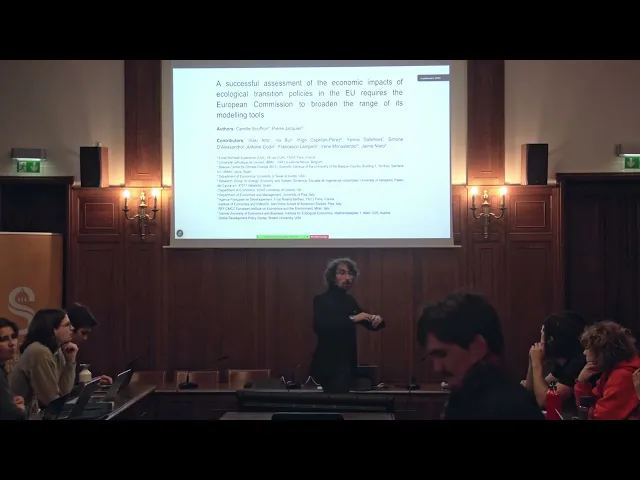
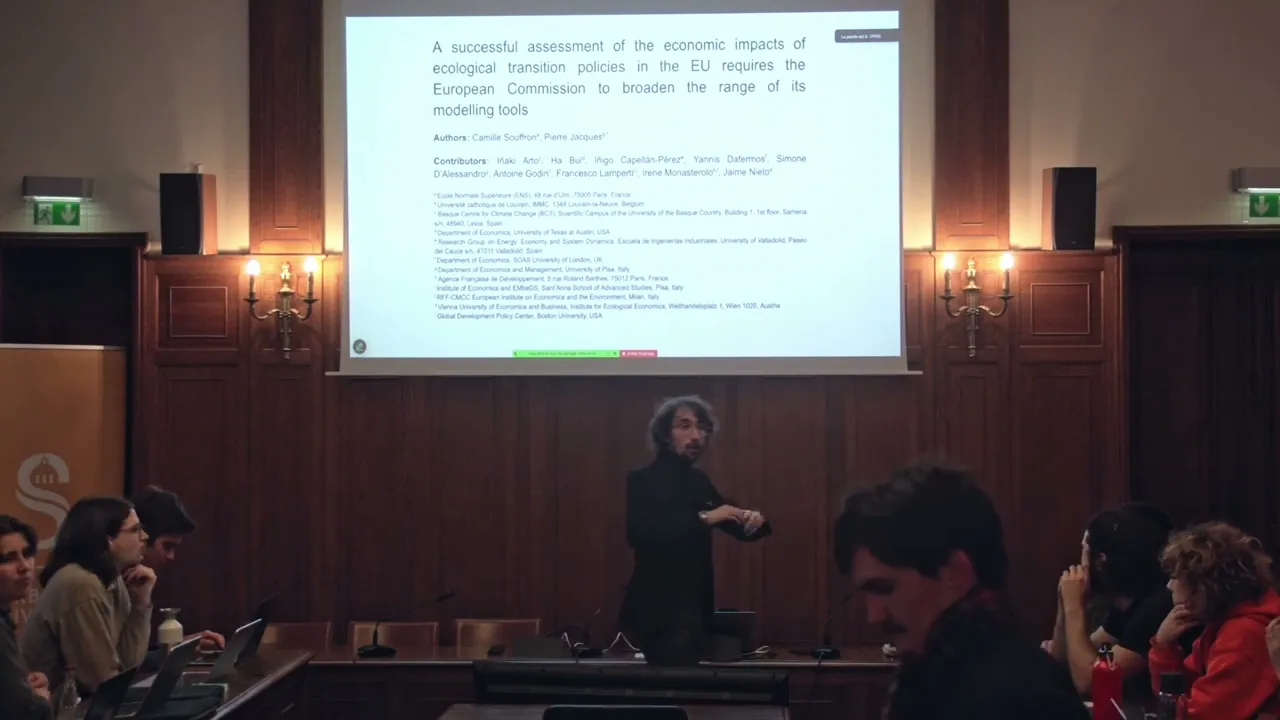
usually bad math or bad use of mathematics at least epistemologically we will see that actually we can really criticize those models so what was the original um stuff working paper it was more like a policy report it was a successful assessment of the economic impacts of ecological transition policies in the European Union requires the European commission to broaden the range of its modeling tools so to put a bit a bit of context um during the the end of spring 2023 happened um in Brussels with the European commission at the European Parliament big International N conference
called um Beyond growth sponsored by by European commission president so it was the first time that you know lots of economists and other thinkers and NGO Representatives Etc came to the European Parliament to talk about other economic strategies than growth post growth the growth circular economy donut economies Etc so it was quite milestone for that kind of of purposes and so with with Pier Jac who is who's about to defend his PhD physis he's um a student of antoan godan he's PhD student at the University Lov and at the IFD the idea was to say
okay actually from what we've heard people in the European commission Economist but also policy makers are not a prior you know against that kind of ideas of possibilities but the main thing that we saw is that we need tools and those people lack tools they are not aware they don't know what is what is happening about ecological economics they don't know what is happening about stock flow consistent models sometimes they don't even know what are sfcs or agent based models Etc so there are we we need to acknowledge that some people are open-minded thus it
is our responsibility as researchers to bring those resources and not say oh they are just mean neoliberal that want to privatize every Public Services Etc that's our responsibility to go out from our Labs from the ecological economics gpke and Cambridge journals Etc to bring those to season and so the idea uh with the sponsoring of former MP Philip lomber who was the head of the green GRE me green members of parliament in the EU uh we wrote a big contribution inviting all actually head of the research teams of all the ecological economics models that we
wanted to present so for example mon monastero who who worked at the ECB who is responsible for the aurine model Antoine who at the afd who is responsible for the GS models yanos that you've heard about about it you had yeah you had classes with him I think this no not this year please no and so the idea was to contact all those research teams to write a paper saying oh you want alternatives to mainstream neoc classical models even if you are not theodox or poian or institutionalist regulationist Marxist whatever there are resources we summarized
all those resources in one paper and we contacted all the head of those models to say oh if you want to work with them we are we have already The Hub we have already the scientific Community with models that are ready to be applied to your institutions and in this paper there were even the contact you know the scientific mail address professional uh emails of of those researchers so that you know if you are a random guy at the European commission or whatever International institution you had access to that kind of resources and it was
completed by uh an open letter that we we we written with Pi who wased by more than 2, 200 economists like Tim Jackson Marana Muk J whatever uh in the press to call for new models in the European Commission in order to build the eological transition so the argument was to say you know it was it was about being diplomatic not to say oh we don't believe actually in a Astic F fix point which is called gener equilibrium where everything is stable demand equal Supply there is no profit rate there is no inflation or 2%
Target inflation there is no involuntary unemployment BL blah blah blah blah no just say oh your models are right there have been big advances in those models but we understand that you have yourself issues as researchers and policy makers so we are not coming oh we Areo your things are bad here we have developed lots of complementary resources that you can use with your dsgs and cges and so it led to really interesting discussions with for example The Joint research ccil the GRC which is a kind of like public Think Tank resource center of the
European Union Etc showing that actually you need because maybe you will you will work after or during PG CIS in central banks in international Institution the bit the OCD Etc and you will see actually that mainstream economists that are Economist in institutions are usually more open-minded than neoclassical Economist that work in Academia why because they have the obligation to bring results so they are pragmatic so if they found a model that have a better accuracy than the classical ones if they want to keep that job by forecasting the future inflation of the five to the
next three years for the the the FC Committee of j po at the FED Etc they will use your model they will be happy to use it even if they have a political disagreement with you so it's important if you want to work in institutions to go in that kind of open-minded diplomatic thing to say oh I'm just thinking about complementary tools to help your own issues to address your own issues and so here so and uh so we we transform we just transed this paper into a more academic paper that we submitted to eological
economics so it's going under review but I think you have access to it it's more no compress and less policy political design um so there were there were two there the main objective was to say the the main strategy was to say not to focus on uh on doctrinal oppositions like demand or Supply like equium or out of equum framework Etc it was more to say um what are the Alternatives in term of really concrete specific modeling tools and modeling uh modeling results what could impact the modeling results and uh we we we were not
focused on the energy environment climate because you know in I IM there is lots of work that's not our speciality um there there is more and more consensus on this subject you we see expect of course on the damage functions Alan nardos which are you know which is the issue what will be the impact of a plus five degrees in average in global temperature anomaly at the end of the century uh people will say oh it will just decrease the GDP of 5% it will be okay like the covid and some people say actually there
there won't be any longer complex organized Society because everything will basically burn you know so there is a a lot of debate about the the like the feedback from environmental damages on economic damages that's another story fascinating a really really scarying really terrible but important so and actually uh the other challenge for mainstream Economist in institutions in opposition with those in Academia is that they need good communication tools because they work with policy makers so they need tractable models for example the policy maker may ask you in in your phg Etc okay but what for
example what happen in your model if I move these really hidden elasticity parameters or maybe you will discover because you didn't do a sensitivity analysis before that's a bad practice you would discover oh in fact that the value the threshold value of this hidden small parameters that drive all my results ah what a p not a good thing but if you are in Academia you don't have to do that this the reviewer won't try to move your parameters because they are you know they have too much work they don't really read your papers Etc so
but to to see that actually the challenges in Academia as ches in institutions are really different so I think you you you get it so three contributions first and it's important in order to communicate with with those people is of course to do criticisms they are totally legitimate and it's it is a healthy epistemologically healthy to do that kind of discussions in scientific discipline that the we are in sban so like about six seven centuries ago it was called in Latin disput Scholastica so controversies between theologist so a critique but an updated critic because what
really Drive crazy lots of those Economist is to hear actually criticisms against mainstream models that are really outdated that where that were legit in the 80s with Tom sergant Rober Lucas you know RBC models real business cycle models with always perfect for Sight representative agents blah blah blah blah fortunately even the mainstream neoc classical field is moving that that's a good news fortunately we we could expect from the scientific Community even the neoc classical one to to to to still develop new tools and actually they do they are doing every day so it's important to
to acknowledge what are the the most state-ofthe-art models and tools and what are their longlasting limitations second things it was still to you know to present a literature review of all macroeconomic ecological macroeconomics model that were already designed and be able to work for for institutions and to see how they could be applied to policy making so um have you maybe in your in your first year abroad Etc have you heard about the SG and CG models or not not some some people do I need to not not all one okay so let's so the
idea is to say oh maybe I will begin with the all right let's do a really small crush course even for institutionally and and qualitative researchers there really small crash course in mainstream models so the general equum theory but applied you know not not the indifference curves and that kind of stuff at the micro level but applied to the macro macroeconomic analysis you know we are at the beginning and the end of the 70s and you know more and more people were going to were coming to to to see the mainstream economies the neoc classical
economies to say okay you are always talking about General equilibrium ASM totic things point where Supply equals demand no inflation no unemployment everything is perfect everything is par to Optimal okay okay but come on guys there are financial and economic crisis and recessions every four years in aage and so those people they were at the MIT at the time so they were not in the teams of solo samel son that was another team of Robert Lucas Prescot K the bar Etc and they thought and they tried to find a solution to to to reconcile genum
Theory and the empirical data that we're seeing there are crisis everywhere what was the solution is it was to say that and I have no B okay um imagine those people would say imagine there is a there is no shocks no oil shock no monetary policy shock no demand shock no no technological shock Innovation ET nothing thus according to the general eum theory we would have like a steady state trajectory it would be basically like fukuyama the end of history no nothing happen any anymore any longer perfect par optimal okay but if we see empirically
fluctuations and financial crisis and economic recession and mass unemployment and station Etc because they they couldn't say oh it's not true basically that were empirical time series showing that thus they said okay if there are fluctuations it's only driven by exogenous stochastic shocks and if there were no shocks there would be no economic fluctuation neither nominal nor real and that's a really powerful solution to say we are still in the general framework but but we integrate economic fluctuations so for example there would be of course there are always shocks in the economy the oil shock
in the 74 following the the the K war between Israel and Palestine the the covid lockdown um the the war between Ukraine and Russia of course there are rich shocks and we need to integrate those impacts in the models but in reality as you know the social realm is a complex Dynamic nonlinear system and we could assume that even with those those exogenous magic shocks there would be endogenous fluctuations and actually it's the case in physics models it's the case in biology models in case is the case everywhere even in sociology except in economy but
it was really the core of this model to say if there are fluctuations it because there are exogenous shocks and not only that the impulse but they would say you don't need public policy even when you are in the the the baddest point of your crisis why because as people are rational as people are has perfect foresight even the baddest the worst point in the time series you know in in history it is already the Paro optimal response of the economic agent to the economic situation so no more room for public policies no more room
for monetary policies as the famous rule versus discretion paper of K Prescot 74 things that actually um people would expect would perfectly anticipate the rise in inflation if they were if there was like an expansionary monetary policy so up no impact and for fiscal policies that the famous bar um um bar Ricardo hypothesis no connection with Ricardo I've read Ricardo there's no don't know so the bar hypothesis to say that if the state do a kesian SP you know public spending rational perfect forsight economic agent will expect either in their life or in the life
of their grade children graduate children that the inter generational alism hypothesis they will expect rise in taxes one day in order to pay for the current public spending so they will increase their savings and decrease their consumption by the same amount of public savings neutralizing any kesian multipliers and so no more room for monetary policies no more room for fiscal policies even the worth crisis that's already the optimal responses of Agents of economic agents to exogenous shocks and that the and then so it's way it's called Dynamic there is time stochastic that that kind of
random shocks General acum still the general Corum structure models and um that's really the core of mro so of course when for example you are in a I won't say name but you are in a famous university Economic Department you want to do a PhD in macro will take that model and as all of your peers like all of your peers you will the point of your PhD thesis will be to add a new feature to this score for example a new frictions for example wage rigidity or Price rigidity or imperfect competition and mark up
for films or some inequalities between agents lots of bondages but still on that kind of exogenous stochastic general program core and we'll see that that actually the main issue you know the main issue are are in my opinion of course in my humble opinion that's not about oh Supply driven models or demon driven models it depend of the scope of History depends of the periods it depend of the places depend of the conjuncture depends of the wedge bargaining ability of workers for example if you are Marxist you will consider a supply driven model because growth
is investment are driven by the profit rate so basically so it's not really about demand or Supply it's about do your model does your model allow even without shocks without Stuff Etc just basic endogenous fluctuations to represent our Dynamic complex nonlinear system that is reality that is the social world and just again it's already the case in physics in statistical physics in biology in demographics I mean everything and so to to to to finish with this we need to acknowledge um of course especially after the gr financial crisis of 2008 some mainstream Economist said okay
come on there are like basically strong issues with that kind of models we need to correct them and that will be the famous new kesian flavor new kesian coloration Newan saying that we are still on uh that kind of gener equum framework but we will add frictions nominal frictions bounded rationality wag rigidity imperfect competition all that kind of new kesian flavors but not really kesian um and you a few want cge models that's more CG models computational General models are are more used in the world banking institutions that like the really highly disaggregated versions of
DSG is with lots of sectors you have a in fact it's coupled with a with um a social accounting matrixes s you've heard about it maybe no imagine an input output table you've seen the input output so for for each sectors for each you have a matrice and each point it will take the the input of the line I and it thanks to that it will produce the output of colon J so it's kind of really basic you know industrial accounting and on this you put some distributions you put the the distribution between wedge and
profit between um consumption investment Etc so you have a kind of representation of flows not stock that's not sfc just flows of your economy and then you add general equum theory on it you have a cge so it's basically a dsge but with more accounting and highly disregulated if you want for example to to test for a carbon tax on an environmental policy on a sector and you want to see if it will it will have impact on the other sectors the fishermen fisher woman Etc I don't know Okay blah blah blah and so that's
not only me who who is saying all that kind of stuff that basically leading neoc classical economists some with the Nobel Prize so for example Robert Solo in his Congressional hearing the US in 2010 who said that basically I don't believe in that kind of stochastic stuff my solo growth model was just a toy model it was a euristic it wasn't any to be the core model of all B economic Bachelor students in the world blanar Olivia blanar the former Chief Economist of the IMF we will see his criticism just after Paul rer Paul Romer
who was the former Chief eon of the World Bank who got fired because he revealed that actually the World Bank were cheat was cheating about you know it's international ranking of like good countries to invest in you know and he he show that usually when there is a leftwing government that got elected in that in those countries they would automatically lose ranks this guy is half but he still has intellectual honesty and if he sees something like this he will say that's not okay so still you can talk with people who have a really opposite
political or epistemological approach than you those people can still be intellectually honest and open-minded so I really no push you to to talk with those people and he say basically Paul R he really criticize that kind of stochastic shocks he say um what are those all those shocks that that are drive driving all those models basically he he he was in a PhD defense committee the the the he of like the supervisor of the PHD student [Music] was Ed Prescot Nobel Prize dsgs rbcs Etc and one of the guy in the jury told the the
pH student oh really interesting but what are those all those negative shocks those negative productivity shocks stochastic that are driving all the results of your model and the supervisor got angry he looked at at the window and said oh it's a it's a traffic out there traffic in French and so Paul R in his paper really 20 pag paper really readable I really push you to read it he he he called those shocks flugy Stone no flugy stone Magic flugy Stone that will know change all the economy movements and variant Etc so um that's the
issue of identification actually I'm I'm talking a lot about Theory but just the beginning I will of course adapt for example in um when there is a really interesting paper using the models of the European commission the the GSG of the European commission which is in them to to study Germany Germany economy between 1995 and 2013 and in order to have a model that reproduce the data which is a point you know to explain reality time series they needed in it's return they needed to assume 46 hypothetical shocks on Germany it's written in the paper
I there is absolutely no rational or ideas or insight about what are those shocks that's not if they were doing like rigorous AO regressive instrumental identification to say oh it might be maybe this deficit impact with China ETA no just oh we have a model and so that the in order to have a model that reproduce all the time series and in order to be able to say oh my model is good because it reproduce all the time series I need to assume 46 invisible stuff magical stuff that will impact my imagine okay there are
46 CHS you don't know what they are maybe the conferences of Anga Merkel I don't know maybe the big party in the I mean whatever in Berlin okay so after explaining his story you might want to use your model for another goal which is forecast you know probably for future inflation future unemployment blah blah blah if you have because in terms of in statistical terms what is the name of this practice it's called overfitting overfitting which means of course you can reproduce all the empirical time series because you have an infinite degree of Freedom like
for example in a basic OS you know economic linear regression imagine you take like 1,500 explanatory variables in your in the in the right hand side of your linear regression or okay maybe your air squ will increase but just because you are overfitting the model with all the potential things that can capture the variations there won't be any any longer coal analysis and what's the issue with forecasting okay you can reproduce the time series with that in a bad way but can you forecast no because all your model is built not on the understanding of
reality and what moves reality is buil on invisible shocks and by definition that's a stochastic shock so you cannot you cannot um forecast them yes fat looks so when you are running for your your your exam you know the papers that you need to do in February your linear regressions and you think oh maybe I've added too much explanar terms don't be ashamed always think to those macroeconomic DSG guys and saying okay at least I didn't put 1,500 terms in my linear regression not I'm not like and actually um so Blan oliv Blan who was
one of the main developers of the G in the 2016 said himself in the paper that I suspect that even dsge modelers will agree that current DSG models are flowed um when they are used for normative purposes normative implications are not convincing uh the mix of calibration and ban estimation is unconvincing and all the all the part of the models in terms of consumption inflation investment Etc they are profoundly at odds with Theory and empirics that we have on those specific subjects so everything is wrong it's not about it's no longer about bandages frictions scan
flavors no we need something different and actually just to just to see the accuracy of the models for example there was a the tra and IMF D sge forecast are on the left side for Greece during the Greek crisis you know we when the TR basically destroy Greece with sza Etc and on the no left side and on the left side IMF W forecast for a global GDP so you can see that each year the forast forecasts a new growth a new increase in GDP and each year you know the empirical realization for Greece it
was a collapse same for the IMF forecast about DDP so the other issue of those models beyond beyond exogenous chocks is still the genium framework why I cannot I I cannot even draw like a picture so that's a bit an issue but those models the idea is to say that with time people will find the the the optimal choices investment consumption Etc we will convert to a steady state which is par optimal and it will be the end of hisory right modulo of course exogeneous shocks the issue with that is that whatever the the strength
of the shocks that you will put into your economy for example the great financial crisis 2008 well huge oil shock the C Co lockdown Etc whatever the size of the shock and are real shocks of course we need to put them because it is an equilibrium model ASM totically with enough time it will always converge back to the optimal C state to the dynamic fix point so whatever the size of the shock that you throw on your economy you you will never have long-term mass unemployment that's an issue because empirically in some cases we have
seen mass unemployment right no same thing even if there are discrepancies between the in the in the distribution in the distribution of added value between wages workers and profit Capital asically due to the Assumption on the prod function which is homogeneous of degree one so through the O theorem the earnings of the factors of Productions are equal to their marginal productivity so asically it will converge to this what does it mean in French no no in English but in like literal literary words whatever the shocks the share of workers and the share of capitalist will
always be the same in long term and only deter by technological properties like productivity of Labor productivity of capital Etc nothing about um bargaining nothing about class struggle while we've seen empirically that the slope of the Philips curve linking employment and nominal wages growth rate I.E the bargaining capacity of workers to have better W better purchasing power the slope have flattened flattened a lot we've seen that nowadays even without even with a really small amount of employment of unemployment people are no longer able to bargain for better Wages that's an issue those models are not
designed to integrate what we call structural breaks regim changes for for example the aftermath of the financialization of the 0s the 19s that deeply transformed our economy the globalization the the decrease in Union Union power and Union member members Etc okay so I I won't I won't do all the the criticisms but of course lots of issue about integration of private debt and Financial instability because in order to have an optimal path of I know it would be clearer if I had a BN just to do some curves no no math but curve but let's
say that in the models that even in the models the few models like gerler kotaki or people like that they are doing an accelerator but the some people who are ping debt they're saying oh I've already private debt in my model they put a condition which is called the transversality condition the no scheme which prevent all building of financial imbalances which means that you cannot have Financial instability you can have you can't have py Finance or mean moment and Cycles why because the the structure of the model does not allow you to build Financial imbalances
and as those models are not stock flow consistent they are only in terms of real assets when they put money or private Deb is just either a proxy for Capital because they mixed factories and savings so for example I will invest instead of consume today so that I will consume more tomorrow but today I invest savings and tomorrow I will consume these savings but the savings turned into factories so I will consume I will eat factories like a sandwich but a real fact roles instead of a sandwi that's basically a huge confusion between real resources
and financial resources for those people Capital Big K you know in your models it's both factories both and savings there is no disentanglement so no Financial instability representative agent and rational expectations are more they are introducing more and more bonded rationality so it's a a good thing still substitute ility of inputs in production function and increasing return to scale so we've talk about production functions and finally so lots of criticism but a last one is that at the top of all of this in fact some really important variables of those models are not observable the
two the three m one uh called the nuu or the natural unemployment rate what is the natural unemployment rate is the unemployment rate in the economy that is not inflationary which means that that the amount of unemployed workers such that people are not able to to go to see their boss and to say oh I want a better wage increase my wage or I have I leave and I go to another FM no because thanks to this natural rate this the boss will say uh if you don't want this job just leave there are people
in the street that are waiting for your job so that's the N that's the potential output which is the the level of fput which is not inflationary and there is airstar you've seen a bit in my class that's the natural long-term interest rate but to say that the issue is that we are using variable to do policy making that are not even observable just a small example for example Italy in 2019 the European commission calculating that Italy's production level was almost almost at its potential output level so almost at the you know inflationary production because
too much demand not enough Supply scarcity Etc so what Italy should do in this situation decrease the economy do a contraction public policy decrease the spending Etc when you looked at the data in Italy there there was 10% unemployment which is big and it was even the beginning of a deflation which is not a good thing and the European commission model say oh actually you have 10% unemployment you are in deflation but our model told us that you are in inflationary pressures because too much demand so you should calm down you should cool off your
economy that's a really concrete I mean sorry for people who are not allotting models but I think it's important for you also to understand how those model works and that those models that's not about you know only for nerd guys or or girls theoretical debates Etc in in random papers it is impacting life of people it has impact a lot and it has legit legitimized right yeah it has legitimized all the austerity packages against Greece and it's legitimate elected Sera government so those models it's not only about epistem epistemological debates etc those models are leading
to legitimizing public policies that are destroying the life of millions of people T millions and the environment soah so what can we do next in in in front of those models actually we've identified with pier three main categories of complementary or alternative models first one main one are famous sfc stock flow consistent models coupled with input output in order to have a safc which is disaggregated at the sectorial level you know with mining with agriculture with energy production um Services Services of course we we are in a highly service sized economies and those models usually
don't integrate servic there are and thanks to the stock flow consistent framework you can also include I will talk a bit about this after you can include environmental resources and flows and energy flows and stocks even pollution stocks and Wast then you have ABM agent based models I think you had a class with federo and Andre Lawrence this year about ABM okay okay um so the idea is to I have a framework I will talk a bit about this I have a framework that allow to capture all the heterogeneity of lots of diverse and different
agents and their interactions in order to avoid the the you know representative agent without inequalities without feedbacks without interactions Etc and finally the last category which is which is you know capturing actually all the other models which are multi sector models with lots of their with their own specific features so and the the three main advantages um of all those models before going a bit into the those models is one it allow to remove the equilibrium assumptions so that we can have a nonlinearities we can have endogenous fluctuations we can have K house at least
we can have interesting Dynamics like like what it is happening in real life you know other thing is that it incorporates real and financial sector inages so that for example you can have Financial imbalances you can have speculation you can see for example the impact of your credential or monetary policies like quantitative eings on the the the price of equity on the accumulation of private debt with mean scan stability Etc and all the investment constraints of course and finally explicitly modeling climate and resource constraints mainly through the stock flow consistent expanding with Resources with energy
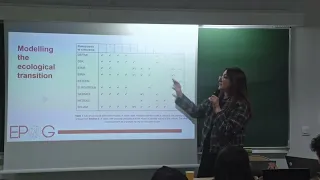
with waste framework so you have a if you want to read a bit on those models you have a table that present what uh what problems are addressed by what models if you want to for your masteris or whatever your PG says or working paper or ideas Etc internship you want to contact those the research teams of those models there are their professional email addresses that I encourage you to you know to to write to meet always interesting just to to talk so stock con so I think with Danny you with Dan you've seen everything
I've seen AIT everything understand stock consist models or just no okay a few words the idea that you know in the economy which is important is not only flows like flows of savings of investment of consumption but also stocks for example if you look at only private debt flows each year maybe you won't see the accumul of these dangerous private depth and financial markets that up to a point where it it will lead to a financial crisis like 2008 so even the models in 2007 who were who were taking into account private debt they were
only taking into account flows of private depbt not the accumulation so you want to see the stocks but you also want to see in which hands those stocks accumulate and especially if those agents are liquid they are you know if they are about to able to pay ET so you want a framework with which is talk and flows consistent and thanks to that on this framework you can put distributive assumptions you can put distributive framework for example okay I know this share go to workers this share go to capitalist Etc and you can also integrate
like yanos and his team you can integrate resources again to say that why couldn't we see natural resources energy and waste like in a thermodynamical approach also to be stock flow consistent in terms of available natural resources their regeneration rate and speed our rate of consumption and driu of those resources of energy consumption and what are the waste that we are producing we can integrate all those Dimensions into a stock flow consistent framework in the same way we can put for example gender inequalities in your sfc you just add New Dimensions in your matrices of
stock and of flows and of transactions with with for example the different gender that you want to study in your model so it it offer you a kind of skeleton on which you can add whatever the behavioral equation that you want but at least you won't have black holes and that's already a good beginning for people who who will do modeling I really encourage you first thing before going into you know investment equations and solving the log linear differential system just build the sfc framework what are your agents what are the flows what are the
stocks and in which hands in which hands the flows are accumulating as stocks and for financial variables of course each asset is also liability and each liability is also an asset so it it should equal zero when you had things that's would be a good practice in January February to begin your your your modeling phas so the so Define is the one by dmos um Euro green Euro green is a really interesting model built by Simon alandro at Al the first version and friend the second version who is about to be published in Italy and
this um a is really interesting because it it has really disaggregated framework with lots of social classes lots of worker skills lots of sectors and actually it allowed us with u with gjiro and the Russo Institute to publish a small report about for example the macroeconomic simulation of the the last uh the last um leftwing Coalition of the the last parliamentary election in France um with Euro green so we we we we were able to simulate because you know in political compain usually parties or think tanks Etc institutes are just Computing the cost and the
benefits you know just the cost of the political program here the idea was to go further to say we will not only compute the cost we will simulate in medium run the impact of this policy package on GDP CO2 emission inflation public deficit commercial balance trade balance Etc so in order to feed the political debate James James is really interesting James is a model developed by G the afd and then by go and his team his idea is it is built on the Goodwin model Goodwin model which is maybe the the most really developed economic
model with endogenous fluctuations because the issue with kesian models or post kesian models that lots of them even if they are pan demand driven Etc inequalities Capital share Etc capitalist they are still equilibrium models so you have equilibria kesian equilibria with lots of unemployment Etc but it's still stable the goodwi model is the idea that you want to build your economy on the class struggle between capitalist and workers that's a really maxian Marxist approach in order to have endogenous fluctuation of the class true goal for example unemployment decrease so people bargain for better wages it
increase the wages capitalist invest less it puts the economy in recession unemployment increase wages decrease and again and again and again class goal no equilibrium real dynamics then you have the ABM agent based models so abms let's say that AB agent based models is less about forecasting it's more about tics about mind experiment thought experiment like in philosophy in order to have some emergence everyone the concept of emergence is a it's coming from physics and biology for example um you know your Consciousness is not the simple sum of all your neurons the interconnections of your
neurons lead to emerging properties for example it is consciousness or for example life in bacterias the first form of life procaryotes UK carots without nucleus Etc it's not just the sum of the molecules that are forming this cell this bacteria there are this interconnections of molecules and it bring an emergent property which is life and that's the same thing in sociology it's more called holism you know the idea that the whole is not just the sum of the individual Parts Society is not just a attacher attacher it's not just individuals there stuff Beyond and that's
the idea of ABM is to say that we will simulate lot lots of individual agents which are heterogeneous lots of companies lots of banks lots of workers consumers Etc with rules about their behavior and their interactions how they interact do they learn from each other how local film invest if they discover a technology do they share with other films are there spillovers are there externalities and we see what happen is it about the size of the population is it about the ti of interactions and thanks to that you can obtain really unexpected patterns so it's
it's not about forecastings about euristic about mind experiment and finally you have uh you have uh the the other models that are not specifically stock flow consistent that are still aggregated model but with input output tables which allow you to track all the industrial exchanges so you can focus on the min sector the agricultural sector the service sector Etc so for example e which is also developed at the afd who focused a lot on the trades and international flows of resources and of financial resources and material resources between Global South and Global North which is
really interesting and if me if me it's uh from combridge it's it's a really funny model because it's a kind of mix it's a really micro founded with some local agents it's still a macro model but for example techn technological innovation it's really disaggregated to see how local FMS invest and find new form of Technologies so you can also for example combine a macroeconomic framework with big behavioral equations for consumption investment ET but for some part of your models you can still have a microfounded EOG genous agents sector if you want really to study how
those agents interact in this sector for example or in this dimension for example technological innovation or for example credits and Investments and endogenous money that kind of things so to conclude um so of course there is a need for collaborative dialogue and institutional convergence of ecosystems um and to quote blancha which is quite quite amazing to be able to quote on leg blancha on this the profession and again this is a note to the editors of the maor journals so a GP econometrica qg Etc must realize that different model types are needed for different tasks
and actually um a diverse portfolio of models provide greater predictive accuracy that's theory of dynamic systems greater predictive accuracy and that's Scot Scott page is a specialist he a researcher specialized in in dynamic dynamic systems and how models can allow us to understand Dynamic systems and she she she show that actually the set of models accuracy is the average model accuracy plus the variance plus the model diversity the more you have diverse models whatever their accuracy the more you will be able to converge to the true empirical parameter to the true data gener process a
bit like the the estimating um the like in OS you know in statistical inference the the average the the distribution of the sampling average you know through the limit Center theorem so we need a collaborative efforts with academic and public institutions for a systemic research program and institutional converence and of course that's that's obvious but we need also to connect research committee that was a point I almost finished that was the point of this paper not only to say oh there is a list of good things is that we've contacted all the researchers that are
developing those tools and they are ready to work with you and institutions and governments Etc in order to lead the eological transition to build better forecasting tools better public policies for the common good to reduce inequalities to reduce Financial instabilities imbalances Etc also because it might be a bit depressing if you work in a isolating environment or neoc classical environment you know to just do on your stuff and being rejected so we're also talking about mental health and and well-being and I think it's important as researchers also to be able to to build a strong
research links and strong human links because we are living in a really really tough times where even researchers which had a few decades ago still some kind of respect by all the political sides nowadays we are called leftist socialist Islamic terrorist in Fr the word islamist which is a combination of radical Islam and like I mean terroristic Islam and and leftist and actually the former former former so many dissolutions of the government but former former former Minister for higher education ask the cnrs which is the main research agency in France to lead an investigation on
public researchers about their Islam leftist features in in the Congress in the National Assembly so so being a researcher imply nowadays more and more also to be explo exposed to political violence to harassment on Twitter to Media back backlash Etc so it's important also to to build human communities not only for the quality of our works but also for our mental wellbeing and last last oh to to see ultimate penultimate slide to see that actually things happen for example the World Bank in Washington combined e and manage for the country climate and development report for
China the IMF and the ECB with ir monaster LA are using Ain for climate related Financial disclosure so the impact of of FMS and Banks disclosing you know Brown the risk of brown asset strandings fil asset strandings the European commission have if me the poian heterodox model in its toolbox and the IFD of course with its mission of technical assistant to the global F mainly so to see that things are happening and not in Academia not in top American journals but in institutions and you might want to work in that kind of framework at least
for a few words if you want to really have an impact and to have papers read not only by two other people in the world and the last thing that usually there are there is a counterargument against pluralism against model diversification which which may be valid epistem in terms of philosophy of Sciences and epistemology it is a valid point mainly from Michael po Pani the brother of car Pani it was kind he's less known that car Pani and the great transformation but it was kind of a great Brotherhood you know um the basically the risk
of anything goes without Cen ific rigor and so we really need to defend that pluralism does not imply a decrease in quality of model and research it shouldn't be an excuse to produce bad models or bad qualitative research bad institutionalism Etc there are really bad regulation papers nowadays you know in every field inod mainstream I mean bad researchers are every everywhere that research are everywhere it should be an excuse also in terms of legitimacy and actually there is a counter example that you can quote that's called climate Sciences um actually the models the the model
the circulation General the G jcm General circulation models that are used in climate Sciences in the ipcc reports Etc they are huge huge huge model far more huge than economic model like five 500,000 equations and parameters the parameter contributions for sn3 about parameters value everywhere it takes usually between two weeks and months to have one run one simulation you you you launch it on your computer on your servers you need two months to have a result so you shouldn't do this for your master CIS because you will even for September session you know it w
bad idea that's nav St equation so partial differenti equation discretize sphere I mean that's extremely complex and uh even with that climate scientists since since the end of the 90s have been able to develop an international framework the cmip CM CM cmip CED model intercomparison project under the the World Meteorological organization whom the the role is to compare to rigorously compare the validity the accuracy of those of the models of all the res teams and to build standardized rigorous databases so that when you have a different result for a model is due to the model
and not to the variability of the database or cherry picking that that you've done so it's to show that even in a discipline with much more complexity in terms of modeling size and D dimensional complexity there are ways and even insti alized International ways to have a healthy transparent well organized scientific debate and we are not able to do that in economics so we should try to to build that kind of stuff so um thank you for listening and I'm really happy to discuss in a less theoretical thing all of this review [Applause]