interestingly over time over the history of clinical research there's been interesting changes in how we think about this tension so for many years for hundreds of years there were very few rules physicians mostly physicians experimented for two reasons one because they were curious and they had the luxury or the resources to be able to do so and two because they they wanted to benefit individuals they they found individuals that they didn't know what to do about in terms of their illnesses and so they would experiment on them to try to figure out well does this
work or does not does it not work but there were no rules we went through uh what people have referred to as a utilitarian area in era excuse me in the united states maybe in other parts of the world as well where the emphasis was on benefit to society and many of the participants in research during that era were people who are now recognized as vulnerable they were captive populations people in prisons people in um institutions for the mentally ill and in orphanages uh people who were seen as not only captive but in some respects
sort of marginal or marginal to society and they made their they made them useful by including them in research is the sound good can you guys hear me okay okay i can't tell that led in the um late 60s early 70s to a period of time where there was some pretty uh deep scrutiny of the scope and limitations of research so studies that you might be familiar with that sort of led to this level of scrutiny um the tuskegee syphilis study where all of a sudden people realized you know for 40 years we've been studying
the natural history of a disease that had a treatment available to it and the people in the study were not getting that treatment led to a series of congressional hearings led to a congression an act of congress called the national research act the creation of a commission the national commission for the protection of human subjects of behavioral and biomedical research and then some rules and the rules and regulations that we currently operate under were created at that time they started at that time and prior to that there were very few rules about how we did
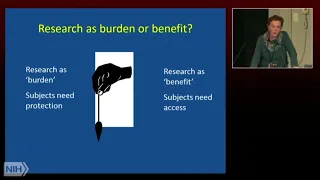
research or very few uh laws or regulations that um had much authority the rules and regulations that were put into place starting around the 70s really had the focus or the emphasis of protecting human subjects providing lots of um procedural rules and other rules that would lead to the protection of human subjects from undue risk as was already pointed out from exploitation and would respect their rights through the process of informed consent in the last probably 20 years or so there has been increased recognition of the possibility of benefit through participation in research and this
is benefit not just for the individuals sometimes the individuals who participate but benefit for populations so a recognition for example that doing research with children sometimes is really important so that we don't end up with therapeutic orphans people that children who we don't know how to treat appropriately for certain diseases whereas if if we don't include them for research we're in in clinical practice we're making guesses about how to treat children so having children participate in research is a benefit to children at large um international research has been seen in some cases as beneficial um
and there's lots of ways that that research has been seen as not just something to be protected against but beneficial in some ways during this same period of history and i just went through a lot of history in about you know very short amount of time i can answer questions if you want more details but during the same stretch of history there are lots of important codes and guidelines that were written and are still still have some power and i suspect that many of these are familiar to you um the nuremberg code was the code
that was written as part of the nuremberg trials of the nazi war crimes um and it still has some influence in terms of how we do research in the world not just in the united states it's a it's a very succinct code of ten principles the declaration of helsinki which came along about uh 15 years later was written by the world medical association which is a sort of group of like the american medical association and its equivalence in different countries around the world and they wrote a document called the declaration of helsinki which was some
people say in a little bit of a way a response to nuremberg but a response in the following sense that it recognized that a lot of research is done by physicians with patients whereas the nuremberg code was written as a result of research that was done with prisoners in a in the context of war the declaration of helsinki is as people describe it a living document it's been revised multiple times this slide needs to be updated it was most recently um revised in 2013 and it has a lot of very important pieces to it and
a lot of authority around the world and i can talk about what those are if you want to know the belmont report is a document that was written by the national commission that i mentioned a few minutes ago and it's a pretty short uh pretty clear explication of the principles that underlie the conduct of clinical research and i'm going to come back to that in a moment if you haven't read that i would say take take the time to do so it's not very long seahams and the who seams is the council of international organizations
of medical sciences and they in collaboration with the world health organization developed international guidelines which were designed to take the principles enunciated in the declaration of helsinki and apply them to the context of doing research in the developing world and there are two published versions of those guidelines 1993 and 2002 and just in the last few months a revised version is online for people to comment on and so if you're interested in international research in particular it's worth looking at one of the things that i really like about the cms document is that in addition
to principles which many of these have it has long not long but clear detailed explications of how they came up with that principle and what they mean by it so it's very useful and the ich gcp is a very influential document in the world it's a international conference on harmonization good clinical practice which is originally came about through the regulatory agencies of the united states the european union and japan who wanted to find a way to agree on or harmonize the rules under which clinical research could be done so that if you did research in
one of those jurisdictions and wanted to have it approved by in the other jurisdiction you'd have to start all over again which is what a lot of countries do require so ich gcp has now been adopted by a number of countries around the world and it allows for this regulatory reciprocity if that's the way you think about it in terms of e-6 is the part of the ich-gcp that speaks specifically to ethics and it does adopt most of the principles from the declaration of helsinki so you can see lots of interaction with these documents so
the belmont report i mentioned is a document that was written by the national commission and has three underlying principles for clinical research respect for persons beneficence and justice and in the belmont report they take each of these and not only describe what they mean by it but they also apply it to a specific aspect of clinical doing clinical research so probably especially those of you who have ever studied ethics these are principles that are commonly discussed that don't just apply to clinical research they apply to lots of things but in the context of clinical research
the commission applied respect for persons to the idea of informed consent they re they applied beneficence to the idea of risk benefit assessment and how you make those calculations and justice to the idea of selecting fairly selecting subjects so that there are fair outcomes as well the other important thing i think that the belmont report did is it described a distinction between clinical research and clinical practice and this is useful for thinking about the ethics of clinical research to sort of make these these kinds of distinctions so one thing that i've already alluded to is
the the goals so the goal of clinical research is to generate useful knowledge the goal of clinical care is not to do that is to benefit the person or persons in front of you the persons that are being cared for in a practice and you can see how sometimes those two goals can come into tension and need to be reconciled methods are also very different so common methods in clinical research we talked about double-blind trials placebo-controlled trials dose escalation trials the kinds of things that we do all the time in research are very foreign concepts
in clinical practice so it would be very weird for you to go to your doctor with a sore throat and have the doctor say to you i'm going to give you one of two drugs but neither you nor i are going to know what the drug is to to heal your sore throat and yet in research we do that all the time the other thing is the other important difference from an ethical perspective is the justification for risks so it's clearly not the case then in clinical practice everything there are no risks involved there are
certainly risks in taking medications and having surgeries and interventions etc but all of those risks are justified by the potential for the benefit that that intervention offers to the individual who's undergoing it whereas in research we often ask people to do certain things procedures or interventions that have no corresponding benefit to them but they're being done to answer a question so we might ask for an extra biopsy an extra blood draw an extra scan a pharmacokinetic test something like that that exposes people to certain risks for the purpose of answering an important scientific question but
not for their benefit and so those there's three ways that research and clinical research and clinical practice are distinguished and they're very important to keep in mind because they help us answer a lot of questions about what's acceptable and what's not and the belmont report begins to describe those differences in addition to codes and regulations sorry codes and guidelines there are regulations okay so in the united states um there are two important sets of regulations that are worth knowing about one is the common rule how many of you know about the common rule a couple
people okay not everybody okay the common rule is the well let me start with u.s 45 cfr 46. also you know walking around the halls of this building sometimes you hear people just talk about it like that they don't call it the common rule they call 45 cfr 46 and so the co 45 cfr 46 is title 45 of the code of federal regulations part 46 and it is the department of health and human services version of the common rule the regulations for protection of human subjects that anyone getting department of health and human services
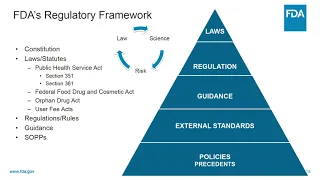
money has to follow the reason it's called the common rule is that there are 16 other federal agencies that also follow the same set of regulations their their regulations are found in different parts of the cfr not all in title 45 that's dhhs but there but the content of the rule and the regulations is similar across 16 other federal agencies in the united states one of the agencies that does not follow the common rule is fda and fda has its own set of regulations the regulations that are found at title 21 of the cfr and
at part 50 and 56 are very similar to what's in the common rule have a lot of the same requirements but some important differences and then there are other parts of the fda regulations that are very important for somebody who's doing a treatment ind for example or a device trial and then there are policies and guidelines that the nih requires so for example how many of you are investigators couple okay so if you're do how many of you are irb members anybody no okay there are some um requirements for inclusion of women and ethnic minorities
and children in research that are nih requirements but that are [Music] requirements i guess is the way i would say it and there are some others that the nih has that are nih policy that um apply to clinical research so what does 45 cfr 46 in include um there are really three things that are there there's a lot more than this there there's um federal regulations are you know i don't know how many pages 15 pages or something of of details and so if you are on an irb or if you're getting ready to write
a study you might really want to know about what the details are but basically they cover three broad areas one is a lot of description about the composition and function of local institutional review boards or irbs another is the criteria that irbs should use when they're deciding whether or not a study is approvable and the third is requirements regarding informed consent of individuals that are going to be included in the study so these are spelled out in the common rule and also in 45 cfr 46. 45 cfr 46 also has subparts subparts that pertain to
additional protections for groups of people that are considered vulnerable for a variety of reasons so subpart b refers to fetuses pregnant women and human in vitro fertilization c to prisoners and d to children and there are some very specific additional requirements that research with these populations entails the fda regs i already mentioned that the 21 cfr 50 and 56 are very similar to what's found in the common rule the the part 50 is about informed consent part 56 is about irb composition and function there is also a subpart d uh in the fda regs that
deals with extra protections for research with children and then there are ind and ide regulations found at 312 and 812 that are very important for your investigator who's testing a new investigational new driver device you