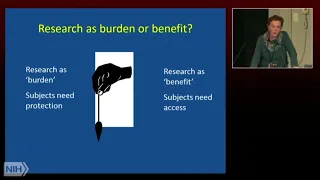
i'm very excited to introduce the next speaker dr zeke emanuel is the vice provost for global initiatives and chair of the department of medical ethics and health policy at the university of pennsylvania he was the founding chair of the department of bioethics at the nih until august of 2011. he recently served as special advisor on health policy to the obama administration dr emanuel received his medical degree from harvard university and a phd in political philosophy from harvard university he is published widely in the area of health care reform research ethics in end-of-life care in addition he is often contributing to the new york times editorial page and cnn in 2018 he received the dan david prize in the category of bioethics i'm confident you will enjoy his lecture today whenever i begin talking about the ethics of clinical research i'd like to start with a little history to situate our thinking about research ethics because it didn't begin yesterday it didn't begin with the declaration of helsinki it didn't begin with nuremberg one plausible way of starting the history of research is in the year 1767 william watson who was then a physician at the foundling hospital in london sought to test two claims related to smallpox inoculation he wanted to know was preparing the patients with a purgative beneficial to their getting inoculated and second what was the best source of the inoculation was it an early pox or was it a late box he then conducted several trials the first trial was he had 10 children treated with mercury and yallop a very strong laxative and purgative 10 with senna and syrup of roses a mild laxative and purgative and 11 had no medications all the children at the foundling hospital had the same diet similar clothes they played in the same field and slept in the same dormitories pus from an early park was used the end point was the number of pox on each child because researchers at that time knew or doctors at that time knew that the number of pucks correlated with the severity of the illness well watson's experiment had a deliberate study design he had controls and matched subjects he controlled the circumstances and other factors that he could identify and he had a quantitative end point many historians say that clinical science began in 1767 with this experiment we can go on and there are many other experiments that are important 1938 was the first placebo-controlled trial 1948 was the first modern randomized placebo control trial it was streptomycin for treatment of tb that is just two or three highlights of the history of clinical research simultaneous with the history of clinical research is the history of research ethics the first recorded mention of consent in a legal case related to medicine occurs in 1767 in a british lawsuit slater a patient who had broken his leg had it re-broken by two surgeons and re-fixed to get better alignment the two surgeons were held liable for re-breaking the leg without consent because as the judge wrote it appears from the evidence of the surgeons that it was improper to dis-unite the callous without consent this is the usage and law of surgeons notice what the judge is saying at that point that consent was necessary and that that was the common practice of the surgeons and that they had violated that important need for informed consent well another important landmark in research ethics occurs at the end of the 19th century in 1897 in the wake of pasteur and koch many researchers are trying to find bacilli that are causing various diseases giuseppe sanorelli an italian researcher working in latin america announced that he discovered the bacillus of yellow fever and produced yellow fever by infecting five patients leave aside the fact that yellow fever is not caused by a bacteria sir william osler at that time he wasn't sir william mosler who was merely chairman of the department of medicine at johns hopkins but the most important physician in the entire world got up at a meeting and condemned sanorelli saying to deliberately inject a poison of known high degree of virulency into a human being unless you obtain that man's sanction or consent is not ridiculous it's criminal now notice what the most important physician in the world is saying at that time that you need consent to actually administer a toxin to a person and conduct research on them that event heavily influenced her walter reed when he was appointed head of the yellow fever board by the u. s military because of that event walter reed decided that his research on yellow fever in cuba had to have certain ethical rules and the rules that he established were first there would be self-experimentation every person on the yellow fever board would actually have to participate in the research he did not participate because he went back to washington when they were going to conduct it for consultations second there had to be written agreements with the other subjects the cubans who were participating third the cubans who were participating had to get payment in gold and if they died their family would get payment in gold fourth research was restricted to adult subjects you don't do research on pediatric patients until you do it on adult subjects and so it's safe and fifth he said that every paper had to have the phrase with his full consent in the articles to make sure that everyone knew they were the research was done in compliance with the patients well we could go through a lot of history thinking about what the right ethical requirements are there were 10 principles in the nuremberg code the declaration of helsinki initially had 22 paragraphs but we've proposed that there are eight distinct ethical requirements for research to be clinical research to be ethical first there has to be a collaborative partnership second the research has to have social value third the research has to be done in a scientifically valid manner fourth there has to be fair subject selection fifth there has to be a favorable risk benefit ratio to this research six there has to be an independent review of the research to make sure that it's ethical seventh there has to be informed consent and eight there has to be respect for the humans who are participating in the research after they've agreed in the informed consent process now one of the things i want to emphasize is that those eight principles are not higgled higgledy piggledy put together there's an order you start at the top and work your way down well what do those eight principles mean well the first one of collaborative partnership means that to be ethical clinical research must involve the community in which it occurs it can't be subjected the community can't be subjected to the research they have to actually agree this requires community participation in planning conducting and overseeing research and somehow integrating the research results into the actual health care system it means avoiding supplanting existing health care services and the sharing of the rewards with the actual community mechanisms to achieve collaborative partnership can include community advisory boards patient advocates on scientific advisory boards even the advocates urging funding and remember the community doesn't just have to be a geographic area it could be a community of patients with a particular illness second principle social value to be ethical clinical research must lead to improvements in health or advancements in generalizable knowledge we must consider how the research will improve health of the participants in the research the community in which the research is conducted and again doesn't have to only be a geographic community and the larger world research which is valueless does not fulfill this principle is research that can't be generalizable me two studies where we've confirmed some finding three or four or five times we don't need the sixth study and very importantly research which is not disseminated that has no value because no one can learn from it so research where the results are in the bottom drawer they're never discussed that is valueless research that research actually is unethical third principle scientific validity research must be conducted in a methodologically rigorous manner that is practically feasible to be ethical the research must produce reliable and valid data that can be interpreted invalid research includes underpowered studies where you have seven people in one arm and eight and another arm what are you going to conclude studies with biased endpoints biased instruments to assess outcomes or statistical texts that aren't appropriate to the study studies that can't enroll sufficient number of subjects are also not scientifically valid the fourth principle is fair subject selection the scientific objectives of a study not the vulnerability and not the privilege of patients should guide inclusion criteria and the populations targeted for enrollment lowering risk enhancing generalizability these can be considered convenient groups such as the children in a foundling hospital should not be selected groups cannot be excluded without good scientific reasons we don't just exclude women piggle the piggly we actually have a reason we might not want to enroll them higher risk is a valid reason to exclude groups that's why we often test a patient's renal function to make sure that it's adequate to the research and finally we shouldn't select rich or politically powerful or otherwise well-connected people for promising research studies and here a little example might be helpful several decades ago when anti-angiogenesis factors were coming on to be tested in clinical research the new york times on a sunday had an article above the fold on page one saying that this was going to cure cancer this was the next best treatment the next day monday telephones at the several institutions that were running that trial were ringing off the hook people were trying to contact members of the board of directors or the head of the institute trying to get on the trial because it was so promising it would cure their cancer well institutions had to actually have a way of not just selecting those people who had connections to the most powerful people in the institution for the study you have to have fair uh subject selection and that includes not only getting those people who are well-connected for promising studies fifth principle favorable risk benefit ratio this may be the most important principle in assessing the risk benefit ratio i think that there's a four-step evaluation process first the risks have to be identified assessed and minimized the risks include physical risk we're all familiar with that death or disability or infection psychological risk depression anxiety we should also consider in some research discrimination social risks economic loss we need to evaluate the magnitude of those risks and the likelihood of harm but we shouldn't invent the magnitude or likelihood and when data suggests the likelihood of harm say psychological stress from genetic studies which has been shown not actually to be present we shouldn't invent those harms and we should identify mechanisms that minimize the risk maybe you do a study that's high risk initially in the hospital or you observe patients in the outpatient setting before sending them home second identify potential benefits to individual participants and enhance them consider the physical psychological social and economic benefits but you should consider only benefits from research interventions not benefits from added health services say a special vaccine or payments that are not necessary to the research goals third step if the potential benefits to the individual outweigh the risk to the individual then you can proceed but what happens if the risk of the individual might outweigh the benefits to that individual then it's important to evaluate the risks to the individual against the social benefits or the social value of the knowledge gained if the social value is high sometimes we accept higher risk to individuals sixth principle independent review investigators have multiple legitimate interests they have potential conflicts of interest independent review of the research is aimed to minimize these potential conflicts of interest independent review also assures society that it won't be the beneficiary of unethical research seventh principle informed consent informed consent ensures individuals decide whether they enroll in research and whether the research fits with their own values interests or goals for those who can't consent such as children and mentally impaired we must ensure that research fits with their interests usually through a surrogate decision maker well what constitutes valid informed consent there are four principles that have to be fulfilled competence of the subject disclosure of information to the subject understanding or comprehension by the subject and voluntariness they decide to enroll of their own free will now the federal regulations require that every informed consent document have eight elements that define the purpose and duration of the participation the risks the alternatives the benefits the confidentiality of records the compensation if injuries occur if any doesn't have to be compensation persons to contact to answer questions about the protocol and voluntariness and the patient's right to withdraw from the research now when i was training many decades ago i thought well you get the signed informed consent down document done that's the end of the ethics of research that is wrong we need to respect human subjects who are enrolled in research and that's the eighth and final principle the ethical requirements of research do not end with the signed informed consent document they also include monitoring subjects welfare protecting confidentiality permitting people to withdraw from the study if they want providing new information that might be learned that might affect their participation and informing the subjects of what was learned from the research at the end of the research so those are the eight ethical requirements let me state all eight requirements are necessary and essential to making clinical research ethical we can't say i like one two four and eight we have to fulfill all eight but we also should recognize that independent review can occur in multiple ways irb is just one of the mechanisms not the only mechanism similarly informed consent are per is a procedural requirement and we don't always have to get a signature to have valid informed consent in some societies a signature is not the way you demonstrate consent a handshake is or a meal is and so we need to fulfill the principle of informed consent but we should be sensitive to the cultural context in which it occurs such that we don't impose our values on another community in fulfilling the eight ethical requirements there can be conflicts and this we must recognize what's fair in subject selection could increase risks what enhances scientific validity may also increase risk what's necessary to respect enrolled subjects might compromise scientific validity there's no simple formula for resolving these kind of conflicts you have to adjust the design to meet the requirements it sometimes said we balance the principles or we weigh them or we specify the principles the important point is to be clear about what is being done and give reasons why we're balancing different principles this has a very important corollary and that corollary is we can have two different approaches to the same research study and both approaches could be ethical even though we balance them differently finally all eight ethical requirements are universal they don't apply only to research in the u.
s or europe no country can say well we're different we have a different value system these eight ethical requirements apply to clinical research everywhere and anywhere it's done all eight ethical requirements must be adapted however to the local health economic cultural and technological circumstances for instance the disease risk that affects your risk benefit ratio may be different in different countries and that will affect how you evaluate the risks of a research protocol that's not to say favorable risk benefit ratio is a principle you ignore it's to say the context really matters and assessing what's a favorable risk benefit ratio so in conclusion let us remember that there are eight ethical requirements for ethical clinical research collaborative partnership social value scientific validity fair subject selection favorable risk benefit ratio independent review informed consent and respect for human subjects and they need to be fulfilled in that order when someone says is a protocol ethical you don't just jump down to the informed consent document you go through a systematic review starting with collaborative partnership and social value working your way down to informed consent and respect for human subjects so those are the eight ethical requirements that make clinical research ethical and it should be applied in every protocol we see the ethics of phase one oncology research there's a very commonly highly controversial area of research i like to begin with a patient that i once cared for she was a 55 year old female she had a right breast mass that was excise a 0. 9 to 0. 5 centimeter mass 0 of 15 of her lymph nodes were involved with tumor she had an er0 but a pr of 538 the rest of the work up was negative she received radiation but no chemotherapy at that time three years later she had her occurrence in her liver and lungs she was initially treated with one chemotherapy regimen when that stopped working she was treated with a second chemotherapy regimen when her cancer progressed in her liver she and i began discussing phase one trials as she said to me i want to fight my cancer the first phase one trial failed after two cycles her tumor continued to grow she wanted another phase one agent rather than hospice after a second agent failed after two cycles uh she be came into my office and i remember the day very vividly she had substantial pedal edema she could barely walk down the hall to the room but she came to clinic wanting yet a third phase one agent now she wanted that phase one trial a lot of people would be critical of her getting the phase one agent how do we evaluate those phase one trials she enrolled in were they actually ethical remember we defined eight ethical requirements for clinical research to be ethical there had to be collaborative partnership social value to the research it had to be done in a scientifically valid way there had to be fair subject selection there had to be a favorable risk benefit ratio there had to be independent review patients had to voluntarily sign an informed consent document and the researchers had to respect the human subjects who were enrolled in the research now the main criticism of phase one oncology research when you actually boil it down is that it violates two of those eight principles it violates the favorable risk benefit ratio principle and it violates the informed consent principle what is it about the risk benefit ratio well critics say that phase one oncology research inherently has an unfavorable risk benefit ratio phase one research is not intended to benefit the individual participants phase one research has some risks to the individual participants especially in oncology when they have toxic drugs and with no benefits but with some risk the risk benefit ratio is inherently unfavorable if the risk benefit assessment is unfavorable for individual participants it's argued then the research is conducted only to gain knowledge for society if the primary beneficiary of the research is society then individual patients are exploited for the benefit of society as one critic put it the fact that there is no treatment for a condition does not make any intervention therapeutic or even quote probably therapeutic phase one cancer drug research may not be performed on terminally ill subjects under these guidelines because there is no reasonable probability it will be the best it will benefit subjects that is george annis from boston university criticizing the ethics of phase 1 research relying on valid informed consent by the research participants has been the response to the possibility of exploitation of patients in phase one oncology research so the belmont report says when the research involves significant risk of serious impairment review committees should be extraordinarily insistent on the justification of the risk looking usually to the likelihood of benefit to the subject or in some rare cases to the manifest voluntariness of the participants well then critics say but informed consent in the phase one oncology space is invalid valid informed consent requires disclosure of information on the objectives of the research the benefits the risks and alternatives understanding of this information by patients and third a voluntary uncoerced consent but the critics say there's a problem physicians don't provide appropriate or accurate information to the subjects and physicians stress and exaggerate the benefits while minimizing the risks to research participants so for example leroy walters another bioethicist said consent forms are very often deficient and they over promise they make phase one studies sound like the cure for your cancer so the problems with informed consent include the fact that the informed consent documents exaggerate but also that patients don't really understand lots of critics will say because patients are terminally ill they can't understand the true objectives the benefits and the risks of a phase one study their understanding is clouded by their physical state and their hope for a cure what clear thinking patient after all will apt to take a toxic drug rather than receive palliative care and comfort measures when they have just a few months to go because terminally ill patients can't give proper informed consent because they cannot understand the information they're given and because they're vulnerable they can't provide valid informed consent vulnerable populations cannot provide informed consent and are protected through special safeguards these safeguards preclude research that provides no benefits to patient it all also includes greater than minimal risk or marginal increment or minimal risk to be present so how do we respond or analyze these critics is it ethical to conduct phase one research when there are no expected benefits to enrolled subject what types of phase one research is being done and what are the actual risks and benefits of that phase one research so first we have to recognize it can be ethical to conduct research without benefits to patients if the knowledge to risk ratio that is the social value of the research compared to the risk to patients is reasonable a favorable knowledge to risk ratio requires that the knowledge gain is really socially valuable and greatly exceeds the risk to individual participants conducting early phase oncology research in which the drug doses are too low may not be socially valuable in terms of the knowledge about safety and toxicity to be gained ironically having a favorable risk knowledge ratio may require more risk because only then is knowledge gained about the actual drugs this thinking argues for the use of more innovative phase one design such as intra patient dose escalations accelerating dose escalation requiring one patient rather than three at very low doses of the drug similarly we actually have to actually look at the data on the risks of phase one research how risky is phase one research the past is not prolonged so let's look at the data so a recent review of phase one studies from the national cancer institute covering 11 years from 1991 to 2002 showed that the research has changed only 21 percent of phase 1 trials are with single chemotherapeutic agents 42 percent are there single investigational agents of any kind and 55 percent of these trials had multiple investigational agents 45 of phase 1 trials actually had a proven drug in as part of that trial so it's hard to say that they might not offer benefit uh similarly a review of older trials showed that about point seven percent of patients on phase one trials got a complete response and 3.
5 got a partial response so there may be some benefits to these phase one trials other studies have shown similar data the ctep database from 1991 to 2002 involved more than 10 000 patients for assess for response and more than almost 12 000 patients assessed for toxicity and they showed that in fact there were complete responses uh studies that had an approved and an investigational chemotherapeutic agent actually had a complete response rate of 5. 6 percent and in some cases what you're looking for is stable disease and had almost a 33 percent stable disease rate overall those studies showed that 10. 6 percent of the patients had a 50 uh partial response and 3.
1 percent had a complete response with a third of them having stable disease so there are some benefits well how bad were the toxicities 0. 5 percent of patients actually ended up dying in the research protocol and fourteen percent had a grade four toxicity so there are some serious risks with phase one trials overall we have to assess what the risk benefit ratio was and whether that's favorable or not there are however also we need to keep in mind some remarkable therapeutic benefits in phase one oncology trials early in the night or late in the 1970s when platinum was tried uh it had greater than 50 response rate in testicular cancer on the phase one trial and 25 percent long-term survival so occasionally chemotherapeutic agents do actually have in phase one do actually have benefit similarly gleevac had a greater than ninety percent response rate in cml when initially tested in the phase one and some data suggest that enrolling in phase one research is beneficial to the quality of life of patients patients in phase one had stable quality of life and performance status over one course of therapy where similar patients receiving just supportive care had their quality of life lowered so it may be that there are some actual physical benefits and maybe even psychological benefits so what can we ex conclude risks aren't as bad as many people think in phase one trials only fourteen percent of patients had a grade four toxicity the risk of death is about point five to point seven percent for terminally ill patients that may not be a very high number and it would be good to have more data especially with the change in research to more antibodies and more biologics there may be benefits also to the research many phase one drugs now have greater than 15 response rate and that there have been several notable cases where substantial therapeutic responses even cures have been seen on phase one trials and quality of life may be better on a phase one trial than with supportive care so on the risk benefit ratio i think many people assess the risks of phase one trial more than they actually are and don't include or assess the benefits that actually result from the trial even though the trials aren't intended to give benefit doesn't mean that they can't be beneficial both physically and psychologically to patients what about informed consent can terminally ill patients provide informed consent so do physicians misinform patients a old study from 1994 actually recorded 32 informed consent interactions between the patient and the doctor qualitative analysis indicated that the three major information points were communicated in eighty percent or more of cases the use of indirect patient response however and request for additional information wasn't so good doherty at the university of chicago looked at 18 phase one oncologist he has sensed their view of research 10 uh of those doctors thought that they would add one or two months to survival that 15 percent uh complete respond or partial response and that a complete response would be one percent what this suggests actually is that doctors who uh administer phase one trials actually underestimate the benefits uh of research in addition they actually dramatically overestimated the risks they thought that there was a five percent death rate on phase one style studies rather than the 0. 5 to 0.
7 which actually exists so even 18 phase one oncologist at the university of chicago overemphasized the risk and underemphasize the benefits that patients could get other studies have shown that you know most physicians discuss possible side effects possible risks possible benefits with patients where there's a discord between physicians and patients is on the expected uh change in the length of life most patients two-thirds of them thought doctors did not discuss a change in the length of life physicians generally think that benefits from the experimental therapy are about 15 adverse events about 10 percent and that is uh different than the actual data underestimates the actual data limited data suggests physicians do not misinform patients and if they do misinform they tend to overestimate the risk underestimate the benefits what about phase one consent forms misinforming patients here we assessed data from 272 phase one informed consent documents from 1999.