that's a whirlwind through a little bit of history and a little bit of the rules and regulations that exist what i want to spend the rest of the time talking with you about are some sort of conceptual ideas about how you think about research in a way that helps you answer the questions of is this research ethical and i want to preface it by saying that you know in our department some 15 or so years ago now we realized that a lot of the guidance that's found in the codes and the regulations were developed in
response to specific problems so they were developed historically at a time that they were responding to some event that happened in history and so they understandably kind of focused on what the sort of details of that event that initiated their implementation in addition to or because for the same reason perhaps some issues are probably incompletely addressed in some of these guidances and some of the guidances and regulations are at least interpreted to have divergent recommendations to not agree on specific things so we thought that there was a need for investigators for people who are interested
in understanding the ethics of research for people who review research irb members and others to have a systematic coherent and universally applicable framework that they could use to make decisions about or make judgments about whether or not a particular research that they were writing or reviewing was ethical and so we proposed of seven principle framework on the seven principles and it's it's published in a couple of different places the first paper was in was in 2000 in jama it's also in a textbook there's some additions to this in the international context so there's a number
of references that i could provide for you if you want that explicate that this pretty in some detail but i'm going to go through it today so there are seven principles they include valuable scientific question valid scientific methodology fair subject selection favorable risk benefit evaluation independent review informed consent and respect for enrolled subjects one thing before i go into each one of them i want to say is we didn't make any of these up so if you look at the various guidelines and codes you will find vestiges of each of these maybe not exact words
these exact words but the concepts and the ideas are there we've just put them together in a way that seemed more systematic to us and what i mean by that is that it seems right that you have to start at the top you have to answer the question is this a valuable scientific question before you go down the list and so you know the question of informed consent informed consent is on there it's a very important part of doing research but you don't even get near it until you've gone through lots of other considerations in
terms of a project so what does it mean to have a valuable scientific question so basically what this means is that it has to be worth doing if that's a sort of shorthand for it an ethical clinical research should answer a valuable question one that will generate new knowledge or understanding about human health or illness that's socially clinically or scientifically useful so a good example of this is um an article that was written by a a very prolific writer in research ethics benjamin friedman who wrote an article about in in this article he was writing
about social value in a certain way and what he said was he had a nightmare where he was walking down the hall and he ran into one of his colleagues who excitedly came to him and said i just successfully transplanted an appendix and in the article benji says he kind of scratched his head and he said well was that ethical and his colleague responded well i got the guy's informed consent and he uses that as an example of how informed consent doesn't solve the problem if there wasn't a good reason a good question to answer
by transplanting an appendix something that you might learn something that you might use to do some important work with then it wasn't ethical to do it and it's an interesting concept because it seems like it is the most important first question to ask is this research worth doing now importantly it doesn't mean that the answer to the question has to be positive you can have negative you know ask a question get negative answers and that's still socially valuable it still gives you information that can be very useful and in many cases is but if you
can't answer if you can't say why this question is worth asking then you probably have to re-ask yourself is this research ethical um there are many reasons that social value is important it it promotes benefit to society so the the sort of one side of the the balance that i showed you before and it also minimizes exploitation you're asking people to do things for a good reason not just wasting their time for nothing therefore it justifies asking them to accept some risk and burden and it's also a responsible way to use resources the second principle
in the framework is scientific valid scientific methodology and this basically says ethical research should be designed in a methodologically rigorous manner the design the methods the statistical power etc that will yield valid reliable generalizable and interpretable data so the shorthand here is you have a question that's worth asking the second ethical requirement is to design it in a way that you get an answer that you can interpret that you know what you've found that you have data that's you know reasonably understandable again doesn't have to be positive just has to be understandable and and it
has to be designed in a way that's feasible as well now this requires lots of details lots of details in terms of choices of endpoints choices of designs choices of procedures statistical methods etcetera and you look at this list and some of you might say well those are all scientific considerations and the and in fact they are scientific considerations but every scientific choice that you make has ethical implications and so designing your study picking the right outcomes picking the right design to give you the best most rigorous answer to your question choosing the procedures that
will be used to measure outcomes or data points or whatever and not only planning your statistical methods but managing your data well are all ethical requirements in terms of uh good clinical research there's lots of controversies about this um not so much about the idea that things need to be designed in a way that give you a rigorous answer but how do you balance the the best design the most rigorous design with some of the other things that you need to care about like the fact that you don't want to exploit people or expose them
to excessive risk so some of you may have followed the debates that occurred over uh clinical trials related to ebola in the last year and there were a lot of discussions about you know what's the right kind of design that both gives us an answer to the questions that are so urgently needed to be answered and respects the rights and the welfare of the participants that are in these trials there's also a lot of really important ethical weight that goes into feasibility so if you're for example imagine designing a trial where you know you're not
going to be able to get the participants that you need to answer it um that's sort of ethically a non-starter because you you can't ask some people to accept risk and burden to answer a question that you know you're not going to be able to answer because it's not feasible to get all the people that you need or to get the equipment that you need or to have the right freezer capabilities or whatever there could be lots of details in terms of feasibility the third is fair subject selection so you have an answer a question
that's worth answering a design and methodology that's rigorous and it's going to give you an answer that you can make sense out of now you have to ask the question who do i include who do i go after to be part of this study and i think critically especially looking historically the first guide should be scientific objectives that the scientific objectives of the study guide the inclusion criteria the recruitment strategies and the selection of subjects and not the fact that people are easily available or vulnerable or imaginable marginal excuse me or that they are privileged
either you know that there needs to be a fairness in terms of scientific objectives scientific objectives is where you start and then you when you're thinking about fair subject selection there's also a consideration of fairly distributing the harms and benefits so let me give you an example let's imagine you think you're doing a study to test a treatment for breast cancer now scientifically you're going to need people in that study who have breast cancer and maybe a very specific type of breast cancer when you're thinking about fairly distributing the harms and the benefits you may
want to you may think about well which subgroups within the population of people have have breast cancer are more susceptible to the kinds of risks that this intervention might have maybe kidney disease or liver disease or some kinds of things that might need to be used as exclusion criteria in order to reduce the risks and and protect some of the subgroups one of my colleagues talks about the the best way to think about fair subject selection is to flip it on its head in other words not start with who scientifically should you include in the
study but start with the idea that everybody should be included unless there's a reason to exclude them a justification for excluding them and so then the question becomes what what are uh acceptable justifications for excluding people well one might be that they can't help answer the question they don't meet the scientific objectives another might be that they are at higher risk than than everybody else who could meet these scientific objectives and a third and a very important one is that they may be more vulnerable than other populations and therefore we should think about how to
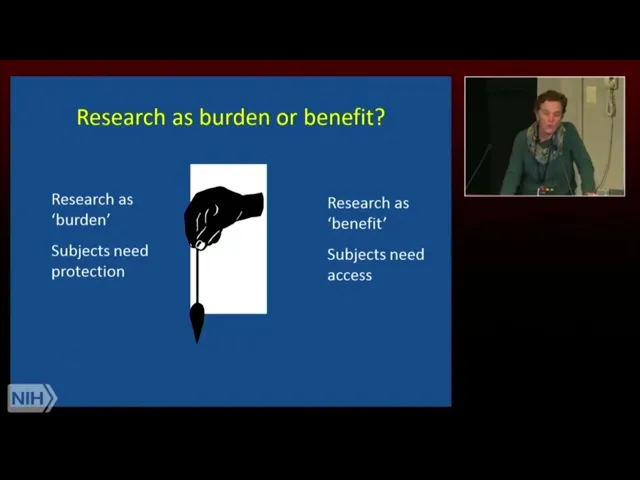
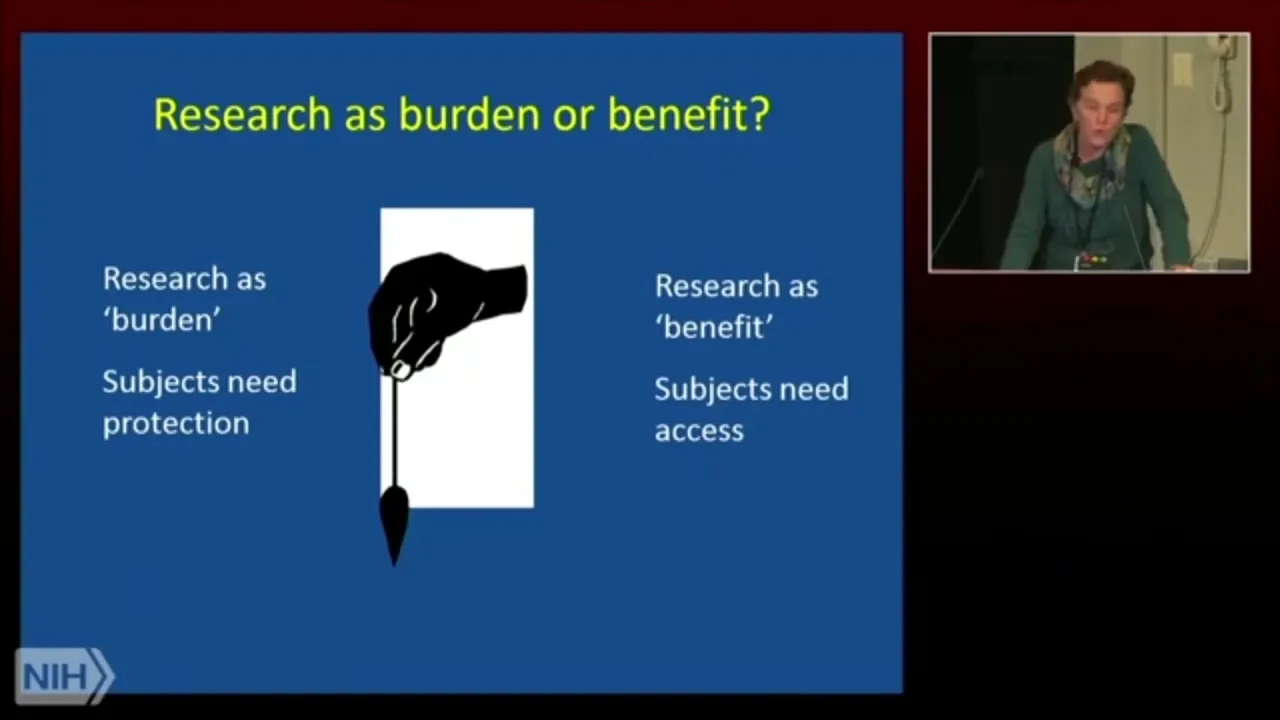
whether we need to include them at the front end um i understand there will be another lecture a whole lecture on vulnerability so i won't say more about that but if you have questions we can talk about that i think it's important to go back to something i've already alluded to and that is in thinking about distributing or fair distribution of the risks and benefits it's important to keep in mind this sort of uh pendulum swing that's been occurring between thinking of research as always a burden and always subjects excuse me as always in need
of protection and the sort of opposite swing of the pendulum where research can be or is in many cases a benefit and subjects need and want access to participation and so thinking about the risks and benefits you need to keep in mind those different polls and where any particular project might fall in that spectrum so you've got a question worth asking a design that's rigorous selected the appropriate population given scientific objectives and risk and benefit and vulnerability and now the question is what's the risk benefit look like for the participants in the study so this
is a sort of different kind of risk benefit analysis than the first one which is is a study worth doing in a study that's worth doing there are still ways that one can make sure that the risks to the individuals in the study are minimized and necessary so you may see a proposal for example that asks to do you know 10 mris over the course of six months and so an interesting question to ask is are 10 necessary or could the could the question be answered by doing six or five or you know spreading them
out over further amount of time are there other ways to minimize the burden of those procedures to the participants are the risks to the individuals in the study justified by either benefit to them or potential benefit to them or or and or the importance of the knowledge the social value and are benefits enhanced are there ways to enhance benefits in in the process of doing research and these are these are you might say well these are pretty normal understandable questions no big deal but the process of doing that is not is not so straightforward i
mean just thinking about risks for example there's a there's a very interesting challenge in terms of defining what is a risk in research what counts as a research risk um how do we know how how bad this risk is or how to think about this risk on some kind of a scale and there are certainly lots of uh reasons to think about both probability and magnitude of risk and different types of risk um so one of the things that the regulations talk about is physical psychological social financial risks it's interesting to think about how often
in research we consider financial risks as an example some people talk about or i've had questions raised that fall in the following sort of category if somebody has to travel through a very tough neighborhood or park really far away from the clinic and and walk to the clinic and there's some hazards in that walk are those risks of research or are those separate from the risks of research how do we take those things into account when we're making an assessment of what the risks are and i think importantly in all cases of research there is
some uncertainty about risks and if there wasn't some uncertainty about risk we probably wouldn't be doing the research because part of doing research is is helping to identify either what the risks are the magnitude of the risks the comparative risks or some other nuance about the risks so defining risks and measuring risks are is a very important part of figuring this out but is not easy in many cases minimizing risks is also something that we need to pay attention to and some things are very straightforward i mentioned already you know reducing the number of procedures
if you can and still get an answer other things that people talk about are you know doing procedures that are clinically required and in other words instead of asking for additional blood for research purposes uh have it drawn at the time when clinical drug bloods are being drawn um making sure that the people who are doing procedures have the right kind of training that's a way to minimize risk so there are lots of really important sometimes very obvious ways to minimize risk and limiting risk really gets down to how we protect certain groups of people
so one of the ways for example that the regulations regarding research with children work is that it limits the amount of risk that can that children can be exposed to in research minimal risk procedures and research for children is basically are generally fine more risk can be accepted when there's a prospect of benefit for the children in the study and then the rules for anything more than a minimal risk without a prospect of benefit in children are much more stringent and in some cases research cannot be done there's also similar challenges in terms of defining
benefits what is a prospect of benefit in research if you're if you have a certain kind of serious illness and there are few interventions available to treat that illness and you are entering a study in which there's an intervention being offered is that by definition a prospect of benefit is it only a prospect of benefit if we already know something about the drug if it's in phase three versus phase one for example how do we decide what's a prospective benefit in certain cases and and a lot of discussion about distinguishing what are called direct benefits
versus secondary or sometimes ancillary benefits so the direct benefits are you know maybe the therapeutic possible possible therapeutic benefit that one might derive from an intervention the secondary benefits might be other medical care that you might receive as part of the study payment that you might receive as part of a study feeling like you're contributing to society that might be psychologically beneficial as part of a study those are generally considered secondary benefits so importantly in going back to my original balancing scale the most guidance recognizes that interests other than the subject those of the subject
may on some occasions be sufficient by themselves to justify risks what this basically means is that research in which we know in advance the individuals who are participating will not benefit there's no prospect of benefit can sometimes be ethically acceptable as long as the rights of the individuals who are participants have been adequately protected so a question worth asking a design that's rigorous the right population chosen efforts made to minimize risks and enhance benefits um now the next thing on that list is independent review and so this is a process which allows an investigator or
research team who has investments in research to have somebody else say is this acceptable to ensure that the other work requirements have been filled check any biases that the investigator might bring and assure the public that research is not exploiting individuals or groups and so most research in the united states is independently reviewed by institutional review boards or irbs there is research that's exempt from irb review and expedited through irb review so there are other methods of reviewing most countries around the world have an equivalent kind of ethics research review committee that that does looks
at research before it starts research with humans and the criteria that are found in both the common rule and in the fda regulations that the irb is supposed to use in order to determine whether a sub whether a particular study is approvable include these and the and you'll see flavors of things that i've already talked about that risks are minimized there's more to that statement than i put on the slide that risks are justified by any anticipated benefits to the subjects or the importance of the knowledge that subjects will be selected and treated fairly and
that informed consent is adequate um there are lots of interesting and sort of in the news challenges right now with irb review one is lots of many irbs have huge volume of protocols to review so how many of you have ever been to an irb meeting anybody only one okay two okay so often times in irb meetings can last four hours but you have you know maybe ten protocols to review some of them protocols sometimes are you know 300 pages long and dense in terms of their scientific background etc so the the challenge is not
uh trivial in terms of understanding what it's about having a process of asking questions often of the investigator and then applying these uh principles and thinking about well is this something that's approvable in its current form or does it need to be changed consequently there's been data plenty of evidence to show that irbs are tend to be inconsistent in terms of how they make their judgments and this has created problems in particular for multi-center studies or multi-site studies so if you have a study that has 100 different sites oftentimes a hundred different irbs have to
review it and they may have either grossly different decisions or sometimes just mildly different decisions but that impact the entire spectrum of of sites that are conducting the study so this is a problem that a lot of people have talked about and lots of attention right now to using single irb review for multi-site studies this year in september of 2015 the department of health and human services published what's called the notice of proposed rulemaking that's what nprm stands for maybe some of you have heard from about it and basically it's a proposal for changing the
common rule and there's some very interesting some minor and some huge changes in terms of what they're proposing one of them is this that that for multi-center studies that are domestic non-international a single irb review will be required they won't be able to have different institutions doing irbs that i mean reviewing different institutions irbs reviewing the study but only one will be able to do it and there's a lot of consternation about how this is going to look and whether it will work and whether it will be adequately protective and how you'll make arrangements between
institutions and lots of details so the sixth of the seven on our list is informed consent and as someone in the audience said a lot of people when they think about you know sort of abstractly what is it that makes informed oh sorry research ethical clinical research ethical the answer often is informed consent and certainly in most cases informed consent is an important part of doing ethical research but what's interesting about it is if you think about it until you have a proposal that's worth doing and well designed and you've minimized risks and had somebody
else review it there is no reason to ask anybody for their informed consent you don't even get there until you've gone through those other steps but informed consent once you're there has a goal of making sure that the people that you're offering participation to have an opportunity to decide whether they want to participate or continue to participate and whether or not participating is compatible with their goals and their interests and their values so it's a really important concept most of the documents the codes guidelines regulations have something related to informed consent in them and some
of them are very strong so nuremberg code is famously quoted as saying the voluntary consent of human subjects is absolutely essential seoms says for all biomedical research involving human subjects the investigator must obtain the informed consent of the prospective subject or an authorized representative and the regulations have pretty much language is very similar to this as well there are some exceptions there are some ways to waive informed consent emergencies are one example so the study i showed you at the beginning where you're encountering and doing an intervention on people in the emergency room who have
traumatic brain injury um there's a process that's regulatory described that one needs to go through in order to do that but those kinds of research can sometimes be done without getting the consent of the individuals who are in a position for the most part to not be able to give informed consent um so i will skip that one so what does informed consent involve it involves a number of steps disclosure of information to people often usually written and oral some sense that they understand the information well enough to be able to make a decision a
choice that they can make which is hopefully voluntary in other words not coerced or unduly influenced by others or other factors and then they authorize it and i don't know if you can see my picture but it's a cartoon which is not really that funny um people standing around a table looking at a guy who's being asked to sign consent and you can see them with their trench coats and their hats and putting a lot of pressure on this poor guy who's sweating unfortunately sometimes informed consent and clinical research does look like that or feels
like that to people um in other times it's done you know in a very open and uh trans iterative way so that people really can engage with the information ask questions understand it and and make a decision um there are lots of challenges to this uh you can tell i spend a lot of time thinking about information i did some of my research is on informed consent but just for example think about how many of you have seen consent forms that are used in the intramural program have any of you have seen them okay and
so the oftentimes not always but oftentimes the consent form in the intramural program is you know 15 18 pages long those are long documents for people to read choices about what to put in those consent documents and how to say things are really very ethically important and very difficult i know to be able to give people the information they need without making it so long and so cumbersome that they they can't read it or they can't absorb it and then the irb has an important role in reviewing consent both the plan for informing participants about
the various uh aspects of the study how their how investigators or the research team is going to know whether or not somebody understands and whether their choice is voluntary so the seventh of our seven principle framework is what we called respect for enrolled subjects and this is a an element or a principle that i think really needs some more work and the reason i let me say where i where it came from first and then say why i think it needs more work so in reviewing the documents the codes of ethics the literature on research
ethics the regulations they all talk about what you do up front you know you get review you make sure the risks and benefits are justified and risks are minimized and get the person's informed consent and then the study begins and much of the guidance not all of it but much of the guidance doesn't say much else about what happens and that doesn't that doesn't make any sense right your ethical obligations to people that you're enrolling in research can't can't end the minute you get their informed consent right you still have obligations to people and so
these obligations include at least things like protecting their confidentiality monitoring their welfare recognizing that they have a right to withdraw providing them new information as it becomes available that might affect their decision to participate informing them of new findings planning for what happens at the end of the trial there are other things that are not on this list compensation for research related injury i mean there are a lot of things that people do talk about that are sort of in this under this rubric of what happens after the study begins and so i think both
hopefully you can see why this is an important element but also you can see why there needs to be more work on this because some of these things are sort of done without a lot of guidance there is some guidance so for example in the nuremberg code it says during the course of the experiment the subject should be at liberty to bring the experiment to an end so can withdraw at any time and helsinki talks about privacy and confidentiality and minimizing the impact of the study on a person's physical and mental integrity so those are
the seven hopefully they made some sense um i think importantly again i've said this but you know we think of them as systematic and sequential so you start at the top and work your way down and that they're necessary so that when you're thinking about a study whether you're writing it or reviewing it or thinking about entering it as a participant it's worth thinking them through one at a time and saying okay does this study have value is it well-designed are the right people being asked to participate are the inclusion criteria right are the risks
minimized has it been reviewed by an irb is there a good process in place for informed consent and are all the things that happen to people once the study starts the monitoring the confidentiality the plans for what happens at the end are those all adequate and you can ask those questions for every single study that you consider in any way it also seems important to recognize that these these can be universal in other words they apply to all studies everywhere across time what's important however is thinking about how they're actually manifested so risks for example
might vary from over time from one time point to another or from one geographic location to another the method by which you disclose information in the process of informed consent might vary by population appropriately so doesn't mean informed consent the principle of giving people information that they can use to make a decision changes it's how you implement it that changes from study to study and of course they're going to require some balancing and specifying so the idea of you know uh having an adequate justification for the risks requires a lot of specification in terms of
determining what are the risks what are the risks that count in this case how do we balance them with the benefits what are the benefits that that count in this case how do we weigh them how do we balance them against uh the rigor of the study and there are a lot of interesting examples of challenges uh for example in randomized controlled trials people worry about things like randomizing people especially if one of the arms to which people might be randomized is a placebo arm people worry about that from an ethical perspective and yet if
the if the question is worth asking and the design is rigorous it might be that placebo is the best way to answer the question and not only the best way to answer the question but the fairest thing for the individuals because if you know up front that the drug is much better than placebo then maybe you shouldn't be doing the study so it's that kind of balancing that needs to be done you