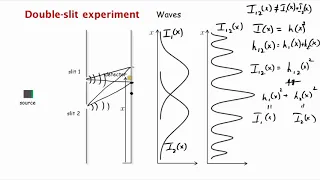
okay so in the last video we saw this very strange behavior of elementary particles in the double slit experiment where on the one hand they behave like particles they are discrete you always see some integer number of them a whole number zero one two on the other hand they demonstrate this interference pattern when we view them you know when when the two slits are open the mathematics of course is very simple it's very much like water waves except how do we make sense of this probability amplitude electron went through slit one and ended up at
the detector the fact that it's some complex number it can be positive negative it can be imaginary how do you make sense of this what does it all mean anyway so you know part of problem in quantum mechanics is coming to terms with this and accepting that this is our nature behaves also understanding how to develop a new intuition about how to deal with it ok so in this video we are going to understand this phenomenon a little more deeply to understand some consequences of it ok so first let's write down a simple proposition which
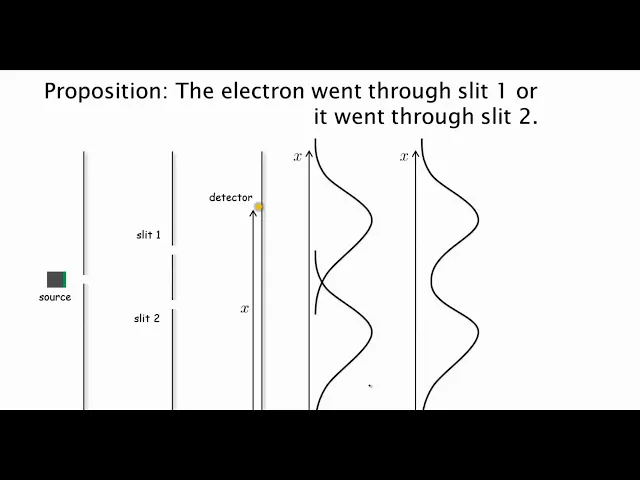
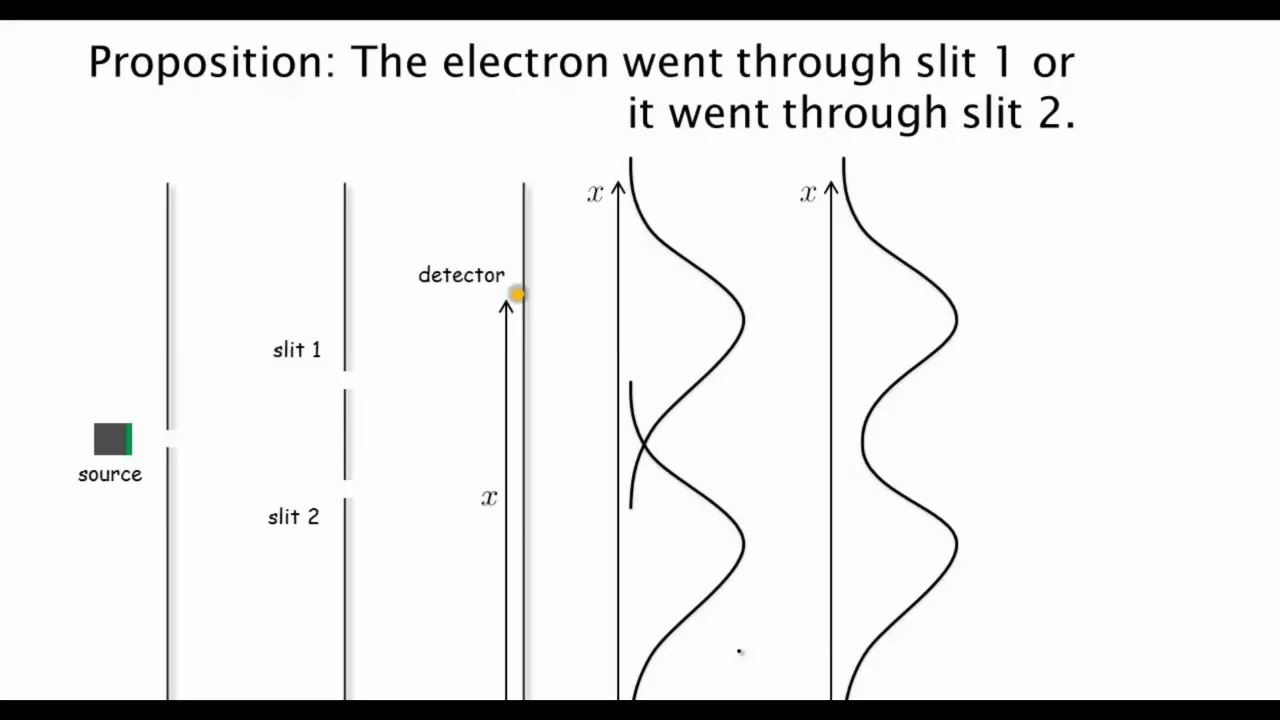
expresses our intuition about how a particle should behave so a particle is supposed to have a trajectory it's supposed to you know you should be able to track its path so this proposition says the electron either went through slit one oh it went through slit 2 so if it arrived at X it started from the source it must have either taken this path or that path obviously if that were the case then we should not have seen the interference pattern we should have seen this curve when both slits were open so this proposition is obviously
false but let's try to investigate it a little further by designing an experiment to see where it went wrong so we're going to test we're going to design an experiment that will test this this proposition so what we're going to do is we are going to place a source of light very close to the slit so to try to detect whether the electron went through slit 1 or through slit 2 now an electron will scatter light and so if the electron is going through slit one will detected there or similarly for slit two if we
place a source of light there we'd be able to detect whether the electron went through slit - okay so let's let's do this and see what happens so now let's close one of the slits and so sorry we leave both of the slits open except that now what we are doing is we count not just how many how many electrons arrived that is at a particular point X but also keep track of at the same time whether an electron went through slit one or it went through slit two or both whatever so now we can
you know it turns out that we can we can create a new new curve p1 prime of X which is how many times did we see an electron we detected that it it went through slit 1 and then we detected that it ended up at X about the same time soon thereafter and similarly we have a curve p2 prime of X which is when did we detect an electron going through slit 2 and ending up at X it turns out p1 prime looks very similar to p1 of x p2 prime looks very similar to p2
of X this was the curve that we got when is when we closed slit 2 this is the curve that we got when we closed slit 1 okay but now what happens but since both slits have been are open surely the probability of 1/4 of an electron ending up at X is really the sum of p1 Prime and p2 prime so how is nature going to escape this and and give us the interference pattern we can look at what we get in terms of p1 2 prime of X which is the total number of electrons
that end up at X and it's exactly p1 prime of X plus p2 prime of X and it's not equal to the interference pattern so neat you sort of manages to if you can tell which slit the electron goes through then the interference pattern disappears this is a very strange thing so now we could try to investigate it a little further and we could say okay what's really happening is that when we put the light here you know these electrons are very delicate and so what the light does is it knocks it you know it
changes its trajectory slightly and so it smoothes out this interference pattern you know in other words somehow we we get we get a smooth version of the interference pattern because the electrons are getting knocked about and we get this this curve so can't we turn down the intensity of the light source so that we barely disturb the electron at all and now we discover something very strange you see because light itself is quantized it comes as distinct photons and so as we start turning down the intensity of the light in fact when we turn it
down sufficiently we stop disturbing the electrons but also there are times when there's no photon being emitted when the electron is going past and so we miss some of the electrons and so what we get is some of the time we can detect the electrons going through a slit once sometimes through slit two and sometimes we don't detect them at all and what do we see as in terms of the probability with which the with which the electron is detected at X well we see exactly that same combination of this curve the interference curve and
this curve so in other words the electrons that we detect where if we detect which slit it went through then then those add up just like this if we do not detect which slit it went through then it creates an interference pattern and so we get some combination of these two in exactly the right proportion what this tells us is something very very important and fundamental about quantum systems quantum systems are very delicate an electron is very delicate if you measure it if you try to look at it it disturbs the system and now your
experiment is not the same as it used to be so you can make the light fainter and fainter to try to not disturb the system but the fainter you make the light the less you can you know the lesser chance of actually performing a measurement and so there is no free lunch you you you know if you're going to measure if you get an outcome then you have disturbed the system and this is something that's expressed in Heisenberg's uncertainty principle this principle says it's impossible in in their in their in the double slit experiment so
if you it's it's a more general principle but if you if you see what it says for the double slit experiment it basically says that it's impossible to design an apart Asst that detects which slit the electron went through without disturbing the interference pattern so the extent to which you can detect which slit it went through is the extent to which you disturb the electron and therefore disturb the interference pattern okay now let's look at let's turn to one more very fundamental thing we can learn about quantum mechanics by examining this this experiment a little
more closely so you might imagine well the you know this this electron when it was emitted from the source the particular part it would follow you know whether whether it got knocked out and it bent around in some some way and it went through slit one or it went through slit two as a diffracted passed this past this this first hole here well you might imagine that if we had much more information about the electron as it was starting out perhaps we could actually predict which slit it would go through you know maybe the fact
that we are saying well it went through either slit one or slit two it's just it's just a consequence of our lack of knowledge about the initial conditions and maybe if we knew enough about the initial conditions of the electron we could predict which slated went through well actually if he could then we could repeat what we were trying to do in the previous experiment with with the light to detect which which slit the electron went through except now we don't need the light at all because the initial conditions tell us which slated went through
and so if we could predict which slit the electron went through then again we wouldn't get an interference but so the fact that we do get an interference pattern tells us that in fact there is no way of predicting which slit takes the a photon the electron went through so somehow this probability is inherent in quantum mechanics you know this this fact that when you make a measurement you you get a random outcome this is completely inherent in quantum mechanics it's not a lack of knowledge its inherent okay so later in in a couple of
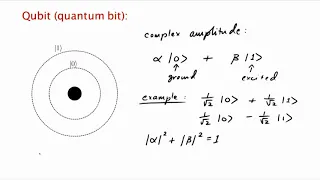
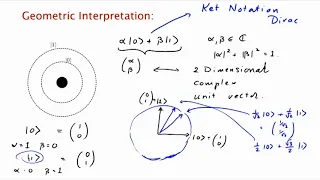
lectures we will see we will see these concepts in a much more emphatic way and also in in a more precise way in the in the language of qubits