in this lecture we'll talk about the basic unit of quantum information the qubit so let's start with the thought experiment let's suppose that we want to represent a bit using the state of an electron so how would we do this so so let's recall something the the energy of an electron in an atom is quantized well what does this mean what it means is that let's say our hydrogen atom then the electron in the hydrogen atom is not allowed to take on any old energy so it it it's in one of several discrete orbitals and
it has it has one of several discrete energy levels so for example it's allowed to be in the ground state or the first excited state or the second excited state and so on depending upon how high its energy is allowed to be so now if we wanted to represent a bit of information what we could do is we could make sure that the energy of this electron is allowed to be high enough so that it could be in the ground or the first excited state but it's not high enough to be any in any higher
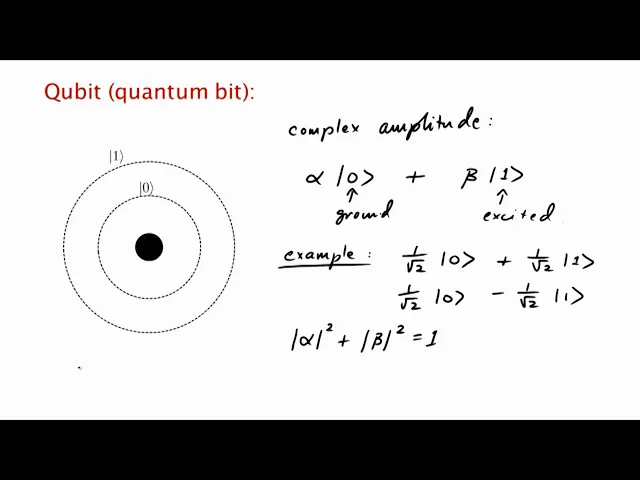
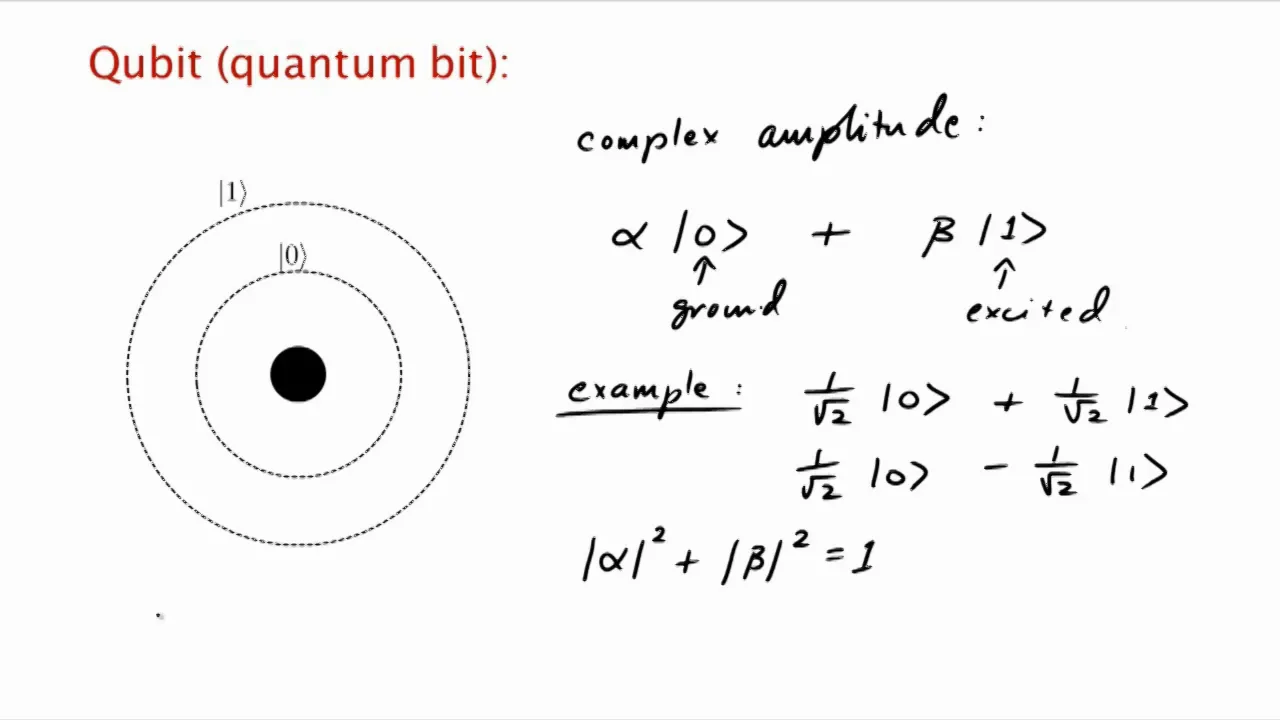
energy state ok so so here's our here's our situation so so we have a hydrogen atom the electron is allowed to either be in the ground state or in the in in the first excited state which will now call the excited state so we could have this you know we could encode the bit by saying that the ground state encodes for 0 and the excited state encodes for 1 ok so now is that the end of the story well no because you see the electron in a in in an atom is it doesn't quite make
up its mind which state it's in so it ends up being partly in the ground state and partly in the excited state now what what would we mean by saying that it doesn't make up its mind so one thing we could mean is that it's in the ground state we probability say one-third and it's in the excited state with probability 2/3 so you know that might be that might be the kind of thing that that might go on but in fact quantum mechanics tells us that something else happens and so what happens is that in
fact you know the the the the electron ends up not making up its mind whether it's in the ground or excited state but it ends up in a superposition of ground and excited state where it has some complex amplitude say an alpha of being in the ground state and some complex amplitude beta of being in the excited state so this is ground and this is excited okay now what do we mean by this what does it mean that there is a complex amplitude of being in the ground or excited state you know this is this
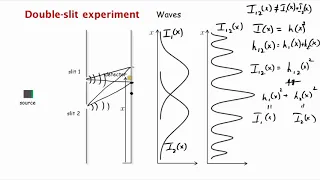
is exactly the problem that we encountered last time with the double slit experiment we can only describe this phenomenon be it's it's hard to picture what the electron could be doing but let me just see a few more constraints about what these complex numbers might look like so it could be for example that that you know so the way we will write the state of the electron is just by saying by writing it in this notation we'll say it's in the ground state with amplitude alpha excited state without it an amplitude beta 0 of 1
okay so for examples so it could be that you were in the ground state with amplitude 1 over square root 2 and in the excited state with amplitude 1 over square root 2 you could also be in the ground state with amplitude 1 over square root 2 and in the excited state with amplitude minus 1 over square root 2 now there's something going on here why did I choose 1 over square root 2 well there's a condition that must be satisfied which is that the state has to be normalized so the absolute the the square
of the magnitude of alpha plus the magnitude of beta must be 1 and so you can see that's that's the case here 1 over square root 2 squared is just a house at 1/2 plus 1/2 regardless of the of the sign but now as I said the amplitude is allowed to be complex so for example you might have the state 1 over 2 plus 1 over 2i 0 minus 1 over square root 2 so is this state normalized well what's the square of the magnitude if this is alpha what's the square of the magnitude of
alpha so so remember let me remind you about complex numbers if alpha equal to a plus B times I V and B are reals then the magnitude of alpha is just the square root of a squared plus B squared so in this case you know 4 squared would be 1 over 2 squared plus 1 over 2 squared which is 1/2 and of course magnitude of beta squared is also 1/2 so it's a normalized it okay so let's let's get back to what this is saying about the electron so you know here's what quantum mechanics us
about the state of the electron what it says is the electron doesn't make up its mind whether it's in the ground or excited state it's in some sort of a superposition of the two where it's in each with some complex amplitude the complex amplitudes are normalized however if you look at it okay so so if it's in this state alpha 0 plus beta 1 as soon as you look at it what's called a measurement then it quickly makes up its mind whether it's in ground or excited state so it it goes into the into the
ground state 0 with probability magnitude of alpha squared and into the state 1 with probability magnitude of beta squared and that's what the result of the measurement is so when you measure the system you disturb the state so when you're not looking the electron is in this superposition of ground and excited but as soon as you measure it it quickly makes up its mind and it goes into either ground or excited with with certain probabilities and as you can see this is this is the reason we why we wanted wanted the state to be normalized
because these probabilities must add up to 1 so so we we have the condition that now for magnitude squared plus beta magnitude squared equals 1 ok now there are a number of questions you could be asking at this point of course the the primary one is how could the electron possibly be doing this or what does it mean for it to be in a linear superposition you know you could say well I and I can imagine what it means for it to be to have certain probabilities of each outcome that's just a statement of uncertainty
you know the fact that we or lack of knowledge about the system you know what could it mean to say that it's in the ground state with amplitude half plus I over 2 or that it's in the excited state with amplitude minus 1 over square root 2 well you know there there's a lot of very smart people have tried for a very long time to interpret what this means and you know they have many ideas about the subject but but nothing that's that that I can say I found very convincing ok but on the other
hand what's you know what's very easy to say is here's the his mathematics of it and we'll start developing an intuition for this peculiar state of affairs the second thing that that's worth noting here is you know that the electron has a kind of complicated state the superpositions it only as long as you don't look at it as soon as you look at it it it's either in the ground state of the excited state so think about it the amount of information it required it takes to specify the state of the electron when you're not
looking you have to specify two complex numbers that's an infinite number of bits of information so it's a very complicated state that describes what the state of this electron is when you're not looking at it but then nature presents a very simple phase when you actually try to look at it when you look at it it just pretends to be this very simple system either ground or excited can be represented by a single bit