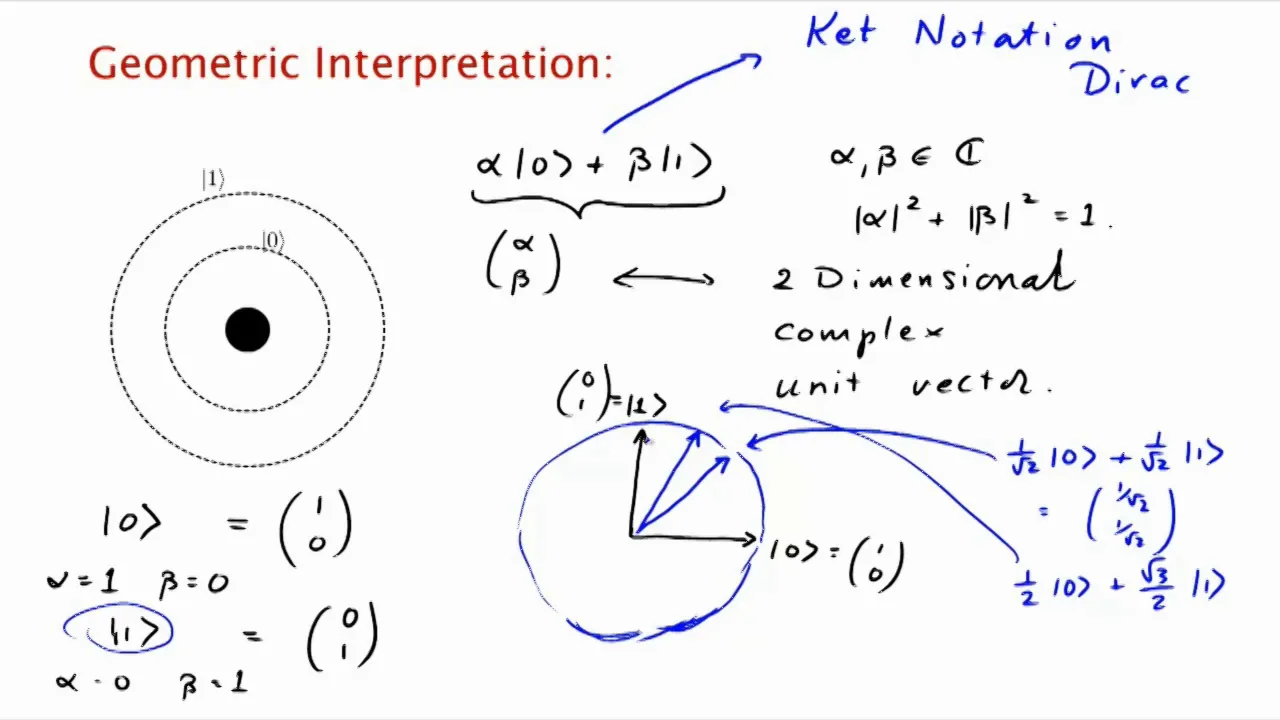
okay so in this video we'll talk about a geometric interpretation of quantum bits so let's remember what what a quantum bit is it's the state of you know something like an electron in a hydrogen atom if it's confined to be then it's ground or excited state which we think of as zero and month the general state of this electron is a superposition of the ground in excited state which we wrote as alpha 0 plus beta 1 where alpha and beta are complex numbers and they are normalized so we have the condition that alpha magnitude squared
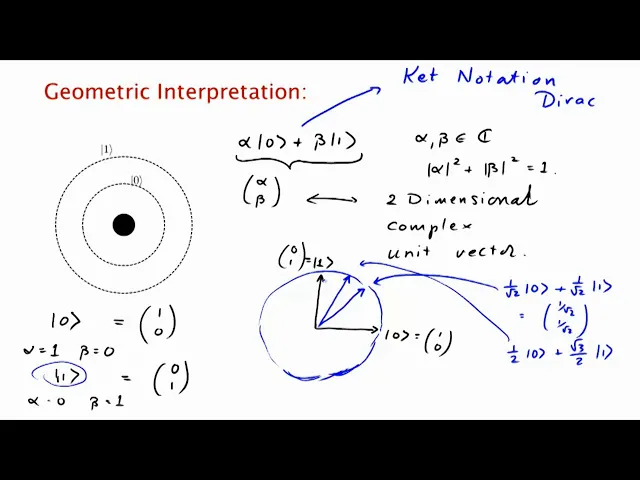
plus beta magnitude squared equal to 1 so now to specify the state we need two complex numbers this was just one way of writing down that state another way we could write an under state is by saying by stacking the two numbers one on top of the other like this alpha beta and now this is very suggestive because it says the state is a vector in a two dimensional vector space ok so what do we know about this vector space so it's two dimensional it's a complex vector space because the entries are allowed to be
complex and what do we know about the vector well we know that it's normalized and what's what's alpha magnitude squared plus beta magnitude squared this is just the length of the vector or the square of the length of the vector so it's a unit vector ok so now let's try to understand a little more about this this vector so let's figure out what about the vector what about the state zero what does it correspond to well in this case alpha equal to 1 and beta equal to zero so this is the same thing as the
vector 1 0 what about the state 1 the excited state well in this case alpha equal to 0 beta equal to one so this is the same thing as zero one so if you were to plot it out okay so let's let's just do this with real let's assume alpha and beta are real because you'll make it easier to draw so what we have here is a picture that's the vector zero the ground state because it corresponds to that basis vector that's the excited state because that corresponds to that basis vector and now let's just
draw a few other vectors in here so for example if you had the state 1 over square root 2 0 plus 1 over square root 2 1 where would this sit well okay so in in your usual vector notation you would you would write this as 1 over square root 2 1 over square root 2 okay and it sits like this that's this vector how about the vector 1 over 2 0 plus square root 3 over 2 1 okay so this makes a 60-degree angle so it's its but all of this sits all these vectors
are are required to sit on the unit circle ok so what have you learned we've learned that a cubit is a unit vector in a two dimensional complex vector space another thing we've learned is that this notation that we had been using before is really another way of writing vectors this is called ket notation and it was invented by the great theoretical physicist Dirac so it's also called de rocks get notation so again what's this get you know this this thing in putting the zero in these in these funny brackets makes it a vector so
this is uh not just another way of writing the unit vector in this basis Direction this get one is another way of writing the unit vector orthogonal to it now there's something very nice about the ket notation for vectors when when you are doing quantum computation quantum information because you see you want to acknowledge the fact that quantum bit is on the one hand it's a bit it's carrying information so you want to say that when it's a ground state it's encoding a zero and it's in the excited state its encoding a one and so
this gives you a way of naming these two these two states as being 0 and 1 but on the other hand it also acknowledges the fact that the qubit is a more complex object it's not as weak it's you know it's not just a bit 0 1 but it's a superposition of 0 and 1 and so it's really a vector it it's a unit vector in a two dimensional complex vector space and so this notation has the has the wonderful property of expressing both these these aspects simultaneously ok so so now let's let's now that
we have this geometric interpretation let's go back and try to understand what it means to measure this qubit ok so so here's our picture again that's the state 0 that's the state 1 ground excited here's the way to write it in in usual vector notation but this is you know this is kept notation that's the usual vector notation and now let's define a couple of other other states which we want to measure so or let's let's write out you know suppose we have we have a state like this and let's call this state sigh so
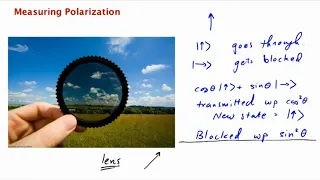
now suppose that this state makes an angle of theta with with the with with the with the zero state with the x axis okay so this angle is is Theta and all our amplitudes are real because I'm drawing everything in a two dimensional real space so it's not what's I well the intercept on the x axis is cosine theta so it's cosine theta zero plus sine theta one or if you were to write it in usual vector notation cosine theta sine theta okay I'll write you know I've I've been writing it in usual vector notation
now for a while but hopefully soon you'll make a transition where this notation the ket notation will seem perfectly natural to you okay so so now what happens when you when you perform a measurement well when you measure you see zero okay so the this the the qubit quickly makes up its mind whether it's on the ground or excited state it goes into the ground state with probability this is alpha so it's alpha magnitude squared so with probability cosine squared theta and it goes into the excited state with probability sine squared theta so your measurement
gives you as answer zero with probability cosine squared theta and one with probability sine square theta now remember that the measurement disturbs the system so you not only read off 0 and 1 but the state of the qubit actually becomes ground or excited at that moment ok so what's another way of of interpreting measurement so so now we have this geometric interpretation of measurements of what when you measure the state if it makes an angle of theta then okay so let's let's write let's write sine squared theta as cosine squared PI by 2 minus theta
so so now what is it saying well you see the state gets projected onto either the ground state or the excited state with what probability is going to is it going to be projected onto each one well it gets projected onto the ground state with probability cosine squared theta so with probability the square of the cosine of the angle it makes with the ground state what about the chance of getting to the excited state well this angle is PI by 2 minus theta ok so it gets projected to the excited state with probability cosine squared
PI by 2 minus theta ok so that's the rule of measurement so when you're measuring the state it gets projected onto one of these two states ground or excited with what probability with the probability cosine squared the angle it makes with each one so that's that's what a measurement is it's a projection onto this standard basis the basis consisting of the ground state and the excited state ok so now that we have this notion of measurement as a projection onto the ground or excited state we can also stop thinking about what it you know what
would happen but whether we can generalize this notion of measurement ok so so here's our picture again that's the state 0 that's the state 1 let's say this is our state sy this is the state of this of the actual qubit it's of 0 plus beta 1 and now what we are going to do is instead of measuring it in the in the 0-1 basis what we can do is we can measure it in any basis of our choice any other organelles basis of our choice so so instead let's pick a new basis which consists
of this vector you and the orthogonal vector you kept and we asked what happens if we were to measure the stateside in this Hubert basis and the answers exactly what we said before so if it makes an angle of theta here then so if we measure sy in the U u perp basis then you see the new state is U with probability cosine squared theta u perb with probability sine squared theta what does all this mean though what does it mean to measure this this state in the you you perp basis okay so what it
means is you're you're measuring to see whether the state is in this particular superposition of ground and excited or that superposition of ground and excited so for example you might be 1 over square root 2 0 plus 1 over square root 2 1 + u perp might be well now this is minus 1 over square root 2 0 plus 1 over square root of 1 and so what you're trying to tell here is you're measuring to see not whether the whether the qubit is in the ground or the excited state but to see whether it's
in this state or in that state and what quantum mechanics says is you are allowed to do this kind of measurement as well