so now let's see an example of this how would this actually happen in real life okay so to do this let's look at another example of a cubit so it turns out that photons have this property called polarization which carries a cubit of information okay so here's a here's a way to understand this it's it's sort of a semi-classical kind of interpretation so light is an electromagnetic radiation so you think of it as being carried by an electromagnetic wave so so let's say that the light is moving in this direction so it's it's going from
from here to here that's how it's moving and now the electrical field oscillates in the in the in the orthogonal direction but but now it can be oriented so so if it's if it's if it's going like this then in in this direction then the electrical field oscillations can be oriented let's say either horizontally or vertically or at some some diagonal angle the state of the polarization of this photon we will think of a horizontal orientation of the of this electrical field oscillations as as the polarization state of the electron where where where the the
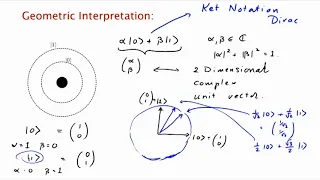
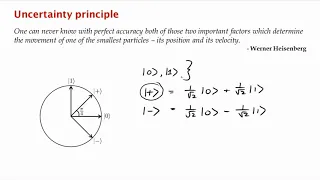
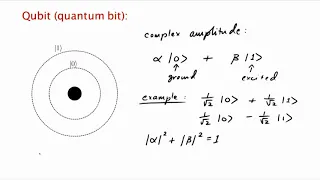
state is zero and if the oscillations are vertical then then the state is is one but now what happens if it's if it's diagonally if it's up to 45 degree angle well then the state of polarization the state of this qubit is one over square root 2 0 plus 1 over square root 2 1 ok so so basically what you get is a qubit where this is horizontal polarization or it's also it's also usually written like this this is vertical polarization which we call one or it might be written like that and then you could
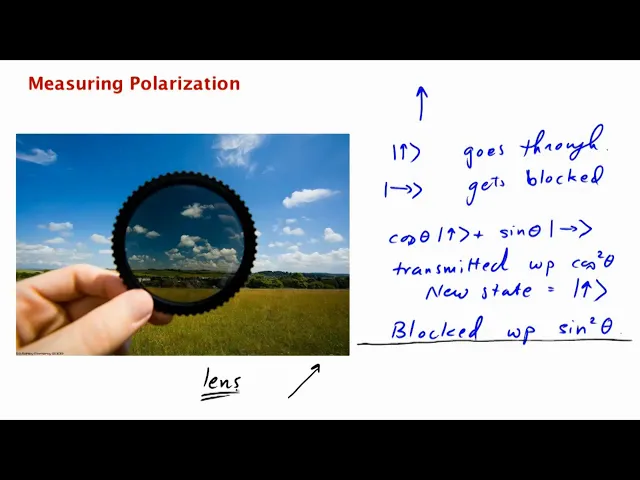
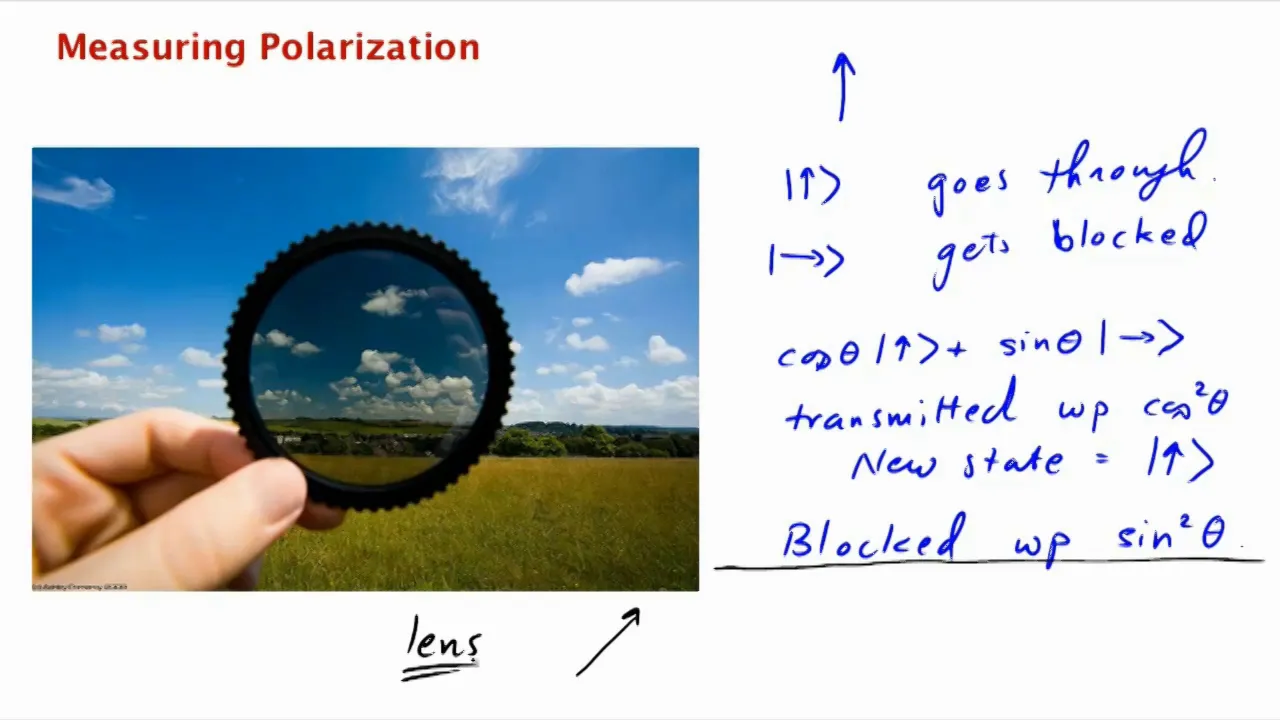
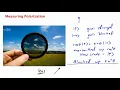
also have a polarization that makes any angle and that's you know that's that's the state of the qubit that you know this qubit the polarization qubit the single photon is carrying a row how do you measure this for the polarization of a cubit well you use a polarizing filter a polarizing lens now this is the same kind of polarizing lens you might have in your sunglasses what it does is so so the polarizer the lens has a certain orientation the filter has a no orientation so for example this filter might be vertically oriented which means
what it does is if there is a photon coming through and it's vertically polarized then it goes through but if it's hollow horizontally polarized then it gets blocked so it's performing a measurement it's it's letting the photon through if it's vertically polarized blocking it if it's horizontally polarized but what if it's a superposition of vertical and horizontal so let's say that it makes an angle of theta with with with vertical so it's in the state cosine theta vertical plus sine theta horizontal polarization so now what happens is exactly what you'd expect so it gets transmitted
with probability cosine squared theta by the way if it gets transmitted what's the new state of the of the photon well it doesn't matter that it was it was diagonally polarized when it came to the lens if it's if it's allowed through then the new state is exactly this vertical polarization and then it's blocked with probability sine squared theta now of course the other thing you can do is you can change the angle of this lens you can you can change the orientation of this length lens so you can you can change it so that
so that it's pointing at a diagonal angle and then what happens to the rules of transmission exactly what he said so so for example if you if you rotate this angle so that so that the lens is oriented at 45 degrees now suppose the lens was poori nted like this now that corresponds to a measurement in this basis so photons which are polarized diagonally like this are transmitted photons which are in this orientation get blocked okay so let's see an example of this so let's say that you take to such lenses one of which the
one in the back let's say is oriented vertically the one in front is oriented horizontally and so now what's going to happen to light well you know the light comes in so by the way I hope you understand that when you're looking through this lens you're looking at a very large number of photons and each one is transmitted or blocked depending upon its polarization but the net effect is you know you see the light being cut down by a certain amount but now for the quantum version of this experiment we are imagining that we only
had a single photon that was going through okay so what happens to that single photon so let's say that its original orientation was cosine theta plus sine theta horizontal vertical so now what happens to it with respect to the back lens well it's transmitted with probability cosine squared theta but now if it is transmitted the new state is definitely up now what happens when it encounters the front lens well that lens is horizontally oriented this photon is vertically oriented so it's blocked with probability one okay so no light gets through and that's why you get
this dark spot here where you have the two lenses just a post okay so now let's change the scenario slightly let's take a third lens and we interpose it between the between the back and the front lens so we put in a middle lens and this middle lens is oriented at 45 degrees so what happens now your first intuition would be well the light was blocked you're putting something more in the middle surely that makes it even harder for the light to get through and so if it was dark before it should be doubly dark
now well let's let lets go through the analysis the photon was was in this state it encounters the backlands what happens it's transmitted with with probability cosine squared theta it's new status vertical now at this point it encounters the middle lens okay so let's let's see now what happens after this so the photon is vertically polarized the middle lens is oriented at 45 degrees so it's transmitted with probability 1/2 and it's blocked with probability 1/2 but if it is transmitted what's the new polarization well the new polarization is 1 over square root 2 up plus
1 over square root 2 horizontal right it's a 45-degree orientation okay now it encounters the front lens but the front lens is horizontally oriented so now this photon which is which is polarized sort of diagonally at a 45 degree angle it gets transmitted with probability again the square of this which is 1/2 and the new polarization of the photon is horizontal so the net effect of all this is that it's interposing this lens in the middle what it does is it gives you a quarter chance of transmission after this you know after whatever whatever the
transmission chance was on the first lens and so you interpose the lens in the middle and suddenly what you get is is a faint amount of light coming through or some chance of transmission