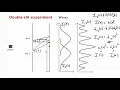
in the last video we saw the strange behavior of subatomic particles like electrons and photons in the context of the double slit experiment so in this video we are going to investigate this a little further and try to understand this behavior a little better so the way we will do this under try to understand this behavior better is by comparing and contrasting the behavior of electrons and photons to the behavior of classical particles which will model as bullets and waves which will model as water waves so what we are going to do is we are
going to study how the double slit experiment behaves what's what's the outcome when our source is a source of bullets when it's a source of water waves and then how does this contrast and compare to what happens as we already saw in the case of subatomic particles so let's perform the experiment with bullets so let's assume that our source now is a machine gun now we'll assume that this machine gun is somewhat unsteady so it fires these the bullets come out in some sort of an arc so they they randomly get fired in in these
directions okay what do we assume about bullets we we assume that they are indestructible so so they never break apart and so our detector which might be a box of sand always detects a whole number of bullets so you know at the end of our collection P you know of the period during which we are detecting we leader C 0 or 1 2 some whole number of bullets also if we put 2 different detectors at two different places we never see a bullet arriving simultaneously in both detectors and this is because of the firing rate
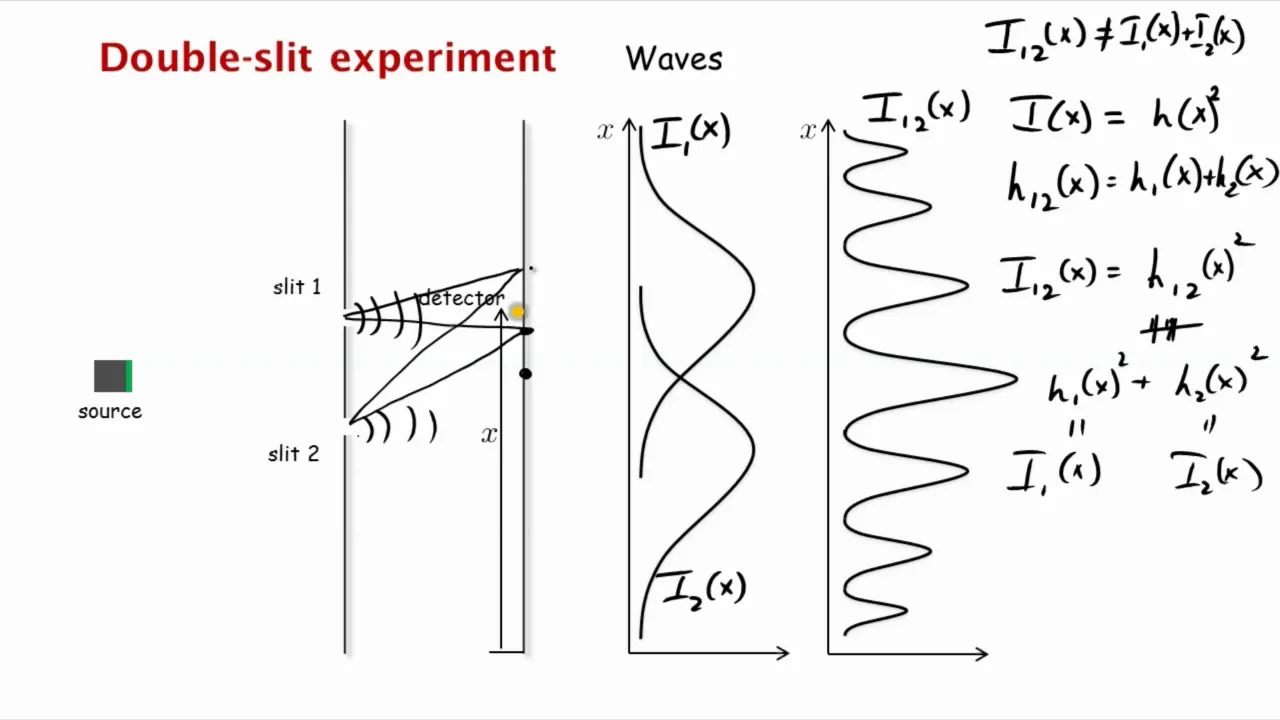
of this machine gun okay so now what do we expect to see well what we see is that if we are looking at the probability of arrival of the bullets as a function of X we see a curve P 1 of X when only the first hole is is open the probability of arrival P 2 of X when only the second hole is open in this let's let's think of this as an Armour plate with two holes and then a backstop some sort of armor plate maybe where the bullet comes to a to arrest and
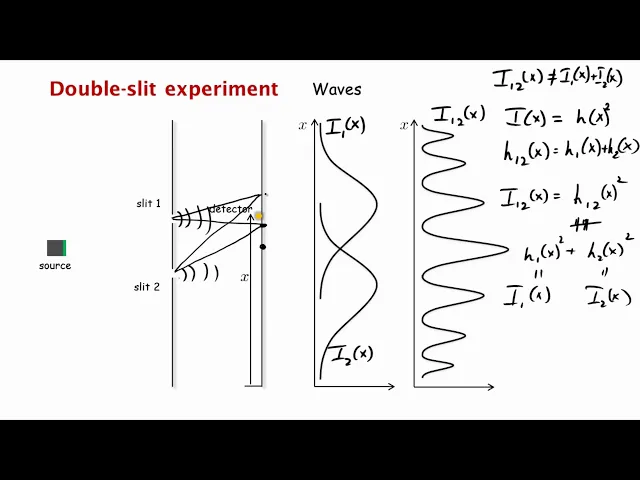
now when both slits are open both holes open the probability of arrival of the bullet at this detector at X is actually the sum of these two curves P 1 of X and P 2 of X just as we'd expect with with bullets okay now let's repeat this experiment with waves so let's assume that to be looking at water waves so this is a pond the sources is some object that vibrates at a at a constant rate maybe it's even your hand that's making waves as long as you make it very steady so the wave
sort of they they start spreading out their crests and troughs and then when they encounter this barrier with these two slits two holes in it and so the waves sort of start again from here but now because the source is equidistant from the from these two slits the waves are completely synchronized the crests and troughs completely match up and so what we are going to be detecting at this backstop is is the energy of the wave and the way we will detect it is by putting a cork in the water and seeing how it oscillate
up and down and calculate its its energy so let's call this I as a function of X the intensity or the energy and if we plot this out when only one of the slits is open we get this function I 1 of X for this energy if only slit one is open I 2 of X if only slit 2 is open but now if both slits are open we see this function I want two effects the interference pattern this was exactly the same interference pattern we caught in the case of electrons and photons but here
we have a very good explanation for why I 1/2 of X is not equal to I 1 of X plus I 2 of X so the reason is that the energy of the wave is really so I of X is proportional to the height of the wave at x squared the energy I of X is proportional to the square of the height of the wave at X and so what you have is that when both slits are open the height of the water at X is really the sum of the heights due to the way
from from the first slit and the height from the due to the way from the second slit so the heights add up but the energies do not so you have I want two of X when both slits are open the energy is H 1 2 of x squared but this is not equal to H 1 of x squared plus h 2 of x squared which was I 1 of X and I 2 of X so let's try to intuitively now understand this interference pattern so what happens to at this midpoint here so at this midpoint
since its equity equidistant from the two slits what happens is that the crests you know when when a crest of a wave arrives from slit 1 the corresponding crest of a wave arrives also from from slit 2 and so both these crests are trying to move the water up and the water moves up by the sum of these two two crests and so you get a particularly big wave and similarly when a trough arrives from the first slit the corresponding trough arrives from there from the second slit and so you get a particularly big trough
and so there the water oscillates particularly violently in in the in this in the middle this means that the that the wave at this point has a lot of energy by contrast if you move a little way from the center so that now the wave from slit to has a longer distance to travel then the way from slit one so if you move just the exact amount of distance where by the time let's say the fifth crest is arriving at at this point from slit to already the sixth trough arrives at this point from slit
1 and so the crest is trying to make the water move up the trough is trying to make it move down and as a result the water stays still and stays level and so you get destructive interference at this point and the water doesn't move at all or essentially not at all and so you get almost no energy in the wave so you get this you know these correspond and as you move away again to the point where you're exactly a wavelength apart you know this this the distance from slit 2 is exactly one wavelength
more than this distance from slit one then by the time let's say the fifth crest arrives from slit to the 6th press from slit one so already arrived and so you again get constructive interference so you get this kind of constructive destructive constructive interference and so on giving you this interference pattern so now let's go back to the experiment with electrons and photons what happens here well we have it's it looks a little bit like bullets because as we said electrons and photons they are they are transmitted in discrete packets of energy so the they
are transmitted more like bullets they arrive in all numbers at the detector and when we close one of the slits this is the probability of arrival this is p1 of X P 2 of X and then we have P 1/2 of X which is manifestly not equal to P 1 of X plus P 2 of X and of course our mystery is how could it be that this packet you know this this discrete packet went through either slit 1 or slit 2 and and the probabilities did not add up so the mathematics behind this is
very simple the mathematics is just like that for water waves so what we say is the probability of seeing the the electron let's say at X is the square of something we called a probability amplitude that it gets to X so what's this probability amplitude so what we're saying is well there's a certain probability amplitude that the photon goes through slit one and ends up at X so we'll call this a 1 of X now the thing about the probability amplitude is it's allowed to be positive and negative it's like the height of the water
it's positive or negative and similarly and there's a probability amplitude ay-two of X that the photon went through sorry that electron went through slit 2 and ended up at X again a 2 of X's either positive or negative when we try to detect the electron the probability that we detected there is the square of the total amplitude of the electron being at X where the total amplitude is a 1/2 of X which is day 1 of X plus a 2 of X and so once again we see what we saw in the case of water
waves where p 1/2 of x is a 1/2 of X whole squared it's the square of this probability amplitude which is not equal to a 1 of X squared plus a 2 of x squared which is of course P 1 of X and P 2 of X ok so mathematically this is just as simple as the case of water waves what's problematic about this scenario is what do we make of these probability amplitudes which are positive or negative what does it mean that the electron has minus point zero five amplitude of going through slit one
and end is ending about X how do we make sense of this and what what is nature doing behind the scenes to make this happen you can ask what's the underlying mechanism what is it that nature is doing behind the scenes well with quantum mechanics physicists have have had to accept that they cannot ask these questions about nature that this is not a question that we have a satisfactory answer to so here are a couple of quotes from two famous physicist Heisenberg who invented the Heisenberg uncertainty principle and Richard Fineman so Heisenberg said if we
want to describe what happens in an atomic event we have to realize that the word happens can only apply to the observation not to the state of affairs between two observations so we have to give up on understanding what's happening behind the scenes and Fineman says do not keep saying to yourself if you can possibly avoid it but how can it possibly be like that because you will go down the drain into a blind alley from which nobody has yet escaped nobody knows how it can be like that