Day 8 Remember when you were a kid and you built something cool but dangerous, like a pirate ship- using all the pillows you could find? And you’re in the Caribbean on a swashbuckling adventure with your little brother using broomsticks for swords? Then suddenly some grownup walks in yelling at you to to stop, ‘cause ‘it’s all fun and games until someone loses an eye’?
Followed by angry questions about what the hell are all the pillows are doing on the floor? Suddenly you’re at home again, the ship is gone, and you’re just standing in a mountain of old pillows, realizing that this maybe was, in fact, a bit dangerous and you could’ve maybe hurt your brother. That’s probably round about how the Soviet leadership felt on the eighth day of the Cuban Missile Crisis.
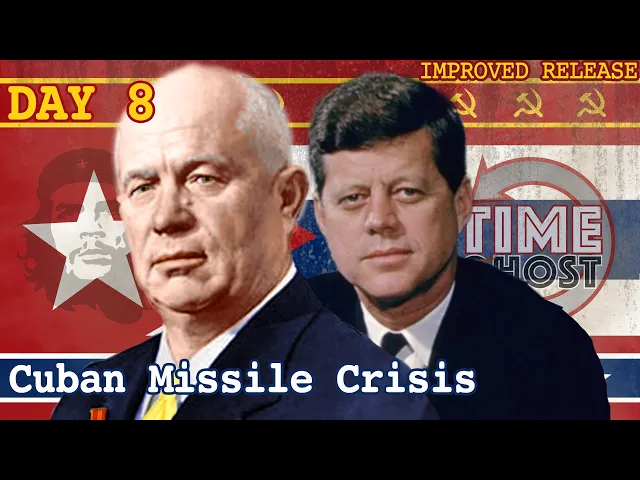
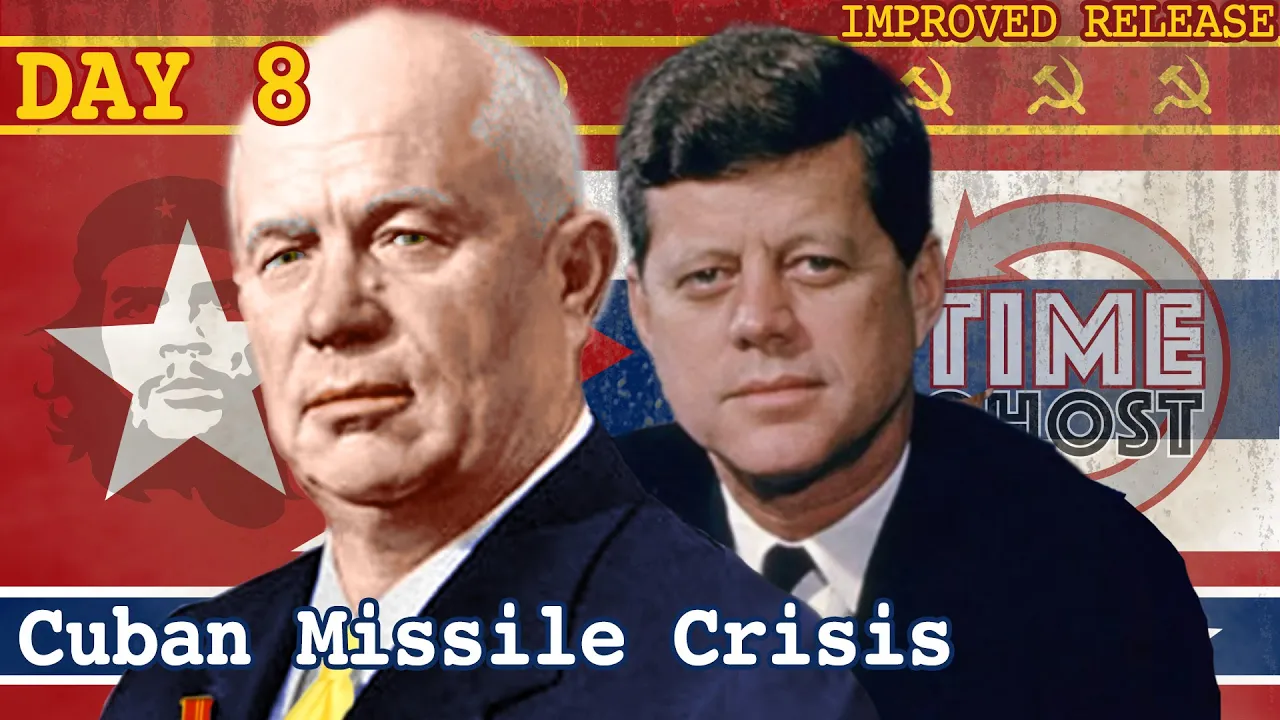
Except it really was the Caribbean and it was nuclear missiles and it was, in fact, extremely dangerous. This is TimeGhost, the Cuban Missile Crisis. I’m Indy Neidell Yesterday, President Kennedy announced to the world that there are Soviet Medium Range Ballistic Missiles on Cuba, and announced a blockade to stop any further weapons arriving on the island.
He claimed that there was no desire from the US to take unilateral action and start a war, but the actual plan that he has set in motion includes an invasion of Cuba and possibly even the total annihilation of Cuba- if the Soviets do not remove the missiles and warheads immediately. From a Soviet perspective, the Cuban Missile Crisis starts today, October 23rd, 1962, just after Kennedy’s announcement. Until now, it has been Operation Anadyr - a bold, secret adventure to even the odds a bit with the Americans in the nuclear arms race.
Or, as Nikita Khrushchev phrased it, "putting one of our hedgehogs down the Americans' trousers. ” When it became apparent that the American announcement was coming, they convened their version of EXCOMM, that’s American’s executive Committee of the National Security Council- who deal with the crisis from their end- with the crisis on the other end. Theirs is a subset of the Central Committee of the Communist Party with some military thrown in, and it will meet in several different constellations as the crisis proceeds.
In this first meeting the main participants are: Premier Nikita Khrushchev, who is under increasing political pressure as his economic reinvigoration plans are failing, his de-Stalinising reforms stalling, and now his grand foreign relations adventure is on the brink of failure. Chairman of the Supreme Soviet, Leonid Brezhnev - formally the head of state, but in practice the second most powerful Russian politician. Brezhnev is a longtime faithful Khrushchev friend and ally, but has secretly started moving away from his failing leader.
First Deputy Chairman Alexei Kosygin, another Khrushchev friend and ally. Kosygin favors soft power and a rapprochement with the US. He is also drifting away from his failing friend and will eventually lead the coup against him and become the next Premier in 1964.
Deputy Chairman Anastas Mikoyan. As we already know, he’s the only member of the Politburo that opposed Operation Anadyr. He was the first to visit Cuba after the revolution and knows the Cuban situation better than anyone else in the room.
Mikoyan also favors a rapprochement with the US and liberal reforms. On a side note, his brother Artem Mikoyan is the airplane designer that partnered with Mikhail Gurevich, to create the MiG aircraft designs. True story.
Second Sectary of the Communist Party, Mikhail Suslov, a staunch ideologue sometimes called ‘the pope of communism’. He is vehemently opposed to rapprochement with the US. He leads Khrushchev’s main opposition and favors a hard line against the West.
First Deputy Prime Minister and Chairman of the Committee of Party and State Control, Alexander Shelepin, the former head of the KGB and now political leader of the party branch that controls the KGB. Shelepin is a serious Communist hardliner and the architect of communist rebellions and revolutions in other parts of the world. As such, he was instrumental in helping Castro take control of Cuba and believes in an aggressive militarist foreign policy.
Defense Minister Marshal Rodion Malinovsky - as we know from the last few days, Malinowski is a traditional military man that opposes the use of nuclear arms in any conflict. Although he was a co-creator and early supporter of Operation Anadyr, he now questions the operation as having gotten out of hand. Deputy Army Chief of Staff General Semion Ivanov supports Khrushchev.
He’s a career military man and doesn’t get involved in the political side of things. The group meets the first time at 10PM Moscow time on October 22nd. With the time difference, this is two hours before Kennedy’s address, and they have received neither a letter from Kennedy, nor a transcript of his coming statement, but they have been informed that they are on their way.
General Ivanov gives an update on the deliveries of arms. Several new shipments have left port on their way to Cuba. Most ships are too far away from Cuba to make it across the blockade line before it takes effect, but one very important ship with a four-ship escort is close enough to maybe make it into port before the blockade takes effect.
It is the Aleksandrovsk, a large, Swedish-built cargo ship, carrying 24 1-megaton nuclear warheads and 44 14-kiloton warheads for tactical cruise missiles. Malinowski opines that the US will not go to war over the situation, if not further provoked. He believes that Kennedy’s statement is a stunt for the upcoming elections, but he also believes that further provocation could worsen the situation quickly.
Khrushchev sides with Malinowski, saying: “The point is that we do not want to unleash a war, we wanted to intimidate and restrain the USA vis-à-vis Cuba. The difficult thing is that we did not concentrate everything that we wanted and did not publish the treaty. ” See, just like the Americans were a few days ago, Khrushchev is concerned with the legality of their actions.
They do have a defense treaty with the Cubans, but it is secret, so this revelation makes them look bad and weakens its legality. They argue about announcing the treaty immediately via radio - but don’t do it since it’s unclear if this would help, or worsen the situation. Khrushchev concludes: “The tragic thing — they can attack, and we will respond.
This could escalate into a large-scale war. ” This leads to a discussion about the appropriate immediate response. The hardliners advocate allowing the forces on Cuba the discretion to use their tactical arms in case of US aggression.
Malinowski points out that if such an order became known it would give the US justification to strike back with atomic force. Especially if it came out that the order was given before Kennedy’s address- remember we’re still ahead of Kennedy’s TV speech. Obviously, there’s also a risk that actions resulting from the blockade could escalate into a nuclear exchange.
For now, they decide to order the Cuban forces not to use the nukes, and decide to revisit the subject in the morning, after they have read Kennedy’s note and transcript. They will, however, inform Agricultural Specialist Pavlov, aka General Pliev, on Cuba to make his troops combat ready. They order all ships still in the Mediterranean to turn back to Soviet ports.
The ships that are in the Atlantic, but have no chance of reaching Cuba before the blockade takes effect are ordered to hold for now. The Aleksandrovsk, with her deadly cargo of warheads totaling over 30 megatons of explosive power is to proceed to the closest Cuban port. They adjourn for the night and await Kennedy’s missives.
When they meet again they have regained some resolve. They create a laundry list of actions, including informing their allies and the public about the situation, they draft a resolution for the UN Security council, and they write a strongly worded protest note to President Kennedy. They also decide to send a telegram to Castro informing him that they will stand by Cuba, and ask him to come to the next session of the UN.
They will also immediately inform USSR Ambassador to the UN, Valerian Zorin, so that he can start preparing for a face off with his American counterpart, Adlai Stevenson. The most significant decisions they take, though, are military or about legality of action. Four nuclear-armed foxtrot class submarines are on their way to Cuba.
Their purpose is to take up permanent base in the port of Mariel. Codenamed Operation Kama, this is a response to the permanent placement of US subs armed with ballistic nukes in the port of Holy Loch, Scotland. Now, the four submarines are still far away from the blockade line, but are to proceed as ordered and try to run the line.
This decision will eventually prove central to the chaotic escalation of the crisis. Last, but not least they decide to not officially announce the defense treaty with Cuba; this too will prove central to the outcome of the crisis. So.
. . the Soviets have decided to stay their course, but will try to avoid a direct confrontation on the blockade line.
They’re playing for time. In the communication to Castro they explain about the whole missile plan: “It was halfway successful, and half not. It is positive that the whole world is focused on Cuba now.
Time will pass, and if needed, weaponry will again be sent”. Meanwhile in the US, President Kennedy is turning words into actions. He meets with all of the members of the OAS, the Organization of American States - the continental organization of cooperation between the countries in South and North America.
Cuba was excluded on January of 1961, on grounds that Marxism-Leninism “is incompatible with the inter-American system. ” Kennedy manages to get a unanimous vote ratifying his blockade. Moreover, under the Rio Treaty on mutual assistance between the OAS states in case of aggression, several other nations will participate actively in the blockade.
Argentina, Colombia, the Dominican Republic, and Venezuela will provide ships, air support, or even ground forces. Trinidad and Tobago offers the use of Chaguaramas Naval Base to warships of any OAS nation for the duration of the blockade. Kennedy then spend the rest of the day in a series of meetings dealing with the details and minutiae of how to enforce the blockade and still minimize the risk for outbreak of general war.
We’ll get back to that in a few days. At 6 PM, he signs the Proclamation for Interdiction of the Delivery of Offensive Weapons to Cuba at the Oval Office. The blockade will go into effect at 1400 hours Greenwich time tomorrow, October 24, 1962.
That line is set at 800 nautical miles from Cuba. When the last meeting with EXCOMM ends, The Kennedy brothers are alone in the room with the recorder still on. The President is on the Phone with the First Lady and then returns to his brother.
What was that? [annoyed] Oh Christ, about the dinner tonight. What?
About a dinner tonight. She’s invited somebody and I invited somebody. They return to the crisis.
How does it look? Ah, looks like hell—looks real mean, doesn’t it? But, on the other hand, there is no other choice.
If they get this mean on this one, it’s just a question of where they go about it next. No choice. I don’t think there was a choice.
Well, there isn’t any choice. I mean, you would have been, you would have been impeached. That’s what I think.
I would have been impeached. I think they would have moved to impeach. Bobby Kennedy expresses frustration about not having direct communication with the Soviets, and the President asks about the spy Georgi Bolshakov, who has been Robert’s liaison with them.
Take Georgi? No, he had lunch today with— What’s he saying? He said they are going to go through.
The ships are going through? He says this is, this is a defensive base for the Russians. It’s got nothing to do with Cuba.
Why are they lying about that? Khrushchev’s horse shit about the election. In any event, it’s the sickening thing that [unclear] to be getting very mad about .
. . they revealed about this horror that would embarrass me in the election.
Bobby Kennedy now goes to an off the record meeting with the USSR’s Ambassador to the US, Anatoly Dobrynin. Kennedy’s message is simple: tell Khrushchev to start communicating openly with President Kennedy. Dobrynin repeats his statement from previous meetings that there are no missiles on Cuba.
In fact, he’s not aware that he’s lying. Nobody has told him about the missiles. Kennedy advises him to check his facts with his government and returns to the White House.
There he joins the President, who has split from his dinner party, and is now taking drinks with British ambassador David Ormsby-Gore. The Ambassador gives the president some advice - move the blockade line from 800 to 500 nautical miles so that the Soviets have more time to consider their options. Kennedy immediately calls Defense Secretary McNamara and has the line moved.
So, on opposite sides of the iron curtain that night, the two most powerful men in the world go to bed fretting and worrying about their political future, while the rest of the world sleeps restlessly in fear of the nuclear world war that those two leaders may have just launched. Join us tomorrow on Day 9 when the blockade goes into effect, and it looks like Soviet ships might try to pass after all. We are planning to do an even more ambitious project than this one, covering Pearl Harbor minute by minute in real time on December 7th.
If you’d like to see that the please support os on patreon at patreon. co or tg. tv, we are nowhere near close to having the funding for that, and it is your support on patreon that will make it happen.
Don’t forget to subscribe, and ring that bell to never miss the TG action. Good night and good luck.