Day 2 War and conflict have their own dynamics, and once you let out some slack on the leash of the dogs of war, there’s a great risk that they might just slip out of your hands. On October 17th, 1962, American President John F. Kennedy loosens the slack on his dogs of war, just like Soviet leader Nikita Khrushchev had already done five months ago.
I’m Indy Neidell; this is TimeGhost with the Cuban Missile Crisis. When the US administration found out that the USSR had placed nuclear missiles on Cuba, they struggled to come up with an immediate response. EXCOMM, the group dealing with the crisis, wavered between a stern warning to the Soviets and the complete destruction of Cuba.
President Kennedy is undecided and still wants all options to be left on the table. On the morning of the 17th, he receives a briefing outlining the possible courses of action. His close advisor and speechwriter Ted Sorensen has compiled the views from the day before.
He outlines four options: Track A- Political warning, and if the missiles are not then removed; limited air strikes Track B- Limited air strike and then a demand to remove the missiles. Track C- Political actions followed by total naval blockade and a declaration of war on Cuba. Track D- Full scale invasion to ‘take Cuba away from Castro’ with no warning whatsoever.
Sorensen points out: “It is generally agreed that these missiles, even when fully operational, do not significantly alter the balance of power—i. e. , they do not significantly increase the potential mega tonnage capable of being unleashed on American soil, even after a surprise American nuclear strike.
” So, they all agree that the missiles are not a real problem and yet the preparations for war go ahead. In fact, a possible invasion of Cuba has long been in the planning stages. A couple days ago, the day before the crisis began, an exercise was begin to land on the Puerto Rican island of Vieques- which represented a fantasy island nation ruled by the dictator Ortsac, take out Ortsac, and occupy the island.
Now, Ortsac is Castro spelled backwards - so there was little doubt even to the slowest minds involved what the real objective was. The exercise involved 40 ships, 20. 000 marines, massive air support, and Puerto Rico.
Diverting them to actually invade Cuba would be easily possible. With additional preparations and forces, an invasion can be under way in as little as 10 days from today. Those additional preparations begin.
Along the Eastern seaboard, troops at all bases are discretely increased and made combat ready. Spy plane activities are also increased and the plans for the Ortsac exercise revised to fit the new situation. At 8:30 AM, the Joint Chiefs of Staff and the members of EXCOMM meet at the Pentagon to continue the decision regarding a definite plan.
Defense Secretary McNamara has even spent the night at the Pentagon to supervise planning. From the record, it’s obvious that it’s not a response to the possible objectives of the Soviets that’s driving their decisions, but what the different factions already believed before the crisis. Those that believed in thawing relations with the Soviets are advocating diplomacy.
Those who believed that Cuba must be neutralized, tend towards invasion. The idea of a naval blockade - for which there is neither a plan, nor a risk assessment - starts gaining some traction, though, with, among others, General Taylor, the Chairman of the Joint Chiefs of Staff. After the meeting, one of the strongest proponents of an invasion, CIA director McCone, goes to brief President Kennedy at the White House.
His notes show that he walks away from that meeting with the impression that Kennedy too wants to invade, but Kennedy’s notes contradict this; he’s still very much undecided. McCone then takes a car to Pennsylvania to meet with former President General Dwight Eisenhower at JFK’s request, to get his joint presidential and military advice. McCone comes away with the opinion that Eisenhower too supports decisive military action.
And yet, no one knows what the Soviets are really after, which Sorensen points out: “The soviet purpose in making this move is not understood - whether it is for purposes of diversion, harassment, provocation, or bargaining. ” One of the assumptions is that their true objective might be Berlin. The situation in that divided city is the first topic on the President’s regular agenda when he receives the German foreign minister, Dr Gerhard Schroeder, at 11 AM in the White House.
Kennedy asks if the Germans have any reason to believe the Soviets will make another move for Berlin. Schroeder says that they don’t have any indication of an escalation there, nor does their analysis of the situation show that it would make sense for the Soviets to do so at this point. One thing Schroder says in passing though is remarkably important to the situation.
Sie glauben sogar, das man ein Nuklearkrieg wegen Berlin riskieren wird, obwohl ihnen—den Sowjets—das ziemlich verrückt erscheint. Aber sie glauben das. [They even believe that we’re going to wage a nuclear war over Berlin, although from their point of view this looks a rather crazy decision to take.
But they still believe that we will wage a nuclear war over Berlin if necessary. ] Of course, Schroeder doesn’t know the significance of his words at this point, as he does not know about the growing crisis over Cuba. As the day proceeds, this crisis deepens as more intelligence on the missile build-up comes to light.
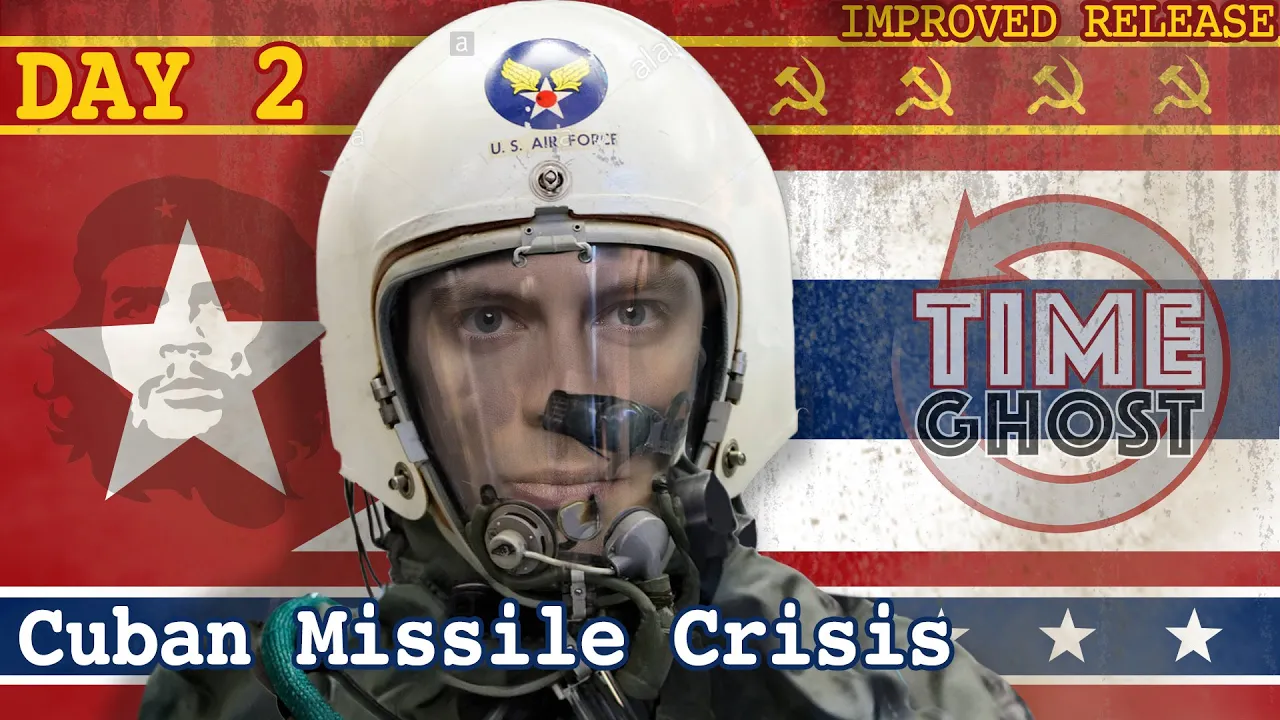
The ultra-high altitude flights over Cuba continue. The Lockheed U-2, known as the “Drgon Lady”, has already played a central part in the crisis and will continue to do so for the duration. This aircraft is a remarkable feet of engineering, but also a little bit crazy.
In 1962, it has been in operation for just over seven years. Improved versions are still in use by the US Air Force in 2020, as it’s the fastest way to get aerial reconnaissance other than satellites. In 1962, there are very few satellites anyhow, and it’s the ONLY way to gather photographic intelligence over enemy territory at a reasonably safe distance from anti-aircraft measures.
Now, “reasonably safe” is not the same thing as safe. See, it had been assumed by the US and Great Britain that Russian radar could only pick up signals up to 19,800 meters (65,000 feet) because that was as high as British and American radar worked. It was also assumed that Soviet surface to air missiles- SAMs- could not reach any higher.
Both assumptions were wrong, and back on May 1st, 1960 the Soviets used SAMs to shoot down a U-2 over Russia. The pilot, Captain Francis Gary Powers, parachutes out and survives the crash, while the pilot of a pursuing Soviet MiG 19 isn’t as lucky when he is hit and killed by friendly fire. Powers is then captured by the Russians and the whole thing becomes a complicated diplomatic incident, which only ends this year in February 1962 when Powers and another American spy are exchanged for two Russian operatives held by the US.
But the U-2 isn’t only dangerous to fly because it can be shot down, in essence the plane is a combination of a subsonic jet and a glider. At ultra-high altitude it has to be flown within a narrow speed corridor to avoid stalling - the pilot can only vary speed by 5 miles per hour upwards or downwards to keep the plane flying, and not have it fall apart around him. At normal altitudes, the controls are extremely resistant, requiring the pilot to use muscle strength to maneuver.
With its short fuselage and enormously long wings, it has an operating altitude of 70,000 feet (21,336 meters), but to be light enough to reach that altitude many compromises in safety design had to be made. The cabin is only partially pressurized, and the pilots have to wear space suits and breath oxygen. There have been several incidents of decompression sickness and at least nine cases of pilots suffering permanent brain damage from flying a U-2, and at least one Pilot has passed out, crashed, and died because of a malfunction in his oxygen supply.
Landing the plane is extremely tricky, as the long wing to fuselage ratio creates ground effects that can cause sudden up-surges and a crash. When you put the plane down, the wing tips are actually pulled against the ground, which is why they’re coated with titanium to withstand the friction. Landing is so complicated that it requires a chase car to guide the pilot and a second pilot on the ground assisting the flying pilot by relaying how the plane is behaving from an outside view.
Because of incidents and acciedents- and the obvious fact that it’s illegal to fly planes into other countries’ air space without permission - the U-2 program is highly controversial. In 1962, it isn’t even operated by the military. The U-2s belong to the CIA and have been financed without congressional budget approval through secret slush funds, which the CIA is the only federal agency that is allowed to have.
At this point, though, they prove invaluable in assessing the situation on Cuba. October 16th and 17th are both clear days over the island. The U-2 flights come back with a load of new images.
The analysts discover a range of Surface to Air Missile batteries that could threaten the U-2s, and which definitely lower the probability of successful air strikes. They discover more mid range missile sites, but the pictures are not high resolution enough to see if the SS4 missiles are launch ready, nor where their warheads might be stored. Most alarming is the discovery of intermediate range missile launch ramps.
Although they don’t find any missiles for these, this now extends the threat beyond the East Coast and Mid-West - these missiles can reach any major city in the continental US, except Seattle in the distant Pacific North-West. While Kennedy flies out to do political rallies in Connecticut, members of EXCOMM meet again. The new information doesn’t help the decision-making, but it does harden the drive for a decisive military response.
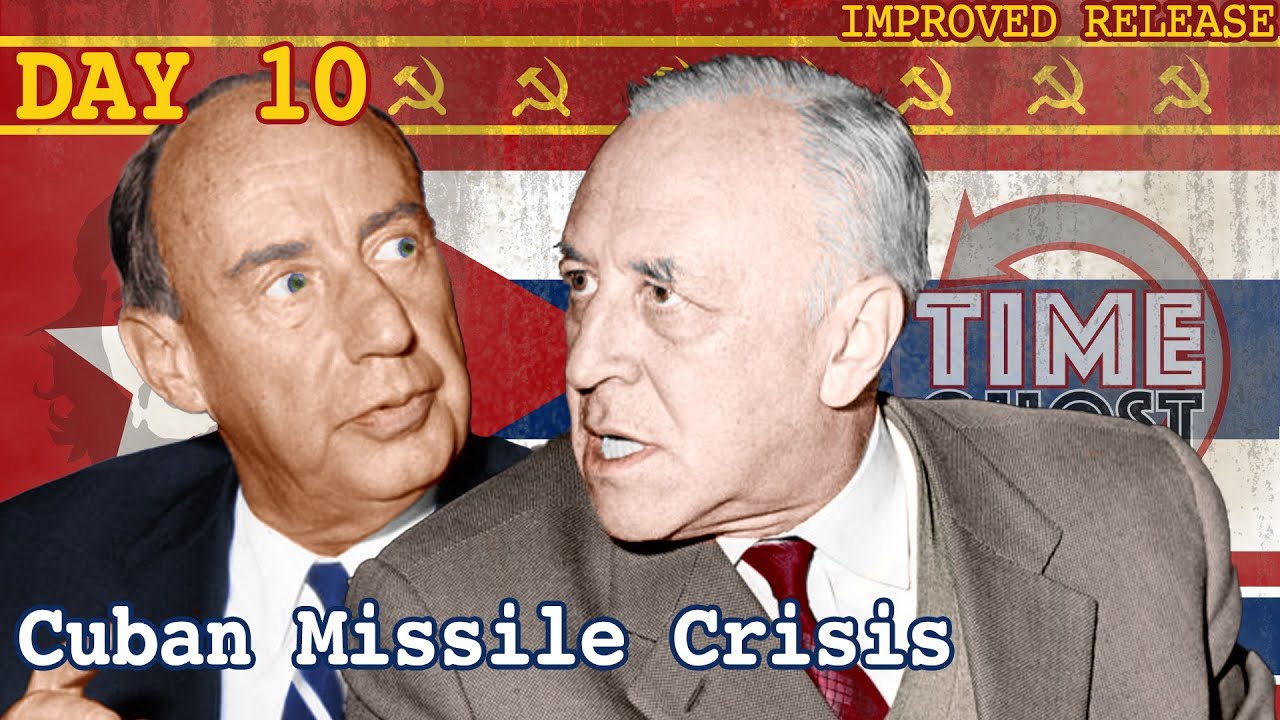
Among all this saber rattling, one voice reaches Kennedy urging restraint — it’s Adlai Stevenson, the US ambassador to the United Nations. The former Democratic Presidential candidate is famous for his intellect, reason, eloquence, and diplomacy. Hardliners consider him ’too soft’ and ‘indecisive’.
During the Bay of Pigs invasion, he had largely been kept out of loop to avoid his uncomfortable advice, and with incomplete information he then suffered public humiliation when he firmly denied any operative involvement by the US in an open session at the UN, only to be refuted by his own administration. This time around he’s in the loop and receives the EXCOMM briefings. He now urges the President to talk to Khrushchev and Castro to avoid a conflict that will inevitably lead to retaliation in other regions.
He writes: “To start, or risk starting a nuclear war is bound to be divisive at best, and the judgments of history seldom coincide with the tempers of the moment. ” He ends his letter with: “I confess I have many misgivings about the proposed course of action, but to discuss them further would add little to what you already have in mind. So I will only repeat that it should be clear as a pikestaff that the U.
S. was, is, and will be ready to negotiate the elimination of bases and anything else; […] blackmail and intimidation never, negotiation and sanity always. ” These wise words will not be heeded for many days to come and on October 17th as night settles over America and a new day dawns in the Soviet Union, the preparations for war on both sides continue and begin taking on a life of their own.
See you tomorrow on day three, when President Kennedy confronts the Soviets for the first time and gets the response he fears the most. And even as you watch this we are making plans for our next big project, which will cover Pearl Harbor minute by minute this December on our World War 2 in real time channel. You can see the teaser for that right here.
We are along way from being able to finance that project, so please support us at TG. tv or Patreon. com Good night and good luck.