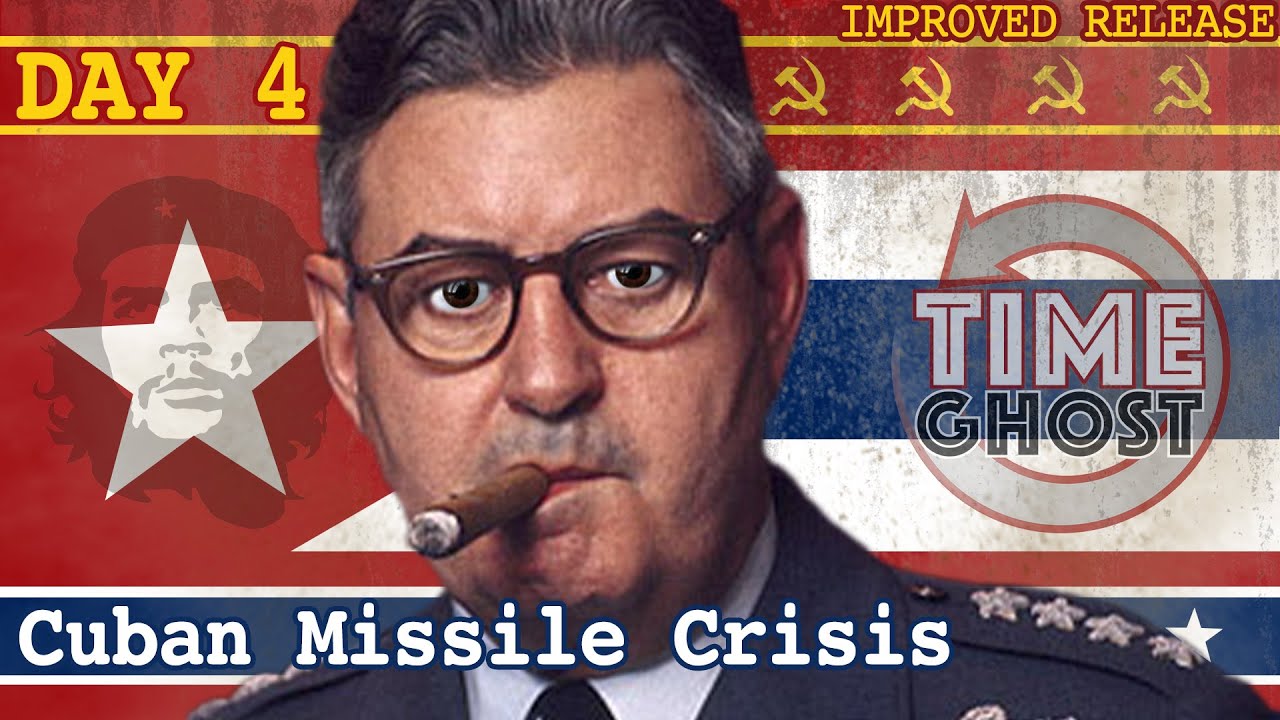
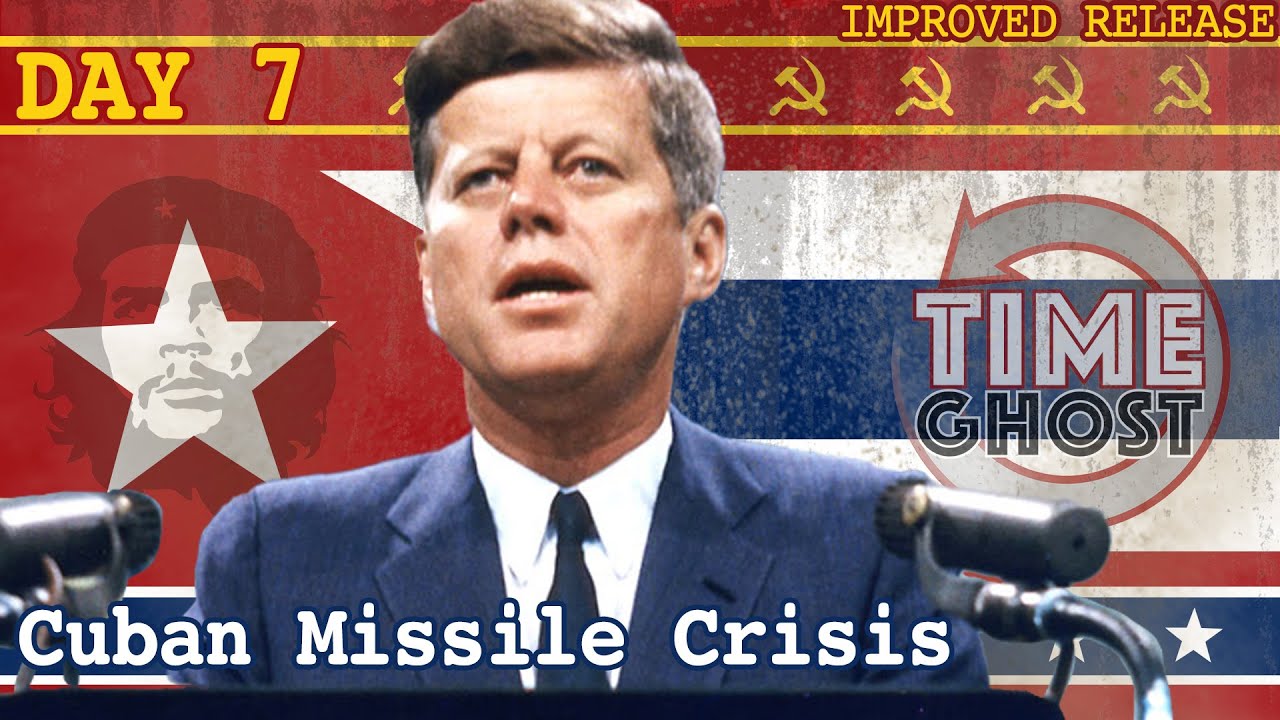
“The prospect of nuclear holocaust can ruin the best of days”. That might be how many people in the White House feel on the first day of the Cuban Missile Crisis. I’m Indy Neidell; this is Time Ghost and the Cuban Missile Crisis.
The weather is foggy in Washington D. C. on the morning of Tuesday, October 16th, 1962.
As the morning progresses, there is a drizzle of rain, but in the afternoon and evening it becomes a warm sunny autumn day. The President of the United States of America, John Fitzgerald Kennedy, begins his day with a meeting with one of the original Mercury astronauts, Wally Schirra, to congratulate him on his nine-orbit space flight two weeks earlier. Mostly, though, the day is spent in the fog of potential war with the Cuba or even the Soviet Union.
Two days ago, Air Force pilot Richard Heyer flew over the island of Cuba in a spy plane equipped with high resolution cameras. The photos he brought back showed three installations of Soviet nuclear Medium Range Ballistic Missile launch sites, with SS-4 and SS-5 missiles waiting to be made deployable. The Soviets now have nuclear first strike capacity and can launch an attack on the US mainland just as quickly as the Americans can on the USSR from Turkey.
The CIA reported this to McGeorge Bundy, the President’s National Security Advisor, last night. Bundy tells Kennedy the news this morning at 8:45 and is now assembling the committee that will deal with the impending crisis. This group is the Executive Committee of the National Security Council, EXCOMM for short.
Over the coming thirteen days, their deliberations and actions will hold the fate of humanity in their hands. Unknown to the members of EXCOMM, though, the President records their conversations. Now in 2020, when the content of their meetings has been declassified, it gives us unprecedented documentation as to how this crisis was handled on the American side.
EXCOMM was created during the Berlin Crisis in 1961 specifically to avoid the mistakes that had been made during the disastrous Bay of Pigs invasion earlier that same year. The decisions during that crisis had turned out, though, to be a textbook example of ‘group think’ - the practice of thinking or making decisions as a group in a way that discourages creativity or individual responsibility. Let’s have a look at the main members of EXCOMM and see where they stand before that first meeting.
John F. Kennedy won the presidency after a campaigning on making America stronger than the Soviet Union in nuclear weapons. Closing the ‘Missile Gap’ that assumed that the Soviets were ahead, although JFK was well aware that the Missile Gap was a myth, and that America was actually already much stronger then Russia in terms of missiles.
Vice President Lyndon B. Johnson supported the Kennedy’s bluff in order to make the ticket look hard on the communism - something their Republican opponent Richard Nixon had accused them of not being capable of. Secretary of State Dean Rusk is in favor of diplomatic solutions and a limited rapprochement with the Soviets.
Secretary of the Treasury C. Douglas Dillon is a deeply anti-communist Republican businessman and long time supporter of a hard line against the Soviets. Secretary of Defense Robert McNamara has been alternating between the calls for rapprochement and harder actions against the Soviets for the past year and a half.
Attorney General Robert F. Kennedy, the President’s brother, leads efforts to maintain a dialogue with the Soviets, and has direct personal contacts with Russian operatives, but he is a hardliner on Cuba. Only two weeks ago, on October 4th, he was made the unofficial chairman of Operation Mongoose - a covert CIA led initiative to support an overthrow of Cuban leader Fidel Castro, or possibly even prepare for another Cuba invasion.
National Security Advisor McGeorge Bundy is an ex-navy man and a staunch advocate for a hard line against the Soviets. Director of the CIA John McCone was the first one to suspect a military build-up on Cuba earlier this summer. McCone is a long time supporter of military action against Cuba and an advocate of increasing the nuclear advantage against the Soviets.
US Army Chairman of the Joint Chiefs of Staff, General Maxwell D. Taylor, a self-described “two-fold hawk from start to finish” - the Joint Chiefs whom he represents are also deeply suspicious of the Kennedy brothers. Shortly after 11 AM on October 16th, EXCOMM meets about Cuba for the first time.
Secretary Rusk opens with a briefing on the situation. Yes. [Well?
], Mr President, this is a, of course, a widely serious development. It's one that we, all of us, had not really believed the Soviets could, uh, carry this far. He goes on to explain the options at hand, first he points out the possibility of eliminating the missile bases, and even notes that this could, theoretically, involve the total destruction of Cuba.
We ourselves are not moved to general war, we're simply doing what we said we would do if they took certain action. Uh, or we're going to decide that this is the time to eliminate the Cuban problem by actually eliminating the island. He then outlines the diplomatic options, including making Castro aware that the Soviets might be ready to take the destruction of Cuba into consideration in order to gain control of Berlin.
This is something that Soviet Foreign Minister Andrei Gromyko had intimated to the press a few weeks back. In hindsight, we have multiple sources indicating that this may have been part of a ruse by the Russians to divert attention from Cuba to Berlin, and give them time to build up the secret missile sites without American interference. First Deputy Premier of the Soviet Union Anastas Mikoyan will tell Fidel Castro and the Cuban leadership on November 4th: “We let the Americans know that we wanted to solve the question of Berlin in the nearest future.
This was done in order to distract their attention away from Cuba. So we used a diversionary maneuver. In reality, we had no intention of resolving the Berlin question at that time.
” The real reason for the missiles in Cuba is to even out the first nuclear strike capability created by the US missiles sites in Turkey. Secretary Rusk and CIA Director McCone seem to understand this full well. Still, about why the Soviets are doing this, um, Mr McCone suggested some weeks ago that one thing Mr Khrushchev may have in mind is that, uh, uh, he knows that we have a substantial nuclear superiority, but he also knows that we don't really live under fear of his nuclear weapons to the extent that, uh, he has to live under fear of ours.
Also we have nuclear weapons nearby, in Turkey and places like that. Um. The President immediately assesses the situation: How many weapons do we have in Turkey?
We have Jupiter missiles… Yeah. We have how many? About fifteen, I believe it is.
Everyone agrees that the Cuban missile sites have to be eliminated, but how? General Taylor is for surprise: Uh, we're impressed, Mr President, with the great importance of getting a, a strike with all the benefit of surprise, uh, which would mean ideally that we would have all the missiles that are in Cuba above ground where we can take them out. He wants to mobilize forces along the Atlantic coast, gather more intelligence, and then take out the missiles.
While the mobilization is in progress, he will assess the possibility of invasion, but also suggests a blockade to stop further missiles from coming in. The President opposes a blockade, in his view it could be easily circumvented with submarines. They believe that it’s unlikely that the Soviets will go to full on nuclear war over Cuba, but Berlin might be in play.
That being said, McNamara is concerned that the Cubans, not the Russians, might have control over the missiles. We don't know what kinds of communications the Soviets have with those sites. We don't know what kinds of control they have over the warheads.
In fact, Khrushchev has considered giving control over at least the tactical nuclear arms to Castro – though control over the actual ballistic missiles has never been an option. First Deputy Mikoyan opposed giving any control whatsoever to the Cubans and had prevailed, though McNamara’s fears are justified in other ways, as we’ll see in few days. In the end, EXCOMM agrees to draw up a variety of plans for airstrikes to knock out the missile sites before they become operational, and to seriously consider invasion plans after that.
They adjourn the meeting and will meet again in the early evening. When they do at 6:30 PM, the discussion continues, and the lines now get drawn more clearly. The Joint Chiefs want to go for a full scale air strike to knock out all of the missiles and any and all military aircraft on Cuba - it can be done with 24 hour preparations any time after the coming Friday.
They also think that an invasion should be left on the table. Secretary Rusk wants to explore political and diplomatic options; he’s especially concerned about the effects of military action on the rest of Latin America and on the NATO allies. He’s convinced that the Soviets aren’t ready to use nuclear force.
Defense Sectary McNamara argues that the missiles haven’t changed anything in practice. The US still has a massive advantage in destructive deterrence — the Joint Chiefs strongly disagree. National Security Advisor Bundy believes in a limited airstrike as ‘fit punishment’ and a warning.
General Taylor is opposed for fear of not knocking out all of the missiles. Robert Kennedy wants to know if invasion after a partial strike is an option. His main concern is that if any missiles at all are left in place they can be used to deter the US from taking action against revolutionary activity in other parts of Latin America.
The President expresses shock that the Soviets have been willing to take this enormous risk of provocation. He’s undecided what action to take, but wants to know if all possible options are in preparation. McNamara assures him that they are.
They agree to continue planning for all eventualities and to revisit the issue tomorrow, and they will continue gathering intelligence via spy plane activity. So at the end of this first day of the crisis the world goes to sleep without knowing that the wheels of war have been set in motion by Moscow, Havana, and Washington - it will be several days until the world finds out, but by then the crisis will have deepened, and many of the fears expressed in the White House this day will look like they are coming to pass. The President and First Lady dine with guests that evening.
One of them is the philosopher Sir Isaiah Berlin. In his book “Two Concepts of Liberty”, Berlin argues that there are two concepts of freedom; ’negative freedom', which is freedom from interference, and 'positive freedom', which asks not what we are free from, but what we are free to do. Little does Berlin know that his host that evening has neither of those freedoms.