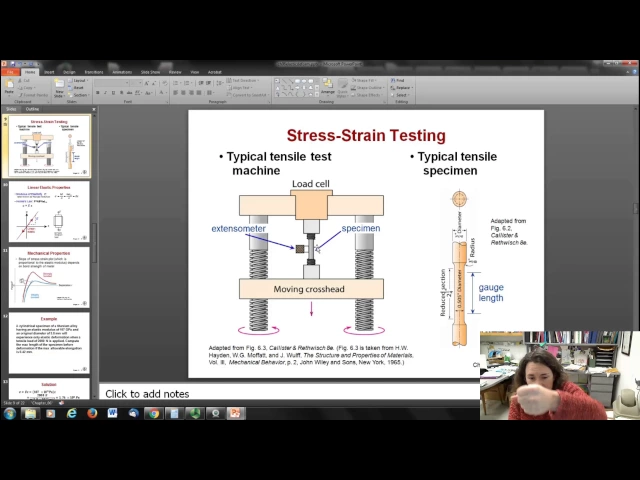
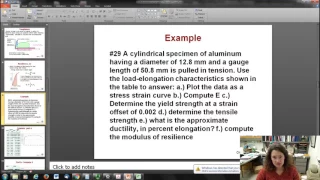
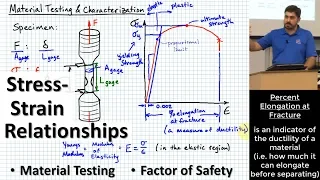
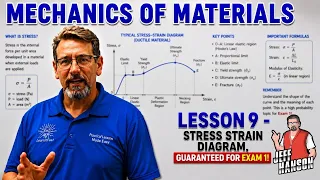
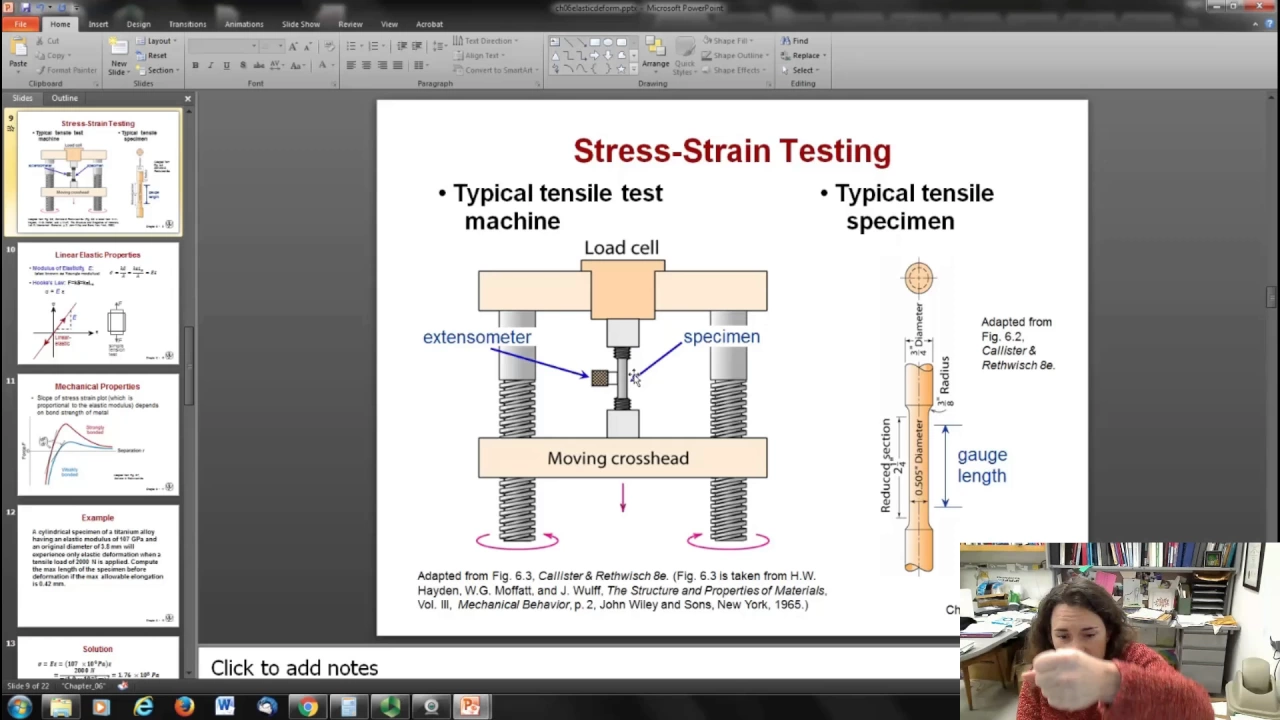
hi so we're going to be starting a new chapter on mechanical properties chapter six so the issues addressed in this chapter are first of all the concepts of stress and strain um so what are stress and strain and why do we use those instead of the load and the straight up deformation of the material we're also going to talk about elastic behavior and this occurs at small loads and then how much deformation occurs for a small load and what materials deform the lead and what are the limitations on that we're going to discuss those Concepts in today's lecture next we're going to talk about in the chapter plastic Behavior at what point does permanent deformation occur what materials are most resistant to permanent deformation and finally we're going to talk about toughness inutility what are they and how do we measure them so today's lecture um the subject of it is elastic deformation and so elastic deformation is deformation that's not permanent so in other words you have a material it's initially got some configuration to it you apply a small load to that material that causes a stretching of the bonds say but then when you release the load and you unload the material it returns to its initial configuration so you're not permanently changing the material you're just kind of briefly stretching it out and then it goes back the way that it was kind of like a rubber band and so this is a linear regime a linear response you have a force applied and then there's a small deformation of the material it's very similar to the idea of hooks law f is equal to K Delta X um for masses applied to a spring when the weight pulls down in the spring and then the spring returns to its former behavior and it can be modeled in that way now this is as opposed to the other kind of deoration which occurs in metals and polymers plastic deoration where you apply a load um it's initially in some configuration then you apply the load it causes the bonds to stretch but it also causes the movement or dislocation of atoms with respect to one another and once those atoms have moved right once the shearing has occurred then it doesn't go back okay so plastic means a permanent deformation of the material a permanent change in the material and of course this looks very nonlinear if you plot the force versus the displacement of the material how much it stretches out it doesn't go in that linear or elastic regime it has a curve to it okay so this is a nonlinear response of the material okay so let's define the concepts of stress and strain okay basically the idea here is that if you're in that elastic regime uh how much force it takes to deform the material is a little dependent actually no a lot dependent on how fat the material is right so a small load for example will deform a big fat thing hardly not at all but that same amount of of weight will deform a small thing by a lot okay it'll stretch out a lot it's kind of the difference between having a very thin wire and a very thick wire and applying the same weight to it okay so what we want to do to normalize for that effect and only think about what effect the material itself has and not its Dimensions is we want to divide out by that cross-sectional area and that brings us into the idea of a stress okay so a tensile stress often symbolized with a sigma is defined as the force that's applied to the material in the tensile Direction which is along the axis along the long axis of the material okay so if you have a wire that's long in this direction a tensile stress is applied where the force is applied in the same direction as the long axis okay so that Force divided by the original cross-sectional area of the material before it's been loaded all right this can be in English units pound per square inch or in um s units Newtons per meter squared so oftentimes this is expressed in terms of pascals remember that one pascal is one newton per meter squared and Pascal is abbreviated PA capital P lowercase a okay you can also apply stress in other directions so for example if you have a material and you apply the stress this way to the material that's called a sheer stress the symbol for sheer stress is a towel the Greek letter towel and so what you do is you take the force that's applied um along the perpendicular axis here this F subs and you divide by the cross-sectional area of the material a now in any device you could have any number of different kinds of stress so this is an example that's pretty familiar to those of us that live here in Boon it's a ski lift all right so the cables on the ski lift are under tension so they're being pulled tight okay that's a tensile stretch and then this shaft here which is helping to rotate um the cable is under a torsional stress which is a form of Shear so for example drive shafts are often under a shear stress and it's kind of like doing this to the material constantly where it's being you know uh torqued one way on the top and the other way on the bottom okay um so that's torsion so that's the same kind of thing and in any given device things can be under both sheer stress or tensile stress depending upon what the device is like some other common stress State um states are compression compressive stress so for example this is common in bridges you have to worry about not being pulled this way but being pushed on from either end okay that's a compressive stress and also um you can apply a sort of a volumetric pressure to something so for example if you are in a submar and you're going down to really strong depths you're under hydrostatic compression you're being your submarine is being pushed in from all sides okay that causes a change in volume trying to push the volume make it smaller or you could have something like a gas cylinder where the gas is pushing outwards on the material and trying to uh get it to expand okay and that's by aial tension pressurized tanks really common example of that so those are some of the different kinds of stress that a material can be under so what happens to a material in the presence of a stress is called a strain a strain is a dimensionless quantity and it's a change in the length for example if it's under a tensile strain it would be the amount the total amount that the material stretches out Delta from its original length which is here called L KN so strain is a dimensionless quantity strain is always dimensionless and it's the change in the length over the initial length and it's often symbolized with an Epsilon as it is in your text you've also got a lateral strain okay so if something gets longer for example stretched out this way then it also might get thinner okay so what dimension increases the other one is going to decrease in that material so the lateral strain is given here with a negative sign um to show that you've got a change that's opposite in sign to the tensile St tensol strain and it's Epsilon sub L is equal to and this is the change in the lateral dimension Delta L divided by here W is the initial width okay so that's the two strings for that if something's under a Shear then that is going to cause it to change its angle um so oftentimes we use the tangent of the angle tangent Theta um that's how much it's gotten sort of torqued if you will um that that angle Theta is how much it was torqued and that is the change in the X Dimension divided by the initial y Dimension component um to give you that angle we're going to do a lab on stress strain testing we have a a tensile testing machine here in our building in Garwood it's on the second floor we'll do one of our Labs on that basically how these devices work is you have your specimen and you have some kind of sensor in there to measure how much the uh material stretches and then you just apply a load an increasing load pulling it apart and watch what happens to material Behavior as you apply that increasing load measure measure the strain in other words so we'll do that for a lab all right um like I said this is a hooks law kind of idea if you're in the linear regime and you haven't begun to permanently deform your material then you're governed by Hooks law which is similar to the force on a spring so put hooks law in terms of some of our symbols that we're using here the force would be equal to K * Delta where Delta is the change in that length similar to K Delta X for physics 1150 1151 now in terms of uh The Strain Epsilon Delta would be equal to Epsilon times that initial length Okay so hooks law could be written f is equal to K Epsilon L KN where K is that spring constant in the material now let's look at it um hooks law in terms of what it would be for these bulk materials um instead of a force like we talk about in physics 1150 1151 we want to talk about a stress which is a force per unit area so we would take that hooks law Force K Delta and divide it by the cross-sectional area a and then plugging in we'd have K Epsilon L KN over a now there's a there's a property that is a material property and it's called the Young's modulus or the elastic modulus often symbolized by this uppercase E in your textbook in other textbooks sometimes they use a y for Young's but here you go there you have it all right so this is the modulus now the modulus of the material you can kind of think of as the stiffness of that material how resistant it is to a force right um kind of like a high spring constant material would have a high elastic modulus as well very resistant to a stress and applied stress but instead it's been Mo uh normalized to get rid of the dimensions of the material and focus in just on material properties okay so this modulus e is going to be proportional to this spring constant or stiffness sort of of the bonds of the material and then normalized out for the dimensions of the material so it only depends upon the material properties okay so hooks law written in terms of Material Science would be Sigma is equal to e Epsilon so what you can do and what we'll do in our lab is we'll uh monitor what happens with stress um how much strain is resulting in the material from that stress and then from the slope of that line we'll get the elastic modulus of the material when it's in the linear regime so the slope of your stress strain plot it's proportional to the elastic modulus it's normalized for the material so it really depends upon only the bond strength of the material how strong those bonds are and how much they're willing to deform okay let me do an example problem for you here um you have a cylindrical specimen of a titanium alloy and it has an elastic modulus of 107 Gap Pascal and an original diameter of 3. 8 mm and it's going to experience only elastic deformation with a tensile load of 2,000 Newtons is applied compute the maximum length of the specimen before deoration if the maximum allowable elongation is 0. 42 millimet now this is the kind of engineering problem that material scientists sometimes face they've got a maximum allowable amount that this material is you know allowed to move and so from that they need to figure out how long they need to make their material um given the elastic modulus of the material all right so we're going to use the formula that we've already been talking about here we have Sigma is equal to e Epsilon a gigap pascal is 10 to the 9th pascals so here we have our elastic modulus plugged in 107 * 10 9th pascals times our strain Epsilon now Sigma is our stress and the stress is the force per unit area Okay so the force here is 2, Newtons and then we're going to divide by the cross-sectional area of the material the cross-sectional uh area of a of a cylinder is due to a circle so that's pi r SAR so you have Pi * 1.
9 millim squared now it's 1. 9 millimet because the diameter was given and not the radius and so we need to divide by two so you have 2,000 / Pi * 1. 9 millim SAR and then when you solve for that you get um your stress which is 1.
76 * 10 E8 scals now your strain is um when you solve for that plugging in for um your stress and for your Young's M you can solve for what your strain is supposed to be via that Sigma is equal to e Epsilon relationship and we solve for our strain and we get 0. 165 and this is equal to the maximum allowable elongation as said in the problem was 0. 42 millimet and then divided by the initial length the initial length is what you're solving for here so you do a little cross multiplying and you solve for that and you get 255 millit millimet or 2.
55 M all right okay there's another parameter that's often given for a material it's called the poon's ratio and that's because as we discussed if you elongate something in One Direction say here's Z then that causes constrictions or also strain in the lateral directions and these are related to one another by a negative sign in other words if it gets long longer in Z then to compensate it's got to get narrower in X and Y and so here your Pon ratio is going to be the ratio of the strain in those two directions um in order to make it a positive number you put a negative sign here up top because remember a negative strain in One Direction is a positive strain in the other so here you have the pon ratio often symbolized by the Greek letter new here lower CL Greek letter new is equal to minus the strain in the X Direction divided by The Strain in the Z or minus the strain in the y direction divided by The Strain in Z so it's just a ratio of the strains in the two competing directions now here we can see that um your presson ratio for typical materials Metals about a thir Ceramics about a fourth polymers about 04 so these relationships again it's a material property so it's something that could be given for a specific property for example you might look it up and say oh what's the plastone ratio for gold and it would have a certain uh value there for gold maybe even given as a function of what kind of alloy it is what carrot the gold is okay so you could find that information out now the threshold value here is about 05 if your prone ratio is greater than 0. 5 then that means your density increases now you can see that typically that's not what happens for these materials Metals Ceramics and polymers have quone ratios that are less than a half okay and what that means is if your Plum ratio is less than a half then that means that your density decreases basically what that means is that you're getting voids within your material okay you're creating voids now why a half why would a half be that threshold value here well that's assuming that half threshold assumes that volume is conserved which is not true that's not a law of physics but let's just assume that it is for a second that means that if the stress is applied material gets thin and longer okay so here's a slice through that and it shows the material Getting Thinner as you stretched it out the blue is kind of after and the green squore on the outside is kind of before and then of course the material got longer now if volume were conserved let's say that it was a square cross-section so that its old Dimensions were x^2 time Z that was its initial volume and then when it deformed it lost material in the X Direction so you had x minus Delta X and then that gets squared to compute the volume but it gets longer than the Z so you have Z Plus Delta Z now if volume's conserved you can set this initial value equal to the final value so that's what I've done here okay and now I've expanded that x minus Delta X term so you have x 2 Z is equal to x^2 - 2x Delta X Plus Delta x^2 and then times Z Plus Delta Z well what we're going to assume is that these Deltas are pretty small numbers like let's say that it only Changed by 0. 0 1 millim well if you multiply a 0.
01 millim change times a 0. 01 millimet change you have something that's pretty vanishingly small and so we can neglect these Delta terms that are squared okay so that goes away it's basically zero so that takes us to this next line here where that Delta X goes away to zero now I'm going to go ahead and multiply the X SAR bit term times the Z term and I end up with x^2 Z + x^2 Delta Z - 2x Delta x z - 2x Delta X Delta Z well yet again if you've got a Delta times a Delta that term's going to go away it's basically zero so this next line is approximating um those Deltas going to zero so then you have x^2 Z is equal to x^2 Z Plus x^2 Delta zus 2x Delta x z okay now you have x s z on both sides so that subtracts and go away and then you end up with Z is equal to x^2 Delta zus 2x Delta x z okay so since it's setting equal to Z and there's an X in every term you can divide out by that and you end up with 0 is equal to X Delta Z minus 2 Delta x z well now we have our equations for strain remember strain in the X direction would be Delta X overx and strain in the Z would be Delta Z over Z so if you rearrange this little equation right here you can get Delta Z over Z is equal to 2 Delta X overx now if you take the ratio of these strains you end up with2 is equal to the strain in the lateral Direction divided by The Strain in the Z okay so that's why the threshold there for that pone ratio is a half because it assumes that the volume is conserved and it also explains why you know the pone ratio being greater than 0. 5 isn't very likely that would mean that the density increases which doesn't happen very often so you have these Pon ratios that are less than a half because volume is never conserved and actually when things get stretched out you get void formations and so the volume actually total volume actually increases a little bit now there's other elastic properties we talked about Shear okay and we also talked about things that were under a stress where they being compressed hydrostatically and otherwise and so when you're measuring other things other than just tensile along the axis then you have different moduli to talk about instead of the elastic modulus or the Young's modulus you've also got your Shear modulus the sheer modulus is often expressed press with a capital letter G here and then you have your sheer stress towel is equal to your sheer modulus G time Delta which would be your sheer strain okay so that's uh plotted here you can also talk about elastic or bulk moduli that's often symbolized with a K okay now since what you're doing for um these sorts of materials is you're putting them under some sort of pressure change usually like taking them down to the bottom of the ocean or filling them up with gas and applying an outward pressure then often times instead of a stress we just put it in terms of the pressure that they're likely to experience and so that's pressure um which of course is the same units as your um stress pressure is equal to negative your bulk modulus times Delta V over V KN so this it's easier of course with these materials to measure a change in volume then it is a change in the dimension in any one particular way so that's how it's often expressed you can get these special relationships for isotropic materials that would mean that it would expand and contract in all directions sort of uniformly sort of a homogeneous expansion and contraction um if that's the case then you can relate your sheer modulus to your elastic modulus in this way um in this relationship given here G is equal to e over 2 + 1 2 * 1 + new or for the bulk modulus K is equal to e over 3 * 1 minus 2 * new so you can put those relationships in I'm not going to derive those they're um if you want to look it up there's these relationships here I do want to mention though that a lot of materials are not isotropic you've got your crystallin directions you got your crystallin faces and of course some directions are more densely or tightly packed than others and so often times materials like to expand along one dimension but not others and so um oftentimes materials are not isotropic for that reason let me do another example problem for you here you have a cylindrical bar of Steel 10 mm in diameter and it's to be deformed elastically by application of a force along the bar axis determine the force that will produce an elastic reduction of .
003 millimeters in diameter for steel the elastic modulus is 207 gigap pascals the shear modulus is 83 gigap pascals and Pon ratio is. 3 okay so they threw a lot of red herrings at you here you don't necessarily need all the information that you're given along the bar axis that means that it's a tensile stress and not a sheer stress so they gave you the sheer modulus which you didn't really need it okay also you're given that radial change but in your formula for the tensile stress what you need is your your stress or your strain I'm sorry along the axis and not that radial so you need to use your poon's ratio to figure out what your change in Z would be what your uh strain in Z would be okay so we're going to use the pon ratio Epsilon R over Epsilon Z is equal to 0. 3 but I'm going to rearrange that so that I can solve for what my strain in the Z direction would be so given that I get um my radial strain is 0.
003 millimeters / 10 millimeters um and then divide that by3 and then I get a strain in the Z of 0. 001 okay using my plon ratio now that I have the strain in the Z Direction then I can use my formula for the um the stress so I have stress is equal to my uh elastic modulus e times my strain Epsilon and that's equal to 207 gigap pascals times .