>> Carrie Kennedy: Hi there, thank you for joining me. My name is Carrie Kennedy, I'm a senior attorney with the HHS Office of the General Counsel; I'm with the NIH branch, the National Institutes of Health branch, so we advise, in particular, the National Institutes of Health. My particular backgrounds in the areas in which I advise include human subjects research and the clinical center, which is the NIH research hospital.
And today, we'll be talking about just some of the legal issues that occur in clinical research. So, the objectives today, as you can see from the slides, are we're going to discuss the history and elements of informed consent for both clinical and research care, summarize the evolution in types of advanced directive and other surrogate decision making, and discuss research specifically regarding children. We'll examine issues related to medical records and documentation, protection of confidentiality and privacy.
We'll discuss, in some part, authorship rights to research data and protections of legal liability for federal employees and nonfederal clinical researchers in particular at NIH clinical center. We won't be going into a whole lot of detail about technology transfer issues, because I understand you have another lecture on that particular topic. So, before we get into the crux of this side with the resources and the legal background, for those people -- I know there's a lot of people signed up for this course who are international and not located in the United States.
So, to give them just a basic background, in the United States, we get the most deference to the constitution. After that becomes -- so, the constitution's the highest level. Next would be laws or acts passed by congress, and those get codified in something called the United States Code or the USC.
Typically below that, you can have an executive order by the president, which is a directive to do something, followed by regulations. Regulations are substantive rules passed by federal agencies as authorized by law. So, as authorized by a United States Code or an act passed by congress.
The agency can take that authority and make its own regulations, and move forward and implement those regulations and oversee those who are subject to the regulations. And then below regulations are federal policy. So, that's kind of the legal framework of what we'll be talking about today, just to give you that background.
So, as you can see in this slide, a large focus of our discussion will be on 45 CFR 46. CFR is Code of Federal Regulations; that's where agencies publish their regulations to make them official. The HHS regulations are at 45 CFR 46.
So, 45 is an HHS specific CFR, and you can see there are five subparts to the HHS regulations. Part A of the HHS regulations is often called the Common Rule. That's because 15 other agencies have the same exact regulation.
It will be found in a different part of the CFR, but it's the same-- [audio echoes] Sorry, we have a little echo here. Okay, the echo's gone [laughs]. Anyway, and so they might not have, and typically do not have sections B-E like HHS does, but Part A is the uniform for those 15 agencies.
It's easier for implementation when we're talking about how to regulate research involving human subjects. There's also three other agencies and departments in the United States that follow what we call the Common Rule as a matter of practice, but they have not actually formalized it in a regulation. The group that has the oversight authority for 45 CFR 46 for HHS, they're called OHRP, or the Office for Human Research Protections.
They are an HHS operating division, similar to how NIH is an HHS operation division. NIH has an office that oversees how NIH implements 45 CFR 46. And this is a policy group, and that's for those of you who are at the NIH, or work at the Clinical Center, or in different institutes or centers.
ICs at NIH, that office is OHSRP. So, I know sometimes the wording confuses people, but those are different offices in their house and different operating divisions of HHS. Again, OHRP is the regulatory group, OHSRP is an NIH policy group that oversees the implementation and compliance at NIH for the intermural program.
The intermural program-- I know this is a lot of background, just trying to make sure we're all on the same page-- the intermural program at NIH are those staff researchers and clinicians who work at NIH or NIH approved sites to perform research on behalf of NIH. It's different than what we would call our NIH extramural researchers, and those are usually our grantees who NIH gives money to fund research, let's say at an institution or an academic center. So, a little bit of history as you probably heard in some of your earlier lectures, but just in case you haven't: HHS actually came out with its first set of human subject regulations in the 1970s; and in 1978, the first, essentially, bio-ethics commission in the United States formed the Belmonte Report.
And that identified three-- well, it considered fundamental, ethical principles for human subjects research, respect for persons, beneficence, and justice. And you'll see on the slide here, that FDA has its own human subjects regulations. That's somewhat of an anomaly because FDA is part of HHS, but FDA is, in itself, is its own regulatory entity, and so it has its own rules, which it oversees.
21 CFR 50-- the 21s of the CFRs are also HHS, just so you know-- 21 CFR 50 are the FDA regulations on human subjects protections, and 56 regards the IRB, or Institutional Review Board. IRBs are the groups that are tasked to oversee and assure that the protocol submitted to them and approved, as required by the regulations, meet the regulations. So, parts 50 and 56 really are very similar to 45 CFR 46, subpart A.
Parts 312 for the FDA regard investigational new drug applications, so if you are testing, part of your research question involves a drug, and 812 regards investigational device exemptions. So, to further discuss some additional resources and backgrounds related to the Common Rule 45 CFR 46, we can talk about some of the changes made to the rule that will become effective very soon. These changes began in their implementation in 2011, and were culminated in the final rules publication in 2017.
The rule that is going to be effective in January 2019, we refer to most often as the 2018 requirements, or the revised common rule. And, although I don't have time to discuss all of the provisions of the revised common rule, I thought that the most relevant ones for this discussion would be those related to informed consent. And informed consent provisions in both the current rule and in the revised rule are found at 45 CFR 46.
116. The changes to the common rule for informed consent were really made to increase and foster autonomy of the individual subject, as well as to increase the subjects understanding of what he or she was agreeing to when participating in research, and to try to decrease what might be seen as unhelpful boiler plate found in consent forms. There are some changes to how informed consent is presented to a subject.
An example would be that key information must be presented first, and must be presented in sufficient detail to foster the subjects understanding of why he or she may or may not want to participate in research. Further, while the existing elements of 116 have not changed, there are additional elements in the revised common rule that I will touch on some of the points of examples. And some of these might not be new in concept, and might already be implemented at many institutions through policy or practice, but now they are being required through the regulation.
For example, one is that, for research that involves identifiable private information or identifiable bio-specimens, a statement about the use of that identifiable private information or bio-specimens for future research. Another element of informed consent under the advised common rule will be that a subject must receive notice about potential commercial profit that the institution might benefit from as related to the research, and that might include whether or not that individual gains in any of that commercial profit. As a third example, the informed consent provisions will discuss when clinically relevant information will or might be returned to subjects that are enrolled in the research, and also whether the research will or might include whole genome sequencing.
Another element that will be addressed explicitly in the regulations of the revised common rule regards broad consent. In the current framework, if you are doing research in today, let's say, and your research involves identifiable private information or identifiable bio-specimens, and then five years down the road, a different researcher wants to use that identifiable private information or identifiable bio-specimens for his or her own research, that person has a few options in terms of how to satisfy the common rule for preceding. One would be to de-identify the information or specimens and proceed because they are outside of the scope of the common rule, but if they wanted to use identifiable information for whatever reason, they could try to go back and find and then consent each individual to then use their identifiable information for this newer study a few years down the line, or seek an IRB waiver for informed consent for the secondary research.
The revised common rule has a fourth option-- it's not a requirement, it's an option-- and the fourth option adds flexibility, and so if an institution anticipates that data or information they're collecting now might be useful in the future, and identifiable form for another study, they can obtain an informed consent for broad future use. And what that looks like is some of the provisions are similar to what you would have for the current use of informed consent and others that would be slightly different, and that's all covered in the rule at 116d in the revised rule. But, effectively, you're obtaining informed consent from the subject for storage maintenance and use of future identifiable bio-specimens and identifiable information.
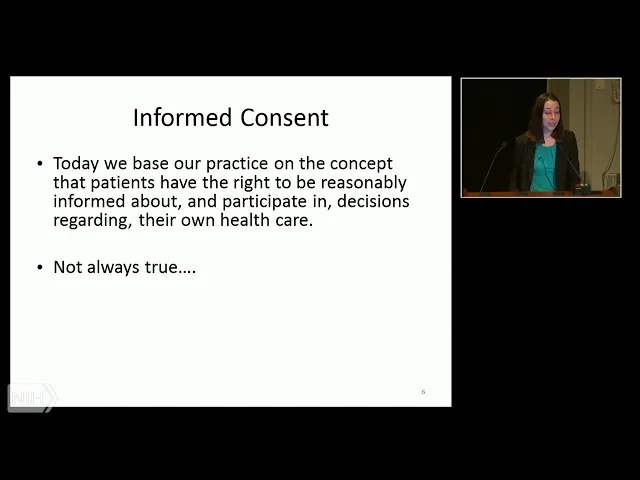
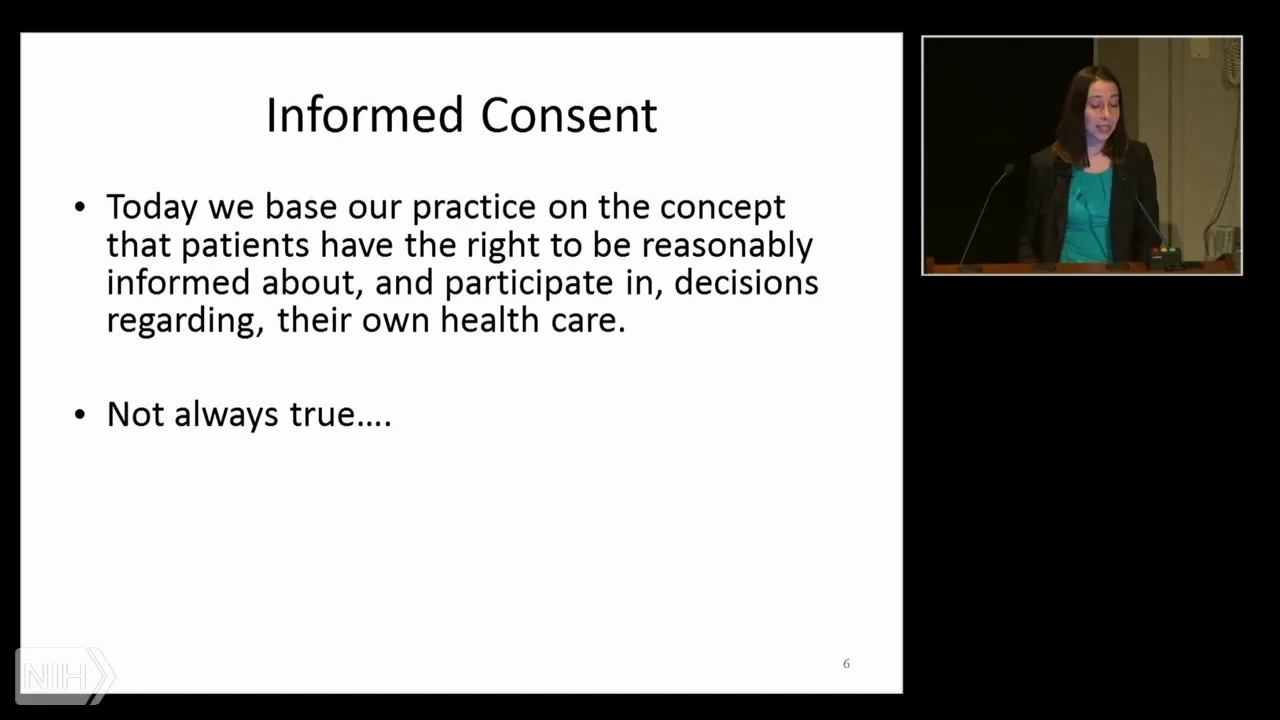
And the future use purpose can be stated as very narrow or very broad as deemed appropriate by the institution and the IRB at the institution. So, now for informed consent. So, now we know that informed consent is essentially the bedrock principle of medical care and research care.
It was developed, in part, the idea of informed consent, through common law, which is precedence set by court cases and judicial decisions as opposed to law that was passed by legislatures at either the state or the national level. The law began, in terms of informed consent, looking at it as a issue of a battery claim. So, in the law for battery, you have to prove physical touching regardless of harm without consent.
And one of the first cases known for considering these types of informed consent issues, but as a battery concept was the one I have on this slide before you. In that one, the plaintiff claims that he had agreed to an exploratory exam related to some stomach fibroid tumors, and during that exam the surgeon went ahead and actually removed the tumors, which the patient, or plaintiff, then said caused some additional distress and surgeries. And so, that was the case where the court considered the additional action by the provider that wasn't known to the patient in advance or agreed to by the patient in advance to be a trespass.
And a very famous Supreme Court Justice declared, in his opinion regarding this case, "every human being of adult years and sound mind has a right to determine what shall be done with his own body. " So, that was in 1914, and then I think the idea of informed consent further developed by various intellectual bodies, and some of them I've listed on this next slide. The Nuremberg Code, as you might be familiar with, was developed after the World War II and it developed standards for physicians and scientist who conducted biomedical experiments on concentration camp prisoners.
And this code became the prototype for many other codes intended to assure that research involving human subjects would be carried out in an ethical manner. And this was relied upon in the HHS Belmonte Report that I referred to that eventually led to the HHS regulations. So, in this slide, you can see that the ideas of informed consent were then further solidified generally within the courts, and the courts reframed the issue as a negligence or malpractice action, as opposed to an action of battery, which we saw in the early 1900s.
Negligence, you have to prove that there's a duty owed, the duty is breached, damages result, and that the damage is actually caused by the breach. In the case on the screen now, this was the first case to actually use the term "informed consent," and this was a case where somebody, a 55 year old, had circulatory problems and underwent some surgery, and it resulted in lower paralysis. And the court determined that there was a lack of informed consent, and that the duty to disclose-- there was a duty to disclose certain risks and obtain informed consent before performing procedures, and that the patient should have been informed of these details, again, in advance, including dangers.
The standard used in this case, and which has been adopted and is still the standard today is the reasonable patient standard, which means, what would a reasonable patient in those circumstances want to know? This is as opposed to a reasonable physician standard. So, it's a more patient-centric standard that we use in the concept of whether informed consent was satisfied.
So now let's move on to the process of talking about obtaining informed consent. Oh, and I'm sorry, I should have mentioned before I started, or as I started, if any of you here with me have a question, feel free to either interrupt by, if you can, going to the microphone and asking question. I also have breaks for questions throughout the lecture.
So, the informed consent process. Today, courts generally focus on the quality of the consent. It's not a legally effective consent unless the patient understands the procedure, and the treatment, and the risks.
The legal standard is the same, essentially, for research. So, in research and in medical terms, the consent needs to be voluntary, it can't be against somebody's will. The disclosure has to include relevant information, it has to be comprehensible to the person, either verbally or if it's a document in writing.
If it's in writing, it also has to be the appropriate language and reading level, generally. Again, the regulatory requirements are very similar to what you would see in the medical context for informed consent. There are some additional ones, such as at 45 CFR 46, which we talked about earlier.
Subpart 116 has additional requirements for informed consent. So, one of those is, you have to be clear and say what you're doing right now as the participant, you say that's the participant in your conversations and documents, is "you're participating in research. " So it's clear it's not necessarily medical care, but research.
That's you try to explain, to the best of your ability, the duration of the research, the purpose of the research, what if any will be experimental as part of the research, that you're participation is voluntary and you can withdraw at any time without loss of any benefits. And the counterpart of the consent requirements under the FDA regs is 21 CFR 50. 25, in case you are curious.
So, what must be disclosed? So, in the informed consent process you generally diagnose the following information on this slide. You don't have to diagnose every possible risk, again it's the reasonable patient standard, it's based on the situation, and a lot of degree to the clinician's judgement.
And often people ask how much information? There's often concerns about what do we say in the consent form, we're concerned about the length, again every risk, how much science. For the research consents, how much must be explained?
And, again, it's about the digression and understanding your patient population, what they need to know to give you legally effective informed consent. Again, it's not every possible risk, but it has to be a reasonable standard. And I think we all probably know this if we thought hard about it, but informed consent is a process, it's not simply just signing a form.
Sometimes we might feel like that, when you go in for, let's say a medical procedure, but it starts at the very beginning of the discussion. It continues through, perhaps, execution of a written document, and it can continue beyond that. This slide explains who can obtain informed consent.
It's generally up to the institutional policy of who can obtain it. It has to be somebody who's not only effective communicator, but has an in depth understanding of the research procedure, or if it's a clinical issue, the clinical procedure. And then the other question is on the counterpoint of obtaining it, you can actually provide the consent.
A competent adult can provide informed consent. In the United States, we as a legal matter assume that once somebody has turned 18 they are competent to make their own legal decisions. If the adult is not competent, or if it's a child, it would be the person's legally authorized representative.
Now, the term legally authorized representative in the research context has a specific definition. And it's defined in both the HHS regs and the FDA regs as "another person, such as a parent or a legal guardian, or entity such as child protective services or the court, who is authorized under law to consent on behalf of the perspective subject for the subjects participation in research, and it's largely a matter of state law. " So now let's continue to discuss this concept of legally authorized representatives, and why it's necessary and useful.
So, like I said, competent adults-- we assume when somebody turns 18 that they will be able to make their own legal decisions. If somebody's a competent adult, they can consent to participation in research or clinical care, or refuse. If somebody lacks, as an adult, capacity to consent, you can provide emergency clinical care.
If you're a clinician, you can provide emergency clinical care if you can't obtain consent, either from the patient or the surrogate. However, research is another story. Generally, it's not appropriate to initiate research without obtaining legally effective consent, from either the patient or their representative.
Which is why advanced directives in surrogates are particularly useful in the research context. So now let's get into the types of surrogate or substitute consents. There's three types with some subdivisions, as you can see on this slide.
The first one we'll talk about are legally appointed guardians, then we can talk about advanced directives. And those, there's generally two types: living wills or durable power of attorney for healthcare. And the third type we'll talk about is substituted consent.
A guardian-- again, in the US if you're over 18, there's the assumption that you're competent. If a adult [sic] loses capacity, or has never had capacity by the time they turned 18, because of a developmental delay, let's say, one can petition the court for guardianship. This-- there's a whole legal process that the court goes through.
There's fact findings, usually there's an attorney representing the person who is being questioned in terms of their capacity. And then the court makes a decision about whether or not that person, which we call, in the legal world, "the ward" if it's deemed that they don't have capacity, is able to make certain legal decisions on their own or not. If a guardian is appointed-- so, let's say a guardian is appointed for healthcare decision making, the guardian, not the ward, consents in the future and is the one who can give legally effective consent.
States have different laws about what a guardian can and cannot consent to. For instance, some states, I'd say maybe even many states have laws restricting guardians from enrolling wards in medical or biomedical research, or clinical research. And that comes from legislative action by the state in order to protect the ward.
And you can imagine where those types of laws might have arisen out of. If a guardian is a guardian of a state that has such a law, at the clinical center what we do, we accept guardians from 50 states where federally-- we have federal exclusive jurisdiction, so we're not subject to state law per se by law, but when it comes to guardians we follow the law of the state where the guardian was appointed. And so if the guardian doesn't have legal authority to consent to research on behalf of the ward, the guardian essentially would need to petition the court for the additional authority to do so.
Okay, so let's move on to advanced directives. As you can see, these are the two advanced directives that I discussed-- that I referenced before. A living will is very specific to the factual situations, it discusses lifesaving measures that you would or wouldn't want, such as a feeding tube, antibiotics, and also for the types of usually very broad conditions like persistent vegetative states.
And, as opposed to a durable power of attorney for healthcare, that is appointing a proxy decision maker. It's appointing somebody and giving them flexibility to make determinations based on a condition or situation that may occur in the future. The flexibility allows for a wide variety of factual decisions that you might not be able to anticipate, as well as changes in technology, research, and medicine that you might not be able to anticipate through a living will.
And the word durable is added, and it has a specific meaning. It means that the power of attorney somebody is assigned lasts beyond their capacity. So, if you assign a power of attorney, depending on the state law, but often times you have to specify that it's durable, otherwise that power of attorney is really only considered to have authority when you are still competent.
And if you lose competence, they might not necessarily still have the authority to make decisions for you. And, again, that is a variable state by state. And I mentioned-- I'm sorry.
In the prior slide, I didn't mention, but it's written about a living will that it usually relates to terminal conditions. And the term terminal also varies state by state, as decided by a legislature, sometimes court cases. It generally means a condition from which there can be no recovery, including death.
And, increasingly, states have been adding PVS because it has been relevant. And the way it's been relevant is in the courts, and we might all remember some of these cases that I've given as examples on this next slide: the Quinlan, Cruzan, and Schiavo cases. I'm happy to talk in detail about these cases with anybody if they want, but the general takeaway is that, generally, courts and states favor the preservation of life unless there's clear written statements by the person before they've lost capacity to speak for themselves, or the appointment of a proxy by that person.
For instance, in Quinlan, that was a 1979 case, and it's known as a right to die case, and the person was not terminally ill, but was in a persistent vegetative state, and it wasn't quite known what her wishes were. And so, the state, it argued, had an interest against anybody terminating life. And the courts found that the state's interests weakens as the individuals rights to privacy grows, and the degree of bodily invasion increases, and the prognosis dims.
The Cruzan case, which is also on this slide, regards a woman who was 25 years old and was in an accident and became, also, in a persistent vegetative state, and she had had a conversation with her friend about her wishes. And the issue was about what level of evidentiary standard the state could require a family to prove in order to remove life-sustaining support. And the standard the state wanted to use was clear and convincing evidence, which has a whole legal term and lots of legal precedent behind it that I won't go into.
This case went to the Supreme Court, and the Court ultimately stated that that was an acceptable standard, that's a high standard, but it was acceptable given the circumstances. And it was remanded to this state court for ultimate decision, and what happened was the state withdrew its claim and essentially ceded to the family to make the decision that the family felt was in the preference of Mr. Cruzan.
And this, the takeaway, I guess of the legal summary and kind of the crux of that case was that the states interest in preserving life was challenged by the family's constitutional ability to refuse care, which is a 14th amendment due process. They were due their due process prior to taking a liberty, and the liberty here was the right to refuse treatment. And so the courts were balancing the liberty interest versus the state's interest.
And in the Schiavo case, that one really I mentioned because it highlights what advanced directive in living wills can do to prevent the, I guess, unknowns in future, unanticipated circumstances. In that case, Mr. Schiavo had a cardiac arrest and a coma, and was in PVS.
There was a feeding tube inserted, and her husband wanted it removed, and her parents petitioned against removal. And this became a very controversial public issue. But congress commented on it, President Bush at the time commented on it, there were 14 appeals in the courts of Florida, five appeals to the federals, four denials by the Supreme Court of the United States simply about this one case alone.
And, again, it demonstrates the legal issues when you have incapacitated adults and you don't have a living will or an advanced directive to understand what they would have wanted. And the last point I'll make on this slide regards the Patient Self-Determination Act, and that essentially requires that hospitals who accept Medicare and Medicaid funding to inform patients about their rights to execute advanced directives, and it's really a floor in terms of rights, not a ceiling. It prevents the hospitals from discriminating patients who make advanced directives, and it's intended to protect autonomy and self-determination.
So, we've talked about guardians, and we've talked about advanced directives, now we're going to move on and talk about surrogates. Surrogates, the power of a surrogate varies from state to state. Some allow surrogates to make decisions only when it's known, but the patient's wishes are.
Some states, like Maryland, allow the surrogate to make a decision in the best interest of the patient. The forms also vary state by state, generally have to be voluntarily executed, written, signed, and witnessed by two unrelated people. For medical providers out there, you may be interested to know that usually there's no criminal or civil liability if medical providers, including researchers, file an advanced directive in good faith pursuant to reasonable medical standard.
And so, this puts a notice on medical practitioners to know whether an advanced directive exists, so that they can follow it. And at the clinical center, again, we are not subject to any particular state law, but the clinical center accepts durable power of attorneys and advanced directives from outside states or countries, if patients bring them with them. And we also allow patients to execute ones that we have here, which actually specifically talks about research participation.
And, as you'll see in the last bullet point on this slide, some research protocols, as a condition of participation, required the patient to have an advanced directive because it's anticipated that the patient will lose cognitive abilities, such as in an Alzheimer's study. So, now let's talk about what happens when somebody is a patient without a guardian, without a durable power of attorney, without a living will, and then they become mentally incapacitated. So, if they've expressed their wishes previously, and certainly if they're documented in the medical record, clinicians can follow those wishes.
Without them, then there are certain ways for state law, in particular, to authorize individuals to give substituted consent for furnishing, but not withdrawing care. Unsubstituted consents, there's a hierarchy. So, if a spouse or domestic partner exists-- and the example I have shown you is the clinical center policy, which mirrors the Maryland law.
A spouse or domestic partner, and they can be on the same law because that, as a legal matter, you can't have both. You can only have one or the other. So first is that, and then you can see the down-- the hierarchy.
If somebody higher on the hierarchy exists, they're the ones to make the decision. And, do you have any questions for me before we move on to the next section? Okay.
So, now we're going to talk about children and their participation in research. A child is a person who hasn't reached legal age to consent. So, a child, as defined by the research regulations, is a person who has not reached the legal age to consent to the research, treatments, or procedure under the applicable law under the jurisdiction in which the research is to be conducted.
Different states have different laws, typically child [sic] is somebody under 18. Sometimes different clinical settings that the age might be younger, such as obtaining sexual care, healthcare, provision, and other circumstances. At the clinical center, the definition of child is, "anybody who is under 18 and not themselves married or a parent.
" So, under the research regulations, a child doesn't have the legal authority to consent, but they can be asked to assent. Generally, the permission is sought from both parents of the child, or in their absence it would be a legal guardian. There are exceptions in the IRB, again the Institutional Review Board who looks at protocols before they're implemented, can approve the consent of only one parent as being sufficient in certain, usually lower risk research.
And something for clinicians to perform research related-- if you have a child who is in foster care, you have to give extra scrutiny to the law of the state, because you need to assure that the person who has physical custody of the child actually has the legal authority to consent to their participation in research. For instance, a foster parent might not actually have that legal authority. You might need to get it from a court or the Child Protective Services of the state.
And, I should say, when the permission of both parents is required for consent under 45 CFR 46, there is a provision that, if one parent is unavailable or deceased, then both parents do not need to consent. So, in the situation where you're dealing with children, and the parent or legal guardian isn't available. So, for emergency medical care can be provided without consent [sic].
If a parent or legal guardian refuses to provide their permission for research, their choice governs. If they fail to provide consent for clinical care, it depends on what the situation is, right? If the benefits of the care outweigh the risks, sometimes the state will step in, or the hospital can seek a court order, and in fact the parents' rights are essentially abrogated and the court will speak on behalf of the child.
Sometimes, and in pretty rare exceptions, I would say, you can have a mature minor exception. And that is when a minor, who's usually closer to 18 years old, but an older child can go through a court process and petition the court to be deemed an adult for the purposes of making their own legal decisions. And the court usually tries to assure that this minor, person under 18, understands the consequences and permanency of their medical decisions.
And sometimes, this comes up in the case. One example could be Jehovah's Witnesses and a child understanding the implications of not receiving, for example, a blood transfusion that might be critically necessary to their health. And for children who are participating in research at NIH, care providers and researchers need to be sure that they know who has the legal authority to consent for the particular child, and ideally in advance of the child's arrival.
There's, in very, very rare circumstances, the clinical center, at least, will allow a temporary decision maker in place of the parent to attend for the child for their research visit to the clinical center. And there's a lot of balances to be had in this situation, such as how risky the trial is, what clinical care might need to be provided, what the child's current medical or future medical state may be, and why the parent can't attend. Convenience isn't usually accepted as a sufficient rational, but let's say you're in your ninth month of pregnancy and a single parent, and you can't get on the plane to accompany your child, that might be deemed a sufficient reason.
At the clinical center, when a temporary decision maker is invoked, it is the parent assigning somebody to make a decision for the child on the parent's behalf, but the way the clinical center operates is that we still call the parent and have the parent consent by phone as much as possible, and direct the person who's here at the clinical center so that the parent still understands and has some sort of oversight facility. So, that wraps up our discussion about children in research. And so now we can go on to talking about medical records.
So, basically, medical records should contain diagnostic and clinically relevant information. It needs to be accurate, and it needs to be timely. If somebody looks back on it, it needs to give a full picture of what has happened: discussions, lab results, the like.
In the clinical center, medical records, just like at other institutions, are maintained to provide continuous history of treatment, and they also provide a database for clinical research conducted within the hospital at the clinical center. Again, they document care to patients, and they plan and evaluate the patient's treatment through them and sometimes a support justification of somebody's involvement in the protocol. Of course, medical records at the clinical center, and elsewhere, facilitate communication and support adequate discharge planning.
And failure to document properly may lead to inappropriate treatment and possible patient harm. Now, at the clinical center at NIH, medical records are distinct from research records, and that might not be true in outside, let's say, academic or other types of institutions, such as industry. At NIH, the research records contain data about the individual as relevant to the research study.
So, the clinical medical record might be more voluminous than the research record, if the research record doesn't need all of the information that's collected in a clinical care setting. The research record serves to track, monitor, and evaluate the clinical, epidemiologic, and biometric research activities. Generally, medical records can rarely be disclosed without the patient or their surrogate's consent.
And if patients do consent to release their records, they can consent to release only certain types of records, or to only certain providers. At the NIH, there's policies about record releases, if you have any questions, we have, at the clinical center, the medical administrative seers, or MAS. There's also the medical record handbook.
And at the National Institutes of Health, as a federal agency, we are subject to the Privacy Act, which I'll talk about later, which in part discusses medical records disclosure and disclosure of Privacy Act records. Now the Privacy Act. So, the Privacy Act prohibits disclosure of the records as defined on the slide that I've given you.
It's basically record under the control of an agency from which information is retrieved by the name or identifying number of the individual. So, generally the Privacy Act, which was passed in 1974, prohibits disclosure of records to third parties without the written consent of the individual to whom the record pertained, unless one of the 12 disclosure exceptions enumerated in the Act would apply, and the permissible release without consent is limited, and rarely would include identifiable information. Some examples of when it might be released without written consent would be fore law enforcement purposes, or health and safety for emergent care.
So, for instances, again just a hypothetical, if somebody landed in an ER and the last thing they said before they passed out is, "I just came from NIH clinical center and I'm on this medication," and then they pass out and the hospital needs to know what medication the person was on, depending on the facts of the circumstances, that might be an urgent medical circumstance in which we would give very limited information for the patient care. And then there's other rules about how we would do that and how we would notify the patient after the fact. But, again, it's pretty rare.
The Privacy Act notably applies to US citizens and lawful aliens, it doesn't apply to corporations. Privacy Act rights end at death, they don't extend beyond death. The Privacy Act was enacted to balance the government's need to maintain and collect information about individual, with the right of the individual to be protected against unwarranted invasion of their privacy stemming from the federal collection maintenance, use, and disclosure about this information.
Individuals under the Privacy Act are entitled to their Privacy Act record with some exceptions, of course. Notably, one would be law enforcement. And individuals are entitled to correction of the record.
And, related to the Privacy Act, one can bring suit in court for Privacy Act breaches. And this is an area in which the United States government, which normally by law cannot be sued, it has waived its ability, its sovereign immunity as it's known, and will allow itself to be sued in this type of instance or violation, in particular circumstances of the Privacy Act. Notices of any systems of records, so records collections, for instance, need to be published in the federal register, and the notices cite the legal authority for collecting and storing the records.
It discussed about-- the individuals about whom records will be collected, so for example, the clinical records here at the NIH clinical center would regard patients who are seen at the clinical center for research. The publication in the federal register also informs what type of information will be collected, and how it will be used. And the public is considered unnoticed once it's published in the federal register.
Violations of the Privacy Act can lead to both criminal and civil prosecution-- or penalties, I'm sorry. So, one of the exceptions I mentioned about the Privacy Act, in which you can release information without explicit consent of the individual about whom the record pertains is a routine use. And routine use is when published in the federal register allow, again, the release in certain situations, so the law defines routine use as, "the use of a record for a purpose which is compatible for the purpose for which it was collected.
" At the clinical center, a routine use for the clinical center medical records is responding to congressional inquiries, allowing social work departments to reach out to local agencies to aid in the transition of the patient or the family back home, or get other services that they need if there's a referring physician that's taking over care after discharge, and other medical organizations or consultants that are connected to the treatment of the patient. Research records, again a different record system than our medical records. They also have routine uses.
Sometimes-- and some of the routine uses I've listed on the screen just to give you a flavor of what they are. So, you might have also heard of FOIA, which is the Freedom of Information Act, and this was passed in 1974 after the Watergate scandal. And so, the idea of FOIA is that it provides individuals with the right to access records in the possession of the federal government.
The government, however, can withhold information pursuant to nine exemptions and three exclusions in the act. Medical records typically fall within an unwarranted invasion of personal privacy, which is in exemption number six. And that protection under FOIA may continue after the death of an individual for the benefit for the privacy of the family.
And, let's see. The FOIA-- as compared to the Privacy Act, FOIA is applicable to people or a corporation, so it's broader. For those of you at the National Institutes of Health, if you ever have questions regarding a record release, we have Privacy Act experts called Privacy Coordinators for each institute and center.
We also have FOIA coordinators for each institute and center. And when a request for records is made, it might be specifically in a Privacy Act aspect or a FOIA aspect, but if it's not, or if it's both, you do need to evaluate both standards before releasing information to assure you're not releasing information improperly, or to the wrong person or entity. So, HIPAA.
HIPAA is the Health Insurance Portability and Accountability Act, and it has a privacy rule that was passed, I think four years after. And it applies, by law, to covered entities. NIH is not a covered entity.
NIH does not bill for its transactions, and so, by virtue of that, in short, it is not a covered entity. HIPAA is relevant to NIH researchers because many of our collaborators or partners may be subject to HIPAA. Generally, HIPAA also requires that an individual give authorization for use or disclosure for certain information PHI, which is Protected Health Information.
That's a term of art under HIPAA. And again, it's attempt to strike a balance between information exchange as necessary for either clinical or research purposes, and the patients' privacy. This slide gives you a flavor of ways in which PHI, again Protected Health Information, can be released under HIPAA.
Under HIPAA, decedent information is continued to be protected by the law. Again, that's slightly different than the Privacy Act. In application, though, under the Privacy Act, the clinical center extends the Privacy Act protections for the benefit of the privacy of the family, even if it specifically ends with the death of that particular patient, we can extend it, in essence, to protect the privacy of the family.
And going back to HIPAA, authorizations for waver of consent to sharing can be granted by the Institutional Review Board or Privacy Board, which is a term of art that relates mostly to HIPAA. And switching gears to one of our, I guess our second to last topic tonight, sometimes folks have questions about authorship, and who is seen to be an author on a research publication. Generally, this is a policy matter.
There's no specific legal requirements, but there are professional standards, and NIH itself has policies that require the designation of authorship be based on significant contribution to the conceptualization, design, execution, and/or interpretation of the study. Otherwise, contributions can be handled by a mere acknowledgment. As for data rights, data that is developed by those at the clinical center-- again our intramural research program-- those at institutes or centers at NIH are generally the property of the federal government.
When research is supported in the intramural program, there are protections that apply to the inventions of both the researchers and the government. However, an extramural research-- again, the grants concept where NIH is funding outside institutions to perform specific tasks with little-- I guess I would say where the government doesn't anticipate substantial programmatic involvement during the performance of that task, the data rights will vary. And finally, our last topic: legal liability and malpractice.
So, it's been said, and I tend to agree that clinical researchers and clinicians at the NIH are subject to fewer actions for negligence or malpractice than is common in some other institutions. The type of claims most commonly filed involve mistakes of treatment or diagnosis, or defects of informed consent. So, the Federal Towards Claim Act, you may have heard of it if you're an NIH employee, the legal citations at the bottom of the page.
Again, I mentioned before, the sovereign immunity doctrine in the United States. Generally, the United States can't be sued as a party unless it agrees, by law, to be sued. And, under the FTCA, the government is allowing itself to be sued.
And so, what happens is that, under the Federal Towards Claim Act, or FTCA, the FTCA becomes the exclusive remedy for somebody who has a complaint against the government and its employees. Generally, the FTCA provides immunity to employees from claims of negligence relating to contact that in in their scope of employment. What would happen is, if somebody is sued in their official capacity relating to negligence actions related to the scope of the employment, the government would substitute itself for the individual.
So, the person would no longer have personal liability. And if damages were found to be necessary paid out, it wouldn't come from per se your personal pocket book, it would be from the government. It's a way, essentially, to-- that the government self-insures itself.
And when FTCA matters come up, FTCA requires that a claim be filed. You can't go straight to court and file litigation. The claim can either be disallowed, and then the person could file suit, or the claim could be allowed and it might be settled.
And often times-- always, I should say, those claims are reviewed by the HHS office, the general counsel. And depending on the stage of the claim and if it has become litigation of also the Department of Justice, who defends federal agencies in court. But the HHS offices general counsel provides support to the department of justice in those situations.
And I should note-- oh, I'm sorry, it's on the slide-- that healthcare professionals, for example, at the clinical center who are not federal employees are required to be insured, to maintain professional liability insurance for the reason of the fact that the FTCA covers employees. And that is all I have for you today that I was planning on discussing. If anybody has any questions, I'd be happy to answer them.
All right, thank you, have a good night.