D and happy New Year to everybody so I'm coming from R 2 as you can see uh and the topic today will be on a late industrialization so I would speak mainly on about manufacturing sector I would Reise it again but don't uh don't mismatch it's only about the manufacturing sector um starting by by um a retrospective view on on the manufacturing fast one because I'm sure you know already the major role of manufacturing development uh in grow and and catching up and then uh I will move to a second part which is more which
U is more um relevant with the title about sub subaran Africa and the potential or the possibility of more industrialization in this area okay so I start uh by declining the the the question um well first about the wider issue um on late industrialization for developing countries now in Africa or elsewhere which has been a little bit discussed recently by a number of papers started the mid 2000 and there has been a a set of papers about the limits or the new um condition uh of uh late industrialization in developing countries just I start by
reconing you this point that you know already I'm sure that no countries has become rich so far without having a stage of uh manufacturing expansion in terms of uh in terms of output in terms of employment there have been only a very uh small number of exceptions such as uh Financial Heavens or oil producing countries but in terms of world population it's uh almost nothing all other countries had started to develop their economy by increasing the size of their manufacturing sectors it was the case in the 19th century it was the case in the early
20th century with Japan in the late 20th century and still in the early 21 century with a major uh example which is which is China and as a matter of fact there is and there have always been since two 2 200 years a quite strong correlation between the manufacturing value added perad in a country and the GDP per capita in a country except and I say it for a small very small share of the world population so so far there has been no development without industrialization there has been no other way there has been no
alternative uh why why is is manufacturing so important why the role of man of the manufactur sorry of the manufacturing sector is so heavy in the development process there has been a number of papers already and studies that explain that at the macro level through uh empirical studies through history using alsoo uh historical survey well the the main um the best explanation is probably from Kor with the Kor low that show that in fact the growth of the manufacturing sector in a country even when this manufacturing sector is small or at the beginning if the
growth rate of this sector is enough a strong Dynamic it will it will um induce it will lead to productivity Improvement in the manufacturing sector but also in the other sectors of the economy so this is the major development power of the manufacturing sector and the second one of the other strong Advantage probably the second one is the ability or the capacity of the of the manufacturing sector to absorb large volume of low qualified workers coming from the countryside without any specific qualification and so far there has been no uh alternative in terms of uh
employment employment uh expansion at such a fast rate for this is this is a historical um background so far but and the conclusion still is no other way for development than through manufacturing through the development of the man the manufacturing sector even if after a certain stage there could be of course a de-industrialization I'm moving to high productivity services but the manufacturing stage has been un avoidable so far this view or this view or this result or this consensus has been um challenged by several papers one of the most famous as in U It Is
frequent was from rodri Daniel rodri who published a paper in 2016 and a premature deindustrialization but in fact as in other uh of his papers the major inspiration came from other researchers uh the SC and sing especially anyhow it is a paper which is very influent which has um lead to a number of comments quotation and so on and what U rodick show in this paper is that in fact since the 90s roughly in developing countries the peak of uh industrialization so the ratio of manufacturing valuated on GDP or the share of the manufacturing valuated
on GDP this peak has been much lower so since the last 20 or 30 years than before meaning that in fact in fact the potential for industrialization has narrowed has reduced is much smaller than before and he Pro he propos a number of econometric results which show roughly division by two or a PE two times lower than before in terms of uh manufacturing expansion so it the consequence is that in fact manufacturing could not probably lead anymore to a long and sustainable process of Economic Development increase of income level and so on this is the
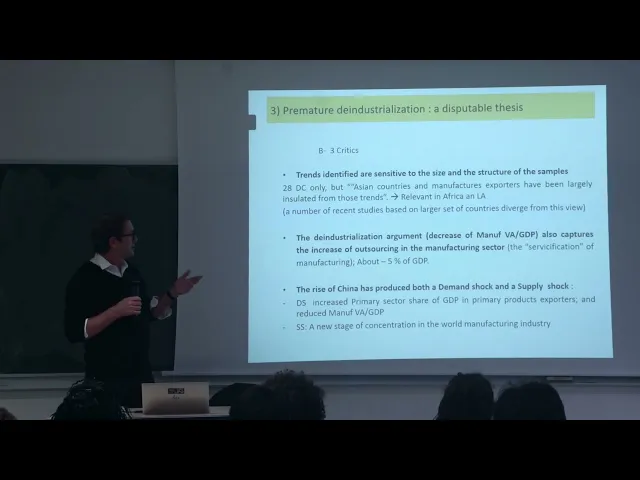
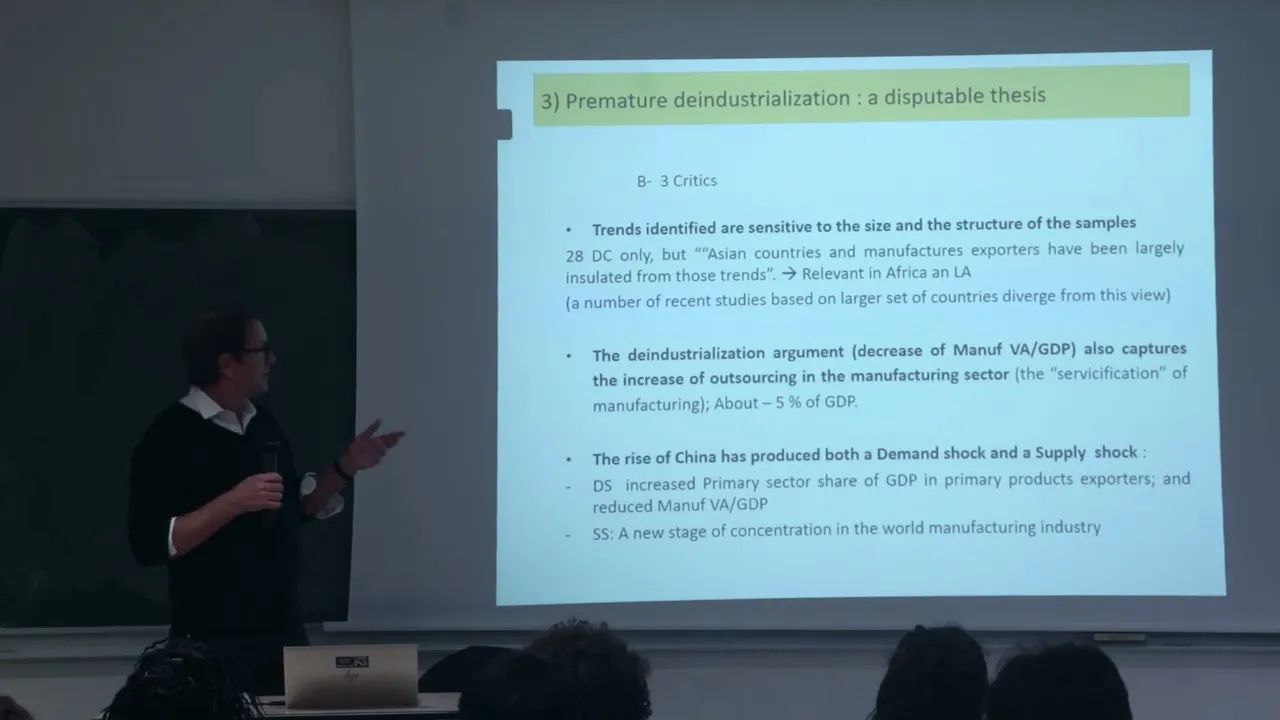
major conclusion uh I don't know whether you have heard about this paper or the thesis on premature deindustrialization yes no okay so I move to the critique we can make to this paper and after that I will confront um the argument with the real Trend the real statistic Trend about manufacturing activity in developing countries but first of all three critics about the paper the radi Rodrick papers first uh the sample he used is very narrow the number of developing countries is less than 30 and he precised in the paper that in fact you have roughly
six or seven African countries uh 8 n south or Latin American countries and so on and he preise in the paper that in fact the trends are relevant except for Asian countries and Manu manufacturing exporters so in fact you have eight 28 countries but you have to uh you have to you have to you cannot count sorry you have to D the substract thank you Alexi to substract Asian countries and manufacturing exporters of course if you subtract from the developing world asan countries and Manufacturing exporters very probably you will found a lot of primary product
exporters and no more manufacturing exporter so there a strong Bas at the beginning H secondly his major argument is that the peak of manufacturing valuated on GDP has reduced from 25% to less than 20 okay but in fact and there other studies on the structure of the world manufacturing industry clearly uh show that uh the Outsourcing Trend Outsourcing process in the manufacturing industry has uh led to uh fall of the apparent ratio of manufacturing Val value added on GDP because of the externalization of a number of activities especially Services activities that was formerly integrated into
the manufacturing value added okay when Reno Reno or Fiat or or General Motors Outsource Services activities they move these activities these valed move outside from the manufacturing sector to the service sectors and the trend is very strong everywhere it's difficult to estimate on average of course but it's in the the range of minus 5% so roughly the Gap discovered by rodwick is not far from the uh amount of new activities that has been outsources during this 30 years period and finally there is also one point is that the uh the the frontier in terms of
in terms of period for World week is the 90s or roughly before and after the expansion of China okay after the 90s it's the rise of China on um on the World Market both in terms of in terms of manufacturing production but also in terms of imports of raw materials with two major uh consequences first the rise of primary product prices and then for uh the countries that were exporting primary product the ratio of primary product export and GDP increased because of the volume but also mainly because of the price increase okay when oil copper
uh nickel and so on prices increase but for countries such as Chile Brazil and so on the ratio of The primary sector valuated on GDP increase without um any specific implication on the status of the manufacturing industry okay and secondly uh secondly the rise the rise of China as a world manufacturing product uh exporters also closed or narrowed the opportunities for other exporters but it has been a specific uh stage or time period which has no reason which has no reason um uh to to last indefinitely there is no reason that the very strong 30
35 40 45 world market shares of China uh will last of course China is the largest world exporter and world uh producer in manufacturing and it will be R fre it will keep the status during the the century very probably but there is no reason to believe that this market share Chinese market share will stay the same will remain as high and in fact they started already to decrease in a number of labor intensive Industries you have a a picture here garments uh Footwear and so on China reached a peak roughly in the mid 2010s
and since and these market shares have the trend is is decreasing um now if we look more at the data and in fact this paper and this research was uh made uh for the IFD for the French development agency in order to assess whether there are still um growth potential in manufacturing for for non-asian countries so we built uh we for this we built database on manufacturing activities in order to check whether the the picture given by rodri the the premature deindustrialization thesis was right or not uh and in fact we found very wellknown uh
Trend so the decrease of the manufacturing variated in the north so North and South it's a very simple division let's say that North are oecd countries and South it's a rest of the world okay um so in the north the share of manufacturing in GDP has decreased while in the South it's r growing slowly okay so far there is no confirmation of the deindustrialization thesis and if we look at the structure of the world manufacturing value added uh so you have we have divided the south in two parts almost the same share China and the
South minus China okay the rest of the South okay so you have a three uh um Parts World North China and South without China okay and you can see that of course the Chinese uh rise has been impressive nothing new but in fact the South has not the South without China the rest of the south on average has not declined so far okay in terms of Val uh and in terms of employment the the the share on aage so the world share the world average the share of manufacturing employment has not really changed it's relatively
stable one job among seven on average still uh 30 years ago and now is in the manufacturing sector but of course the distribution of the jobs of these jobs has changed decline in the north expansion in the South was is still the question which share for China and the rest of the South okay it clear or okay um and it becomes a little bit more interesting because in terms of structure so decline in the north growth in the South but a let's say a stronger or um more solid growth of employment in the South than
in China in fact when you estimate uh manufacturing employment in China which is a little bit complicated because the data is not fully transparent uh and you include the formal and the informal sector because roughly at the World level half of the manufacturing employment is unal okay so estimated uh you can see that in China since roughly 10 Years it'll bit more than 10 years in fact manufacturing employment is uh stagnating okay it's stable and a little bit decreasing in some industry while in the rest of the South but of course it's an average it's
an aggregation as the grow the grow goes on and finally finally if we look in terms of numbers roughly you have four 150 million jobs in the manufacturing sector in the world well the share of the north decline okay no surprise but you have a diverging since recently you have had and before the covid period you have had diverging Trends between uh China and uh the rest of the South okay continuous growth of manufacturing employment in the rest of the South while the trend is uh so so in China but very probably decline declining okay
decreasing and of course in terms of uh in terms of prospect what is interesting is the most recent Trend so I move now to the case of uh Africa so in fact I will not answer this question I just uh draw a few consequence implication of uh what is happening now at at the world industry level and the consequence especially of uh the Chinese industrial transition well in uh in your life and in the most recent period in the world economy and the major change change has been the rise of China okay uh from nothings
in terms of exports it was under 1% of the of World Trade in the 70s H and very fast expansion becoming almost depends how do you do you measure uh the largest world economy and at least the economy with the largest potential but it restrictor process has started and and as I said it's not fully transparent as the data are not uh always very accurate but however the available information available um solid information we have clearly show that there has been some uh transition and it will continue of course and especially in the Labor uh
intensive Industries that were at the beginning at the start of the Chinese expansion garment uh laser products shoe making uh electronic assembly it's not here in these industries China is losing has lost is losing its competitiveness for not uh including the trade um conflict or the Press protectionist pressure without this this um trade policy aspects at a more structural level the wage level in ch in China the productivity level qualification and so on has uh major consequence that in fact in these uh Industries based on low wages and mostly not so qualified worker or people
with low qualification um the Chinese industry has lost is losing its competitiveness and it has a major impact on the world uh economy on World Trade because of the size of China China has reached roughly 30% of World Trade and in this labor intensive industry it's often between 30% and 50% of the World Market okay so if you have a lust of competitiveness in these industries as it has been the case before for Japan for South Korea for Southeast Asia Thailand Malaysia and so on that uh follow the same transition process because for the same
reason uh wage increase and loss of competitiveness in labor intensive industry the major difference is the impact is the size okay because South Korea and Taiwan when they were at their peak of their uh competitiveness and World Trade they which together well less less than 10% of the World Market when it's the case of china it's three four five time this um this share but it's the same process it's the same process for the same reason the question is uh the speed at which uh with which this uh producers in China will move abroad or
we Lo will completely uh lost their competitiveness but not the trend main major question is the speed and it's uh the process is already quite advanced it means that in fact the market share lost by China are won by other exporters and roughly there are half a dozen of new uh small manufacturing exporters that compensate for China Bangladesh Cambodia Vietnam Pakistan Indonesia a little bit depending on the product okay but it's relatively concentrated in fact you have half a dozen Asian countries that benefit now or that have benefites the last 10 years from the loss
of competitiveness of Chinese producers okay this is the case of garment and the average uh growth rate uh annual growth rate during the the during the between 2015 and 2019 so Bangladesh Vietnam Cambodia and so on expand their export when when China is um is exporting this and the amount is not so big if you compare to Chinese export but if you compare the loss of China market share if you compare that to the size of this economy it's quite quite um it's quite impressive in fact okay the growth of the export which has been
very fast in a number of this relatively small economy banglades is not so small as the other one that's not very big has had a major impact on wages on this country and this is a case of uh Cambodia for instance so you have the relationship between the volume of export of garment okay they started to export garment in the early 2000 at a low level with very low wages 5050 do a month something like that okay and they expand the export relatively fast and wages follow it might not be high wages at even at
200 or $250 a month life is not very uh comfortable in Cambodia however you have a strong relationship between export volumes okay and wages mainly because due to the size of the this economy which is small the impact of this exports is huge on on wages okay and the point is that in fact in this labor intensive industry such as garment or Sho making um international buyers they start to have difficulty to Bress when the wage when the wage reach roughly $300 a month when they reach $300 a month they start to look to other
location cheaper this has been the long story of Nik factories all around Asia Gman factories from Japan to South Korea to China and now to Cambodia for instance and of course when you have a strong demand a pressure that increase or push wages uh at highest uh at higher level which is quite a good result for the economy at the same times it reduce the competitiveness of this garment producers okay and when you consider that um China will be replaced uh sooner or later maybe partly uh by this uh small economies in fact the ab
the absorption capacity of these economies of these countries it's much smaller than China if you if you add Bangladesh plus Vietnam plus Cambodia plus myar if there is a stabilization in mymar is very small in comparison with China so it means that in fact wage expansion will be relatively fast if the if the trend continue and so this is not a this is really this this are um past figures okay it's realized it's not a prospective uh estimation but if we estimate similar relationship for the other uh small manufacturing exporters Bangladesh Vietnam and so on
in fact and we consider that there will be a limit in terms of competitiveness it means that they cannot grow as high as China in terms of market share because when their export will continue to grow wages will increase and they will reach a noncompetitive level meaning that export production and so on will stabilize in this country countries which is already the case in countries such as such as Vietnam for instance Vietnam is not far from the 300 uh dollar limit the major major potential is in Bangladesh because of the size of the population especially
in the countryside so there will be limits to uh the absorption capacity of this of this economy um and it means that roughly in the next 10 years they will reach there will reach this limits and it will uh reopen opportunities for a new generation of exporters if there are still available countries with lower wages than in Asia okay and in this uh phases in these phases if we estimate uh potential potential uh in terms of export for these industries it's roughly around 150 uh 200 uh billion dollar in terms of export in the next
in the next 10 years that will be Out Of Reach of China out of which of the current excuse of the current uh new exporters and that will remain available for new generation of exper of exporters in terms of job in terms of jobs creation um it will amount to roughly 30 to 35 millions of jobs in 20 35 of course depending on the different Trends the the speed of the Chinese decrease or fall the absorption capacity of the new um the small manufacturing exporters such as Bangladesh or or Cambodia but even the case of
Cambodia it's not they are not far from this unit so it's not um is not so small and the question of course will be where where the international buyers H&M and so on will be able will be able to find enough uh workers at lower wages than in Asia for East Asia okay in fact uh there is not many uh Direction it will be in India or in subsaharan Africa it will won't be in South America wages are too high it won't be more anymore in China or East Asia because the wages have increased North
Africa well thanks to some economic crisis could compete but roughly wages are also too high and the main um labor Supply cheap labor Supply will be in India and China will be sorry in India and Subs Africa so the question is how this um stock of job will be divided between these two location here there are only two hypothesis the the the African emony is a scenario in which African count or the African continent will take um all the jobs while the second hypothesis is a scenario in which the the job creation will be divided
between equally between India and uh Subs Africa okay but India the prospect for India are not very um let say there is no reason to be optimistic but because if you can see this is the the the market share of India in on the world government uh Market with a very huge population cheap population and so on India is not exporting at all almost well of course it could change but so far the M the Made in India plan moodi Made in India plan I don't know whether you have people from India here is not
very recent the impact in terms of manufacturing export has has been n so far of course in the next 10 years there could be a lot of changes but still there is there is a strong opportunity for African countries to increase uh to increase their activity in the manufacturing sector and to create jobs to create jobs rly uh brly 30 35 25 around 30 million jobs um will move possibly to possibly to Africa but it won't be it won't be enough it won't be enough because as you may know there will be a very huge
increase of the working a the working age population in Africa Subs Africa the next decades roughly 700 Millions uh new workers are expected in Subs Africa so even if they are the catch Africa is able to catch a share a significant share of this mobile jobs in labor and iive industry it won't solve the major problem of Africa which is to create enough jobs for the for the young entrance on the labor market but Africa Subs Africa is made of 50 and so on countries and in fact it's not as a world continent that we
should uh which should think but more it would be more more relevant to consider the case of specific countries at a level of Sagal Kenya Madagascar or Ronda uh this amount of job could change a lot of things okay at the level of one or a small number of countries not at the level of the continent well I will stop uh I will stop at this point and let uh the comments flow