hello I'm a mesh was irani at UC Berkeley and I'm delighted to welcome you to this course on quantum mechanics and quantum computation I'm sure many of you know that quantum computation starts with this remarkable discovery that quantum systems are exponentially powerful so a major goal of quantum computation is to harness this exponential power to solve interesting computational problems so in this overview I want to tell you about what you can expect to learn from this course and how this course is organized okay so let's start with trying to understand more precisely what it means
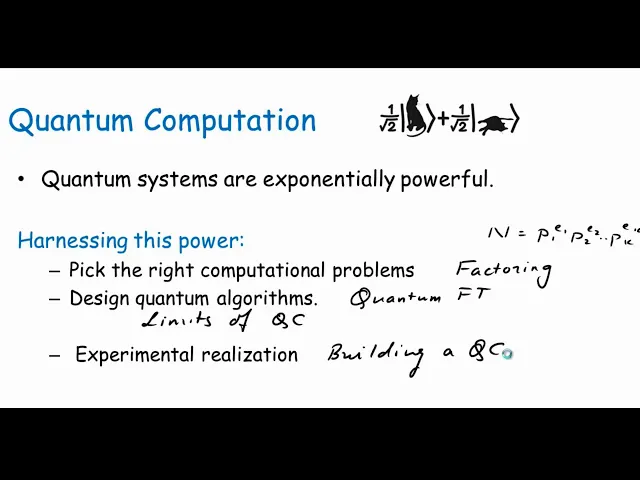
let me say that quantum systems are exponentially powerful imagine that we have a small quantum system of a few hundred particles like few hundred electrons or photons or something so let's say for definiteness we had we had a system of 500 particles now if we could harness all the computational power inherent in the system that quantum mechanics promises us then in each cycle of the resulting quantum computer we would be able to carry out exponential in 500 say 2 to the 500 steps now how big is 2 to the 500 you know it sounds like
a large number but you know the interesting thing is 2 to the 500 is an impossibly large number so 2 to the 500 is much larger than estimates for the total number of particles in the universe it's also much larger than estimates for the age of the universe in femtoseconds fact it's much larger than the product of these two quantities so what this means is that if we could harness this computational power then there's no way that in the classical universe we could match it even if we could if you were able to use the
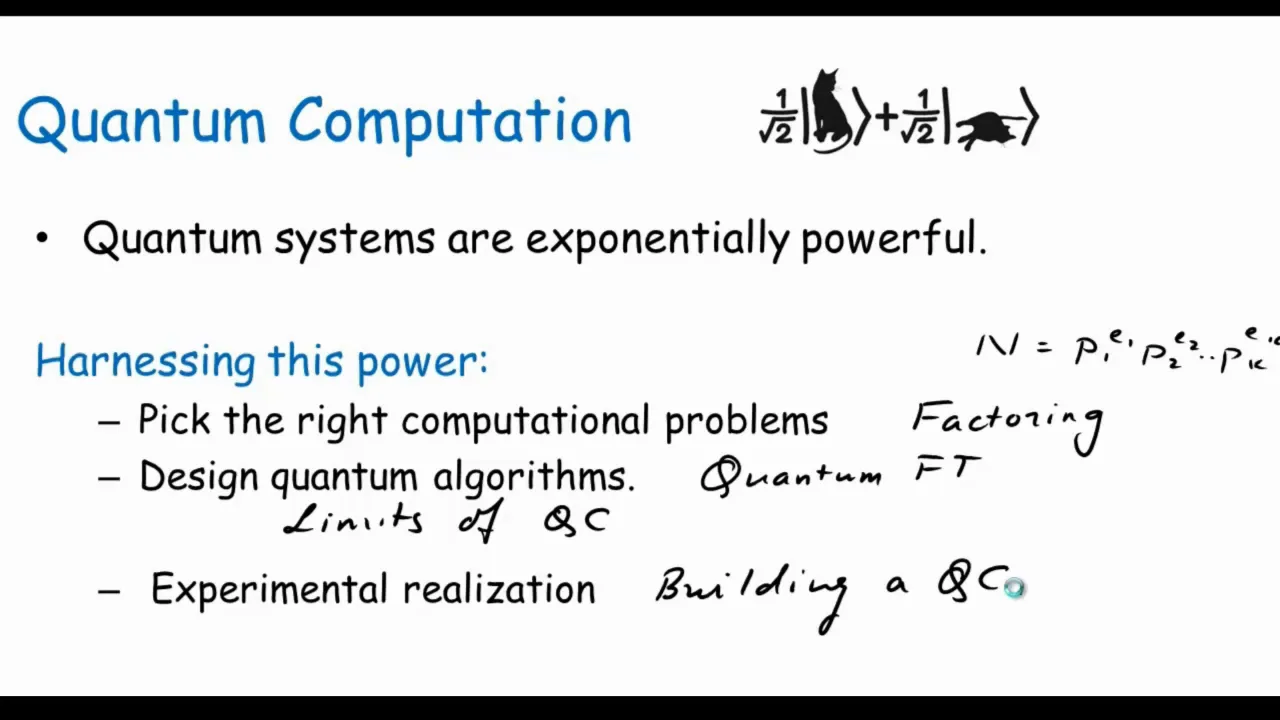
entire resources of the universe in that computation but now of course the difficulty lies in harnessing this power and there are several challenges and these are the challenges we'll speak about in this course so first we have to pick the right computational problems so not every computational problem can be sped up by quantum computation probably the most famous example of of a computational problem that can be sped up is what's called the factoring problem where you're given a number n and you want to write it as a product of you know factorize it into its
prime power factors okay know even if you have the right computational problem designing a quantum algorithm is a very tricky task and actually for those of you who are already familiar with the design of classical algorithms quantum algorithms look very very different and they have very different design principles so we'll talk about things like the content Fourier transform and a completely new style of designing algorithms we'll also speak about of course what are the limits of quantum computers what are those problems that cannot be solved or we believe cannot be solved quickly by even if
he had quantum computers and then there's of course the challenge of building a quantum computer ok so this is something that hundreds of scientists are working on around the world today it's a very difficult challenge and in this course I just touch upon briefly you know the the kinds of systems and you know the principles that that go into designing such such quantum computers so that's you know that's what we'll cover in quantum computing but of course in order to study this you'll have to learn the basics of quantum mechanics and this brings me to
the other part of the of the course which is an introduction to quantum mechanics now the way we will study quantum mechanics in this course is in terms of vase building block which comes from corner computation which is that of a qubit so just as a bit is a simplest it's the simplest representation of information in the classical world a qubit is the simplest quantum system that we can think of and in describing quantum mechanics the basic principles of quantum mechanics in terms of qubits greatly simplifies the presentation okay so what this will mean is
that within three to four weeks you'll be in will be in the position where we can start covering you know start studying quantum computation the basic notions of quantum computation as well as quantum algorithms designing quantum algorithms okay now there's another advantage to covering you know to studying quantum mechanics this way which is that we'll be able to jump right into some of the most counterintuitive aspects of quantum mechanics so in particular we'll right away you know within this probably the second week of off the course start talking about entanglement which is one of the
most mysterious aspects of quantum systems okay and once we are into entanglement we will actually talk about you know various manifestations of it we'll talk about Bell inequalities and we'll talk about things like quantum teleportation and so very quickly you know very soon in this course you'll start grappling with with the counterintuitive aspects of quantum mechanics this is quite important because of course quantum computation exploits the most counterintuitive aspects of of the mechanics now there's a sense in which this way of learning quantum mechanics might actually be a good thing independent of whether you're interested
in quantum computation or not so here's a quote from Niels Bohr who's you know the famous physicist who discovered the structure of the atom he talks about how quantum mechanics is a very counterintuitive theory and anyone who is not shocked by quantum mechanics has not understood it another way of understanding this court is that if you really want to deeply understand quantum mechanics then you have to grapple with the quantum counterintuitive aspects of the theory and so for those of you who haven't really studied quantum mechanics before in this way of approaching it you know
this emphasis on the one simple systems which illustrate the most counterintuitive aspects of the theory this might be the right way to you know the the right way to start studying the subject and then later if you're interested you can go on to take a standard course in quantum mechanics to learn you know the physics of the hydrogen atom etcetera etcetera and for those of you who have already studied quantum mechanics this treatment might deepen your your appreciation of quantum mechanics ok so this finally brings me to the required background for this course and the
teaching velocity of the course so in terms of required background we've really try to design this course to make it as broadly accessible as possible so two people from computer science physics math backgrounds and so the prerequisites are have been pared down to the minimal possible prerequisites so basically there are two prerequisites the main one is that you must have a solid background in basic linear algebra and the second requirement is a pretty simple one you should you should be able to analyze the running time of you must have seen how to analyze the running
time of a simple algorithm you know any simple algorithm likes like sorting or multiplying integers how do you count the number of steps of the algorithm as a function of n the size of the input so something very basic okay let me also say a few words about the philosophy of the course or how it's going to be taught so there's one interesting aspect of it which is what I call a Kanban approach to mathematical notation or math concepts so if this is an approach to manufacturing that you know that the Japanese Japanese have a
Kanban means just in time it's a just-in-time approach so in the 80s they came up with this approach where instead of creating large inventories of raw materials and parts what they would do is make the inventories as small as possible and have these parts supplied just in time this made things much more efficient ok so what I'm after here is is that you know you're going to be seeing a lot of interesting new concepts and many of these concepts are going to be paradoxical and understanding them you know wrapping your mind around these concepts and
being able to intuitively understand them is going to be quite challenging and so I would what I want to do is I don't want to overload you with mathematical notation at the same time that you're grappling with these concepts you know what the course will do is it'll adopt Kanban approach to mathematical concepts and notation and so to the extent possible when a new concept is introduced I'll introduce it as naively as possible so that you are confronted with it and you can build an intuition for it and then of course things will be made
precise I'll push that off as late as possible but in a way that it's still understandable in every and can be made precise okay so finally let me just say that probably the most important thing that you can bring to this course make sure you you bring your imagination and your you know an ability to think grapple with these these concepts some of which are going to be quite mind-bending so it should be an exciting eight weeks and I hope you I hope you enjoy