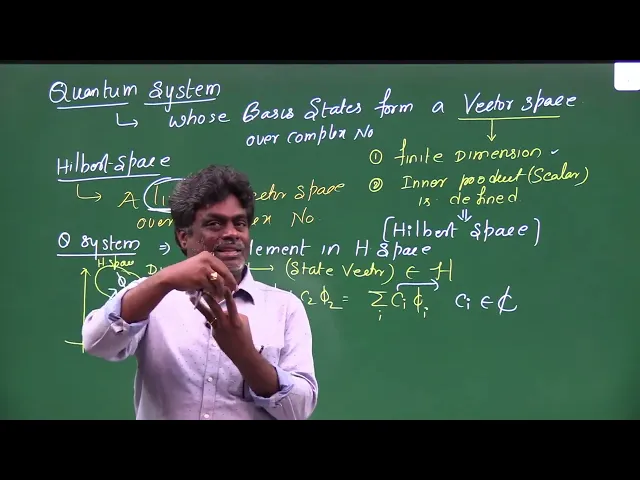
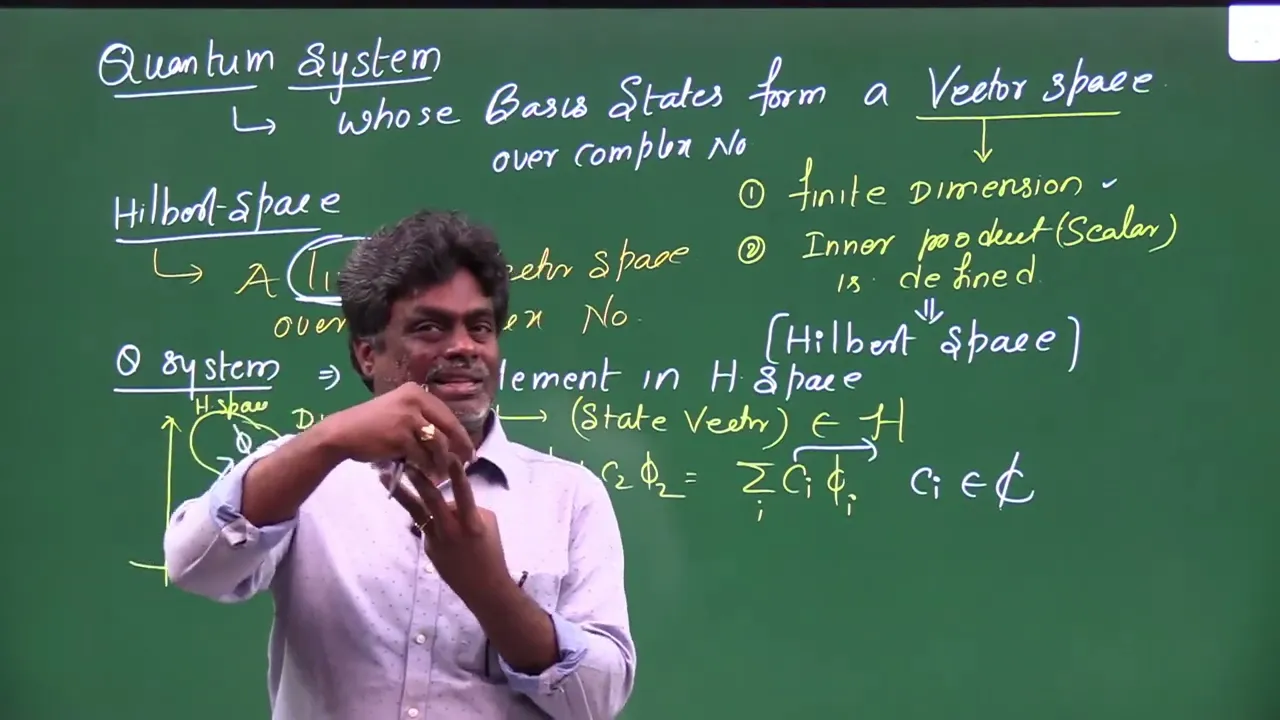
All right ready so here we are going to discuss about this Quantum computation and let us start from the basics okay so first what is meant by this Quantum system first we'll start with this Quantum system what is a Quantum system one minute yeah so what is this Quantum system a Quantum system means whose base states Whose base states form whose base states form a vector space a vector space over complex numbers over complex numbers that means generally whenever we are describing the vectors then regular three dimensional velocity acceleration all these things we'll take the
constants as a real numbers that's why We call it as a real space but here our Vector space is defined over complex numbers means simply our amplitudes our constants or everything belongs to these complex numbers right now what is this a vector space whatever the vector space we are taking here it is satisfying few properties first one generally it is an infinite Dimension but we are taking finite dimension finite dimension And whose inner product is defined inner product is defined our scalar product is defined inner product or scalar product anything sclr product is defined already
defined like this okay and that's it so a vector space is simply here we are taking only finite Dimension and uh whose inner product is already defined inner product means is quite similar to our DOT product a bar dot b Bar is quite similar to that ok and this Vector space we are defining as a Hilbert space okay that's it so finally what is a Hilbert space the Hilbert space is because if you want to Define any Quantum system we need a space and here we are taking that as a Hilbert space so finally what
is the helbert space a linear A linear a vector space a linear Vector space over complex numbers over complex numbers so here I explain what is sorry yeah coming to that coming to that so first here I defined a vector space first of all what is a vector space a vector space is a group under addition and satisfies the four properties under multiplication Distribute to associate to something like that four properties will be there in the multiplication and it must be a group under addition that is called a vector space okay next what is this
linear why we have taken this Hilbert space as a linear that's the question now already OK let me describe here okay finally the quantum system whenever you are defining a Quantum system we need a Hilbert space simply the element Of the Hilbert space is nothing but a Quantum system or a Quantum system is represented by an element which belongs to Hilbert space I think this point is clear so finally we are representing the quantum system as a simply an element an element in helbert space that's it or sometimes we call it as this element is
nothing but the state vector State vector which belongs to this Hilbert space fine ok now I am taking a helbert space just an example then you will understand what is meant by linear so this is my helbert space now I am taking the dimension I already defined my Hilbert space Dimension is two ok so what is the meaning of a dimension is two means we have only two base states means this entire Hilbert Space is expanded by two base states let us say Phi 1 and Phi 2. now I am I have a Quantum system
in this space so how to define this Quantum system now this Quantum system I am representing with the site of course the PSI is a nothing but the linear combination of these these two base states because this entire helbert space Contains only these two bases so whatever the system you are representing you must go with either the I mean you must go with these two basis states only so every Quantum system is represented by a linear combination of base states in the Hilbert space this point is clear so that's why I can write like this
c 1 Phi 1 plus c 2 Phi 2 and generally summation over i c i Phi I and one most Important thing this is C is belongs to this complex numbers now coming to this point why Hilbert space is linear what is the meaning of linear right linear okay so now my helbert space is spanned by basis Vector it is very clear if any system for example spin half system it is expanded by two base states up and down Okay if you have a spin one particle it is expanded by three base states that is
a spin one spin zero spin minus one like that ok so what is this a linear for example I have three states here let us say PSI 1 psi 2 PSI three these are base states so what Quantum system will do it will go from one state to another state go from one state to another state means whenever you make a measurement It will be available in any one of the states for example three chairs are there in the room on which I mean which chair you will occupy any one of that but electron what
it will do it will take the linear combination of those three chairs so it is going from one state to another state that means once you make a measurement it will be available in any One of the state any one of the state means what it is making a transformation from one state to another state those Transformations are linear Transformations means if you operate any operator on Phi 1 we will get some Lambda Phi 1 so these operators are linear operations linear operation and this transformation is called linear transformation and mathematically how they will Define
the linear transformation means like This for example I have a linear operation a it is operating mathematically a one PSI 1 plus a to psi 2 linear means operation on a combined system is nothing but sum of operations of individual systems I repeat operation on a combined system is equal to operation I mean sum of operations of individual systems so A1 s i 1 plus A2 s i 2 that's it So this is the mathematical definition of a linear operation now please ask sir X so that's okay okay so here linear transformation means for example
this is the eigenvalue equation you are earlier also you said whatever the state we have that will be expanded that means we that's a length is extended our contracted something Like that yeah that's it that is called a linear transformation here and of course basis change means it's not an eigenvalue equation for example more generally a s i 1 equal to Lambda PSI 2. so this is not an eigen value equation but the transformation is linear so that is why what I am saying is once our Hilbert space is spanned by some basis vectors your
system must be available in any one of the states there Is no other possibility definitely so whenever it is going from one state to another state that a transformation whatever we are doing that transformation is nothing but linear transformation that every linear transformation is represented by a matrix Square Matrix so one more thing I wanted to point out yeah I [Music] yes yes Yes I'm coming to the next point that only if this linear is clear I will go to that only first so linear is clear linear definition everything is clear sir Vector space is
infinites are but in our Quantum computation whatever the space we are taking that is the finite Dimension only okay because our systems are discrete so that's why it should be finite okay Right fine ok so now we want to ah see what is this a Hilbert space and how to how to visualize this okay Hilbert space so finally yes that also I will explain that is one of the postulate actually that also I will explain right right Hilbert space so finally the Hilbert space definition is a linear Vector space means whose operations are linear a
linear Vector space Over complex numbers over complex numbers and one most important thing whose inner product is defined whose inner product is defined input inner products let us say inner product inner product is defined okay now what is this Hilbert space ok fine so please come back to this euclidean space first I have a real space now forget about this Hilbert space I have a real space this is the three dimension No Doubt why we said real space all constants belongs to real numbers right now here I have coordinate system this is x y and
z now if you want to write a vector let us say a bar how we will write this Vector we will write this Vector as a bar equal to ax I cap or X cap anything you can take plus a y j cap plus a z k cap This is you please write another Vector let us say velocity Vector velocity Vector equal to 2 I cap plus 3 J cap plus a Phi K cap meter per second I want to ask a question without i j k can you write any Vector in the real space
in 3D real space is real space is 3D only can you can you write any Vector without i j k you can have a you have a point on the Plane or a vector you are talking about null vector um anything any one is required am I right yeah that's why without i j k we can't write any Vector that's why I J K are called base states so that is the definition of basis without this we can't go back I mean we can't write basis that is the base states right okay now come to
this point For example you have a basis I J K let us see the properties I dot I one J dot j 1 K dot k this is also 1. I think you know this condition is called normalized normalized at a complete overlap complete overlap next one if you take I dot j or J dot k r k dot I so it will be zero sir yes that means what orthogonal Right yes right so our basis is satisfying two conditions called normalized and orthogonal that's why this i j k is a basis which satisfy ardu
normal condition is it okay normal condition fine remembers are all base states need not to be complete all base states need not to be complete But the base states which satisfies this is very important normalized an orthogonal condition that basis state is said to be complete so this is the base State okay these base states satisfy which condition are though normal condition that means they are satisfying the orthogonality as well as a normalized right that basis is called complete if this condition is satisfied this set Is called complete now you got a doubt what is
meant by complete no other basis is required no other state is required only three is enough now you got another doubt if it is not complete what we will do we will make it complete how we will make it complete by using Graham Smith our dhog analyzation process whenever we have some State vectors if They are not a complete set we can make them into complete set by using our the organization process that we will discuss later ok so first come to this point whenever these two conditions are satisfied then only the basis is said
to be complete is it okay because this is quite related to our Quantum that's what I am saying is the is there any uh please tell me Any any doubt right okay now come to the Hilbert space I am taking the analogy between this Hilbert space and our real space because this is very well known and these are the properties we have seen and if these two conditions satisfied that set is called complete fine everything is nice now helbert space okay so on now I am in the Hilbert space Ah let us say this is
a spanned by spanned by three base states let us say PSI 1 psi 2 PSI three just like i j k so my basis State I mean my helbert space contains PSI 1 psi 2 PSI 3 like this now if you want to write any system Quantum system this is my Quantum system if you want to represent the quantum System just to compare any Vector is a linear combination of I cap J cap and a k cap similarly any Quantum system is a linear combination of these base states that is c 1 psi 1 plus
c 2 PSI 2 plus c 3 PSI 3 okay right now come to this point your base states already given that is uh here what are the basis States PSI 1 psi 2 PSI 3. now tell me what can what condition they they must Satisfy that's it so that means I think I can write it as integral PSI I star PSI J D Tau equal to Delta i j Chronicle Delta this is called Chronicle Delta yeah data means the volumes are space integration over volume ah three dimension three dimension generally generally three dimensional if you
are talking about one dimensional write it DX that's it Yes Yes actually three three will be there this is the integration over volume so this is equal to Delta i j this is called Chronicle Delta chronic sorry Delta something and I hope this you know this is I equal to J its value is 1 if I is not equal to J its value is a zero in the direct notation we can write because we won't use any integration notations here so this is the bra Vector PSI I get Vector PSI J equal to nothing but
Delta i j actually this is the integral form and this is the direct form fine so finally we got this is the inner product which is equal to Delta i j actually this is called inner product this is what we Define a linear Vector space over complex number whose inner product is defined hey That's it for good OK finally I mean this is satisfying both orthogonal as well as yes condition is satisfied then that set is no no no no no if these two conditions satisfied that the base states are called complete so here our
basis our basis is complete please remember this very very crucial because what we what we think Algebra I mean Quantum mathematical quantum Mechanics mathematically any wave function if you want to start you have to use this completeness rule that starts from the completeness rule actually that completeness rule I will explain now please see sir this is the Hilbert space and I defined the three bases and whose inner product is defined that is a Delta i j so it is satisfying both our dominant and a normalized that's why this basis state is said to be Complete
is it okay sir right okay fine complex conjugate complex conjugate will go to bra Vector normal will go to get vector shall I explain that a direct notation okay fine right ok then PSI is normalized and all these things okay right so fine what we understand the wave function or a Quantum system is represented by state Vector which is belongs to Hilbert space now coming to this generally we will say PSI is normalized what is the meaning of PSI is a normalized ok now see for it now here I already defined PSI is equal to
C1 PSI 1 plus c 2 PSI 2 plus c 3 PSI 3 right ok now let me take the integration integral PSI star PSI D Tau D Tau means generally three dimensional do if it is a one dimension d x you can Write or DV also we can write no issue if you are having a d v volume that also can be possible ok now I am multiplying PSI star so integral C1 star PSI 1 Star Plus a c two star PSI 2 Star Plus a c three PSI 3 star okay and here c 1
psi 1 plus c 2 PSI 2 plus c 3 PSI 3 into D Tau r d v whatever it is now see sir so this is nothing but a constants will Be out that is a c one mod Square integral PSI 1 star PSI 1 D Tau plus c 2 mod Square integral PSI 2 Star PSI 2 Data plus c 3 mod Square integral PSI 3 star PSI 3 D Tau sir why you are not written another three we have written only this product PSI 1 psi 1 we have not written PSI 1 psi 2.
[Music] that's it that's it so this is equal to 1 this is one this is also one remaining Things Are 0. so finally what we get integral PSI star PSI DV equal to how much we got mod c 1 square plus mod c 2 square plus mod c 3 square is it okay sir right now come to the point what is meant by sign normalized this is the question um then it will be one that's it so if this value equal to 1 Then we will say PSI is normalized so finally we can say if
integral PSI star PSI d v equal to 1 then what we will say PSI is a normalized okay so just uh take this condition as like this so that implies what mod c 1 square plus mod c 2 square plus mod c 3 Square equal to 1. so sum of squares of constants is equal to 1. ok have you seen this anywhere in the Regular mechanics or real space unit vector unit vector right so PSI is a normalizer then what is the physical significance okay PSI is an armalizer integral equal to one sum of squares
of amplitudes equal to one this is nothing but sum of squares of amplitudes sum of squares of amplitudes what is the physical significance right come to this For example now I am a particle I mean classical particle now I am moving like this okay so you can find my position exactly at X1 or X2 or X3 am I right that means what is my probability classically classically what is my probability at this location 1. at this location 0 because I am a classical existence that's why we can find the probability either one or zero am
I right side Yeah at a given point that's it now come to the quantum description for example I am an electron I am moving how we will describe so whenever a particle is in motion for example a particle let us say electron this electron is in motion how we will describe this in Quantum mechanic in quantum mechanics for example if a particle is moving that will be visualized I mean how how it is moving how to visualize means Simply represented by motion of a wave packet once again that motion is described by a wave packet
what is a wave packet sorry the terms idea you have idea right so the wave packet means simply just like this like this and here we will be having the superposition I will explain right If you want to know completely first we have to go to D brogli that is a 1927 I think Nobel Prize deep brogli hypothesis let us discuss briefly about that Shalom shall we right so for example this is the particle now if you throw like this then what will happen it will move like a projectile why it is moving like a
projectile because this is having only particle nature Right so and what debrogly proposed light is having both particle and wave nature light that means ah I mean light which is having a wave nature as well as a particle nature how do you confirming so you know ah wave nature is confirmed by the diffraction experiment something like that okay so it is having both wave wave nature as well as a particle nature this entire nature contains only two things one is the radiation another is The matter so nature loves symmetry is actually his thesis based on
that nature allows the Symmetry okay so if light is having a dual nature why don't this matter is having a dual nature so then he proposed this matter also should have and he of course he derived a matter also should have dual nature both I mean a particle nature as well as a wave nature now you can ask a question sir if you throw this pen it is moving Like a particle why that wave nature is not there the reason is the wave nature is not a prominent why wave nature is not prominent it's a
wavelength is very very very very very less okay right so why wavelength is very very less means debrogly explained Lambda of any moving particle is given by H by P now you are taking this as a one gram or Something like that that means what this is the order of the Planck's constant but if you take the electron electron mass is a 10 to the power of minus Thirty one so this is the 10 to the power of minus 34 almost cancel and we are getting a significant wavelength this is the reason why the human
being is passing through door why he can't be diffracted an electron is passing through the slit will be diffracted why we are we are Also moving through slit why we are not diffracting the reason is that a slit width it is not in our order that is one of the reason and the next one is we are not having a wave nature prominence we have only particle nature we are probably we are in we are having prominent in a particle nature that's one of the reason sorry yeah yes sir Lambda is equal to H by
P that H By m v okay fine so now what debrogly suggested okay if your particle is moving actually it is not a single wave it is a group of matter waves which are superimposed repeat for example now I am moving I am a Quantum particle if I am moving you are not a single wave you are made up of with so many matter waves which are superimposed each other Constructively where the particle is present destructively where the particle is absent so he completely described the vision I mean how to visualize the motion of a
particle in Quantum in quantum mechanics so if a particle is moving you just visualize it as a wave packet wave packet is nothing but superposition of so many waves constructively where the particle is present destructively where the particle Is absent for example for example if I am an electron I am moving like this why you are able to see me here with more probability constructive interference why we are seeing here with less probability destructive interference that's it so this is the meaning actually okay okay Carry On foreign we are discussing what is meant by Normalizer
so for that we are representing the motion of a Quantum particle by using a wave packet so this is called a wave packet okay that is superposition of so many group of waves constructively interfere where the particle is present destructively interfere where the particle is upset so if you take this region one I can say the probability is a P1 in this region that is a probability P2 in This region probability P3 let us say because the particle may exist between any two nodes any two nodes at a node it's not possible amplitude is equal
to zero that is why whenever if you are searching I mean if you are finding if you want to try find for a find a Quantum particle it will be available between any two of the nodes is a clear so I have taken these probabilities if You add all these probabilities it should be 1. ah that is called normalized generally normalized wave function normalized wave function will say what is the meaning of normalizer total probability of finding the particle in the space is one for example I have a 1D box an electron is moving in
a one day box I ref I return I have written a wave function somebody asked why you have not done Normalization if I have not done normalization what will happen probability will be greater than one so if I normalize the wave function then only the total probability of finding the system in the given space is 1. I hope you got the physical significance which ones are what I'm saying is probability of find you are talking about example 1D box right ah okay right so now here the Constructive interference and destructive interferences are there that means
amplitude is keep on changing in the region so finally what I am saying is the probability in this region is B1 in this region is P2 in this region is P3 so definitely particle must be available between any two nodes between any two nodes if you take the sum of those probabilities it must be equal to 1 then Only we will say the say the PSI is normalized this is what I am saying yes yeah it's a it's a superposition of group of waves superposition of group of waves actually I will tell you one more
thing this white color you just take it as a group sir and this yellow color individual called A phase phase velocity this is the group velocity that means individual waves are moving with their own velocities all of them grouped together and that entire group is moving with a single velocity called group velocity which is nothing but the particle velocity I said here electron is moving with the velocity V if you represent the electron with a Group of waves that group of waves must be equal to I mean that group of waves must travel with a
velocity which is equal to V that's why a particle is represented by a wave motion that entire group of waves are also moving with some velocity I will tell you a small example if you take a stone and throw in the pond what will happen some waves are moving but entire group is also moving that entire group is Carrying always momentum and energy that's why group velocity is nothing but a rate of energy transfer rate of momentum transfer we will say like that similarly individual waves are also moving and the entire group is also moving
but that entire group represent a particle yes individual you you are combining first combining and breaking again okay all right all right okay fine that's it so let us take a small example Then you will understand okay so here let us say PSI is equal to some uh of PSI 1 plus 2 I PSI 2. that means I have two base states 1 and PSI 2 and they are asking what is the normalization constant find normalization constant thank you the condition is this one if it is a normalized sum of squares of amplitudes Must be
equal to 1. why you are making a mod because it's a complex number so first let us check whether it is a uh com I mean whether it is a normalized or not what is its coefficient one mod 1 square what is its coefficient 2i mod to I Square so this is equal to 1 plus 4 which is equal to 5. if it is equal to 1 then only it is normalized now it is is it normalized no then how to make it normalize Then the normalization constant is simply one over under root whatever you
got the answer 5 okay that's into as usual PSI 1 plus 2i PSI 2. okay so this is nothing but normalization constant foreign right now is it clear sir one day and these are simply for example finally I can say like this you have ESI 1 plus B PSI 2 sir what is the normalization constant 1 over under root um mod a square plus modules so this is the normalization constant so every in the Fourier transform also we will do the normalization without normalization we won't proceed actually because total probability should be one that's a
meaning right okay so let us uh close this helmet space With an X ah square plus 2 square water uh foreign so wait a minute so here we are writing the wave function am I right wave function of a Quantum system again this complete wave function based on the three base states because we have already taken an example of Liberty bases the four bases are three bases are seven base are ten baser Does not matter so whenever it is as three bases we will write like this a PSI 1 plus b PSI 2 plus a
c PSI 3. this is the amplitude of PSI 1 this is the amplitude of PSI 2 this is amplitude of PSI three OK and now if you want to see this that is a sum of squares of their amplitudes must be equal to one because this is the combination of only Three waves I mean not three waves sorry it's it's not three waves actually this is the different okay this is the phase velocities and this is the group velocities and that entire wave function is again represented by the linear combination of three base states in
the Hilbert space okay uh we can't relates are actually the problem is this group and phase velocity is Completely different because enough finite number of waves are there for example if you take this matter this matter is moving means enough finite number of waves will superimpose so we CA I don't know that means ah constructively wherever the particle present for example it is here here constructive and here destructive like that ah now I will take one example to make the I mean and close this helbert space so now we are in the Hilbert space final
conclusion right so what is this now I am taking electron first let us write the base states for electron the base states of electron is represented by spin bases s comma MS the electron spin is half circle and Ms takes values from minus S2 Plus s in your Chemistry also I think you know all these things Yeah aha different ah sorry sorry sorry I'm sorry ah okay okay sorry sorry right sorry right ah okay okay so I will tell you what is the MS also then okay right this this is the spin of the electrons
we know the electron is a half what is this Ms I will tell you whenever we consider the electron Motion in the Hydrogen atom or any atom electron is having two types of motions one is a orbital motion another is a spin motion so if you are talking about spin I am taking the spin angular momentum of the electron this interesting circles this is the spin angular momentum of the electron whenever you are measuring the spin means you are studying about the spin angular momentum of the electron according to This Vector atomic model are spectroscopy
this spin angular momentum is always processing about a reference axis this is called one state R it will processes like this this is called another state means means you know already s is equal to half if you take the projection along the Z axis this is the Z axis then here we will get a plus half And another projection will be possible which is a minus half which is a minus half so what we are saying is your electron will be either processing in this state or it will process like this so what we are
taking is this state we are taking as up spin and this state we are taking it as a down state so how we will represent this up State let us say up equal to it's a spinner Yes already we know half I told you it is represented by SMS half comma what is its projection half this is called up spin state downspin state line and for electron for electron for for electron um for electron that two spill motion and that's a spin angular momentum means it Is a ah the spindangular momentum processes processes processes about
Z axis okay okay um yes yes with a particular angle it depends upon its speed right okay so down state is represented by half comma minus half according to according to Quantum Mechanics according to Spectroscopy the electron spin states are these yes MS if you want to no no no no no no generally this is wrong actually they are not as speaking like that actually spin angular momentum is a processing about Z axis one more example just for clarity I will tell you please huh bro for example you have taken hydrogen atom so this is
the nucleus here we have electron Now just now I said electron is having orbital motion now you please let us suppose this electron is moving in the P state let us suppose okay piece ah P State P State means L equal to 1 yes L equal to 0 P L equal to 1 D L equal to two F equal to three am I right sir now how you will visualize this this is orbital motion that is why it is Having orbital orbital angular momentum so quite similar to this what this electron is doing you know
so same reference z-axis and here we have orbital angular momentum Vector L Bar this time it is having a projections ml takes values always from minus L to plus l that's why plus 1 0 minus 1. so 1 projection plus one one projection 0 another projection minus 1. So finally it processes either in this orientation are in this orientation are in this orientation now if you combine this is why we are calling electron is moving like a spherical shape or something something I mean electron is moving on a spear something actually the orbital angular momentum
either processes like this are processes like this are Processes like this definitely it will be available in a one comma one state one comma zero State one comma minus one state this we call it as a p x p y p z ero which ones are nucleus no this is everything is happening around the nucleus only nucleus has the origin nucleus as the center and its happening no no no no no That is initially Rutherford all these things planetary model they consider but after that the reality is a vector atomic model this is a reality
Vector atomic model foreign I used to discuss with the students also this one uh for example wait a minute internet if you do for example people pendulum just like this Okay so this is simple pendulum right okay and this is the conical pendulum okay what is spherical pendulum spherical pendulum what they are saying is a particle or a body moving on a sphere actually it is not moving on a sphere now see mirror conical pendulum one day like this you have taken right just to combine conical pendulum and simple pendulum means once again Simple pendulum
Theta is changing right sir and a conical pendulum here Phi is changing it's moving in a circle combine both means Theta Phi another Theta Phi another Theta Phi another Theta Phi another Theta Phi if you combine all these things you will get a sphere Ah okay okay okay huh is okay okay if you want to try to find it where it is it will collapse it as long as you are not finding it will be it's moving like this only but once you try to measurement once you try to make a measurement it will collapse
to one of the state Okay once you disturb okay okay the actual motion of the if you combine this both orbital and spin that is the motion of electron in an atom that is the picture gorgeous okay okay just like a Coke a high change both conical and a simple pendulum combine Ah yes exactly exactly yes yes yes this is a root under root 2 maximum under root 2. but here radius is not root 2. because this is under root L into L plus ones are root 2. right that's right okay now so we defined
already what is the Hilbert space and what is The example everything we have here given now let us move to the next one the next part inner product and outer product inner product and outer product right so what is this inner product and outer product okay so we have already defined a Hilbert space now I am assuming let us suppose you and we are the two basis states are two State vectors belongs to the Hilbert space foreign now let us Define the first one inner product so inner product is what it's a simply scalar product
so why it is called a scalar product means it's a product belongs to I mean it products to become a number which belongs to complex number this is scalar belongs to the complex number That's it so how to define this ready sir generally everybody will write the expression inner product formula but I won't explain like that I will explain a different way see now for example you are here this is your initial state your electron is here or your particle is here now I am trying to I send a torch light I mean I I
focus a torch light and I am trying to find the electron where it is okay so what it will do it will absorb that light okay and it it will go to the another state am I right because simple logic for example you have a hydrogen atom hydrogen atom ground state energy is minus 13.6 Now I send some energy to detect the electron or to send some light then What electron will do electron will absorb the energy once it gain the more energy than the required to stay in that state why it will stay there
it will go to some other state so finally what is happening descending light to striking bombarding all these things we call it as a measurement so what you are doing here you are Making a measurement on the system and what it is doing once you have done a measurement it is going to the another system I mean another state sorry is going to the another state level high energy level yes or if you lose the energy it will come to the lower energy level so anything is possible I told you already in a Hilbert space
whatever we are having all the Transformations I Told you already it will go from one state to another state so those Transformations are linear something like that okay so it is coming to these two states uh okay fine now ok so initially it is in the signature and once you make a measurement this is in the PSI final now my question is what is the probability of finding that particle to come to this state if I make a measurement on this state Repeat because here everything is talking about the wave functions that's why we have
to talk about the probabilities now it is going from initial to final I am asking a question what is the probability of finding the particle in that final State once you make a measurement on the initial set this is the question what is the what is the probability Off finding the particle or system in final state after making a measurement after making a measurement on initial state you're not the answer is inner product So linear products significance is that only what inner product is giving in our product in our product will talk okay we will
take two vectors and we will multiply what inner product is giving inner product is telling you probability amplitude probability amplitude of what probability amplitude of finding the system in the final State once you make a measurement on the Initial state so this is represented by the inner product I mean get notation bracket notation final okay and you make a measurement on initial we make a measurement on initial and we got the system in the PSI final that's why yesterday also I said circuit is operating Phi is the final State this is what I said um
we will operate on initial and we will Get this in your unitary Transformations also this is our initial State and you operate it and you are getting final I hope now you understand why we will write a cat here why we'll write bra here and and what we are finding here in our product I mean inner product means after operation sorry after operation means you will operate on this after that we Will multiply that and this that that is different that will come back later again again you will get confusion okay fine so inner product
means probability amplitude this is nothing but probability amplitude so inner product significance is probability amplitude sir is it clear um there are so many other things now some other basis States may exist for example you have taken three qubits Okay eight states are there so always the system is a linear combination of these these eight states or three states or four states now you will get one definitive one travels in there I mean not probability amplitude this implies probability probability is nothing but a mod Square PSI final PSI initial mod Square okay so I will
I will give you an example now take the qubit state qubit State is Alpha Cate 0 plus a beta Cat 1 right sir now tell me in which state you want finally one then what we will do is we will take this aside and we will make the inner product with one sorry you have taken one your final state is one this is my initial state this is the superposition State my initial state Now you make a measurement and it is available in the cat one right now I am finding probability amplitude of finding the
system in Ketone after making a measurement on PSI then get one alpha get zero plus beta Ketone now it is Alpha out bra one Cate 0 beta out get one sorry bra one get one so finally these two are orthogonal states zero this is equal to Beta now what is the probability amplitude of getting the state 1 beta What is the probability probability is nothing but a beta Square mod beta Square that's why in the textbooks they will write mod Alpha square plus mod beta Square equal to 1. right fine fine now no problem no
problem no problem no problem now here we are discussing what is the significance of inner product inner product is nothing but a scalar that means the scalar belongs to complex Number now let us take a small thing now let us suppose ah let us suppose my system is in the initial State let us say PSI initial now you are making a measurement what is the meaning of making a measurement you will send a bombarding particle or you will send a light that's nothing but a measurement okay once that light or anything is energy absorbed definitely
it will go to some other state Definitely not sometimes it will go to some other state so what we are questioning is once you make a measurement system is changing from one state to another state so what is the probability of finding in a particular state if I make a measurement on the initial state final State we don't know now probabilistic in a wave function we do not know It may or may not know so that's that's why grow Growers also what he did is he kept all the states in the remain I mean remaining
and he kept the Target in the one separately and just keep on doing the iterations the amplitude of Target is increasing this amplitude is decreasing that's it so finally we got this output we know what is the Target and we are searching that is the searching algorithm now So like that if you find the amplitude we will know the probability of finding that because we have to make the measurement on the initial itself every time initial state only sir whenever you have taken Quantum circuit you started with which states are PSI initial you have taken
first all zeros okay so then if you two zeros are there we are Writing PSI initial my sign initial is zero zero after that you made a measurement of Hydra mod it is giving superposition something like that just I am giving an example what is head mods are rotation only now you are doing a measurement only you are up you are operating Z you are operating poly x what is this what are all these things all these things are Rotations only Quantum gates are nothing but the rotations only now right this is my initial state
which is a superposition of 0 and 1. okay then after that I would like to find what is the probability amplitude Okay if I make a measurement on this I have two possibilities I will get I may get 0 I may get one now I want to find what is the probability to get 1. Then mathematically what we are saying is whatever you want to find keep it in the bra vector whatever you are measuring keep it in the cat vector this is our Target and this is our initial whatever you are getting that is
the probability amplitude and if you make it Square that's a probability yes I am Yeah confidence probability yeah yeah probability yeah probability amplitude to get zero yes yes hmm thank you they are the same so yeah we probably amount of yes That should not be equal to 1 Alpha always all mod Alpha square plus mod b square equal to one probability amplitude is Alpha Square only what you got is Right 0 Alpha at 0 plus beta keto 1 now if you multiply you will get Alpha so probability amplitude so this is a probability means mod
Alpha Square this is not one all right but once you make a classical measurement then it will be one it will Be collapsed to the state ah definitely finally we have taken eight State superposition once we given a classical measurement in the circuit what we are getting only one state foreign right so that's it finally inner product significance is simply the probability amplitude inner product represent probability amplitude of finding the system in final state after Making a measurement on initial State clear right the probability of sorry probability amplitude sorry probability amplitude of the initial state
yes yes yes right sir uh small [Music] Oh just just answer Ed okay [Music] okay okay are the basics complete Basics what is the wave function and how to visualize all these things given I will check it not prominent hmm [Music] right sir shall we start right So here we are discussing this inner product so it's very clear that is uh it's simply probability amplitude the significance is it's a probability amplitude that's it okay now let us take an example then we will get clarity so take an X small example so here I have this
uh PSI 1 okay so this is a one two three I okay so now I would like to find the Inner product that is a PSI 1 psi 1 just example I am doing okay so like this or else we can take another one one more one more let us take ah one one two is it okay right right so this is the PSI one side two eigen State I mean two states we have taken the inner product is asking to find sorry sorry okay okay Find both find both PSI one side to side to
side questions the second one is yes 3 minus 6i and next one is a three plus six correct because both are complex conjugates right okay fine and let us a small note for example if the inner product PSI 1 psi 2 equal to 0 so what is the meaning of that PSI 1 and the PSI 2 are arethogonal That's it we know already right so this is about inner product now shall we move to the outer product sir outer product so what is this outer product actually this is very crucial sir outer product is very
important we will explain clearly what is this outer product okay now here again I'm defining the two vectors ketu and KETV which belongs to the Helbert space so whatever the algebra we are doing everything belongs to the Hilbert space right now the outer product is defined as what so the outer product is defined as like this that means uh this is the kit and this is the sorry this is the cat and a bra so product of cat and the bra Earlier one this is the product of brand kit and here the product of KET
and bra so this is called outer product what is the significance I will tell you sir so before going to start that let me take a small example okay now earlier ah we have taken PSI 1 equal to the same example we are taking so we got PSI 1 equal to 1 2 3i and PSI 2 we have taken I think it is a one one two one one two so once again I'm asking okay let us find this outer product outer product so here this is a outer product what we are finding is PSI
1 into PSI 2. can you do this the same vectors I have taken but now I am finding the outer product significance I will tell you just the cat PSI one yes yes please yeah yes yes three by three Matrix Yes one one two two four three I three I six I correct right so finally what is this outer product outer product is giving you a complex Matrix right that's it complex Matrix so shall we say this is an operator shall we say it is an operator okay so right so for example yeah this is
nothing but the outer product is Always an operator outer product will take it as operator okay sir now see no one was careful let I'm taking the outer product of same state same state means uu this is called projection operator actually outer product is defined for any two any two cat vectors if you take same get Vector Psi Psi Psi 1 psi 1 psi 2 PSI 2 U this is called projection operator if you want to understand more properly About this projection operator I will go to classical mechanics once foreign so for example come to
the real space so here I have euclidean space this is X and Y and a z okay now sir I have a vector sir this is a bar okay so now could you please tell me along this Y axis we have y cap and here x cap and here jet cap if I ask what is the component of a bar along y cap what you will say sir what is the component okay I will write Like this ax X cap plus a y y cap plus a z z cap what is the component of a
bar along x axis no no ax only that that that coefficient whatever we are taking that is called component only a x okay what is the component of a along Y axis a y only now I am taking the component of a along Y axis as a y is it okay there is one more word for this projection If you take a vector and a project along x axis it will overlap this much only I hope you are observing this much overlap only will be there because for example this is the y axis okay now
this is your vector so how much overlap will be there on Y axis means what you will project you will project the vector along Y axis right just like shadow And the shadow shadow shadow ah yes actually if we stand like this we'll get the shadow here now on the floor that is nothing but projection projection on that plane I mean ah projection on the y axis projection on the y i here we have consider a y that is why this is the projection of a along Y axis is it okay wait now from here
I will get back to this Okay because this is very well known so a y is called projection of a bar a long white white cap clear side right now I want to ask one more question can you please define the only Vector they mean the vector along y axis can you please tell me what is the vector along along Y axis only a y y cap That means I I don't want other things I want only y axis a y sorry that's it that's it correct correct now wait a minute ready sir so you
have taken only along Y axis that's why a y y cap clear could you please rewrite this a y in terms of a bar I want to get by I want to get a y from a what shall I do dot product dot Product of the X cap a DOT product with Y cap or dot product with the jet cap one second one second wait wait wait sir wait sir because if you understand this I will explain one more time no problem now projection you understand a y is nothing but the projection of a bar
along Y axis are over Y axis right now what is the vector term corresponding to I mean along the y axis a y y cap right Now what I am asking is simple I don't want a y can you please rewrite this in terms of a bar some dot product no no no no no what I'm saying is you have a bar listen listen say a x x cap a y y cap a z z cap okay now what I am asking is a bar dot sum dot product such that I want to get a
y out what you will do no I am making the dot product on both Sides okay I think question is not clear one minute this is a bar is clear sir so what I am saying is I am taking this a bar totally as it is and asking some dot product such that I want to get a y only from this I don't want ax I don't want a z i want a y only then what you will write here which one which Vector which vector foreign No problem no problem ah right so now you
have a bars are ax X cap plus a y y cap plus a z z cap now could you please find a bar dot X cap ax xcap dot exacer cap plus a y I hope you are observing X cap dot y cap plus a j x a cap dot jet cap is it okay sir now so x dot y x dot Z 0 Then what you remain sir so a bar dot x a cap is nothing but ax am I right so if you want X component take that Vector make the dot product with
corresponding unit vector if you want a y a bar dot y cap remaining things will be 0 now yes yes exactly exactly hmm which one yep Now just we'll talk about the dot product s x dot wire X cap dot y cap ah X Y cos Theta Theta is 90. while I'm explaining Hilbert space I explain one point C here foreign they are the inner product and analogous analogy right Yes yes yes so what I ask earlier question now you have this Vector a y y cap and a z z cap okay now I want
only a y a y what you will do take a bar dot product that's it okay sir no no no no problem no problem no problem you understand now I will write here one thing a bar dot b bar equal to a b cos Theta Right maybe I didn't ask the question for Apple I don't know okay right right fine now again this is important sir okay again this is x axis y axis and Z axis okay fine now okay forget about these three only take two this is x axis and this is y now
I have a vector now what I am asking is I think you know what is the projection What is the projection here ax so the unit Vector along x axis is X cap unit Vector along Y axis is y cap this component is a y that's why you are writing a bar as component X cap plus component along y cap am I right now please take only one thing that means either this or this I am assuming axx a cap is it okay now please tell me How can you rewrite this in the a bar
form just now we discussed a bar Dot that's it into X cap so this expression is clear now this we call it as projection projection of a bar over X cap am I right right now come to Quantum so this concept is clear right It's a DOT product Dot inner product projection is always inner product that's clear if it is a y y cap then a bar dot y cap into y cap and I am not doing anything this x cap as it is only this eax is nothing but the projection of a along X
cap that is nothing but a about dot X cap actually what is the meaning of dot products are a bar b equal to a bar dot b bar equal To a b cos Theta this is nothing but a COS Theta into B right it intermediate we will study what we studied a COS Theta is called projection of A over B the significance of dot product is this only that a COS Theta we have written like this if it is a unit Vector a b cos Theta B is a unit Vector that's why a COS Theta
right Foreign right [Music] okay Clarity Garland this is nothing but a COS Theta right side now come to the quantum so just a few minutes back we defined a projection operator actually outer product we Define outer product I am taking U only that means both states are same Are you observing sir right both states are same and what I said this is called projection operator what is the duty of operator in quantum mechanics it will do some operation that's it what this operator is doing you know for example you have given a vector okay that
will project that will project this will project that Vector in its own Basis I don't know how whether you catch this point or not one more time what this projection operator will do it can present any vector in its basis in its basis are in its Subspace whatever it is in its space yeah I will explain example um a low line Oh yeah ah okay yes um right 5x Capo another White Cap going on yes yes yes yes yes hmm I have to get a magnitude and a vector then they correct exactly correct what we
are finding is we want 0.5 x a cap so Magnitude cover the direction we know already that operation we need an operator in quantum mechanics who will do that operation who will tell us this magnitude that is the projection operator yeah sure sure yes yes wait now I am going to verify what this operation and here right ok now I have a vectors are U So ah I have taken another vector v foreign so this is like our a bar now I am projecting so this must be here I told you this is nothing but
inner product am I right so this is nothing but inner product of u and v so if you want to get a vector in this direction you will write it as constant direction is u So what we have done is we operated something on V sum operator operates on V we got this I repeat some operator I don't know operating on V I want to get a projection but I know what is a projection now who will do this I mean which operator will do this that's it now I am defining ocap as outer product
okay now let us take this and operate Sir outer product you are operating on V now this is as it is ketu I will write in the another color this is as it is get U but here if you see carefully there is a product I hope you got it this is nothing but some constant into U what you have taken V now this V is projected into the sub Subspace are presented in the space of U yes yes yes so what I want sorry oh say them tell them no problem either clear as our
definition right and just compare whenever you got what is the projection operator means what we have done in the classical mechanics we same thing but we are representing that Measurement or that process as an operator that's it yes sir that operator is nothing but a projection operator so projection operator basically it's a duty is IT project any vector any vector into or onto into onto on onto the Subspace onto Subspace of other another vector Right just like we have taken the projection of a bar along X cap X cap is also Vector prosection of a
vector along another vector project any Vector onto the Subspace of another vector is a clear right now come to the example now earlier example only I am taking PSI 1 is equal to OK anything we can take one to one And PSI 2 equal to 1 0 1 something like this now I am going to find the outer product o here we want to find the projection operator right projection operator means what we have to take a same that means I will do this and you can do that so this is the projection operator yeah
okay okay fine questions Okay so let me do it first one to one and this is a one two one so this is one two one and two four two and one two one right that's it so what you are saying is this is the projection operator which will project any Vector into its Subspace am I right okay now sir see this one p one I have represent as a p one right now I'm going to operate this Projection operator on PSI 2. that means I am projecting PSI to into the Subspace of PSI 1
is a clear then what is your P1 your P1 is nothing but outer product of PSI 1 and PSI 1 okay into PSI 2. fine now this is nothing but the inner product this one is as it is now what is this inner product the inner product of this PSI 1 psi 2. You should get six no no not six so sorry do we do it not six I am sorry foreign right so this is a two cat PSI one so what what happened you defined a projection operator in PSI 1 Subspace which you are
using to project then how much projection we got two yeah please foreign Yeah because its duty is to project any other of any other Vector it will project any other Vector into this Subspace because you define the projection operator with PSI 1 okay this is my projection operator I defined here and I have another Vector PSI 2 and you are projecting so in this example we got this as 2. yes yes foreign P1 P1 operating on PSI 2. that's the measurement that measurement is represented by this operator foreign if you are projecting PSI 2 on
PSI 3 you will take the inner product of PSI to psi 3 only so that's why this is also involved now you are projecting PSI 2 on to psi 3 that means in the Subspace of PSI 3 that means you are projecting PSI 2 on PSI 3 So we have to take the inner product between PSI to psi 3. quantum mechanics means no overlapping no overlapping like that oh what happened right fine so that's it so this is the projection operator now ah I want to say one small thing whenever you have PSI 1 and
PSI 2. so here we got the inner product how much Sir two am I right small nodes are so I again I am finding outer product is I 1 psi 2. just finding out a product of PSI 1 psi 2. this is the KET one to one this is the bra one zero one you will get a matrix 1 0 1 2 0 2 1 0 1 right sir Now please find the trace of that Trace trace and test sum of diagonal elements Um very terminate Trace means Sigma summation over I Lambda I I means
sum of diagonal elements sum of diagonal elements now please add this 1 plus 0 plus 1 how much is that must be equal whatever the outer product we got of two vectors the sum of diagonal elements is called a trace of a matrix that a trace must be Equal to inner product outer product is a matrix whose sum of diagonal elements is nothing but inner product that understands that yeah it will be useful actually I will tell you uh double I entered and a matrix Elementary one one two two three three eigen values eigen values
[Music] A i i a one one a two two a three three ah okay a one one is one a two two is a zero a three three is one is it okay sir right okay okay okay so finally trace of outer product equal to sorry ah trace of outer product equal to Inner products Loop yourself yes yes while you are finding the inner product I said sixth answer Is come to this so PSI 1 Simon inner product you have done right sorry outer product we have done outer productive diagonal element sensor what are the
diagonal elements of outer product some six now earlier you have done one inner product by mistake you have done PSI 1 psi one you said six because if you take the inner product of PSI 1 psi 1 under 1 2 1 1 2 1 you will Get six so finally whatever the outer product you find the trace of that Matrix should be equal to inner product that is very that is very very important actually yeah outer product is an operator every operator is represented by a square Matrix if you want you can write that also
every operator is represented by Represented by a hermitian matrix a hermitian matrix whose order equal to whose order equal to dimension of the Hilbert space right sir answer example if you want example I will tell you now earlier we have taken Hilbert space electron what is the dimension of the Hilbert space in L of Electron 2. because the one spin up and one spin down right any any Matrix corresponding to this electron spin is represented by a two by two Matrix that you know is poly X poly poly Z all these are operators only all
right so that's it sir this is the basic up to inner product and outer product will stop here and tomorrow we will see that outer product how to uh how to make a Measurement by using outer product if you understand this outer product concept then only will understand measurement then only you will understand density operator right sir sure okay quantum mechanics you started with quantum mechanics okay okay quantum mechanics so under quantum Mechanics are I mean wait