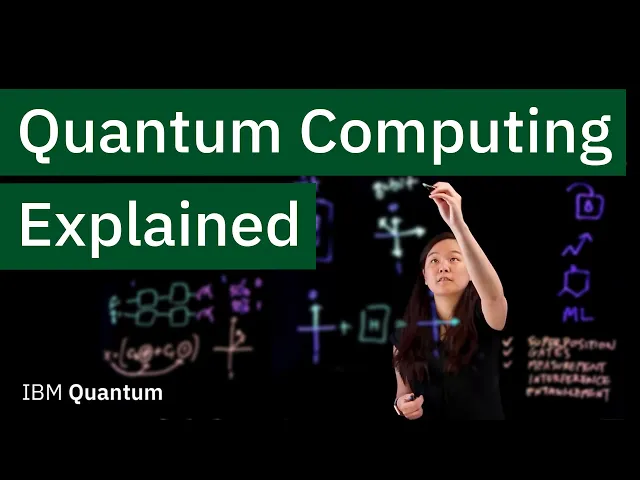
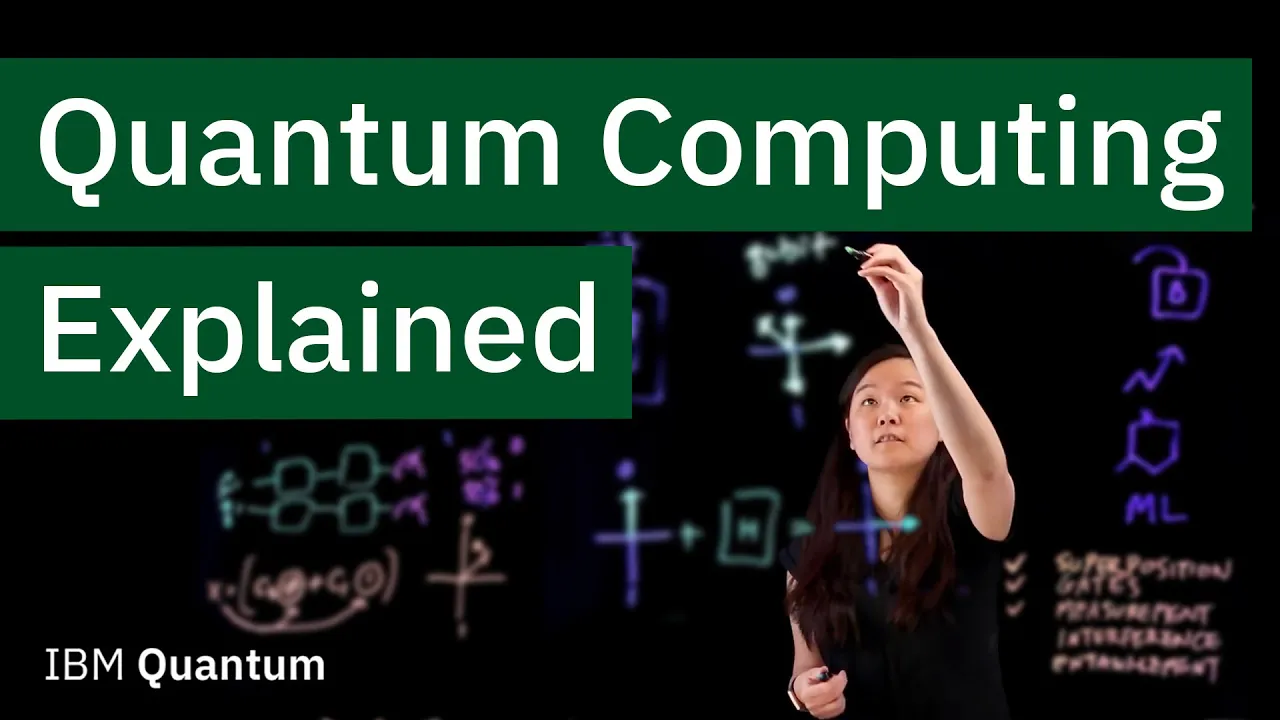
An ideal quantum computer can break the encryption standards we use today by finding prime factors of a large integer in just minutes instead of the thousands of years it would take for a classical computer to do. But before you start to panic, while we have real quantum hardware today, it's not quite powerful enough to do that just yet. However, technologies are advancing faster than ever.
The cell phones we have today are more powerful than the mainframes that we used to send people to the moon. And the researchers believe that we will soon be entering an era of quantum advances where quantum computers will be used to accelerate classical computers, just like GPUs. In this video, I'm going to talk about five foundational topics in quantum computers: superposition, gates, measurement, interference, and entanglement.
But before we dive into that, let's first talk about bits. Classical computers that use bits which are like switches that can be a 0 or a 1. This way of computation has served us well.
So well, in fact, that almost all modern computers work this way. However, this approach doesn't solve all the problems that we have today -- problems that can blow up exponentially and would take a classical computers decades or more to solve. We already talked about the algorithm we use for encryption.
Other types of difficult problems include optimization, chemistry simulation, and machine learning. Now let's talk about our first topic, superposition. A quantum computer does not use the simple 0 and 1 bits.
Instead, it uses qubits. Qubits can be a 0, a 1, or any linear combination of the two. This spectrum of states is what we called a superposition.
Our next next topic is about gates. Similar to classical computers, we use -- we string together qubits using a construct called gates that can alter the states of qubits into circuits. For example, we can have a qubit that's at the state of 0.
Then we can use Hadamard gate, or H gate for short, to put it in a superposition between 0 and 1. And, of course, you can have multiple qubits with multiple gates in a circuit. For the circuit will be useful, at some point that you need to read about its outputs.
Which brings us to our next topic, measurement. When a qubit is measured, it loses its superposition and collapses into just a simple 0 or 1. That means an arrow pointing this way does not measure a 0.
5, instead, it has a 50% chance of measuring a 0 and 50% chance of measuring a 1. It is this in-between state that sometimes people say that a qubit can be a 0 and a 1 at the same time. It also means that just a small number of qubits can represent a large amount of information.
So for our next topic, interference, we begin by addressing a common problem -- common question -- why is it that quantum computers can outperform classical ones? So, if you remember, a quantum state is a linear combination of the 0 state and the 1 state. So, an operation applied to this can be seen as applying to the 0 state and the 1 state, doing two calculations at once.
It is this parallel computation that gives quantum its unique advantage. However, as you may recall, when a qubit is measured, it loses its superposition and collapses into 0 or 1. That means we can only get a single answer instead of all the answers from this parallel computation.
And to make sure the single answer we get is a correct one, quantum gates need to be arranged in a way so that it would amplify the correct answer and cancel all the incorrect ones. A process called interference. Now this leads us to our last topic, entanglement.
When qubits are entangled, their states become strongly correlated. That is, changing the state of just one qubit would change the state of another. For example, we can entangle two qubits so that their states have 50% chance of measuring a 00 and 50% chance of measuring a 11, but never a 01 or a 10.
In this case, if we just -- if we change just the state of one, the other one would also change. So with the combined power of superposition, interference, and entanglement, quantum computers can solve things that classical computers simply cannot do today. It can lead to better drug -- better drug discovery -- or enhance the stock portfolio or even artificial intelligence.
Now we just need to wait for the quantum hardware to catch up. Thanks for watching. If you have any questions, please leave them in the comments below.
Also, please remember to Like this video and Subscribe to our channel so we can continue to bring you content that matters to you.