all right so principals my nest what we're going to cover today is how an works and what we use them for appreciate why we need to a denier nests with other senses and then we're going to look at the effects of other sensors on I&S performance as well as the effect of a 9s on other sensors performance which is which is the reverse of that or the vice-versa of that the first of all what is and is anybody tell me put it into the chat or put it onto the screen there is an obvious answer
because it is an acronym so what is an earnest and you ready tell me national navigation system excellent stuff thanks Adrian good stuff short navigation system okay right so that's their that's the acronym doubt dealt with what does it do can anybody tell me what it does in a couple of you know a couple of words just just tell me what they think and I NS does clear those on staff navigation system I can see in the chat as well thanks for that guys but what does it do underwater positioning to a certain degree yes
aids subsea navigation in absence of GPS excellent gives the orientation and position of the vehicle it certainly does all these add up into into one 9s does any other artists Oh precise 3d special relative positioning okay yeah one way right knit but yeah definitely Joby's put into the chat real-time heading pitch and roll its yeah that comes into it but it's a bit more than that actually a bit more bit more involved than just real-time heading pitch and roll but you certainly get that information from the system okay good some good answers there dead reckoning
a cell that's the words always looking for gold star - ASIS a dead reckoning okay before we go on with what an AI NS actually is and what it does it may it's usually good to put into context straight away so what we've got on the screen here is a commercial airliner and these systems are used in commercial aircraft to circumnavigate the globe obviously this particular moment in time there aren't many of them up in the sky but but when they do eventually start to start to fly again they will all be using inertial systems
in order to navigate themselves across the oceans etc etc okay the actual definition for a 9s just so you're aware is it calculates the position of a body based on knowledge of a previous position and subsequent movement from that position okay so somebody said earlier a sir said dead reckoning so that is basically what dead reckoning is you give something a starting location and then we we utilize information available to us from that starting location in order to predict our next positions in time okay so dead reckoning we've talked about dead reckoning actually comes from
you know more of a maritime industry type scenario where you've got a surface vessel and usually a surface vessel would be traveling at a constant heading and usually a constant velocity okay so it's very easy once you've got an initial position for your surface vessel it's very easy to predict your next position in time because you've got a constant heading and constant velocity but obviously we're not interested in that because we at Sona Dayanara subsea positioning company so we are positioning rvs you can see on the screen there Eevee's and subsea all sorts of shapes
and sizes these days so particularly our RVs do they travel on a constant heading and a constant velocity question put it into the past dismiss now if you want thumbs-up or a thumbs-down or a cross or just put yes or no into the chat do they travel on a constant heading or a constant velocity usually steve says no good stuff to tears you sweat Sweeney says no don't you thank you yeah they go wherever they want they did thanks I mean yet depending on the pilot yeah so lots and lots of heading maneuvers lots and
lots of upwards and downwards movement as well don't forget and very rarely do they travel at the same velocity unless they're doing some kind of survey run where they're trying to maintain the same velocity okay so we obviously need from out from a positioning perspective in order to predict our next positions in time we need to know real-time information about how that vehicle is moving okay in terms of velocity heading changes pitch and roll changes and all that sorta okay so we need to measure the real-time changes in velocity attitude in order to update our
position estimations how do we do it tell me what do we use in order to maintain these these changes in velocity and attitude maybe tell me into the chair onto the screen if you want there's some systems that we utilize in order to get this information any takers a house system in SPS yeah certainly comes into it motion sensors in the gyro steve says accelerometers good stuff just when he says dvl for us it says gps potentially yet if we're at the surface we could utilize a ga gps or GNSS accelerometers good stuff so we
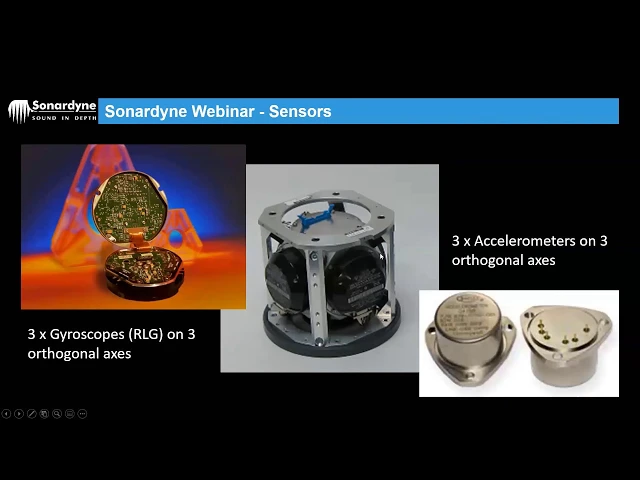
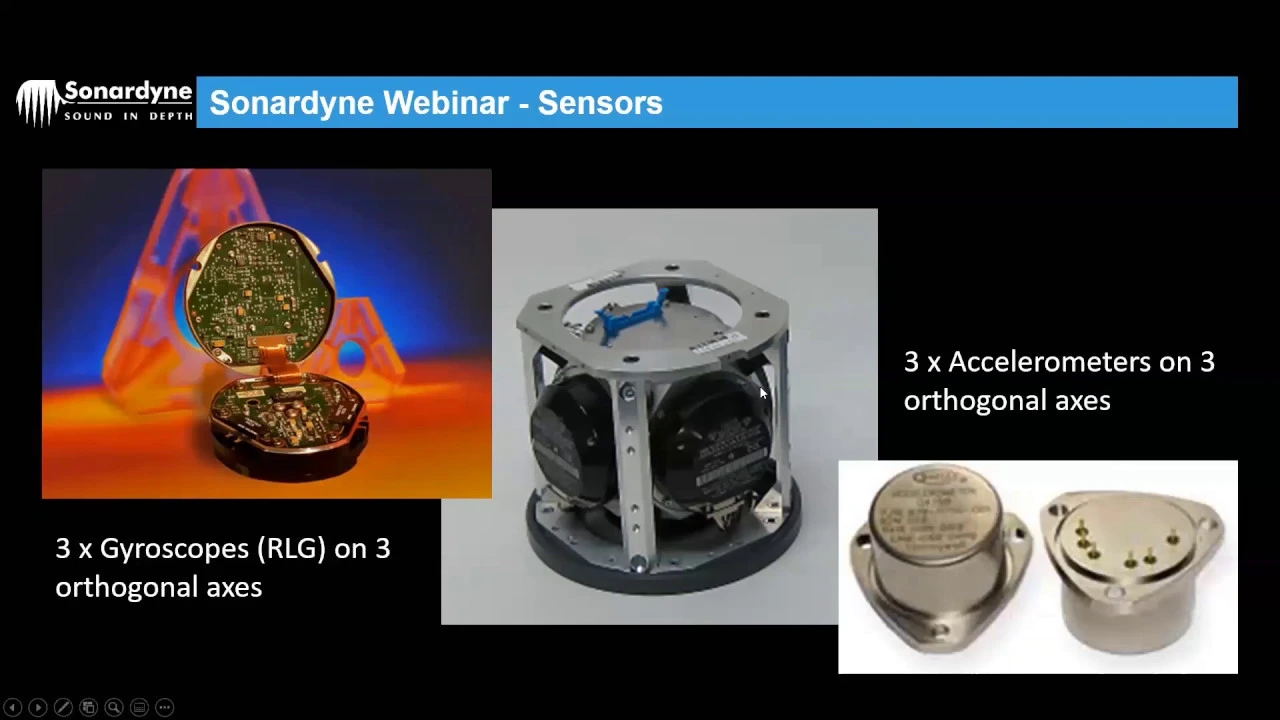
got gyros and accelerometers so what have we actually got exactly right we've got three ring laser gyros and three accelerometers in this particular case okay so I'll come on to why we use ring laser gyros in a minute but basically we've got one ring laser gyro for each axis orthogonal axis and then we've got three accelerometers at one for each axis okay so on the on the picture in the middle here you can see this is an older system but the principle is the same we've got two gyros here we would probably have a third
dryer on the underside of this this particular cube formation and then the accelerometers over here would make up the other sides to this cube okay so there'd be a sensor for each axis which allows us to measure you know take gyro readings for each axis as well as accelerations that he chances so the reason we use as soon as I honestly use ring laser gyros is is because their stability is very good almost straightaway once you power these things up where is that the other type of gyro on the market the fiber optic gyro which
you sometimes see in these systems is more susceptible to temperature change and vibration and so that requires a little bit of a calibration if you like in order to get them to be to read sensibly from from the off so ring laser gyros are much more stable to start off with so that's kind of why we use them they're also used in commercial airliners as as I said earlier so they're proven technology there they're built to last which means you know if these commercial airliners were falling out the sky or ending up in the in
the wrong destinations all the time they're not see that would prove that these systems aren't good but they're proven overtime proven over a number of years and that's why we decided to utilize them in our system okay so three ring laser gyros three accelerometers they make up what's called the IMU which we'll talk about in a minute but before we do that let's talk about how they work okay so on the screen here we've got a basic picture of a ring laser gyro okay so on the picture we've got this laser here this laser source
we've got a circuit in this particular case it's a triangle usually these days they're in a square formation so it's a square circuit where light is sent in two different directions from this laser circuit okay at the far end here you see we got this readout sensor so what happens here is that it's the two beams of light exit the ring and what they basically do is the detecting end we see if you think of the two two beams of light as two counter-propagating waves that's the blue and the green waves in the diagram on
the left-hand side here okay so if the gyro is stationary it's not rotating at all then the two beams of light would be equal and these two waveforms would be in phase with one another they'll be overlapping each other gain meaning there's zero rotation and you can see what's happening here when the peaks and the peaks line up and when the when the peaks and the troughs line up we've also got this other frequency that's that's appearing called the peak frequency this this red frequency okay if you're familiar with the way these these things work
with we're talking about constructive and destructive interference but basically we're analyzing the interference pattern between these two waveforms to counter propagating waves traveling around this ring and where when when when they're constructive we get a peak in the bead frequency and when they're destructive it flatlines and what we're basically saying is that we can analyze using that beep frequency we can analyze the the amount of rotation this particular body just to put that into into simple terms is right now the the two paths for the beam of light are equal because there's no rotation okay
so we can assume that that there would be they would be both arriving at the same time in phase with one ana which means there that there'd be no beat frequency develops because there's no rotation okay if we rotated the body and bearing in mind would rotate the whole thing here this is the whole whole ring is rotating relative to space one of the one of the paths the beam of light is actually having to travel slightly further than the other okay so depending on which way you rotate one of the wavelengths is shortened one
of the wavelengths is extended and what you effectively see at the detecting end is a change in the face you know the way the way these two the interference pattern of these two waveforms okay so what we're basically saying is as we rotate the body we're going to affect the the interference pattern which is directly going to affect this beat frequency that exists okay and the beat frequency is basically going to be proportional to the accumulated rotation of the gyro itself same if you rotated the other way we're going to see a difference in that
in that arrival time for each waveform and that's going to adjust the beat frequency accordingly as well okay does that make sense to everyone just give me a tick or a thumbs up in there in the chat that's the basic principle of a ring laser gyro is the beat frequency is proportional to the rotation stuff okay seeing ticks and thumbs up which is nice okay all right what about accelerometers so this is quite a simple accelerometer but it's a very good way of explaining the way an accelerometer works okay so what we've got here is
a mass on a pivot or a pendulum if you like and we've got these two talked coils either side so when the mass is in the center with we're basically saying there's zero rotation and we are applying a stabilizing current in order to keep that mass in the center okay so that'll be zipped that'll be pretty much zero current effectively but it but it's the null point where the pivot is is stationary okay them at the mass is stationary but let's say we got an acceleration in a direction look what happens to the mass it
swings on the pivot the opposite direction to the acceleration because it's certain it's just it's a mass on on a pendulum so in order to keep that mass in the center we apply a current to these two talked coils that would push the mass back to the center and depending on the amount of current that we apply to these taut coils that is again proportional to the acceleration reading from this from this accelerometer same the other way if we accelerated this way we would apply the current in order to push the mass back to the
center okay but basically we apply current whatever that current is reading is proportional to the acceleration reading that we get from these accelerometers I make sense to everyone just ticking thumbs up just just and make sure you're following along with that bit as well and your thumbs up to ticks if you like good stuff okay if you're not happy if we've got any further questions by all means fire them into the chat and we'll do our best to answer them okay so as I said earlier those two systems the accelerometers and the gyros they make
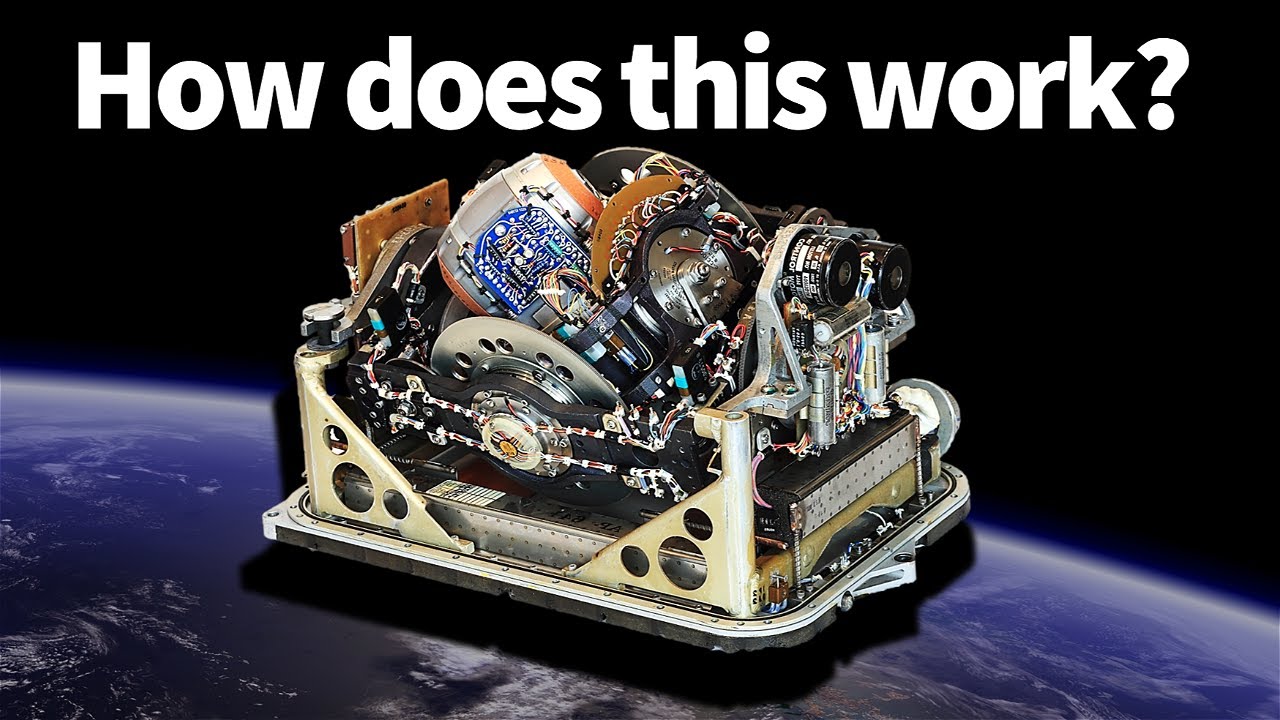
up what's called the inertial measurement unit and the thing you saw at the beginning in the center the center picture with the cube formation of all those sensors combined together that would that is an IMU effectively so that's an inertial measurement unit which allows us to provide data for rotation about you know the angular rate from the gyros and acceleration along each axis using the accelerometers so basically we're getting lots and lots of accelerations angular accelerations and linear accelerations from these two system a good way to think about the way these systems work is let's
imagine I put you're in the passenger seat of a car and before before we go for a drive I'll show you on a map where we are I give you an idea of where we are on the map you're you're then gonna basically estimate based on the movement of the vehicle where you think we're going to end up okay so before I take it for the drive actually put a blindfold on you I then take you for a drive for about an hour round round this the area on the map and as I accelerate you
get thrown throwing back in your seat as I break you're thrown forward in your seat and as I turn left and right you can sense that movement okay so this inertial measurement unit that we've been talking about the combination of these accelerometers and gyroscopes they are actually going to sense the movement of the vehicle that they're connected to in much much in the same way as you would if you were sat in the passenger seat of a car your your your your your sense of balance and all that sort of stuff you're going to be
using in order to sense the way that vehicle is moving okay so a good analogies always always this this type of thing once I have finished the the drive you know we've taken taking it for an hour's drive I then show you the map afterwards and you would potentially have a very good idea of where you think we are now based on the movements and the things that you've sent and that is basically what an IRS does is it uses its own internal sensors in order to predict its position next position in time using dead
reckoning okay does that make sense to everyone tics and thumbs up again please just to make sure you're following along thanks ASA yeah but yes in the chat as well if you want to create stuff okay so the actual definition for an IRS the way it works is the proper integration and that's the mathematical integration of acceleration into velocity and velocity into a position okay so what we get what we've talked about so far is is raw gyroscope signals and raw accelerometer signals okay so initially the whole system is going to derive some kind of
orientation it's gonna it's going to need to know that it's up right all or or where certain things are okay so one thing it does initially as most gyros would do is derive where North is okay so utilizing the gyroscopes and accelerometers it's going to have to in order to derive north it's gonna need to detect other bits of information in order to define that direction okay so what do you think is going to be used by these systems you know these accelerometers on these gyros what forces are acting upon it now or more more
specifically what what forces are acting upon you guys Satur your desks right now maybe tell me that thanks Adrian yeah so we got the Earth's rotation but we are actually accelerating through space at this particular moment in time what else what other forces are acting upon it or acting upon us right now gravity excellent okay so as rotation gravity hit the nail right on the head there with both of them so these systems are going to be sensitive to both of those those elements okay so the accelerometers specifically the one that's going to be that's
going to be on the axis that's sensitive to down is going to be detecting a gravitational force thanks Ben yet gravitational force yeah so the accelerometers are going to be detecting that for that call in the downward direction okay you also said Earth's rotation so they're also gonna be sensitive to some kind of earth rotation speed and the earth rotates in the easterly direction certainly in the northern hemisphere and so by knowing where down is from the gravity fall and by knowing where East is we can determine where North is okay there is a picture
so what you can see in the picture here is we've got one of our inertial systems you can see we've got a gravity vector towards the center of the earth and what it actually does is is monitors the systematic change in that gravity vector as the Earth rotates in the easterly direction because monitoring this information and building up a model based on on what it's what it's sensing okay but looking at that picture what piece of information would be incredibly useful to this thing in order to determine what gravitational aspect to it to expect and
also what type of rotation to expect what piece of information can we provide this system with initially so that it that it starts to estimate gravity and Earth's rotation much better what what can we provide it with there's a clue on the screen really in terms of where that system actually is is SAP what piece of information what single piece of information would we like to give it excellent adrián latitude oh and they say yeah that's a Sagat there first though latitude yeah exactly so by providing these systems with latitude we are going to give
it an idea of the rotation speed at that particular latitude but also what type of gravitational component to expect to that particular latitude okay so you may or may not be aware that the equator the Earth rotates about 15 degrees per hour the further north or the further south you go towards the poles the less rotation there is okay until you get right at the pole and then there's this pretty much zero rotation okay but because we've got this latitude you know we can position you can give you the system and idea of where it
is on the surface of the earth effectively and it knows what type of rotation to expect in it and it starts to build up a model for all that all those those those bits of information okay at the same time it also starts to project all those bits of information into a real-world frame okay all we've talked about so far is the fact that we've got these raw sensors we got these gyroscopes and accelerometers in a what's called an instrument frame okay so that they exist in their own at their own frame but what if
we wanted to transfer that knowledge to all that information onto a real world frame so we actually know what speed were actually traveling you across the surface of the earth so in order to do that we utilize the same sort of thing we've got this North East down Convention so that is effectively going to project all those bits of information into a real world global frame which is north east and down okay because of that we now need to correct for a couple of things okay so we're at this stage here now so once we've
once we've converted all the information from from instrument frame to real-world frame because we're now in real world frame we need to actually remove those two things that we just talked about okay because right now if we we just sent a vehicle across the seabed across the surface of the earth the accelerations that we are reading will be subject to gravity and also Earth's rotation okay so we're effectively adding those bits of information onto our actual acceleration our vehicle acceleration but obviously we're not going to be interested in we're actually interested in what the vehicles
acceleration is only not without any other aspects involved okay so the thing we do here is we actually remove the gravitational component and remove the artifact which which comes from from Earth's rotation okay which leaves us with a true vehicle inertial acceleration if you like okay without all those other bits include so far just give me a tick or a thumbs up just to make sure you following because it's a little bit a little bit more technical I should say yeah good stuff okay excellent so once we've got this true vehicle in acceleration we then
utilize that we combine it with an initial velocity and as I said earlier the way these systems work is we integrate those accelerations into into velocity estimates and then once we've got velocity estimates we combine those with an initial position and then integrate those into position estimates okay which basically completes the whole process the this is obviously now what you want what you'd like to see now is it's a fact that if we've got any errors here in our true inertial acceleration yeah which could come from our raw sensors our gyroscopes then those incorrect accelerations
will be integrated into incorrect velocities estimates and those incorrect velocity estimates will be integrated further into incorrect position estimates okay so one of the downsides of our of an inertial system is obviously the short-term accuracy sorry the long-term accuracy is is not as good as some of the other system subsea positioning systems okay because we've got these these sensors they've got by their very nature gyros have a little bit of drift and if there is any drift in these in these measurements and we just left this system running then it would eventually have position estimates
that have also become compromised because of the drift of the inertial sensors okay so what I've just touched on there is answer to this once given a starting position the iron s will continue to estimate its position by dead reckoning okay so we've talked about dead reckoning but just bear in mind that although it's dead reckoning it's going to keep keep estimating position if there is any drift in in those those initial sensors then that might have a knock-on effect to your position estimate okay back to this just just to finalize the way these things
work is let's say I now take you for a drive for 24 hours okay did the same thing I showed you the map blah blah blah I put a blindfold on you and then took you for a drive for 24 hours you're gonna get grumpy and hungry but what you will do by driving for 24 hours and utilizing all your your sensors other than sight you will get very used to the way that vehicle moves maneuvers okay so the reason we the reason I'm telling you that is basically because the longer these AI NS systems
are running the better they get a predicting their position estimate based on on all their maneuvers and things like that okay but as we just talked about will that position estimate remain robust for extended periods of time as a question for you will it wear will it remain robust thumbs up now it will drift thanks a joinha so we kind of just talked about it a little bit but yeah exactly right no it does drift okay so a good example here it's very a very simple way of looking at it but over here we've got
our pirate ship let's imagine we're all on a pirate ship with it with a 9 s we've also got a GNSS could be an RT k position feeding us okay so we're gonna we're gonna have a 9s running with the GNSS feed but we're also going to maintain monitoring just the GNSS position as well brass for our surface fear vessel here okay so we've got GNSS where we're gonna disable the GNSS to the i NS and then we're gonna we're gonna basically go navigating if you like and over time you'll see that the green line
here is the GNSS feed so that's that's just GNSS feeding a vessel position so that can act as our truth and then the red line is our i NS solution but with GNSS disabled once the system had settled okay over time you can see the to drift apart the red line has gone into what's called free and national drift because it's got nothing aiding it okay and the green is obviously where we we actually are so that's our truth position so you can see there's a difference between the two and that's because of this drift
that we've just talked about all these you know any errors in those gyroscope measurements initially it's going to have a knock-on effect it's the RNs predicted position so how do we correct for it anybody tell me what we got available to us there's a clue on the screen what we got what other systems that were available to us that's going to allow us to stop this free and natural drip DVL thanks Steve yeah you SPL from a so good stuff well else TV do you SPL Tamil to helps that the Kalman filter needs information from
other sources in order to keep it robust and next to any external position sauce thanks Adrian yet pressure sensor good Steve yeah you've got most of them okay so all right thanks for that you SPL we've mentioned so we can use you SPL to aid our iron s system okay in this particular case that is all we are aiding this iron s system with apart from pressure probably but let's just imagine we've got just us be up nothing else on the on the graph over here you can see we've got a blue line so we
give it our system a good starting position but then for the blue line we disable or laugh all our eating sources and that goes into that free national drift that we just talked about okay so you can see it's an exponential increase and typically these systems you can see on the screen here it's about you know twelve meters in about four minutes which is quite quite a big drift that number is incredibly difficult to actually put a perfect number on because it will change obviously the longer these systems are running the more the greater integrity
they have so they may actually last a bit longer because they've got more confidence in the information they have already received but basically yeah it will be quite a quick drift on the graph we've also got a USB L which is the redline okay and you can see here as a period of erratic behavior could be thrust or wash noise aeration across the transceiver face okay so USB L behaves erratically but the key to the key to this this picture here is the long term accuracy of the USB our system is actually fairly good okay
it's got these periods where it where it it skips around a little bit but overall the long term accuracy of the acoustic system is very good okay the Green Line is our USB out aided ans and you can see it's quite happy all the way through even when the USB L decides to start behaving erratically the ILS is still happy until we get to this point here where it starts to respond to what the USB I was doing now what you think happens at that point what do they need can he tell me what they
think has happened why does it ride out and ignore the USB out for a period of time but then it starts to respond to it what's happening in retell just a couple of word answer you don't need to give Mia Albarn analysis of the onus changes in the waiting excellent Adrian yeah ignore in the false position yep so it's ignoring it to staff with a say yeah but Adrian Adrian's got it pretty close there changes changes in the waiting okay so it's not changes in the waiting in real-time basic what's happening here is is when
we get to this point when the USB L starts to behave erratically the I NS is saying actually I'm gonna ignore that for a minute because it hasn't actually sensed that it's moved okay it's going to continue on its path so you know back to the driving the car passenger seat of a car analogy that we talked about earlier let's imagine you got you were you were driving along and then somebody said that you were or a position came in there was 20 meters out to the left okay you're gonna ignore that bit of positioning
information because you haven't sensed that you've moved 20 meters to the left so you're gonna ignore it for a period of time okay but at the same time or actually getting less and less confident in your position estimate okay so your uncertainty is increasing okay so basically this period of time here you're you're you're quite happy to start off with but then because you're not getting any other updates from any other positioning system or anything your confidence is decreasing until this point here where your confidence has decreased that much that you'll believe anything anybody says
basically okay so one of those USP observations is going to closely match the Associated error with your position estimate and so you're going to lock on to it and say yeah I'm quite happy with that and so you start to respond to the USDA lob serve asians okay you can see how quickly it recovers once the USP ourselves down it does settle down very quickly so another thing this this this drawing shows is short term accuracy of a of an RN s is very very good but the long-term accuracy could potentially be compromised based on
on the centers that they're feeding it for so its own internal sensors drift over time and the long-term accuracy of an acoustic system is very good but the short-term there are short-term periods of time with an acoustic system where where they be they're not as good okay so by combining these two systems into an aided I&S system we're getting the best of both worlds we can also use brain dating or some people would call it lvl lbli and s or whatever but it's not technically lvl 80 guy and s because we're not feeding an lvl
derived position to the NS we're just feeding the range information from that LBL system and then we're letting the AI NS come up with its own position estimate based on that range information okay you may see it referred to a sparse array or hybrid navigation as well or sparse lvl I'm not going to dwell too long on this because there is a complete webinar on this next week and but basically we could utilize the range information from our LVL system as well okay we would need an iron s obviously normally with an LVL system you
wouldn't have an AI NS when it's a range aided iron s system then we utilized the range information into the iron s itself and that comes up with its new position estimates okay DVR was mentioned before so on the screen there you can see our syrinx most DV ELLs will give you what's called a frame velocity where they've got four transducer beams in contact with the seabed usually and they're measuring the Doppler shift as the body moves forward so all the body that the DVRs attached to us as that moves forward or in whatever direction
it's it's moving the frequency change back at the transducers is proportional to the velocity in that direction so by having these four beams in contact with the seabed they can actually record a vector a velocity vector if you like okay downside of the oldest type systems is they they obviously need four beams in contact with the seabed in order to perform that calculation to any high precision okay so that means you'll get one velocity observation being fed to the AI NS okay but one thing the syrinx does that the most are the DV else I'm
aware of don't do is we actually look at individual beam velocities as well okay so rather than just having one velocity vector being calculated we've got four velocity calculations which is effectively for individual observations going into the is every time we take a measurement with the system okay so that allows for greater precision it allows us to tightly integrate much better with it with with our inertial system it's more information from the inertial system and as as we'll talk about shortly but more information these systems get the better they get producing positions okay so just
if you're not familiar with it with a Doppler the way a Doppler works is you know you got you got your beams in contact with the seabed what they actually measure is seabed velocity because they as far as they're concerned they're not moving because they're attached to a body but the calculation is basically they'll get they'll get velocity in the direction of truck okay we can use pressure sensors or Zed positioning okay so obviously we've got we've got some systems in our in our raw sense of information so we got our Zed accelerometers they'd be
measuring our upwards and downwards movement but they would be predicting it based on movement okay so in order to assist them with with that feature in order to position the vehicle in 3d we're going to need to assist them with a pressure center of some sort okay just in case you're not he not familiar with with upwards and downwards movement yeah these vehicle do move up and down throughout the water column so in order to keep their position stable in 3d terms we obviously need the pressure sensor which leads us onto the internal algorithms themselves
actually what's in the bottle itself so we've talked about what's connected to it but what about what's actually inside so we talked about the way in our networks but we haven't actually said what else is inside that bottle that allows us to process information okay so here we've got you can see on the screen you've gotten a house processor and a lioness processor so I believe we're still the only manufacturer that has two algorithms in one bottle a houses attitude heading reference system and that will effectively give you heading pitch and roll and I&S is
inertial navigation system obviously as we've been talking about so we utilize the a has information the heading picked enroll information in order to feed the AI NS but we also utilize the it has information as a quality check but for heading pitch and roll for the iron s to compare against okay you can see at the top here we could utilize this system in this way where the ROV team simply uses the heading pitch and roll feed and then something like a survey team may take the Insp but therefore their full positioning so we can
sell this system as an a house or we can we could sell it as a full I&S capable system which brings us nicely onto our sprint them okay so you saw there we got pressure sensor in a DVR we've combined all that information all those bits and pieces into one we've mechanically aligned it we pre calibrated for you and so this is a this is a system that you can you can effectively mobilize fairly quickly and it will give you incredibly good performance okay so or everything's tightly integrated DVL and beams and pressure sensors and
all sorts of stuff so at all it's all you know it's got built-in offsets and everything associated with it couple of Mosiah mobilization picks just just saying you you get a context of how these systems are mobilized this particular one was on the back of the vehicle because because obviously the a lot of rvs these days there's lots and lots of bits and pieces inside so it's incredibly difficult to fit these things in you can see how high it is off the back as well so as long as the beams have got clearance the seabed
it's quiet it's actually a good thing that it's that high up because obviously you won't come into contact with the seabed when when these things sit down on the sea okay again another mobilization you can see again it's it's it's above the skids so it's not going to get damaged but if the if the transducers did get damaged then they're easily replaceable on these systems so and they can also cope they will still navigate with one one or two the transducers damaged okay another example there through that through a through vessel mounting system yeah sound
velocity measurements utilized for DVL compensation and then a nice one here we've got one that's pointing upwards so this was for a project where they were going to use the DVL to navigate underneath ice okay so in an upwards direction so far just give me a tick or a thumbs ups make sure you're all all right with everything then we'll move on to how how the Kalman filter side of things works and then just a few bits and pieces on observations good stuff okay so let's imagine the box here is the whole system let's imagine
it's a sprint now of some sort we've talked about the IMU which is the raw sensors that will kick out data to 100 to 200 texts and you can see here we've got Delta V Delta Theta so angular rates from our gyros and our accelerations from our accelerometer we saw the two algorithms earlier be a thousand the NS so the IMU data will initially go into the a house attitude heading reference system this will derive orientation it will derive when north is based on that latitude information and then that will kick out roll pitch heading
in heat usually after about ten minutes okay so our settling period for this this system is ten minutes once we've got role pretending here we could utilize that as a separate feed you know could be for the hour of eating potentially or a surface vessel of some sort also use that information to kick off the is okay so we've got we've got roll pitch heading heave information orientation information all we need to kick the iron s algorithm off is the starting position and that could come from a USB I'll hit or GNSS on the deck
or whatever then go through all those bits and pieces that we talked about where we're converting it to real-world frame compensating for gravity in Earth's rotation and then that will effectively integrate the velocities into positions and then we get these these position estimates okay so we got a house iron exposition and that will continue to dead reckon but obviously over time it drifts okay so in order to counteract the drift we've talked about it we utilize the addition of external sensors as the observations come in they are compared against the AI NS position estimate if
they agree with the RNs position estimate they get allowed into this error state Kalman filter okay so once they're in here if you imagine this is this is a giant matrix or mixing part of observations okay this is going to refine what's called the error States within that within this is this matrix and it will eventually spit out a correction for the position estimate okay so position estimate combined with the incoming observations it fine-tunes its position estimate based on the incoming observations and the error states associated and then it spits out this correction and then
basically forms a feedback loop okay so what this doesn't do is store the information from these observations it doesn't it because that would be utilizing lots and lots of memory it just updates the error state sort that the level of error associated with lots of different relationships based on the observations that is receiving okay at the same time it produces what's called a sensor model so it's actually starting to model the behavior of these external sensors and so it can utilize that information to start to reject if any of these start behaving erratically but let's
say you SPL started behaving erratically it would look to its sensor model and its own position estimate and it would say hold on a minute the USB I wasn't actually bouncing around like that a minute ago so I'm going to ignore that so now you can start to see the longer these systems are running the better the sensor model becomes the better the error states become and so it gets much better at rejecting external feeds which means it's much more robust okay and that's it that's the basic principle of the whole thing does that make
sense to everyone you tick or a thumbs up or just a yes in the chat excellent okay so just another bit of fun quickly based on the information I've told you this time we're gonna sit at the kitchen table and we're gonna make our way to the bathroom okay so what information as a human being have you got available to you in order to do that let's imagine you're blindfolded you're gonna get up from the kitchen table and you're gonna make your way to the toilet what what bits of information can you use as a
human being in order to get yourself the toilet yes boundaries Chris excellent app Steve sorry excellent boundaries yeah or all walls utilize the walls around you but what are you gonna have balance Adrian stairs that's excellent as well yes that's your internal sensors touch good stuff so when you are touching the walls hey Sarah you can't use your eyes because we're blindfolded so you're gonna have to sense your way to the toilet pretend you're a 9's so when you're touching the walls what are you kind of effectively doing you know how long your arms are
so what can we effectively say that is as one of our acoustic systems what can our arms basically pretend to be steve says proximity yet so proximity comes into it yet so you know how long your arms are so what could that be in terms of acoustic systems you know how long your arm is so that could be a something that can feed the owner dbl not filter something else that we're going to talk about next week in next week's webinar ranges yay excellent so imagine you know you the length of your arms you know
once you've touched the wall you know how far away from the wall you are so you can effectively say that's a range from from a transponder you could be okay so we're gonna safely navigate our way because we've got lots and lots of bits of information coming into our filter to allow us to navigate our way to the toilet okay stuff so just to finish with while we use an 89 s okay because one we can improve the performance of our acoustic systems okay you can see here we've got a you SPL example this is
a pipeline survey with an ROV it starts to the top here and goes down and then back up we've got us BL outliers and we've also got a period of acoustic loss if we overlay the iron s position you SPL derived iron s position us be lady Adonis position I should say ignore the outliers because of that filtering that we talked about earlier and it rides through the acoustic loss but obviously if this was a extended period of time then it may start to deviate a little bit like we saw in that first graph the
usb on obviously if you've got a DV L then that would obviously maintain position because as somebody said earlier waiting would be applied to the DV l for observations and the USB I would read e waited in that case oops but you can see this is our standard system sprint 500 survey grade we can actually start to push the precision limits of our of our USB our system by utilizing the RNs okay so up to four to ten times improvement in precision so we're pushing the boundaries of the limitations of our of our USB our
system so the deeper deeper we go with the usb our system the less precise they get but let's say we connect an iron s to them to the vehicle that we're trying to track we could effectively push that precision limit DVL just just without any acoustic systems let's save a sprint now for example let's again take the the sprint 500 you can see we've got a position error here of 0.07% of the distance traveled which is effectively if we did a one kilometer trajectory we can see about a 70 centimeter error at the end of
that trajectory okay so just using our Doppler is we're getting incredibly good performance from our navigation and this is actually an example that we did in Plymouth C let's look at the yellow line we ran for 74 minutes we traveled six point four kilometers we got a radial of our error of about 1.7 meters which is theoretically zero point zero two eight two percent of distance travel okay I think there was a couple of transponders at some point down the line as well but basically our DVRs performance in a straight line is still fairly good
okay but as I just said that is what we would call distance from origin error so this zero point zero seven I just talked about for the for the standard system 0.05 for the higher grade systems and 0.12 for the lower systems that is straight line accuracy okay so I&S is don't like traveling in a straight line as we talked about they like to have heading changes and things like that to feed back into the Kalman filter so what we've come up with recently is what we'd call typical survey error this is DVI Lyoness performance
because we've got lots of heading changes in a typical survey run line formation here we can drop that lower that error right down to about a 0.02 percent of distance traveled which is phenomenal for these systems so you know we're we're approaching here at a time where we don't need acoustic updates for long periods of time because the DVR Lyoness performance is holding up I'll position very well it's keeping it robust okay sparse LBL why would you use it it's its main driver is obviously a cost-saving measure but don't want to dwell on this too
long because we're going to talk about this next week but basically you can see in the picture here for a typical pipeline survey we would have with a full array we would have full LVL we've have transponders all the way around okay but you can see in the picture here we've just got three transponders and they're all on one side of the pipeline so we can reduce the match transponders we can reduce the calibration time and that basically reduces the overall cost of the project okay so we'll talk about this bit more next week so
hopefully most of you or you'll get onto that that particular webinar as well which brings us quite nicely to the end okay so just to summarize we can just worried using our nests and aided our nests we can extend the precision limits of a USB our system we always maintain a high update rate because the I&S is going to kick out in position regardless we can track a vehicle outside of an lvl array but that's something that we're going to talk about a bit more next week we can reduce the line-of-sight dependency to LBL transponders
okay if we dip behind the structure it wouldn't necessarily matter because our NS it's going to hold our position for short periods of time and obviously the big one for particularly this particular in these circumstances that were about to be presented with probably is everybody's gonna be looking for cost-saving measures okay so cost-saving measures associated with this technologies is also important so I just I can see I've just run over by a couple of minutes but that brings us to the end so hopefully you understand what a 9 s does how it's used hopefully appreciate
why we need to aid a 9s with other sensors and then we've briefly briefly at the end there looked at the effects of other sensors on s performance and also how we can improve these other sensors with a 9 it we are in the process of updating all our full courses to online capable so LBL will be online and all our other courses as well so you can contact us at the email address you can also get us on LinkedIn so please get in contact if you want more training but thanks for your time everybody
hope stay safe I hope to see you soon you