Uh first of all thank you very much Mark for the presentation it was very interesting and it's always a pleasure to discuss industrialization is a very interesting topic um first of all a table of contents of our presentation uh we have we were assigned to First summarize the paper then promote some discussion and then uh ask some questions and to to Foster Debate and then open the floor for more people to contribute uh so basically the to trying to summarize the paper very quickly uh the main argument that there's an important correlation between economic development
and Manufacturing industrialization that uh in in the sense developing countries need to learn from past experiences from the first or second generation generation of exporters England Germany uh you also Quote msms uh the rise of the rest China Etc and a very uh interesting quote that you also brought to your presentation the rise of China does not mean the end of manufacturing industry so uh again just uh briefly summarizing why to industrialize because of the special characteristics of industry or manufacturing so the korian laws economies of scale uh externalities in technological development uh quote from
the paper linkages uh alah hman uh The increasing income elasticity of demand so being more resilient to crisis uh and also rodri's idea of the production of tradable goods so wouldn't confine the the development to the produ the size of the economy and uh basically you argu that there's a window of opportunity uh because of manufacturing stagnation or even decline in certain sectors in China since 2015 in this labor intensive industry such as garment uh shoes shoe Making and leather due to Rising wages and uh labor standards and that these South Southeast Asian countries uh
such as Bangladesh Vietnam Etc are absorbing this demand through smmes however these smmes cannot absorb all this demand uh because of the size of of of the Chinese economy and this up uh leads to um higher wages and competition loss uh so basically what we can grasp from the paper is that there's this window of opportunity for African Countries industrializing uh by entering the global value chains in this light labor intensive manufacturing uh and this bringing a quote of the paper uh of the work working paper because we were assigned the paper and also working
paper uh so the international hierarchy of wage competitiveness uh is uh like you argue uh higher than the automation brought by digitalization or even labor standards uh or pardon uh environmental centers uh however I'd like to bring now The discussion to the table so will this industrialization really bring the special characteristics of manufacturing so to guide this discussion I'd like to uh talk about first of all what's the role of the state in the GVC industrialization and this uh risk of thin industrialization that there's some uh literature that talks about it uh so first of
all uh in this um insertion that you argue for so this industrialization or manufacturing by Entering the global value chains uh here I bring GFI so like the father of global value chains analysis so he talks about uh that he understands that the State uh uh needs to create this institutional uh Arrangement so that industrial policy needs to promote business directly and to build skills and capacity to the to the response of priv private sector needs so he understands that firms are Central to the analysis and that Imports are necessary to make exports so the
Role of the state is very um reduced and um to to to then promote uh this insertion so and and the main objetive of this insertion is to move into higher value uh added tasks through productivity and labor competitiveness uh but it's important to notice that uh in this uh insertion usually the for instance in um shoe making garments Etc you have buyer driven chains so this kind of leads to since the competition is done through productivity and labor Competitiveness or wages we have this rate to the bottom of both wages uh and standards uh
labor and environmental uh so here I bring uh some of the the authors or um papers that talk about this risk of thin industrialization because when you enter in this lowest uh um value added part of the global value chain like here we can discuss this myio curve everyone probably has seen it uh that will lead to a lack of diversification and integration of the Economy because uh it would fail to increase uh continuously wages and demand uh failing to to generate uh proper aggregate demand uh and and develop the domestic Market uh in the
sense that well we see that there's a correlation between uh the exportation and celeries but then when they reach the $300 uh dollar per month then they would not be um sorry yeah they they would not uh be reach first of all and uh they they they Would not uh be in this business anymore because they wouldn't be competitive so this would lead to a low equilibrium trap and they also talk about this confination of the gains within within the chains Laing to diversify in uh promote this integration to the to the whole economy and
here um just to like point it out that well there were uh experiences that uh there were uh there was uh structural Transformations within the this approach of uh industrializing Through enter entering the global value chains in the case of china uh but here like I did in my pre previous joint seminar and if you if you all want to watch it YouTube Epoch uh we have uh the role of the State uh in both IP and planning the political regime of China is very different and also the size and the scale of the economy
and here I invite andresa to continue thank you Professor for the presentation to add on what Enzo just Said we brought hosan hodan that it's also uh an important Economist to that talks about Economic Development and also industrialization plan and he states that the state uh has important role in planning industrialization uh because it's the best actor uh to coordinate Investments to achieve social outcomes but also is the best actor to do investments in different productive sector which brings me to the main point of hosin H that is In order to industrialize to kick off
industrialization in a country uh or a region uh you need to investing in a complete productive uh ecosystem meaning invest in different industry in different sector um and you need to do this like at once at one time like you need to do a big push of investments in the beginning and then uh the industrialization can occur in a more um organic way of course the state is is still present but the point of bringing That bringing this is to um ask how the this uh um talks with the idea of focus on one sector
let's say textiles and entering the uh Global value chain instead of uh create a whole productive ecosystem as he says uh and the point of doing this is to generate uh internal demand so you don't rely only on on external Demand only on exports and now we we also would like to bring some sectorial perspective from the textile and clothing sectors because it's um the Main uh sector that the professor brings in the paper uh and its challenge for peripheral economies so there are we brought three main challenge the first one is climate change uh
because uh the textile sector corresponds to more or less onethird of the global emissions also it super resource water consuming uh sector and contributes um like significantly with the pollution in oceans and because of this uh climate policy civil society and consumer demand May push for changes in the production here are some of the new Pro process that can turn the production uh more uh environmental friendly let's say but uh our we were wondering if the um comparative advantage of developing countries in have uh lower labor cost could be outweighed by these new requirements and
talking about subaran Africa they have uh the electricity grid for instance it's based on coal so how uh they can increase exports if for Instance new uh environmental regulations from the importers such as related to carbon content and environmental friendly process May uh have an important role for the upcoming years second trade and globalization so after pandemic also was showed in the graphic brought by the professor China um kind of increased the market share the after the pandemic and it's expected that Asian countries will continue to lead in the near future the exports in The
in the textile and clothing sectors uh there are growing markets in Africa such as Ethiopia and Kenya but it's still very concentrated like in in a few countries so how can we think and plan industrialization in the level of a whole region if we are um relying on a sector that is super concentrated today uh in a few uh countries and finally uh the Advanced Technologies in the sector although the textile and clothing Industries have traditionally been slow To adopting new technologies this has been changed due to the crising co CES of these Technologies uh
and also because of the tendance of near Shing so they are using more uh techniques related to digitalization Etc to uh near the production the the this the process uh of production of textiles and also uh this near sharing process also is being pushed by a rise in protectionism and for this topic there are two diverging views one that says uh the workers in This sectors are at right risk of Automation and the other view that says that okay the cost saving and efficient uh gains of uh of automation may not outweight the competitive advantage
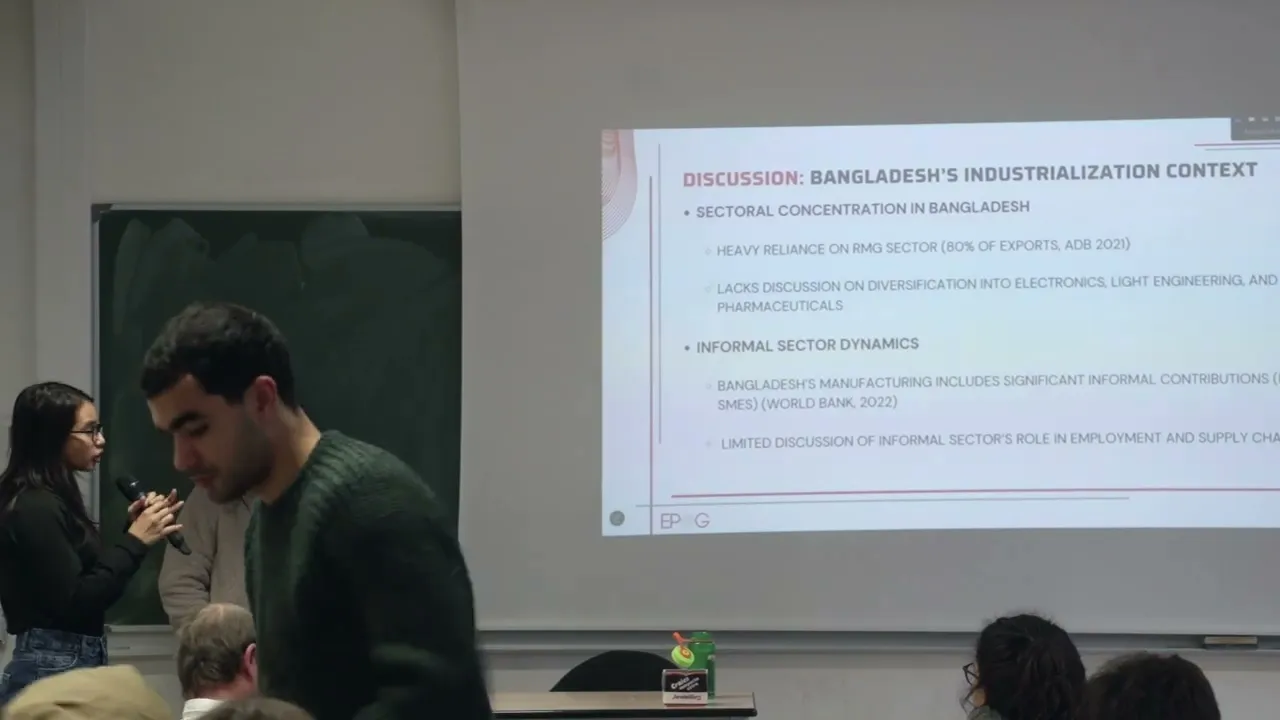
of labor cost so we also like to know uh from the professor war is your view about this and now we are we also brought the case of Bangladesh to to enlarge the discussion uh now I would like to discuss about the industrial industrialization context based on Bangladesh so Bangladesh um industrialization part is heavily reliant on redimed government sectors um uh like uh textile sectors which accounts for over 80% of the country's exports um Bangladesh dependency on redimed government uh uh sector exposes the economy of global demand shocks such as those uh we can seen
during the covid-19 pandemic and underscoring the Argent need for Diversification while our discussion paper emphasizes manufacturing as a whole its analysis doesn't adequately reflect the uh vulnerabilities associated with s sectoral concentration also potential growth areas like Electronics um light engineering and pharmaceuticals are underexplored in the papers framework despite their importance for reducing uh economic risk uh also the role of the informal sector particularly in small and medium Enterprises is important factor in the developing countries like Bangladesh manufacturing landscape uh informal manufacturing which includes activities like uh local government production and small scale engineering significantly contributes
to employment and local Supply chains uh our paper uh the discussion paper briefly acknowledges informal manufacturing but doesn't delve into its specific implication for developing countries like Bangladesh Where informal employment uh constitutes a substantial portion of the workforce in the next slide uh infrastructure and localized challenges hinder the broader industrialization of Bangladesh for example persistence energy shortage and ineducation uh inadequate Transportation networks limit the scalability of manufacturing Enterprises so in this paper Global approach uh lacks the specific City Required to address this localized barriers which are critical to um enhancing developing countries uh industrial competitiveness
and lastly environmental sustainability and label labor standards labor standards uh further complicate the industrial landscape so uh uh Bangladesh redimed government sector which economically vital has been criticized for its environmental impact including water pollution from dying Processes um and for inadequate uh labor protections so I uh we feel like uh in this paper uh the paper doesn't uh sufficiently addresses the need for sustainable practices and the compliance compliance with internal International labor standards both of which are critical for long-term industrial growth in developing countries uh to conclude with the uh discussion paper analysis is valuable
for understanding Global manufacturing Trends its relevance to Developing countries like Bangladesh industrialization is limited by its lack of focus on diversification informal sector Dynamics infrastructural challenges and sustainability concerns so we believe tailored strategies addressing this issues are necessary for ensuring that manufacturing remains a viable engine of growth for developing countries now we are opening the floor for the questions and discussions thank you Of course okay thank you very much for this uh comments uh we start start by saying that for the first uh comments commentators thank you very much because your presentation was in fact
better than mine and it was a really good thing and the issue um uh that we underline after are quite relevant it will be difficult to answer to every point so uh just I wanted to precise that these papers came from a larger studies that Was published for the IFD uh which is 200 or 300 pages in which a number of issue rised has were treated or discussed at least okay but of course not in the in the paper that were that we shorter okay first about the role of the state and IND industrial policy
and so on renin Ron built a full productive ecosystem and so on I of course I agree there is no issue but in fact we are dealing or discussing about countries uh of very poor countries they have a lot Of needs a lot of needs sorry but a shortage of resource if you speak about Bangladesh in fact until the last 20 years in fact Bangladesh was the the example of the a country in complete poverty with almost the same very low level of income per head it was no there was no productive sector except agriculture
I mean it was one of the poorest country in the world okay so it started to uh to grow a little Bit due notably to the expansion of the G export sector which gives effectively that's right very low wages and the labor condition are not good and so on but in fact if you have millions of young women mostly that came from the countryside to work in these very bad factories uh in Daka in the city of Bangladesh it means that in fact the situation for them was worst okay uh in the countryside so it
just it becomes more apparent because they become Integrated into Global Valu chain and they are more visible okay but if they continue to move and to accept such low wages below $100 very often bad working condition in fact it means that their condition their labor condition their life condition were worst before okay so be cautious when you consider that in fact the situation is bad in this Factory that's right but the point is that the situation is worse outside the factories in the countryside otherwise You won't have such hundreds of thousands of of young people
that would move to the to the cities and to these factories uh so about industrial policy I'm right but point it's that you have to enter the manufacturing sector and when you have no Capital no technology no qualification very often even no internal Market or sufficient domestic Market there are not not many um ways of um spinning up the growth process um and It has been shown by the earlier uh fast growing countries in Asia and that um export uh sorry export orientation was a way to speed up uh the growth process and you start
with a product for which you can find some competitiveness and when you have nothing the only competitive Advantage you have is are the low wages it's not a good situation but it's the situation okay and after that the Question is how you move out from textile and La at this point you need industrial policy as you say very rightly but at the beginning I I was invited in in Algeria early November by the ministry of Industry because they wanted to Target to Target uh European investment to reindustrialize Algeria okay but they did not know what
to Target they wanted to Target investment that create job but were green with also with high value Added and so on but in fact it was it's not possible if you consider the basic situation of the Algerian economy now you have to make some tradeoff at the point um so I move to the end of way so the big push well okay the big push it means you have money okay the problem of the big push it was said by say so the balance growth Theory sh if you can uh develop such a Str stry
it means that you are already a rich Country because you can invest in a lot of activities in a lot of infrastructure and to complete that will be able to complete them themselves so but it is not the starting point you start with a poor country which has not the resource to invest in all as the components of a full productive system so you have to start by some parts and you this is the issue of Leverage linkages and so on and internal demand well look at Bangladesh Or Ethiopia and these big countries they have
a large population but the internal demand is very is very small especially is a formal internal demand for manufacturing product so of course you can build uh your investment project on the prospect of the internal demand expansion this is a fantasy of the African middle class for instance are number of figures about the size of the African middle class you know these African people that buy BMW number of computers and so on but in fact if you look at look at the figures they do not exist it's very very very small you have a small
class of eer rich and then uh the consumption power of the population is very very low so you it's long to build the growth process on the interal Demand only especially if you have the opportunity to Bas part of your growth of your investment return return on uh foreign demand which is more Dynamic and And bigger uh well the point of technology is very interesting it's important of course but in fact in most of the labor um intensive production the prospect so far for the next 20 years in 50 years I don't know but for
for the next 20 years the prospect is that the impact in terms of um uh Capital substitution uh to to workers is very low is very low because this shirt is not going to be made by a Computer or manufacturing assisted computer there are limits to automation so there is of of course new technology but in terms of cost competitiveness so far it's not there is no the the the prospect it's that the impact especially on the size uh on the of the number of workers in these industries will not be very important I don't
know if you remind the history of the Adidas Factory in Germany there try to Relocate uh shoes Mak Sho making in Germany in a fully autom uh Factory it failed in fact because still there are a lot of tasks that had to be made by workers or still um it's less costly when it's made by workers so so far in the next 20 years the impact of Automation and Technology change will not modify strongly this Trends maybe later but not at least in the major labor intensive Industries wait So it's a way third question the
third question in light of China sorry I move back to the to yours Point wait so night of uh China change uh the strategy relevant for for po countries one of the way China has start tried to to to answer to this question has been uh through investment in in these countries but in fact most of this Investment has not have not been very um job let's say job creating so far or growth enhancing so far so there is no reason to believe it will change what is show that in fact there will be an
opportunity in this uh lower uh segment of the world industry in labor intensive industry in fact the research for the French development agency was made at the time when on one side you have such as rodick arguments saying that in fact Manufacturing uh development uh it was too late for developing countries it was finished it was no more um no more um a way to to develop a countries and on the other side you had the economist such as Justin ly which was uh who was at this time the chief Economist at the World Bank
and so on saying that 100 million of jobs will fall on Africa when in fact uh China will will um set up it it its transition so tried in fact to see whether manufacturing was still or Not um relevant way in terms of development and if there could be an opportunity for some African countries to catch some of the job so we we arrive to this to this result but um the major the major barrier at China will create for World development will not be in this uh low qualified activities uh it's in the other
way in fact it will there will be more opportunities for poor countries but at middle income level it will become much More difficult because due to the size of China in in Industry where economy of scales um uh technology acquisition and accumulation uh technological norms and so on and standards will be important automobile cars electronics and so on in fact it will become very difficult for uh competitors even from the north and to compete with China in the 10 or 20 next years for sure may I haven't the answer and last Point uh about labor
standards which you you were right it wasn't uh taken into account in the presentation but it's in the study we try to say that in fact the only policy or strategies that should follow development agency would be to insist on labor standards environment standards in order to accompany these countries in their entry into this low uh low skilled activities name and Country um I'm panoi I'm from India first of all thank you for your presentation so uh my question was that uh what is preventing uh or what is preventing the African nations from having a
sort of development trap that India is currently having now like you showed a figure uh whe for the export government share of Indian export governments it was constant throughout the years the same thing is uh the same thing holds for manufacturing value added for India for the past 20 20 years MV has been MV as a percentage of GDP has been stagnant for India so uh so and most of the uh growth economic growth is led by the service sector so uh shouldn't uh the state shouldn't uh like shouldn't there be an uh industrial policy
or state intervention that prevents the African nations from having the same fate of uh growth being led by the service sector and the uh primary sector alone and um the manufacturing sector taking a second stage of having a Um constant MV added to the GDP uh hi my name is nikil rampa I am also from India uh I have one observation on the Bangladesh model and then I will come to my question if you allow so the Bangladesh model um it became the Garment sector's uh in value chain product in the 19 uh post the
1980s and the it was the military regime that introduced this because of their business interests and this military regime also uh LED so many compliances Like it was excluded from so many tax other things and the wages remains subdued and a recent report of the current government shows that the Bangladeshi government of the past fudged the data so it's GDP per capita is 20% less than of India and it's not it's like it's basically a story of data fudging Bangladeshi uh government export story that's what the government has claimed second what I find interesting between
China and Bangladesh is that Industrialization in these countries uh didn't happen with democracy there was a severe Det eration of civil rights and and also the Democratic rights and what are we expecting like when you you coer people to work on Lower wages so are we also expecting African countries to undergo severe deterioration of civil rights for industrialization because these things are going handin hands and and India I mean in that case India hasn't Deteriorated that much but we have a different story to tell do we expect the same in Africa countries thank you for
your very interesting points uh let's start by the final Point your final point do you know the about the Democracy I was in Sagal in um one month ago do you know the to democracy quite vibrant do you know the average wage in Sagal do you have an ID well it's roughly the the official minimum wage is 100 EUR a month but many people earn less than that okay so it means that we are discussing about countries that in which uh the wages income level are very low I'm not at all wishing or expecting these
countries to enter in uh um uh in in in worst wage situation in fact this is the case in Bangladesh it could be the case in Sagal it had been the case in Madagascar for instance as I Said and it was the case in Europe in the 19th century and early 20th century when people move from the countryside to the city dirty uh expensive where the life condition are bad and the exploitation level in the factory and the activity is very high it's because the situation is worse four otherwise they won't move or a few
of them will move but not uh such huge uh huge number of people so you should consider that okay and about Bangladesh that's right About what you say as the figure was false and the previous government was really really dictatorship but still export figures are are correct I mean so it means that they have been expanding the export you're right about the GDP level per capita surely and but I'm not sure about the the the quality of the Indian data or at least the Chinese data are not very accurate as well but uh it doesn't
change much of the story it Means they have been able to to to develop one sector which is uh which has very low wages but still these wages are above far above the income level in the countryside and so the point about India was whether they should it should be better to promote uh the development of services yeah yeah that's true but so the question is but okay that's right about India but the question in and you are um in a better position to answer is It a good thing or not I mean is it
by uh per default by Def fact that the service sector is driving the growth it's because in fact manufacturing is not driving the growth so services are driving the growth uh is it a good thing for the sustainable uh growth and um the expansion of the Indian economy or not and if you make a comparison between China and India for instance uh you you can't find an answer in many countries in fact in many Of in Brazil in in in Africa in subsaharan African services are the most service are the most dynamic sector but service
is a vast agglomeration of very different activities and it does the problem is that services do do not absorb a huge uh volume of of workers uh such as in the man the manufacturing sector can do it so far and if you compare employment um uh Creation in China and in India for instance it's clear that without the Expansion of the manufacturing sector in China you won't have uh you will not have had that this grow even if the gross figure may be disputable I'm Arthur from the Netherlands uh and I was wondering uh if
you see since uh certain subaran African countries are also like uh resource Rich uh especially like with rare earth minerals uh abundant count would you see an alternative Pathway to industrialization through sort of Upgrading their refinement and processing of these type of Rare Minerals rather than this process through uh garments and leather industrialization sorry um this perhaps nicely ties in with the previous question I'm Sarah from Germany and I was wondering what your take is on how senseful such large country aggregations like subsaharan Africa are from an analytical perspective because yeah I I sort of
see why one does that in Research and all that but as you already pointed out there's so many differences and so many different positions to start from and really think about senseful industrialization strategies and where the limitations lay yeah which makes me think think about where where the limitations of this perspective are and where it is perhaps useful because I don't know evidently you see this cluster in Asia and stuff so there needs to be something to it but yeah I would Be curious to hear more about what you think about that next has no
sense to consider especially in terms of manufacturing development or any economic strategy that's right but just we it was K the the the initial the initial region we have to we had to to look at so uh we agerate but in the manufacturing sector the wall subs Africa make 1% of the world production So well it doesn't mean anything but in terms of strategy but we are back to the previous point in fact if you have to develop a strategy but was that wasn't the topic of This research it was to identify an opportunity is
is there an opportunity or not and what was the size of the reasonable reasonable size of this opportunity in terms of number of jobs but about the the the strategy it's another another topic but you're right of course and about your point on raw Material in fact it depends if you are Saudi Arabia you can of course have an oilbased economy uh in which most of the people are nonproductive but you have enough uh enough wealth from the from the oil to distribute income for a very long time to pacify or democratize if you want
or not the country but it's not the case in in African countries you can have you have resource but Nigeria which is the largest oil producer or exporter in Africa has not the resource uh to subsidize its whole population so it means you have to create other productive activities and as you know Dutch syndrome when you have a huge uh primary product sector such as oil it has a very negative effect on a number of economic Dimension especially cost competitiveness so it has been the during the the the rise of primary product price from 2005
to 2014 Alex as the rise of all prices decade of very High prices of oil and raw materials in fact uh so roughly 2005 2014 there had been a number of paper trying to reengineer the arguments about the Dutch syndrome say way but now it's different we can consider using new technology a better institution and so on that in fact as the primary product rent could lead to such a scheme as a as a one you suggest but in fact it failed I don't know where it works in Norway uh but Roughly that's all if
you look at Chad for instance Chad had one of the faster Chad which is a country in Center in the center of Africa had one of the highest growth during this decade and in the World Bank report they say it's a new emerging country it was in fact just because Chad was exporting oil the price of oil had double and the GDP uh the growth of GDP in Chad has exploded okay but it was not the productive activity the productivity the the the Productivity of the the workers and so on it was only rent an
effect of the price hike so so far it hasn't worked regularly and maybe if there is another external shock or new uh hike uh period of hike uh uh oil or or primary product prices surely will be new papers and New View on how to uh transform rent into producive activi and sustainable development but so far I can not see any result uh Enzo from Brazil again uh well When we talk about Labor competitive we need to think first of all of wages of course but also about productivity so when well African countries as this
new uh generation of exporters uh seem to like theone the Asian countries how do you see like the promotion of training or like increasing productivity in African countries and who should um like should the state do it or should private actors do it or how should it happen tal from Egypt thank you first of all For the presentation uh my question would be if there is room for African countries to industrialize within the current um global system or economic global system because as it's presented there are two options either industrialized and maybe they're going to
be having deteriorating uh labor conditions and there's going to be a lot of issues or they don't industrialize and it's going to be remaining the same thing so I was just Thinking like how can African countries move beyond that and industrialize if there's a chance hi I'm Thomas from Norway and you just mentioned Norway and the the oil experts I think one of the reasons why Norway was more successful than other countries is that they put their oil oil revenues in a big fund uh and I want to ask do you think this is a
possibility for for countries in subsaharan Africa with oil revenues too to Um to avoid Dutch disease or what do you think are the the the challenges to this or why uh why why is this more difficult there would you say and I would also want want to ask about the um CFA for um because in some of African countries including senagal they don't have control of their they use their own currency or they it's tied to the euro and do you think this is a how do you think this impacts the aspects of industrialization in
in these Countries round after uh first about training so in fact well I insist a little bit but it was a topic of the paper on labor intensive industry but of course this labor intensive industry are the worst the worst segment of manufacturing industry and but the advantage is in fact for poor countries is the lack of the very weak entry barriers in this industry and especially in terms of training in terms of capital A seing machine uh and workplace and it's enough almost two tables and you have a a garment Factory okay and in
terms of training it's almost the same in fact in a few few weeks uh a young woman from the countryside with no manufacturing experience will become uh not so productive but relatively efficient um garment makers in a factory it has been the process everywhere in the world in Europe before in China in South Korea And so on the productivity level you're right is lower is lower it's lower in Cambodia or in Bangladesh than in China and it's lower in China than in South Korea and Japan that's right but the way Gap is so huge that
even if your productivity uh is 30 or 50% lower you still competitive okay so in terms of it's not really training because in fact training is mainly organized by the by the by the industry itself it's more in terms of uh we are back to Industrial Policy in fact to to to catch this opportunity you need to have some industrial policy and institution already atively efficient an ability to design and Export plant uh to create um a business environment enough uh uh enough competitive because in Africa the lack of competitiveness in African manufacturing sector which
is small is not really due to the productivity of the workers it's mainly due to the out of the factory competitiveness so Infrastructure uh Port equipment transport equ equipment electricity Supply and so on this these are the major handicap of the in Africa in fact so the point was uh your point was on are so they have the choice between remaining at the same level of income or being exploited in factories that's right I would like to have the answer but so far in fact has no um uh no no no way identified as well
there are a lot Of papers on industrialization through services or the potential of new technology and so on but the problem is how you transform labor force or population with low qualification and low productivity so low income into a population with higher income you have to move uh to to to to move in this direction you have to increase the productivity of workers so we don't care about the sector but in fact manufacturing has more power to increase In Mass the productivity of a population than other sectors if you compare to a primary product in
the mining sector you can have very productive people of course but the employment level is very low you don't need much people to exploit to exploit a mine uh in the agriculture sector if you increase the value added through more intensive production and so on is the same you will need less workers so still you have the the question open of how do you Create 700 million job in Africa and in the service sector it's the same you are not going to transform the seven even is the education level increasing fast in Africa in fact
uh many African countries you are not going to transform the 700 young workers into lawyers engineers and so on so Bankers so working in high valuated services and the low uh the lower uh segment of the service Industries Co Center and so on It can create jobs it's what the case in in Cal in in Morocco in Mad in Madagascar in number of countries but the volume in India of course but the volume of jobs created is relatively small compared to the needs uh due to the to the grow of the working age population so
I haven't the answer and so the last point we are back to institution to institution the role of the state which was out of my scope here the role of the state how do you Invest or froze or freeze uh your your rent in order to to accumulate the capital and so on but it's another issue but you're right it's important of course but it's it related to institution if you compare Norway and Venezuela you have already Venezuela which has the biggest oil Reserve in the world which is a complete economic failure but you can
have an idea of the problem thank you for presentation I think now I'm a bit irrelevant because I Wanted to follow up uh Thomas Point uh I don't know like it's exactly IR relevant to like having state fund like separate fund from like um for oil is a best solution I am I did introduce myself I'm Zia from aeran and uh like in aeran in most oil rich countries they have as far as I know like separate state fund but it it doesn't change much because like they receive uh money to this fund and then
they transfer to fiscal budget or start doing subsidiaries for agriculture For example from directly from State from this oil fund which was supposed to be done from like fiscal budget so it's just changing the way how it works but in the end you end up being in Dutch disase so I think the the fact that Norway is so distinct from other oil rich countries is because it's uh State Building and uh industrialization happened before they discovered oil and for other countries it was like along with the process so like they just Trapped in this process
and they F found found competitive themselves in the World Market to sell just raw materials rather than investing in other stuff so I think like to my perception like two ways are possible either like uh climate problems or or like Extinction of oil and gas or natural resources in those countries where they forced to uh start doing other things or uh because they most of them are peripherial countries it's imposing like other um let's say Policy like seom or others like from West where they already don't find any other way but to invest to other
Industries and don't find competitive to just sell oil and gas or other other resources so yeah it's just I wanted to add to this comment I don't know what do you think about this hi my name is mar I'm from Germany I just wanted to bring up uh Thomas second questions about the role of current curency and um yeah and the Financial side of it and yeah if like um internal demand uh let or uh also depth development strategies could work in a different International setup of of Finance yeah thank you for your point on
um on the front the point is just take the the story go back to Chad history so Chad discovered oil maybe 20 years ago and suddenly it had the the prospect of becoming rich or at least emerging from being one of the poorest Country in the world but he need at this time the Chad government need money to invest especially in the pipe to to to export its oil and it negotiated a loan from the World Bank it was very difficult this negotiation the World Bank insisted a lot I think it was written in the
the draft uh that Chad should create a sovereign fund and save a share of the oil income for future generation so well they get they get the loans they build The pipe they export oil but the Ser in Fr had disappeared uh never existed uh so in fact the point is that ins tion first and resource resource as second I mean but is more important as institution so you're right probably about the freshness of this R for for a number of countries but I'm not sure in the case of Algeria since uh 60 years they
have this gas and oil rent it has not really helped to improve manufacturing Activities institution so so but not sure it works Soo well um key point is is quality of the institution of the State of the State policy and it's huge question uh the other point was an uh exchange rate or no currency well so well ma coming back to my speech my story the major difficulty of all this West African countri is in fact that c CFA is Over evaluated so it has to be it has to be uh The Exchange rat has
has to be reduced I don't know which way I mean uh through more independent monetary policies so getting out of the system or a new a new exchange rate but clearly if you look at China Japan South Korea Taiwan uh and so on they started to develop some export uh export promotion but at the beginning it was very very difficult by reducing their exchange rate by 50% devaluation Of a very strong devaluation and after they started to export it's clear that strong handicap for these countries now but still I think that if you compare domestic
poor small poor domestic Market with a huge vast and relatively Rich World Market um there is an opportunity to exploit to exploit the the foreign market so I don't think you can de it would be an efficient strategy to try to develop by by yourself in the current uh World structure World economic structure even China has has um to taken off by insisting on export and also attracting foreign investment which were controlled but the degree of openness of the Chinese economy was strongly correlated with the growth of the Chinese economy and and they had a
very huge potential uh domestic Market I forget something Hello um I'm Kushi and I'm from India um I um I want to just like I I had a question on the premise of the argument uh you mentioned that uh for let's say development we would need industrialization and in the example where let's say industrialization happened even in the case of Bangladeshi example they are working 60 hours a day on top of that they have their care work responsibilities with limited to no social protection benefit since it's all Informal so uh overall like it led to
maybe perhaps income growth but there was no real emancipation so U development in the truest sense which means that the well-being should improve Beyond GDP didn't really happen so is it actually leading to development or is it like is it just let's say an incorrect measure of development here any final question hi um my name is Matilda I'm From Germany um we've been talking a lot about Labor productivity and I think it was often kind of linked to the actual laborers and what they're doing themselves but kind of in an international value chain a lot
of kind of what decides how much value is added is also basically just the the legal system of who has the patent over production who decides to kind of just do the special adding of saying this is an H&M t-shirt um and not the actual Production of it and how does that play into this discussion as well um good afternoon my name is camil I'm from Costa Rica and I would like to know if you know um or some advises for those country from a third wage of industrialization after the United States United Kingdom well
and Europe uh what those country like India or Africa can learn from the process of industrialization of China can they apply it or is very difficult to to Replicate that model we are far from the initial story but uh so just about your point you're right of course but uh I mean it's a capitalism capitalism is exploit people and it Tres to extract profit and um value from everywhere everybody um so it's not specific to the to this Industries to Africa or Bangladesh or the same Everywhere and of course the the distribution of the value
is not um equal is um it is disputable and so on I agree but from the point of view of the country it's not really um it's not really the your major point is whether you enter or not this process and you have to you have to appreciate or to evaluate what you gain what what would be the expectation or the cost in terms of non-development I come back to the to Use your point what is development well may I ask you this in this country where um income level are rising less than what was
believed orade such as Bangladesh and Export are increasing or new relatively modern sector has been created how do you call it if it's not development but Economic Development well it's difficult it's difficult but I agree with you when you have very bad working condition and Living condition it's not uh it's not satisfying and it can maybe not be called sustainable development at least of you're right but it depends of the of the structure of the world uh industry but the World Market in fact the pressure the only in a capitalist system the only efficient pressure
that could reach this labor condition in a small Factory in DCA will come from the international buyer and the pressure on the international buyers will come only From the consumer or maybe from new regulation in um in the Western Market countries but it's not very powerful but there is no other way so far just in the case of Cambodia for instance in five or six years ago a number of workers same profile young woman coming from the countryside as a on you seven we um fall down why doing their work okay because not enough food
or to to hardworking Condition it wasn't very clear but there has been several episode like this in Cambodia that garment factories and in the following months there have been many uh activist action action in especially in UK but also in France in hm store the people consum Comm they fall down into the store in order to to uh to influence uh to influence this uh uh the buyers and indirectly to try to change uh the working condition in the factory and in fact in in Cambodia They launch well National Pro an industry at the industry
level they launch a process to create uh C in each factories okay a place where which will supply food to the worker every day well it doesn't work so well but in fact it has it had an impact but not very strong and it's quite strange to see that in the case of Bangladesh where has there has been a lot of very well informed case of bad working condition Falling factories and people die and so on that International Market and is a buyer still continue to buy made in Bangladesh shirts this is a capitalist system
unfortunately okay no there is not many alternative only one mon from France I just wanted to have your opinion on the per on the of the possibility of the a period of import industrialization in in the country that We talked about uh as we saw in several country maybe it's not the best one in Latin America but um yeah just um is it possible there is a second question so that are there other questions uh hi I'm chit Nan from India um just following up on this uh slight discussion that we had um uh raised
by Kushi uh I just want to say that uh your point of saying that since uh there has been development in terms of uh raising wage because uh women in uh in Countryside did not have options in say in Bangladesh before than the the manufacturing sector alone so just saying that a rise in w could be the way of uh the country to escape this trap uh I don't think is uh something really I mean despite the capitalist system can there be can there be uh ways of generating education bonds or um investment directly in
Social protection systems that can then raise employment in uh education sector or Healthcare Sector and then in the coming years lead to alternative ways of of uh developing the economy rather than just bare blatant industrialization leading to uh a loss of labor standards as well the international labor standard issue is very important is very very important but it it can change can only come from a strong pressure from International Organization possibly National governments and um let say Civil Society or or consumers that's all So it has for Bangladesh is worst example but labor condition have
changed for instance in in in in Cambodia in in the Garment Factory in Indonesia in a number of African country as through the in it's called better factories something it's led by the ILO it's a joint program by the ILO and uh development agency and there is also a program at the ILO which is wider in Asia at least I forgot the name but it's we trying to uh diffuse better social Norms working conditions so it's improving in fact it's improving even if we still have the case notably of Bangladesh which is not quite bad
well the problem of increasing spending for education social system and so on if you start from a very um narrow income basis you don't have the resource if you don't have enough productivity from from the from the basis from the uh if work labor productivity you don't Have the financial resource to finance much uh much uh spending in education social activities and so on even if it's necessary useful and so on it's not a point so it's a tradeoff in fact and all the Richer uh the Richer Asian East Asian countries they started with the
same kind of process as South Korea and Japan for instance the labor condition was not really really good at the beginning one of the point is whether you increase or Not when you become richer the share of the resource devoted to social spending and so on and this is one of the limit of the East Asian model for instance in South Korea in China and so on for instance there is no um let's say social state is very narrow even if this country has Rich are rich but at the stage of the Bangladesh there is
also a problem of a dictatorship it's not uh it's not so easy and in African countries which have Better institution also quite strong difficulty to finance this this activities but you are you are right but it should come the resource should come from foreign uh rather from foreign assistance but it's the great another point was on I forgot uh why that's a a good point but I have the impression that in the next the Following year in fact the advantage or the possibility of import stitution and the advantage of trade protection will come from from
USA and it will it will be diffused in the rest of the world but if you have a country big enough that's right you can have a a more import substitution and and um and prot trade protection but maybe uh it should be targeted a little bit not on all good if you want to create an electronic industry in uh South America it's not going to be easy and efficient at least rapidly question [Applause]