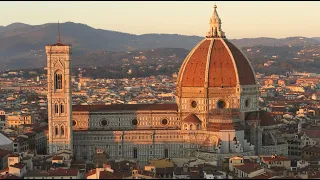
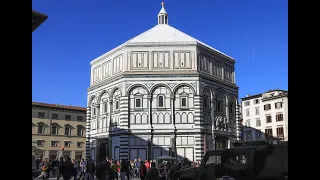
We continue our walk along Via dei Calzaiuoli that connects the religious center of the city with the administrative center. We talked about the details in the previous film and now we are approaching Orsanmichele proudly standing above all the surrounding buildings right in the middle of Via dei Calzaiuoli. I made this picture from the dome of the Cathedral in 2010.
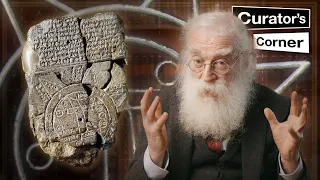
Here is a city map from the year 1470. We see the cathedral here on the left and the Signoria on the right with Orsanmichele right in the middle. Well, but what is this Orsanmichele?
Is it a church, a granary, a garden, a stables? All that and more. .
. Indeed, if we trace the history of Orsanmichele we will see nearly the entire history of Florence. .
. . In the good old times there was a stable.
Some Michele worked here helping his father. He was so virtuous that after work he helped the poor, took care of the sick, brought food to the people in need and so on. People began to consider him a saint even during his lifetime.
When he died suddenly and miracles began to happen in the stable, then all doubts were gone. Moreover, he started to appear in his father's dreams asking to build a church on the place of the stable. So his father did it, and since there was a garden nearby, an "orto', the church began to be called "Saint Michele in the Garden", that is, Or-San-Michele.
This is one of the many legends associated with the origin of Orsanmichele. In fact, there was nothing like that, of course, we’ll talk about it. And we will split this conversation into 3 parts: the history and architecture; the statues in the outside niche; and the interior (the tabernacle first of all).
OK, let's start. Once upon a time there was a monastery here, a female one, it seems. It was indeed called "Orte di San Michele".
A church was here as well. Most likely, all this was founded by Lombards who owned Toscana in those days, for example, Theodelinda (we already talked about this in previous films), who greatly honored the warrior Saint Michele During one of the internal strifes in Florence in the eighth century, the monastery burned down. A grain market was arranged on this site.
This was very important because the lands around Florence provide only half of the grain the city needs. Such was the situation by the beginning of the 14c already. Obviously, the second half was to be imported, sold, and sometimes during a siege of a city to ration, sometimes quite tightly.
In Florence grain rationing was always centralized. Therefore, the grain market was very important. Grain reserves were also stored here to be used by the entire city in case of a siege or famine.
The city government even created a standing committee to monitor grain reserves and their timely replenishment. Therefore, little by little, important meetings began to take place here, on the grain market. Court sessions started to happen here as well as political disputes.
For example, right here in 1176, Frederick Barbarossa witnessed the establishment of boundaries between Florence and Siena. Finally, in 1240 a small church was demolished that was built here in 895 after a fire of the 8th century to expand the grain market and make it permanent. And by 1284 they built a loggia here the very first in the city, similar to the one we saw in our first film about non-touristy Florence, when we walked from our apartment to Mercato di Sant'Ambrogio.
Most likely the loggia was built by Arnolfo di Cambio. One of the pillars of this loggia had a Madonna hanging on it. By the end of the 13th century, miraculous healing of the sick was attributed to this Madonna.
This was one more reason to attribute some kind of holiness to this place as, it became a place of worship, and even a special brotherhoods was organized consisting of six influential Guelphs for veneration and care of the Madonna. This brotherhood very quickly became very popular and very rich because there were no shortage of donors. People would sing hymns here every day after the market closure in honor of the Madonna.
OK, fine, the loggia, the market, Madonna. . .
But what this all has to do with the building that we are looking at for so long? Well, give me some time. Since there was no shortage of internal strife in Florence (as actually in other cities too), in 1304, the entire area was burnt during just another "civil war" in Florence.
1700 palaces, houses and towers burned out, including the revered Madonna. Then Orsanmichele brotherhood replaced her with another one that looked alike Giotto's Madonna Ognissanti. We all know it since it's probably Giotto's most famous work.
And here we come closer to the times that we discussed in previous films. In 1336, in anticipation of the expansion and straightening of the Via dei Calzaiuoli, the government decided that since the grain market is located just in the middle between the cathedral and the Signoria, and since it is also a place of religious worship, something more impressive needs to be built here. Firstly, they restored the loggia.
This project was led by Andrea Pisano, who we already met on Piazza del Duomo. A little later, a few years later, the government called Francesco Talenti and, of course, Neri di Fioravanti (he participated in nearly every construction at that time) we already know both of them, and also Benci di Cione, who we talked about in the previous film. By 1350 the first version of the building was completed.
That's when special channels were created in some pillars for grain distribution. The grain was stored on the upper floors and poured through these channels. In hard times city residents lined up here with grain sacks, The grain was poured out into these sacks from these holes.
By 1380, the building was completed. The church that formed inside as if by itself was dedicated to the Saint Anne (as the one across the street that we visited in the film on non-touristy Florence; the reason was exactly the same) View in plan of this almost spontaneous church was not quite usual because initially it was a loggia rather than a church. This is why there is no usual nave here, but just six such.
. . bays.
But we will talk about the internal structure of Orsanmichele a bit later, and for now let's just mention that that the new Madonna that replaced the burnt one did not satisfy anyone. She did not produce any miracles. That is why, back in 1336 the brotherhood of Orsanmichele turned to Bernardo Daddi who was a well-known painter and a student of Giotto.
He was asked to paint a Madonna that would be a copy of that miraculous one (copies of her were preserved). Subsequently, in 1349 the brotherhood ordered a tabernacle for this new icon, some kind of altar made of marble. Orcagna built it between 1352 and 1359 Now, let's look a the date of the commission.
1349. What? In the very peak of the plague?
! Well, we’ve already talked a lot about the spirit of Florence, that the city was simply obsessed with art, from the government to the very last inhabitant and never spared money on it. What's more, one could be a poet in Florence and live on it!
And even considering all this, the story of commissioning the tabernacle in the midst of the plague, is something unprecedented. We probably have to digress in order to understand, so to speak, the full depth of what happened. And while we digress, lets' take a look at the city from the windows of the third floor of Orsanmichele.
It so happened that being many times to Florence, we’ve never gone upstairs in Orsanmichele. There’s so much going on at the first floor that somehow our legs never reach the upper floors. It's definitely worth going upstairs, and not only because of the views In particular, here are the original statues, copies of which we see in the niches of Orsanmichele.
We will have a separate discussion about these statues, a discussion that will take three films. OK, let's get back to the plague time in Florence. The first, the most terrible outbreak happened from1347-1348 to 1352 The population of Florence before this outbreak was about 100 to 120 thousand (calculated from many indirect sources, in particular from tax records).
But this is inside the city walls. We should add to this another 300 thousand who lived behind the walls, on the outskirts in so called "Contado". That was a big city, the most densely populated place in Europe!
And the most advanced from whichever side you look: social, political, economic, literature and art. . .
As one historian said, "what was in the water of Florence in 14 century and can I have some? " Most likely, the plague got to Florence from the port town of Pisa. Already in April of 1348 there were 60 to 80 deaths per day in Pisa.
The Florentines tried to fight the pandemic. They expelled prostitutes from the city, they burnt goods produced by the sick and the dead, but it was too little, too late. In June there were an average of 100 deaths per day in the city, and 400 in July.
By 1352 in the city of one hundred and twenty thousand inhabitants remained about 40 thousand. The 1300 level of the population of Florence was reached again approximately oh, by 1600 well, here's how to do business how to manage a small state if half OK, well, how they could do business, how to govern a small state if half of the leaders are dead? Moreover, the plague does not choose, therefore, those who ran the government died out faster, simply because there were fewer of them.
In Florence, up to seventy percent of them died. By the way, the Ciompi revolt (1378-1382) was exactly the attempt to turn the pyramid over after the plague. OK, but why the city didn’t plunge into chaos as it happened in so many other cities?
Well, because the remaining authorities took very energetic measures. Firstly, the leaders who, well, as Boccaccio describes, fled the city and quit performing their functions, had to pay a very hefty fine. if survived, of course.
Secondly, the help was arranged for the widows and orphans (that were now innumerous). The brotherhood of Orsanmichele tackled this already in 1348, that is, by the beginning of the plague. Now, this brotherhood included representatives of the Guilds.
In fact, it was transformed into such a council of the Guilds. Already by 1350 all of them helped the poor. Of course, partly this happened because the huge properties concentrated now in the hands of a very few, but nonetheless, it's noteworthy that these huge sums were spent largely on social needs.
Thirdly, the "fathers of the city" understood that the population needed to be replenished somehow, so they actively sponsored marriages and childbirth. But in those days, if there is no dowry - there is no marriage! Therefore, a law was passed in the city according to which there should not be a single dowerless girl in Florence.
If a woman or her family is poor, then her dowry is provided by the city. It is believed that about 30 percent of the marriages took place thanks to this law. Fourthly, Florence began to pay assistance to tradesmеn who were ready to move into the city.
Fifthly, the university was reopened in Florence. Sixth, a "mezzadria", a kind of quit-rent was introduced to attract people to land cultivation around the city. Seventh, a kind of Ministry of Health was created in the city.
This Ministry built several new hospitals, one of which was specially intended for infectious - plague - patients. Eighth, strict quarantine for travelers was introduced. And so on.
. . All these measures, of course, greatly contributed to the fact that the Florence recovered faster than other cities and regained its status, even despite the fact that in the second half of the 14th century the plague returned to the city 14 times, and, as we have already said, in 1427 the population of Florence was about 37 percent of 1347.
The data for Florence, which can be considered as a small nation, in general is very interesting. Besides the carefully maintained city archives we have evidence left by historians. For example there is a chronicle of Giovanni Villani, a banker and an official.
(he was, for example, a superintendent of the Andrei Pisano's project for building the first bronze doors of the Baptistry). Villani was a very scrupulous historian. He provides full detail for everything that he describes, indicating the time, address, etc.
Thank to him, we know, for example, that at the beginning of the plague in Florence there were 80 banks, 146 bakeries, about 10 thousand children went to school, about 75 thousand items of clothing were produced per year, Moreover, Villani provides the production volumes by Guild including profits, he shows the amount of grain imported into the city during a drought and so on. At the end of 1347 Villani starts to write about the plague. He speaks of the arrival of the disease from Asia through the Mediterranean - Sicily Corsica and Sardinia.
The last record of his chronicle says: "And the plague lasted until. . .
" The empty space after these words was never filled. . .
Villani died of plague in 1348. The chronicle was continued by his brother Matteo but he also died of the plague in 1363. .
. The chronicle was completed by Filippo, the son of Matteo. .
. This is the kind of people who lived in Florence. .
. Returning to Orsanmichele, as we have already seen, on the upper floors here there are statues that we will talk about later. These are the originals of the copies that we see in the niches outside.
The history of each one of them is unique. Well, we will talk about them in due time. There is a passage from the second floor of Orsanmichele, built by Bernardo Buontalenti in 1569.
The passage leads to the the neighboring building, Palazzo dell'Arte della Lana. After all, representatives of all the guilds gradually entered the brotherhood of Orsanmichele. Guild of Arte della Lana of the manufacturers of woolen textile was one of the main guilds in the city.
At the peak of its existence, more than two hundred workshops were the members of this guild. One third of Florentines worked in these workshops, which was about 30 thousand people. The head office of the guild was located in this palace.
There are frescoes of the 14th century in the interior that were created by Lippo di Benivieni and Ambrosio Lorenzetti. The palace was restored at the beginning of the 20th century and now it is occupied by Società Dantesca Italiana, the organization dedicated to the study of Dante. Next time we should come here prepared.
This time we just rushed through Indeed, we they didn’t even know that one can visit this palace. That's why I’m saying that every - every! - building in Florence.
. . There is also the Academy of Design next to it.
. . We leave Orsanmichele, more precisely, from Palazzo dell'Arte della Lana.
In the next film we will return to the first floor of Orsanmichele and talk mainly about the Orcagna's tabernacle, from which it is always difficult for me to move away, no matter how many times I came here and no matter how many times I saw it.