In the year 711 the Umayyad Caliphate invaded Spain and occupied the Iberian peninsula for hundreds of years, eventually they were expelled by Isabel and Ferdinand the same kings who financed the expeditions of Christopher Columbus, but before then, Muslims had really placed their influence on the architecture and culture of most of the Iberian Peninsula in a very strong way. Probably the most important religious artifact that remains to us from the Islamic culture of Spain is the Great Mosque in Cordoba, but to understand it, we first need to be in context with Islam, and with how Islamic architecture works. The history of Islam begins with the history of the life of Muhammad, who is a historical figure born in 570 AD.
He founded the Islamic religion and he had various episodes in his life involving exile and return to Mecca, and initiating conquest of many territories surrounding his native lands. He died in 632 AD and already shortly after his death the first Caliphate emerges. A Caliphate is an institution governing a territory under Islamic rule, and the person who holds this institution carries the title of Caliph.
After Muhammad’s death, Caliphates continue the expansion of territories through jihad or holy war, and territories like Jerusalem and Damascus become incorporated into the expanded terrain of Islam. This is Kaaba a large rectilinear volume in the middle of the Grand Mosque of Mecca. this cube shaped object dates from pre-Islamic times, but it's considered to be one of the holiest things in Islam.
It is the sacred center of Islam and the Grand Mosque of Mecca is a place to which many pilgrims pay their homage, but rather than look specifically at this mosque we will look at the type of mosque and variations on the theme of the type of mosque. The type of the mosque is probably the most significant architectural type that we get out of Islamic architecture. The kinds of celebrations that go inside of a mosque are different from Christian celebrations they don't involve the same kind of procession they don't involve the same kind of pageantry they really are more about the Assembly of people coming together to pray together.
It's a place to gather the faithful, it's a place to help orient people toward the direction of Mecca, it's a place that becomes symbolic and capable of organizing prayer and call to prayer. There are a couple of things that every mosque should have, for example there should be a mihrab or a niche, this is an element that is engaged on this major wall called the Qibla facing Mecca, and it organizes the direction of prayer. So Islamic architecture is very interested in the development of interior space because it has to provide sufficiently capacious spaces so that large crowds of people can come inside and worship, and it's really interested in providing some kind of directionality, some kind of graining through the site that emphasizes this very important direction around which prayers are organized.
Other elements would be the minaret which is this tall spindly little tower, there would be someone coming up to the top of the minaret and making a call for prayer so that people can observe their daily prayers on schedule, and you also need a courtyard for assembly and a fountain for ritual cleansing. So as we look at various permutations on the type of mosque we'll begin to see these things played out in various ways. Probably the origin for the idea of the mosque and the constituent parts of the mosque comes back to Mohammad's house.
Muhammad's house is meant to have some kind of courtyard and a kind of wall that orients and so forth so this very simple enclosure almost a kind of hypostyle hall becomes the constituent element to define the mosque form. With the Umayyad Caliphate of 651 to 750 there's a huge expansion of territory. Damascus is the capital, and here you can see the state of the spread of Islam during the Umayyad caliphate.
Included among the territories that Umayyad Empire has taken over are Spain, Portugal, and Northern Africa. A lot of these countries had been Christian territories and they converted to Islam in the middle ages, and the architecture bears witness to these new influences. Cordoba is down here, and in fact the area down here, Andalusia, was the last part of Spain to be overtaken by the Christians, and it remained Muslim for about 300 years more than the rest of Spain.
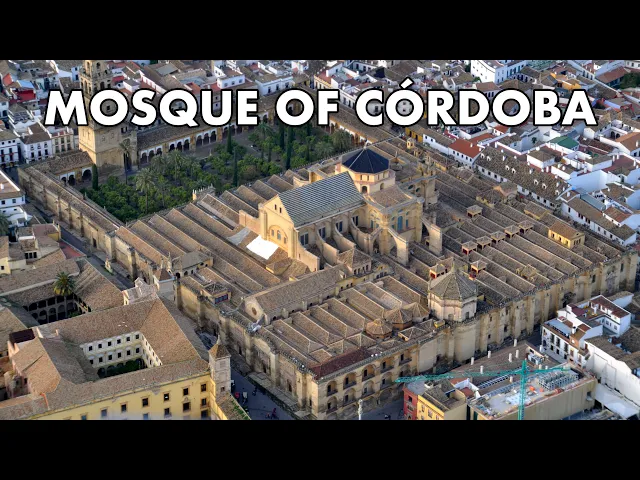
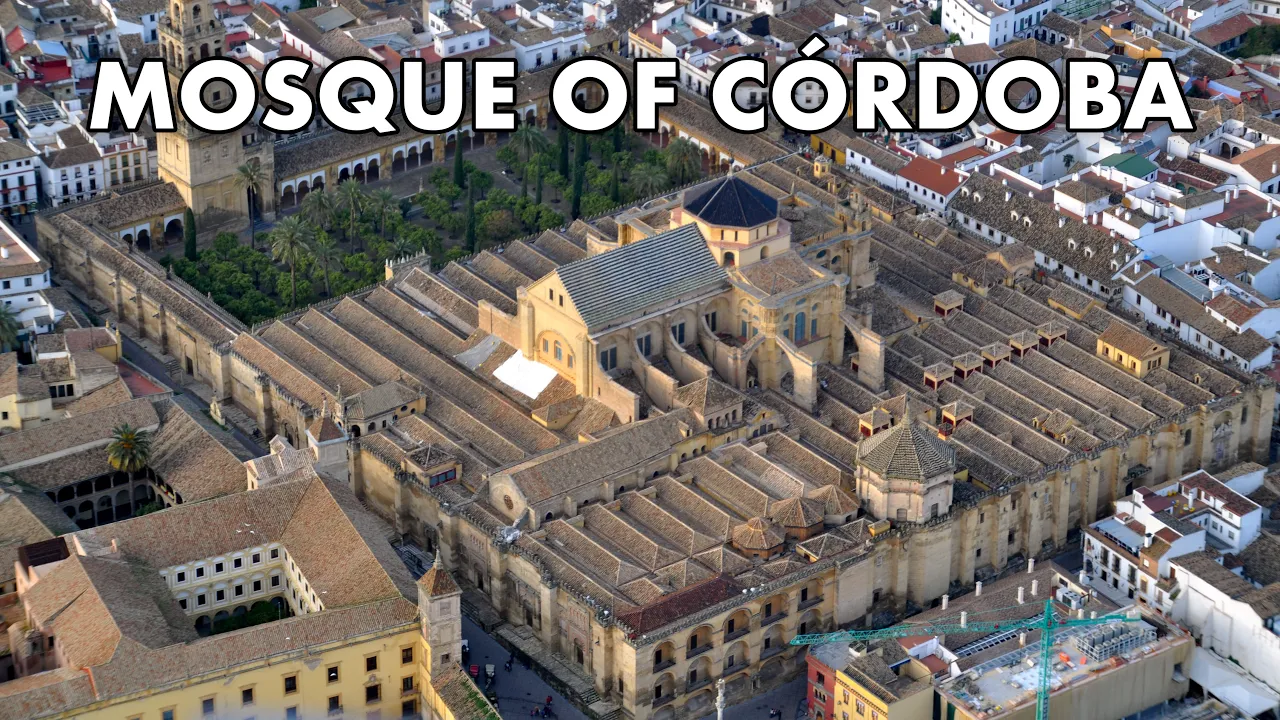
This is the Great Mosque in Cordoba, if you're used to looking at Christian Church plans, it's a pretty strange looking plan, even though it’s axial like most Christian churches, it seems to have something that could be an aisle something that could be a nave but they're not really aisles and naves, they are striations of space they're bands of space, and people don't proceed through the long direction of this series of bands of space, but rather they organize themselves against the southern wall. It's an amazing plan. You see the kind of growth of the plan of the Great Mosque from an idealized condition, it was all perfectly symmetrical, in an axis, and as the needs grew to accommodate a larger population so too did the mosque grow.
It is so big and so many enlargements were made because the city of Cordoba became one of the most populated in Europe. It is estimated that the city reached over a million citizens at the time of the Caliphate. In contrast, today’s population of Cordoba is three hundred thousand citizens.
Something very interesting about this building is that despite everything being built with the same technique and with the same materials, and in the same style, you can easily identify all the enlargements and changes it underwent over the centuries. The original mosque built by Abd-al-Rahman in the 8th century had this shape. The space inside and the space in the courtyard were quite symmetrical and balanced.
There is a part in the pavement where it becomes uneven by a few centimeters, this is where the first expansion that his son Abd-al-Rahman II made to this building in the 9th century, who added about eight additional rows of columns. A century later, his son Abd-al-Rahman III made an extension to the courtyard that rebalanced the size of the exterior space with the interior. In the third expansion, made a decade later by Al-Hakam II, several skylights like this one were made, because by having the front latticework as the only source of light, the mosque began to get dark in the back.
These skylights are large spaces whose roof stands out from the other naves with domes that contain numerous windows to the outside. Notice how the geometry of the dome structure itself accommodates the windows in an extremely elegant way. These Arabs were geniuses of geometry, and great architects, they required light in the building, and so they solved it by constructing one of the most beautiful parts of the mosque.
This type of structure for the dome is an invention of the Arabs from Cordoba, and they were the inspiration for the Italian baroque architect Guarino Guarini. The last expansion to be made, carried out by Al Mansur at the end of the 10th century, is easily distinguished by its red brick pavement as opposed to the marble pavement of the rest of the mosque. The separation between this new part and the old part is also noticeable thanks to this stone wall that was formerly the wall that faced the street.
This latest expansion doesn't add anything new, it simply keeps repeating the same module, which allows the building to continue expanding in any direction and increase the feeling of being in an infinite space. By the time this last modification was made, the builders had no more Roman remains available, so they had to make new columns in the same style as the rest of the columns, and the stonemasons who made these new columns signed each of them with their name at the top of the shaft. There are so many bands of space, you can get a sense of what that spatial quality is if you look at the roof plan, almost look like a train shed where you would imagine lots of trains being parked under here, but instead they're just these rows and rows of transparent screens that allow continuation among the rows but also delimit different zones.
The enclosed portion of the mosque with all of its enlargements occupies more area than any Christian Cathedral, consisting of nineteen rows placed North and South, with thirty-three bays to each row. Despite the numerous expansions it underwent, the entire mosque has the same structure in height. It is formed by a series of columns that were reused from Roman temples and Visigoth basilicas, on the column a cymatium was placed, which is a block of stone that is part of Byzantine architecture, and on this cymatium a pillar is placed that supports the arches themselves.
Above these arches there are a series of channels that still today they evacuate the water from the building, making the arches function as a kind of aqueduct. Here you can see the courtyard, known as the court of oranges, which is another one of the constituent elements you need to have in a mosque, you need to have a courtyard where people can assemble, and also where they can have ritual cleansing. So you look at this courtyard and you might think that the climate in Cordoba is really nice because trees grow beautifully there, but in fact it's a very hot climate, and you need to irrigate in order to grow, and one of the really great things that Islamic architecture does is it has figured out a way to build irrigation into the architectural design of projects in a way that doesn't disrupt the qualities of the space, like a big sprinkler would, but rather enhances the qualities of the space.
So if you get down to ground level you can see that there's this grid of little cuts in the pavement, and water is channeled through here so that the entire pavement becomes a kind of fountain with these little narrow troughs maybe six inches wide, easy to step over, but also very convenient for having a gravity feed of a very gentle slope that gets water to all the trees, and so you get these marvelous oasis-like gardens happening in places that you think nothing can grow of its own accord. Here you can see the arches that lead to the court of oranges and that over there is the minaret, although today it does not have the typical shape of the medieval minaret, since in the 16th century it was covered in the shape of a Christian bell tower. This bell tower though, surrounds an original minaret that can still be appreciated inside.
Between the buttresses of the wall that surrounds the mosque there are a series of doors. The mosque did not have a clear main façade, but it has many doorways like these ones. The doors have these bronze tones, you can see the composition formed by a central horseshoe arch, and above, a gallery of intersecting horseshoe arches, and topped off by a series of battlements.
All within that refined and elegant style of pattern making. On the sides we find multi-lobed arches over windows with latticework typical of Cordoban Caliphate art. One thing that is important in understanding the ornamental pattern and the love of surface decoration for Islamic culture is the tradition of forbidding figural images.
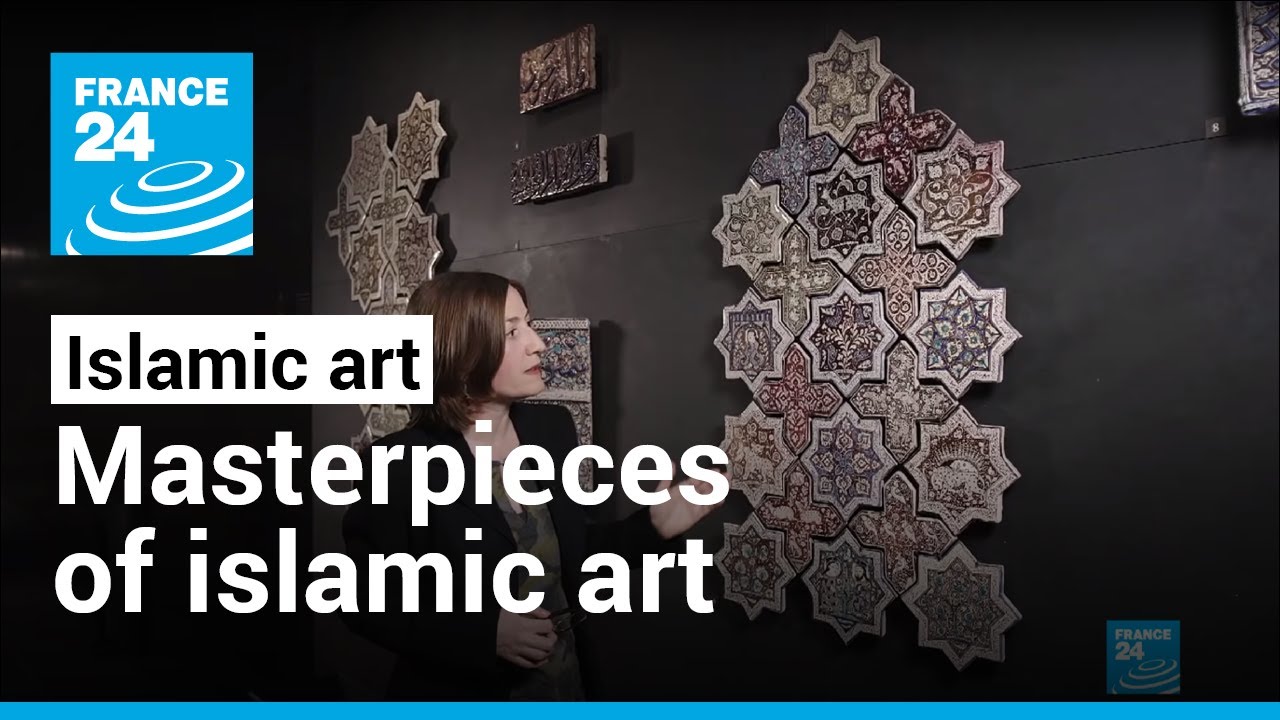
So you’ll never see statues or frescos of human figures in a mosque like you would in a Christian church. There's a strong interest in geometric ornament, the word aniconic simply means not representing the physiognomies of people but rather favoring symbolic ways of representing things like numerology or geometry or pattern making. So here’s some latticework that you’ll find in this church, and you can see that it derives from a really strong geometric structure that gets overlaid and overlaid.
The square rotated on side of the square to begin to give you an octagon that might unfold in a flow rate pattern is something you see again and again. This mistrust of the figural representation of people in favor of geometric pattern making, and this detail of the Great Mosque of Cordoba begins to show you how that affects the qualities of the architecture, every possible color you can imagine is going on. The use of a lot of colors in architecture is called polychromy, poly meaning many, chromy meaning color, and Islamic architecture is highly polychromatic.
We also see the arches, the voussoirs of the arches being polychromatic, the two colors in the arches are neither paint nor pigmentation, the color is due to the alternation of red bricks with stone blocks, this way the tones remain intense. Although Muslims elaborated it when building this wonder, this technique was originally developed by the Romans and a precedent can be seen in the aqueduct of the nearby city of Mérida, one of the most important cities of ancient Rome in Spain, where red brick is also alternated with blocks of stone. So the quality of the space inside the Great Mosque of Cordoba is just spectacular, you have these red and white polychromatic arches, row after row, with that unidirectional quality.
These are also different from Roman arches, they’re called historiated arches, and what that means is that they don't spring in such a way as to create half circles, but they rise up higher, they're sort of like horseshoe arches rather than half circle arches. So something like this looks crazy, but in fact something like this is better structurally than a Roman arch, because it's transferring the loads down and it's getting higher up. Notice how the voussoirs are thicker on the top, thinner on the bottom, and that's letting some of the loads transfer and the natural catenary of the arch is accommodated better within the structure.
The double arches work like an aqueduct, the upper arch serves to transmit the loads of the roof to the ground, and the lower arch works as a buttress, supporting the next arch. These arcades are repeated over and over again ad infinitum to create that feeling of a forest of columns. This idea of superimposing arches has a precedent in Roman architecture, and can be seen especially in the Roman aqueducts in the Iberian Peninsula such as those of Mérida, Tarragona or Segovia.
This way of making arches, this way of conceiving structure, this way of making a kind of diaphanous screen that's happening at this early date in Islamic architecture is something that inspired Gothic architecture toward this condition of dematerialization in later years. Here we have a view toward the Mihrab, that niche in the important wall that organizes the interior space for prayer. In the ceiling plane above it, there’s a series of domes, the geometry of these domes is quite different than domes we've seen in Byzantine and Roman architecture, they are these kind of rotated squares the perimeters of which are articulated with ribs, and it gives you an octagonal star, and as is typical with ornament on a wall surface there is this play of geometrical figures.
The Mihrab shows a profusion of different colors such as blue, red, black, white and gold, all made with small Byzantine mosaics like those used in the Basilica of Hagia Sophia in Constantinople. And at the top of the arch are verses from the Quran in Arabic. Mosques are typically oriented towards Mecca, but this one is facing south.
Abd al Raman came from Damascus, one of the most important Islamic cities at the time, and the Damascus Mosque is also oriented south, since from there Mecca itself is towards the south. He wanted to create a new Damascus in Córdoba and evoke in Córdoba the Umayyad past that he had left in his youth. Right in the center of the building is a cathedral that was built in the 16th century.
When the Moors are expelled from Spain by the Catholic Monarchs, the mosque is converted into a Christian church. The mosque evokes a sense of horizontality with all its rows of arches and shadows with its small domes and skylights, however this cathedral disrupts the scale and rhythm of the mosque to give you a sense of verticality and light. Thanks to the construction of this cathedral, the mosque was saved from being destroyed in the same way that the mosques of other Spanish cities such as Seville or Málaga were destroyed, where today there are no remains of the great mosques from the time of Islamic Spain.
The mosque in general is very well preserved, and aside from the extruded Gothic cathedral in the middle of the building, the mosque still looks much the same as it probably did in the 10th century. It is a pity, though, that some columns and vaults were demolished for the church, King Charles V signed the approval of demolishment before ever visiting the Cordoba, and when he went there after the church was finished, he recognized it was a big mistake, for in his own words “he demolished what you don’t see anywhere to build what you see everywhere”. But part of the historical value is the coexistence between these two cultures.
The cathedral was built and modified over hundreds of years, therefore we can see in its structure Gothic elements such as the vaults and buttresses, Renaissance elements such as the semicircular arches and classical columns, Mannerist elements such as the elliptical dome, and Baroque elements such as the altarpiece and pulpits. After all the modifications suffered, today the mosque consists of 610 columns. If you like Spain, I have a playlist in my channel with videos of Spain, so make sure you go check it out.
Thank you for watching, I hope you enjoyed this video, I hope you learned, please leave a like subscribe to my channel, and I'll see you very soon in another episode. Goodbye!