for the next few videos we'll focus on a very simple experiment that demonstrates the strange behavior of nature at the atomic level this is the double slit experiment that many of you are probably familiar with from high school physics where it's used to illustrate the wave nature of light now the meter of light was a source of great confusion for physicists over the centuries Newton believed that light was a rain of particles which he called copper skulls later there was a lot of evidence that light actually travels as waves but in the beginning of the
20th century Einstein discovered the photoelectric effect which showed that light is transmitted as in discrete packets which we call which we now call photons now there was a similar kind of confusion about electrons which were first believed to be particles but then there was evidence that they behave like waves in the in phenomena such as electron diffraction and so there was a growing confusion about the nature of atomic particles where they wave-like or particle light and this confusion did not get resolved until the mid 20s when the laws of quantum mechanics were were discovered which
actually showed that atomic particles are neither waves nor particles they behave in their own strange quantum mechanical way and it's this strange counterintuitive quantum mechanical behavior of atomic particles that we try to describe through the double slit experiment now this experiment really illustrates many of the features of quantum mechanics and since it does so in a very simple context many of you will find this intuition to be very useful as we go along so many times in the future we'll be able to point back and say remember this double slit experiment it's just like that
on the other hand some of you might find this intuition not very useful because you might feel that it it takes too many strides some if some of you might find it difficult to relate to this to the double slit experiment and some of you especially with a computer science background might prefer the very simple description that of quantum bits that we'll start with in the next lecture that's going to be entirely self-contained so if you have trouble following the intuition from this lecture don't worry we'll we'll get two qubits soon okay so so let's
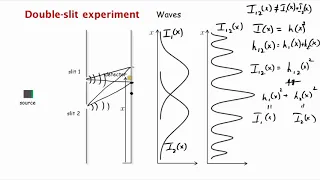
start with the double slit experiment so in this experiment we have a source of either light or electrons so either of a source of photons or of electrons but but now this source is its intensity is turned down so low that it emits these photons or electrons as discrete particles once every soften so let's say once every second no once every 15 seconds now the paratus also has a long way from the source it has a screen with two slits in it and then a long way from this screen there's a there's there's a backstop
along which we place a detector at some point on the screen which will measure by this variable X and so what we are interested in let's say we are doing the experiment with electrons so what we are interested in is what's the probability that this electron is detected at a point X on this back screen so now we will first do this experiment and very block 1 of The Slits so if he block slit number 2 then the probability we see the electron at point X varies according to this curve P 1 of X which
has this behavior because when the it's it's it's what we'd expect because when there when the electron goes through slit 1 it's sort of it's get scattered by the slit and and so it goes in in in some direction but it's most likely to go along the straight line path and so you get us be here and then and then the probability drops off as you go further out there's a similar such curve P 2 of X when we have only slit to open and slit one is closed now what happens when we open both
slits well what we'd expect to see since the electron can go either through slit 1 or through slit 2 is the sum of these two curves so something like this what we actually observe is this interference pattern so let me call this P 1/2 of X this was P 1 of X and that's P 2 of X the mystery is how could it possibly be that when both slits are open we got this strange interference pattern let me put it to you more succinctly so let's look at a particular point on this on the screen
let's say we look at this particular point on the screen so this is a point where there was a substantial chance that the electron got here when when only slit one was open there was a substantial chance that the that the electron was detected at this particular point so now we would say to ourselves if the electron went through slit one how could it possibly matter to it where the slit too was open or not and if it did not matter to it how could it be that the probability of detection of death of that
electron went down from from a substantial value to being very close to zero this is really the you know in a nutshell this encapsulate the mystery of atomic particles how could they possibly behave how could nature possibly what could nature possibly be doing behind the scenes that makes atomic particles behave in this way this mystery is illustrated by by this quote from the great physicist Richard Feynman who once said I can safely say that no one understands quantum mechanics