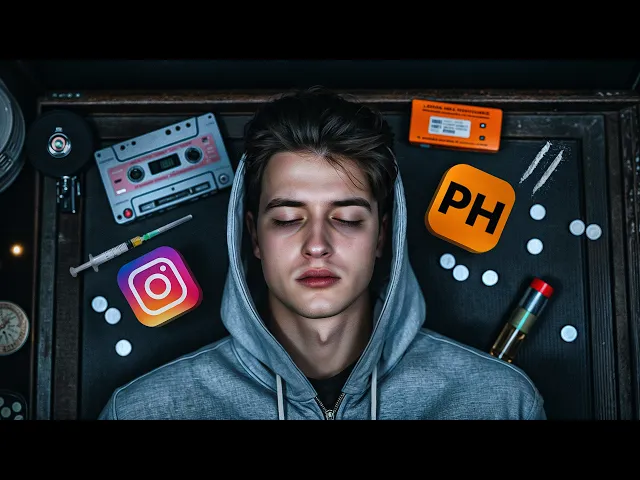
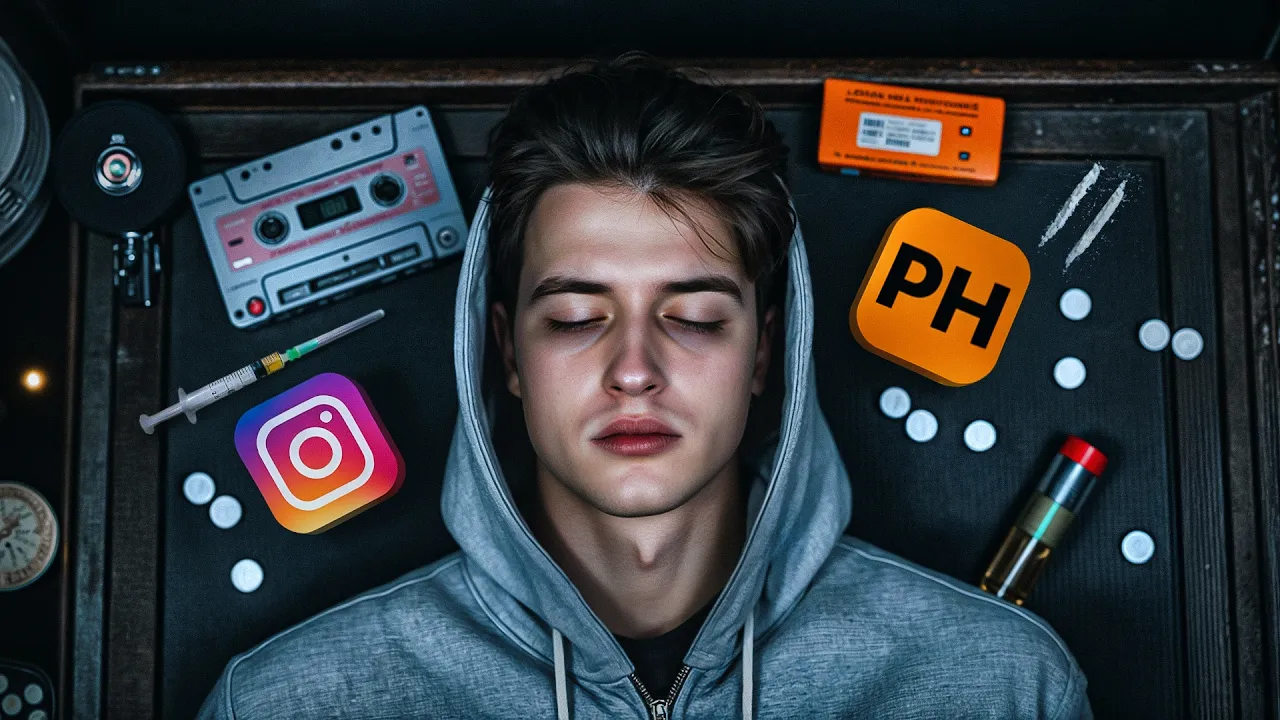
It's Fentanyl, one of the most powerful drugs in the world! ! Just one use of it can lead to instant addiction and death.
Every year this drug kills tens of thousands of people around the world. And the opioid epidemic, which turns people into living zombies, has been raging in the US for years. But you have probably tried it anyway.
If you have been treated for severe pain or have had surgery, Phentanyl might have been one of the drugs that entered your body. And nothing bad happened, you didn't become a drug addict, you weren't behind bars. Your life is not ruined and you are not suffering from any addiction.
Does this mean that addiction is just a myth? But then why do completely harmless things spoil life for most of us: sugar, social media, games, pornography? And for some of us, these things can be more harmful than some substances.
How does it work? How is addiction really structured? Why does our brain become a hostage to its own weaknesses, doing it over and over again?
And why can't this process be stopped? How are bad habits formed? What affects that?
And why is each of us. . addicted?
The average person knows nothing about addiction except that it's bad. But why? After all, it is much more than just an addiction to substances or habits.
It's not just a desire to go to a porn site or smoke a cigarette. It's a complex, unique and individualized process, and sometimes even rewarding. This affects our brain, physiology, and psyche, often intertwining with life experiences and internal needs.
So what is addiction and how does it work? Addiction is not just a glitch, as some think, but an evolutionarily conditioned mechanism, as it helped our ancestors survive. Imagine you are an ancient human living in a world of constant threat of hunger and danger.
You do not want to die, and therefore your brain is programmed to notice, remember, and repeat what brings pleasure. After all, pleasure is the incentive to form security and survival. And that pleasure was very hard to achieve.
After all, to gather food equivalent to a juicy and caloric burger, ancient man needed hours, or even weeks of gathering and hunting. Miles of chasing game, fighting it, then butchering and cooking it. And sugar which is now packed into everything practically did not exist!
It turned out that ancient humans had to fight for their daily calorie intake, struggle for survival, and undergo immense physical exertion. And a modern person can hold their genitals in one hand, watch videos with hundreds of girls, and order enough food on their phone with the other hand, the acquisition of which could have caused an ancient person to bury their entire family There has been progress and what we needed is now all too available. Pleasure can be had in just a couple of clicks.
We live in an age of hyper stimulation where instead of rare prey we have endless access to sugar, social media, games and other doses. The brain had not had time to adapt to these conditions, and it was not ready for so much stimulation, for it was designed for a life of scarcity. Because our internal mechanisms and brains are used to stocking up on it, using it to the max.
He doesn't distinguish between right and wrong. The main thing for him is to reach his goal, to get pleasure, but at what cost is not so important. So you want more delicious food, more incentives, because that's your evolutionary purpose.
But when there is too much stimulus, a tolerance is formed. Because the brain now considers this normal. That's why most of you are addicted to social media, but you don't enjoy it.
After all, it's commonplace in the form of doping, which is not designed for the brain at all. With our heads we are still the same hunter gatherers who just want to survive, to be rewarded. Only now our natural mechanism is working against us, and therefore many suffer from apathy, depression and are not satisfied with life because the world has changed.
We're just learning how to live in this world. . But it doesn't work for everyone.
. . Instead of moving forward, we get stuck looking for instant gratification.
. What's the result? A job that brings no joy, low income, no prospects and complete uncertainty of what to become in the future?
This is not just unpleasant. . It is dangerous.
We are wasting time, energy and the opportunity to make a difference. Instead of moving forward, we get stuck looking for instant gratification. In order to get out of the vicious circle and start changing, you need to find an activity that requires effort but opens up new horizons.
We need to start from scratch. . .
But it is not so terrible, because everything can be taught and at any moment you can start to change your life. Especially nowadays, when from anywhere in the world you can learn an in-demand profession and work remotely. Programming is just that kind of path.
And if we talk about starting, I recommend beginning with Python. It is accessible for beginners and, at the same time, used in a wide variety of fields from website creation to data analytics, artificial intelligence, and automation. And the demand for such specialists is huge, companies are forced to offer high salaries, remote work and other bonuses to developers even with little experience.
That's why I advise you to check out the Python developer course from SkillFactory online school. It is created by experts from major IT companies and is regularly updated to keep up with the current market. Therefore, even if you have never programmed before, in just three months you will be able to apply for an internship and take on your first projects.
And perhaps it's thanks to Fectori, a unique format where you learn from the challenges that developers face every day in real work. This is not just theory, but practice based on real business processes, thanks to which by the end of the training you will have a portfolio of six projects and experience of working on real cases from large companies. The school's career center will help you at every stage from interview preparation to job search.
And if for some reason you can't find a job, SkillFactory will refund your money. So click on the link in the description, use the promo code Albert, and get a 50% discount on the course. Indeed SkillFactory teaches those who get hired.
Any addiction or habit is a cycle triggered by a specific event. For example, boredom or a sense of loneliness is a trigger. Next, there is an action, for example, we open social media.
Browsing through them, we get temporary relief and joy, a feeling that everything is alright, in other words - a reward. And the brain closes that loop, o n memorizes that when it feels bad, it does this and gets better. And the more you repeat this process, the deeper it becomes fixed in the neurons, the more autopilot is formed.
And now, if the trigger goes off, you just do. And that's the problem. In normal life, the pleasure mechanism works for satiety.
Hunger is satisfied with food, and tiredness with sleep, everything is balanced. But when it's too artificial and there's too much of it, we break the balance. The brain gets hung up on shortcuts to reward, but that shortcut exhausts us.
Harmful habits create overload but no real satiety. And so the pleasures of pornography, gaming, and drugs are quickly replaced by feelings of desolation. Because our habits, which have become an integral part of each of you, do not work through the body's natural synthesis and balance, but through artificial stimulation.
They literally suck out your neurotransmitters and then leave you without energy. Useful habits are formed on the same principle, but they work differently. The difference is the process that drives the reward.
Bad habits are like uncontrolled doping; they stimulate the brain externally, giving an instant dopamine rush. And healthy is a process, like a contract, you do something, like exercise, and your body triggers processes that strengthen your body, make you better, and for taking care of yourself, rewards you with pleasure hormones. And in this exchange, the body itself regulates how much, how, and when to give it to you.
Therefore, sharp declines and overloads do not occur. Often, beneficial habits are built on hormesis, on small fears that make us stronger. Cold showers are stressful, but they improve immunity.
Sport is a strain, but it makes us stronger. Traveling and learning new things is stimulation, but which forms new neurons and makes the brain more stable. In general, bad habits are an external stimulus without constraints, and beneficial habits are internal rewards that are synthesized and regulated by the body itself.
That's why bad habits are often built on destructive behavior, and helpful ones on improving yourself physically and mentally. But when our lifestyles are built on improving ourselves, bad habits cease to be harmful when limited. A bottle of Coke once a week is great for recovering from a workout, and a delicious burger or pizza once every couple weeks will help you relax and have a good time.
The key is not to tip the balance in the opposite direction. Therefore, addiction is not a weakness, but a biological mechanism unrestrained by us. Our ancestors depended on finding food, relationships, and security, and we depend on likes, sugar, and virtual accomplishments.
The only difference is that before it saved lives, and now it destroys them. But addiction can be very different. It is divided into two types: physical and psychological.
Physical addiction refers to when we greatly exceed our natural limit, literally breaking the limit set by our body. We use a magical substance and immediately something goes wrong because an external excessive stimulant appears. There appears to be a gap between our natural limits and what we experience from consuming.
And the body gets used to working only on doping, shutting down or changing the operation of its own systems. The body becomes addicted, and the brain begins to interpret the absence of another dose or lack thereof as a threat to survival. You see, for the body, it's not just a cool high, it's a disruption of the chemical balance.
This happens not only because of drugs. Even caffeine from tea and coffee affects the brain in a similar way. When caffeine enters the bloodstream with coffee or tea, it blocks adenosine receptors, which are responsible for fatigue, and therefore we feel a surge of energy.
Adenosine receptors begin to work in opposition and become more sensitive, because caffeine blocks their function. And so giving up, for example, coffee after taking it for a long time makes us very sleepy and irritable until the receptors regain their function. But logically, the power to affect brain function is simply not comparable.
To completely destroy the brain and possibly even die, you would need to drink about five liters of espresso within a couple of hours. But to overdose on the banned Phentanyl, enough only two. .
. milligrams And the stronger the exposure, the stronger the addiction. And while physical addiction is a failure of the body, psychological addiction is a failure of the mind.
Here it's not about chemical effects, but about the need to get the right emotional state, to get rid of apathy, loneliness, to feel more cheerful, more confident or more awake. In a word, better. And the more unenclosed needs, complexes and aspirations inside your mind, the more weak points it has and the more you are predisposed to addiction.
And so, for example, coffee for some people becomes not just a tonic drink, but a compensation for a lack of self-confidence. An opportunity to become more awake, socially active, and even interesting, without which a person would be afraid to go out in public. And it is the psychological addiction that is the strongest and often works together with the physical one.
After all, even the most severe physical disruption and imbalance will recover sooner or later. But an emotional attachment to a state of confidence, euphoria, inspiration or control will keep us from doing so. Because we depend not so much on incentives as on states, even negative ones.
We can miss a bad relationship because we miss the feeling of love. We can also depend on anxiety: by constantly replaying negative scenarios and reading the news, we feel that we are in control of the situation. There can be an addiction to suffering, to misfortune, the expectation of pity, attention, and care.
After all, it is in this state that we feel some emotional nourishment. The true causes are many, but they are usually deeply hidden within us and need to be sorted out. You can access a series of videos on improving your emotional intelligence, which I compiled together with psychologists, by following the link in the description.
We've carefully broken down each practice so you can recognize your hidden complexes, figure out your true needs, and learn to live in harmony with yourself. Additionally, you will gain access to videos on financial literacy, bonuses such as free stocks, an exclusive Telegram channel, and most importantly, an interest-based chat where you can find support and chat on various topics, including with me. And all of this is available in one inexpensive subscription.
By doing so, you will not only support the channel, but also invest in your development. And the link will be in the description. If the brain gets used to a certain state, it will seek it out again and again because it doesn't just become habitual, it becomes comfortable and safe, its home.
Therefore, people who are used to living in chaos unconsciously create it around them. Those who are used to suffering find a reason to do so even when things are good. Therefore, addictions are subjected to therapy rather than treatment.
Because they cannot be cured, they only go into remission. We can control our actions, but we cannot rewrite the memories of a time when we felt things were better. Since different people's nervous systems are more sensitive to certain surges and conditions.
And this is already determined at the level of genetics. Each of us is molded differently, and how successfully you become addicted lies at the level of your genes. And no, there's no code in your genes that says you're going to go straight from the womb for a cigarette.
But there are genes that determine whether you'll like them. Speaking of cigarettes, we have acetylcholine receptors in our bodies that trigger a chain of reward reactions when we interact with nicotine. These receptors encode several genes: CHRNA3, CHRNA5 and others.
Everyone has them, but small mutations in these genes can vary from person to person. Somebody's receptors are more sensitive. Some have higher or lower numbers and activity.
That's why one person gets high from smoking and another person doesn't understand the pleasure of smoking at all. Same story with alcohol. Drnking alcohol makes us feel relaxed and euphoric.
And that's where the ADH1B gene comes into play. It breaks down ethyl alcohol to acetaldehyde, a highly toxic substance that causes headaches, nausea and hangovers. The body tries to neutralize it quickly, which is the job of the gene ALDH2.
The average person will not experience any problems from a small amount of alcohol. But if gene variations work faster than normal, the feeling of intoxication a person may barely feel. And if the first gene is slower, the alcohol takes longer to circulate in the blood, and the feeling of intoxication and euphoria is stretched out.
And because of this, addiction is formed very quickly and the liver suffers more severely. But if the second gene, which does not neutralize the toxic enzyme, is delayed, a person may develop alcohol intolerance. There are many genes, and there are even genes that affect the dopamine system, sort of like DRD2 or DRD4 .
They determine how intensely the body responds to the release of the joy hormone. If a person is more sensitive to small fluctuations in dopamine, they will almost certainly have some kind of addiction. Smoking, alcohol, gambling or regular games, drugs like marijuana, sugary drinks, and masturbation with pornography.
And some people collect all of them. . at once.
And this whole excursion into chemistry is to say that everything is as individual as possible. Even coffee doesn't energize about twenty percent of people because they have a much faster caffeine metabolism. One quits smoking quietly, while the other can't get off for years.
To find out your predispositions, a DNA test is required. For example, mine showed not only that I have no predisposition to smoking, but also that I am not Russian at all, and it is even recommended for me to drink coffee. To learn more about yourself, I've included links to available DNA tests in your area, so you can go here and learn more about your health.
Therefore, bad habits should not be looked at as something unequivocally bad. It is a symbiosis of a large number of things, often beyond our control. Also, not every regular action is an addiction.
But you need to understand the difference between 'I like coffee in the morning, and I can't function without it. ' The difference between 'I masturbate once a week to relieve tension' Or "I masturbate every day because I feel miserable, and without masturbation I'm a wreck. " We have to realize this, we have to study ourselves.
And we must do something about it. The world around us is built on exploiting our weaknesses. These are actively used by big business, so our habits are no longer our own.
For many of us, freedom of choice is a pleasant illusion. Everything around you is designed to get you hooked on it. Social media used to be created to connect people, now to get you to spend as much time on it as possible.
Games used to tell stories, now they take up time. It's no longer about entertainment, it's about retention. Porn breaks the perception of sexuality.
The food is stuffed with shit to make it taste better. Business has made these addictions socially acceptable. It's become normal in society to almost never put your phone down.
It has become normal for a young guy to watch more porn in a couple weeks than he will read books in a lifetime. No one will say it's an addiction because everyone has become like this, because we have become the product. And now the big question is: if everything around us is designed to subjugate us, how do we resist it?
And no, willpower won't help here. It's often said, "get a grip, stop being weak, just stop doing it. " But why does the realization that addictions harm us not stop millions of people from them?
Because willpower doesn't work the way we think it does. The prefrontal cortex is responsible for willpower, but its resource is strictly limited. The abundance of intellectual tasks makes us tired, and it makes it harder to make decisions.
Usually, rest and healthy sleep restores our resources and we continue to function further. But if we are exposed to prolonged and severe stress, escalating to chronic stress, the prefrontal cortex is one of the first to suffer. Neural connections are disrupted, cognitive functions are suppressed, and emotional regulation begins to malfunction.
Some experiments have confirmed this. When a person was exposed to stress and emotional difficulties, they became more passive, less collected, and more prone to impulsive behaviors. Of course, this doesn't mean that willpower doesn't work at all, quite the opposite.
Our ability to choose and control our actions is the foundation of all of our life and its success. Yes, observations show that some people who practice self-control, such as maintaining posture or keeping an income and expense diary, by the way, you can download such a table from the link in the description. Very convenient!
Over time began to have better control over themselves in other areas of life, including their bad habits. In 1977, psychologist Walter Mischel conducted a "marshmallow experiment. " Children were offered the choice of eating one marshmallow at once or waiting 15 minutes and getting a double portion.
This experiment has been repeated many times, and it was found: some people who were able to wait and delay pleasure had better lives. They were less impulsive, accomplished more. So this skill is very important, and it is something you can develop in yourself.
It's just that when a person is too stressed and tired, this task becomes too difficult and it's hard to rely on willpower alone. But in this experiment, what matters is not so much fate as how the children controlled themselves. They didn't just tolerate it, they looked away, played with their fingers, closed their eyes, changed their focus of attention.
Self-control is not patience, but strategy. Performing a bad habit requires no effort, because it's an automatic cycle. About half of our daily actions are learned brain reactions to certain triggers.
So what you need to do is not fight the bad habit, but replace a piece of that puzzle: either the trigger or the action. If you offer nothing in return, the brain will demand a reward at any cost. If you're often distracted by your phone: put it away and put a book next to it.
Eating fast food? Try cooking it yourself instead of ordering it, or at least buy healthy alternatives. Plus, for the habit to stick, it has to be easy.
If we want to start reading books, exercising, we must not read a book in its entirety or run a marathon. And just doing one exercise, opening a book and reading a couple of sentences, and then more. .
and more. When an action is too difficult, we avoid it. But when it's easy, it will take hold faster and replace our bad habit.
Therefore, in the early stages, a useful habit should have a lower entry threshold and time cost than a harmful one. And over time, during moments of boredom, we will start reading books, watching lectures, or going for walks instead of just mindlessly scrolling through our phones. Moreover, it should not be forgotten that such actions are behavioral dependencies that appear and change to others.
On average, they take a few weeks to a few months to form. So find the best strategy for you to change your leisure time, your behavior. And your efforts will definitely pay off.
But what if the problem is not in the habit. Not in willpower and not in the mechanics of actions? It's much deeper than that.
The thing is. . It's you.
In 1978, Canadian psychologist Bruce Alexander conducted an experiment known as the Rat Park. In the experiment, the rats were divided into two groups, and each had a choice between plain water and water with a drug added. The first group of rats were kept in a solitary cell, while the second group inhabited a space with toys, tunnels, and other rats.
Rats that were kept in isolation quickly became addicted to drug-laced water and often overdosed. And the rats in the second group did not touch the water with the drug. Having the same choice, they showed no signs of addiction, being content with their environment.
And what's interesting is that the single group rats, when placed in the park with everyone else, switched to regular water. And also conversely those who were placed in isolation from society quickly became addicted. Addiction is not simply the result of substances or patterns of action on the brain.
This is another way to compensate for internal deficits. It is a distorted realization of our natural craving for the pleasant and rejection of the unpleasant. This mechanism has saved us from extinction for centuries.
It's just that the modern world is disproportionately overloaded with temptations and even living in huge metropolitan areas, we feel lonely and isolated And addictions only fill our emptiness inside. Often pornography addicts quit very quickly once they get into a healthy relationship, even though they may have been trying to quit for years because the previous dose is wearing off. The reason itself disappears.
Because porn addiction masks loneliness and dissatisfaction. The desire to stay up late on your phone is behind the normal desire to spend more time for yourself rather than at work or school. The desire to constantly play games is an escape from a depressing reality, and sometimes due to low self-esteem, we simply punish ourselves by continuing to repeat the habits that make us worse.
Because we believe that if we are losers, we must suffer. That is, the main strategy is not just to close access to harmful things, but to look at your habits from a different angle, to ask the question why do we need it? You don't have to look at it as a weakness.
We need to look at it as a signal for help. If we give up one thing, we are bound to become dependent on another, unless we work on the need within ourselves You don't have to clean it up, you have to realize what it means to you. The answer to this question is different for everyone, so you have to learn to ask yourself: what do you get out of this habit?
What would you really want? If you were offered to trade this habit for something else, what would you ask for? We're not gutless,, we're not weak.
. we just want to be happy. That's what any addiction is built on.
Until you realize what you're running from, you'll always be looking for a new dose. Don't just try to quit the addiction. You can't turn it off and live differently, but you can realize what you're running from.
You can stop filling the void and start building a life where you don't need to hide. Because freedom is not the absence of temptation. Freedom is when you are no longer dependent on them.
Lead a healthy lifestyle and love yourself, it is the best and most rewarding addiction. This was Albert with you, subscribe to the channel and my social media. Also in my private club you will find more practices for getting rid of bad habits.
All links are in the description. all the best.