Gorgo, Queen of Sparta, questioned by an Attican woman on why Spartan women were the only ones to rule over their husbands, replied, "Because we are the only ones who generate true men". Today we talk about women in ancient Sparta. Welcome back!
We've already talked about the education of a Spartiate man. If you missed the video, here's the link, so make sure you watch it. Unlike men, we have less information about Spartan women and their daily life, and, once again, they do not come from Spartan authors.
But despite this, we can still recreate what was supposed to be the life of a Spartiate woman. In fact, this time we are going to analyze the female figures belonging to the élite of the city. Lycurgus, the quasi-legendary lawgiver who had set civil, political, and social life of Sparta, had decided that even Spartiate women should undergo a rigid education aimed in the first place to strengthen their bodies.
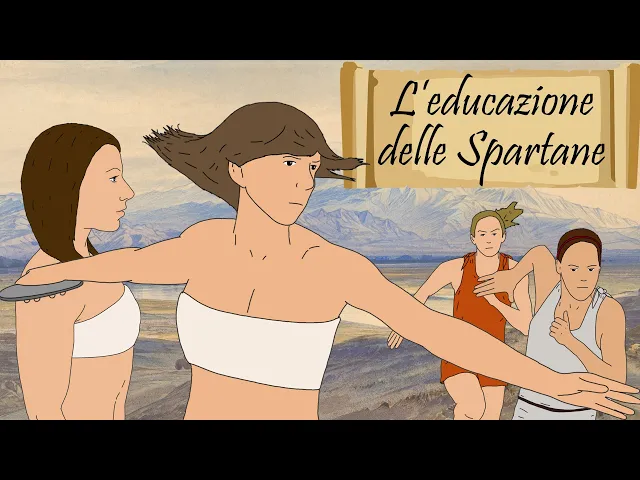
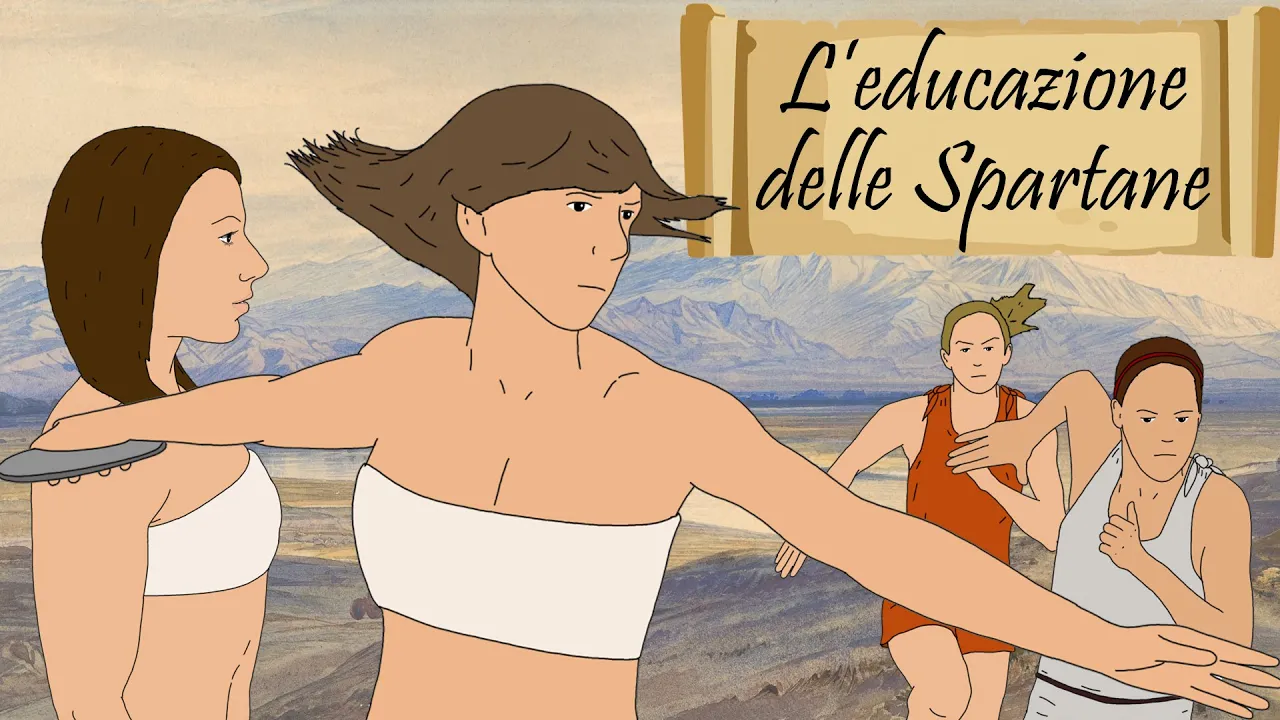
So, young Spartiate women had to engage in a whole series of physical activities comprising several disciplines. Plutarch, for example, reminds us that young women had to train in running and wrestling, as well as in discus throw and javelin throw. We also know that their intellectual preparation was very important, and so they learned singing, poetry, dance, activities that were gathered under the single term of 'musikè', that is, the art of Muses.
On average, their education was higher to that of other Greek women and above all it did not include a whole series of activities which were generally considered feminine, like weaving, beacuse the most humble works were delegated to the class of helots, as we saw in the previous video. Helen of Sparta was considered the most beautiful woman in the world. And Spartan women were also known for their beauty.
Aristotle, however, called them lustful and immoderate, pervaded by a purely masculine audacity, and dedicated to government. And that was a fairly widespread opinion, even defining Spartan women with a nickname, that of 'thigh showers'. Because they usually wore a short tunic for comfort during gymnastic performances.
Spartiate women had a very special condition, almost unique in classical Greece, where women were generally relegated to the domestic sphere and enjoyed an extremely limited social life. Spartiate women were not only educated and exempted from domestic activities, as we saw earlier, but were even held in high regard within Spartan society as wives and mothers of soldiers. And the sources pass on to us the image of extremely severe mothers and attentive to honor and courage shown by their children.
This is perfectly summed up in the phrase, "Come back with your shield, or on it". And refers to the fact that soldiers had to return with their shields, so without abandoning it in battle, thus showing cowardice, or dying bravely during the battle itself. They educated their sons up to the age of seven, they could participate in public processions and athletics competitions in which they performed half-naked in front of an audience which could also include men.
We even know about Cynisca, the daughter of king Archidamus II, who participated in the Olympic Games and won twice in the chariot races. The Olympic Games were a sporting event in which only male athletes could participate, but chariot competions were an exception because the winner was not the 'auriga', that is, the charioteer, but the financier, the organizer of the team, and in this case, it could have been a woman. Well, Cynisca won twice and then obtained two statues dedicated to her in Olympia and a temple in Sparta.
We also have to consider that when Spartiate men leaved for war, the administration, the management of family assets, including helots, fell entirely on women. Lycurgus' rules then imposed a strong limitation in the ostentation of wealth. Which is why men and women greatly reduced luxury in clothes, but the limitation in wearing jewelry and precious ornaments concerned only single women, while the wives could wear jewelry much more freely.
In fact, the wedding in Sparta is a very interesting topic to analyze. Unlike other Greek poleis, where women got married very young, around the age of 15, or even younger, in Sparta the age was set at 20. It was believed that this was the best time to have children, as women had reached full physical maturity.
And this was once again the subject of rumours, judgments and biases by the other Greeks. Sources disagree about the marriage rituals, e. g.
Plutarch tells us that a sort of kidnapping was staged and that the spouses had to keep their relationship hidden for a certain period of time. The newlywed, in fact, had to abandon nightly the banquet he was attending, to go to a dark room in which he would find the bride dressed in a cloak and shoes, exactly like a man, and with her head shaved bald. In this way, women looked in every way like one of those young men who participated in the 'agogè', as we already know.
Other sources tell us this ritual was prior to marriage, and any children born from these relations were not recognized as legitimate. In fact, only those children were such who were born when their parents were old enough, so 20 years of age for women and 30 for men. What was the correct version we haven't been told, but the second one seems more likely.
Women were betrothed by their fathers, or in their absence, the two kings decided who the bridegroom should be. Women, just like men, could have homosexual relations. Polybius tells us about a common practice in Sparta, which was that of adelphic polyandry, that is, the fact that a woman could marry more men, who were brothers.
This practice had the purpose to limit the division of family assets through dowries. Regarding the dowry in Sparta, women could also inherit paternal property, just like men. If the woman was an only child or she was the only daughter left afterwards, maybe at war events, she was called 'patrouchos', that is, holder of the paternal assets.
Obviously, when choosing a groom, they had to respect the limitations already mentioned. This practice of allowing women to inherit was strongly criticized by Aristotle, who, for example, tells us that most of the land in Greece was owned by women. We are at the end of this journey.
If you enjoyed the video, please like it or comment here below, so that YouTube and I will know. Now I greet you and see you in the next video. Bye!
The most humble jobs were made by the class of the idiots - Idiots! They also wanted to limit as much as possiblet - Why is that? Then we must say that when Spartiates went to war, the entire asset, assets.
. . management - Jewelry and ornaments only concerned - Grannies.
Grandmothers. Grannies. Single women.
Single women. They're obviously grandmothers, not women.