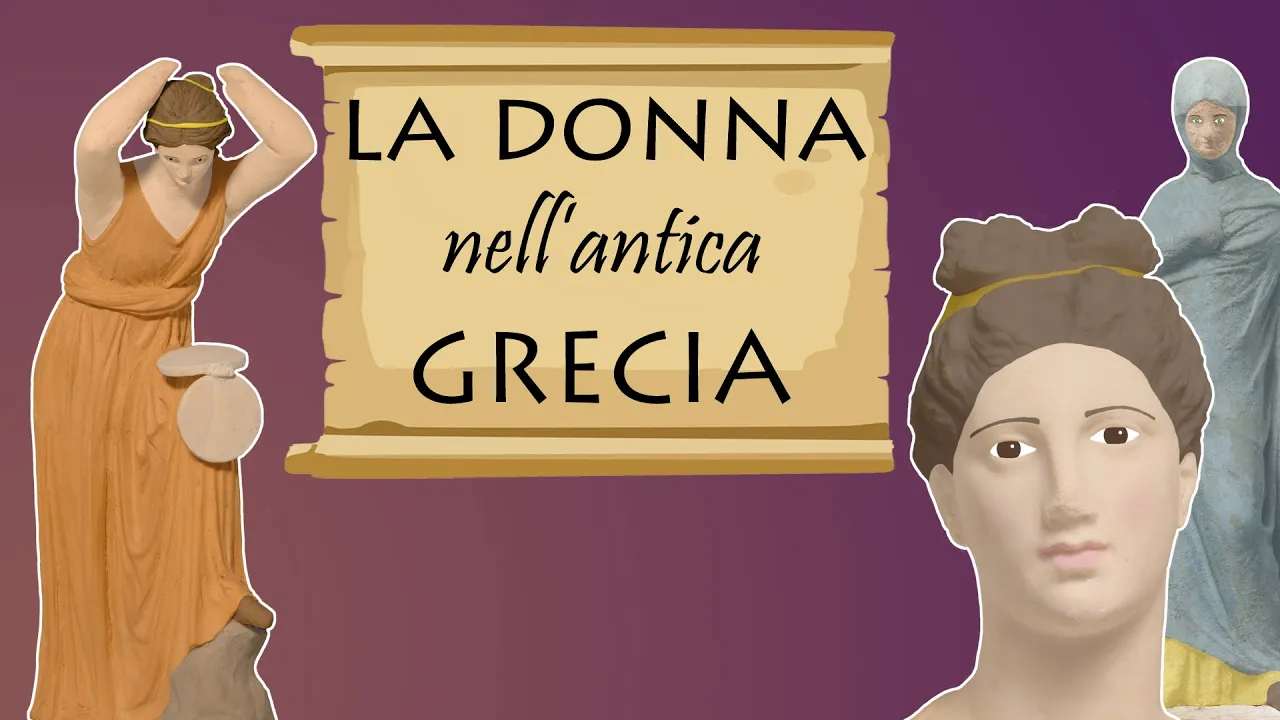
Welcome back to In viaggio con l'archeologo. In this video, we'll see the stages of life of an Athenian woman. But first, we must say that in Greece, especially in Athens, the life of women isn't the best; women have no political rights in the polis, and are subjected throughout their lives to the authority of a man.
They don't even have full management of their assets. Moreover, this point of view is endorsed by authors such as Aristotle or Xenophon, who consider women inferior to men. Women, according to strict morals, especially if of high social extraction, are relegated to the domestic sphere.
They must cover their body as much as possible, and cover their heads with a veil, and beauty standards require a pale complexion. Obviously, all these precepts come from literature and are often disregarded in real life, especially for practical reasons. In fact, most women do jobs and tasks that take them out, in contact with society.
We find women working in fields, in the artisan shops or at the market, and in a variety of businesses. As for Athenian women, the first stage is obviously their birth. Five, seven or even 10 days after the childbirth, an important feast called 'anfidromie' takes place.
The father must recognize his son or daughter and so runs around the domestic fireplace with the baby in his arms. Only then do children become part of the family and can receive their name. During this feast, a sacrifice and a banquet take place.
The newborn is then recognized from 'phratry', a kind of extended family in which we find all those who descend from a common ancestor. Recognition takes place during a festival called the 'Apatouria'. Finally, they are registered with the 'demos', i.
e. a subdivision of Athens. If a father doesn't accept his children, their fate is to be abandoned.
And in Athens such an act is permitted by law. This can happen for many reasons; e. g.
due to physical defects or due to an extra-marital relationship, or, which is quite frequent, for economic reasons, i. e. the family cannot afford to care for another individual and children are often entrusted to other families or even sold as slaves.
Until the age of seven, boys and girls are designated as 'paidìon'. It is the period of early education, which mainly takes place within the home walls, and it's also the time of games. Though there aren't many toys, but girls always have dolls, wood or terracotta dolls.
And like modern dolls, these dolls also have movable limbs, and have the features of young women, which is why they're called 'kòre', that is, girl, or 'nymphē', that is, bride. From ages 7 to 12, girls receive a different education from boys; they must prepare for their future role as wives and mothers, learning domestic tasks from the women of the family. There are also athletic activities and competitions, and the girls belonging to wealthy families receive an early education that enables them to read and write.
From Aristophanes' 'Lysistrata' we learn that there are a number of experiences related to religious activities, but only for a privileged few. 'At seven years old I celebrated the Arrephoria, then, at the age of 10, I was 'aletrìs', then I wore the saffron gown to walk as a bear in the Brauronia, and finally, when I became a beautiful girl, I was a 'kanephora', wearing a dried fig necklace. Let's see what it's about.
The 'arrephoria' was a feast in honor of Athena Polias, held in June and July. Four girls, from 7 to 11 years old, serve in the shrine of the goddess and two of them have the task of weaving the 'peplum', that is, Athena's garment. Girls about 10 years old are called 'aletrìs' since they are in charge of grinding the wheat and make flatbreads offered in sacrifice to Athena.
The Brauronia Festival was dedicated to Artemis and held every four years between March and April at the sanctuary of Artemis in Brauron. Girls aged between 7-12 years take part in a series of rites and they wear a 'chiton', a saffron-coloured tunic which makes them resemble she-bears, that is the animal sacred to Artemis. We don't actually know how long this office lasts, but certainly ceasing to wear this robe sanctions the transition to adulthood.
Finally, a 'kanephora' is a girl who takes part in the Panathenaic Festival and carries the basket containing the special tools for the rite. It is a great privilege and it is up to the girls belonging to the elite and of about 15 years old, thus ready to get married. In Athens, marriage is an early event in the lives of young women.
The law sets a minimum age of 14 years and this probably happens by the age of 16. Men, on the other hand, get married much later, in their thirties. But today I don't want to dwell too much on marriage, for which I intend to make a special video, as I did for Ancient Rome.
Today I'll just mention the three key moments of a wedding. The first one is the 'enguè', that is, the agreement by which fathers or other male relatives grant women to future husbands. This is followed by 'gàmos', that is, the rite itself made effective by 'synoìkia', after which the bride lived in her husband's house.
As mentioned, women remain lifelong under the tutelage of men; their fathers, husbands, male sons or relatives. Besides the wedding, however, there are other forms of cohabitation. In addition to his wife, an Athenian citizen has a 'pallakè', that is, a concubine.
The children born from this relationship are considered illegitimate, but a man can have a wife and a concubine at the same time, as long as they don't live in the same house. Weaving is among women's most domestic activities, and it is narrated in myths, e. g.
the character of Penelope, and also depicted on vases. Cooking is another key activity, especially grinding wheat to make bread and buns. And so all the religious rites we have previously seen are aimed at accustoming young girls into their future lives, but a woman's main task is motherhood.
Childbirth is an extremely dangerous moment in the Greek world and in antiquity in general, and many mothers could die while giving birth. For this reason, many women seek the help of deities such as Artemis, Demeter or Illithyia. Childbirth is followed by breastfeeding, sometimes entrusted to nurses, and the early education of children, especially of females.
Even after the fertile period, women continue to play a social role, although sources regarding this phase of women's lives are very scarce. Many of them continue with their usual activities, others start to work as midwives, and others get religious roles, for example the 'Pythia', the Oracle of the Temple of Apollo at Delphi. A separate mention must be made for all those women engaged in the priesthood.
Here the distance between men and women shortens, both having equal privileges. Being an important liaison with the deity, priestesses are highly respected in the city as evidenced by the funerary stelae that have come down to us. I think I've stunned you enough talking about this topic, so it's time to stop; Thank you for watching this video, and I'll see you on the next journey.
Bye!