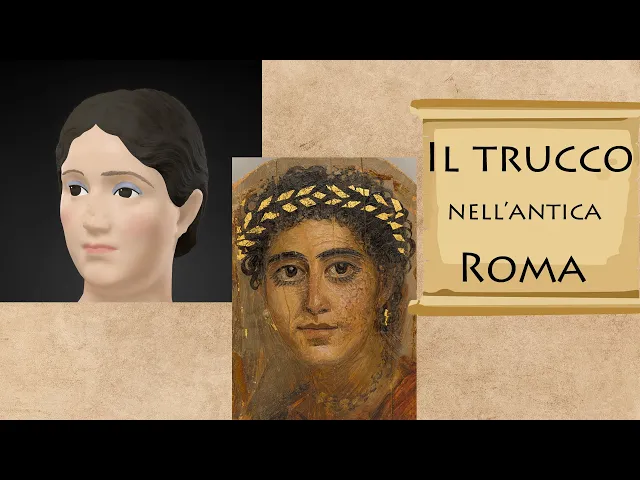
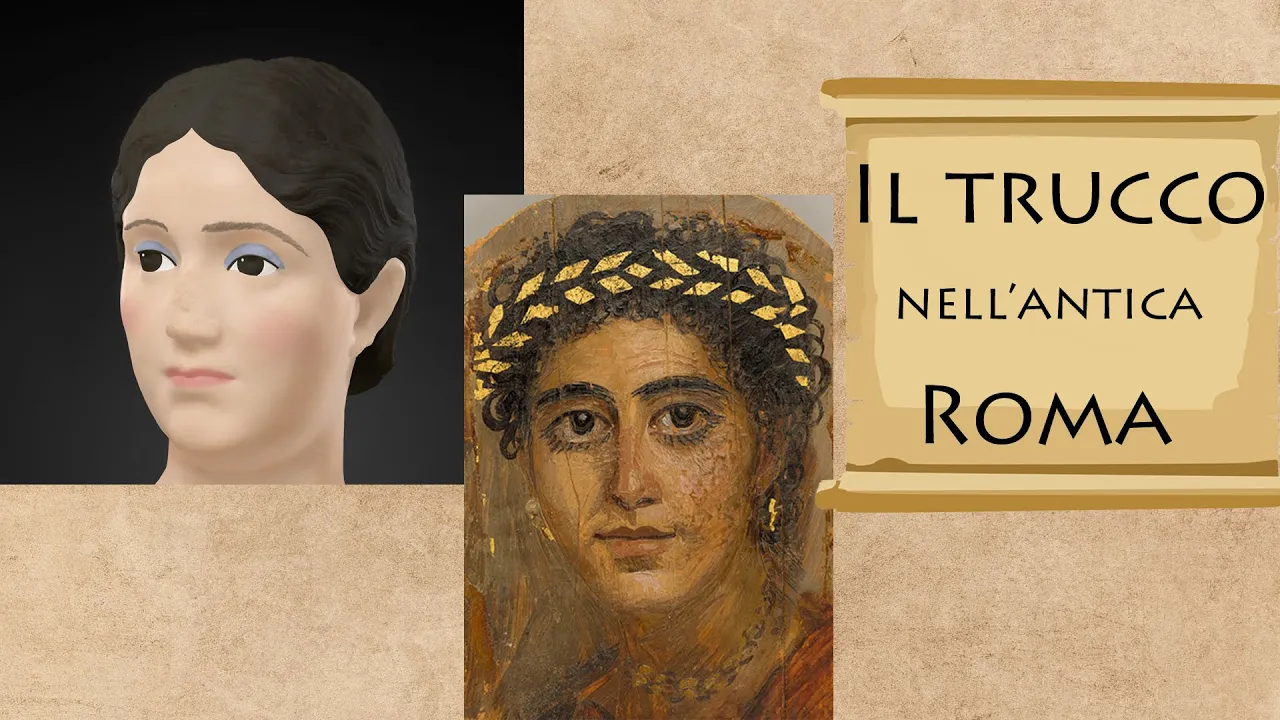
Lead, clay, ashes, and ants. Are they the ingredients for a magic potion? No, they are the ingredients for cosmetics used in ancient Rome.
Welcome back! Today we will talk about the female cosmetics in ancient Rome. As this is a very long chronological period, I focused on the authors of the first and second centuries AD.
However, a clarification must be made, and that is that the information that has come down to us all come from male Latin authors. This means that all the written sources that we have are seen through the perspective of men. And this sometimes leads to misunderstandings on the use of certain products.
Other times,an author may exaggerate in the description for the simple reason of discrediting a woman, in order to make her more frivolous. That said we can still get an idea of what body care and cosmetics was like in ancient Rome. However, in this video I will not mention the part related to personal hygiene, because you'll find it at this link, in one of my previous videos.
Women and men, of course, paid great attention to their skincare. And that's why we have so much information on beauty creams, made from the most disparate ingredients, some even toxic. So please don't try at home the procedures and cosmetics that we will see.
'Oesypum', the modern lanolin, a substance obtained from raw, unprocessed wool, was used as a moisturizing and emollient. Swan fat, as well as donkey milk, were instead considered excellent for wrinkles. Chicken fat, if mixed with onion, wasn't an appetizer but, instead, a mixture used to treat pimples.
Honey combined with lentils rue, or even verdigris and bile, was believed to be very useful to have a softer skin. All these mixtures were also combined with pigments, with natural dyes, or with perfumes with the aim to make these creams more pleasant. Female beauty canons required a woman's skin to have a clear complexion.
For this reason, matrons applied to their skin many bleaching substances. Among these we can undoubtedly mention 'melinum', that is, a clayey rock that was made from Milos Island. We might as well have found chalk powder mixed with vinegar, that had to smell bad.
That's why they added some perfumes. But there were more toxic substances such as white lead, that is, lead powder called 'cerussa' by the Latins. The body had also to be hairless.
And this was true for both women and men in the ancient world. And so they all shaved. Hair removal could be done in many ways.
They used tweezers or waxing creams made from resins or pitch. But we could have also found a little more drastic remedies, such as rub a pomice stone on the skin, or even burn the hairs using tools that had been previously heated. The facial makeup also required great care, especially the eyes.
The easiest way to put on makeup was to use a coal stick and then coal was sometimes faded with ash. Alternatively, they could also use soot or black smoke. Kohl was used as eyeliner, mascara or eyeshadow, and it was a mixture containing antimony.
The Latins called it 'stibium'. This powder was put directly onto the eyebrows or eyelids, like an eyeshadow, or they could use a stick dipped first in water, then in perfume and finally in the kohl itself in order to better outline the shape of the eyes. There were also eyeshadows of other colours.
Yellow, for example, was made from saffron; green was made from malachite, and finally blue, madre from azurite, or even from lapis lazuli. In the beautycase of an ancient Roman we would also have found ingredients for other eyeliners, and so we can find some roasted dates or roasted rose berries, or a black colour made from a cuttlefish and even from toasted ants. All these ingredients were mixed with a vegetable or animal fat.
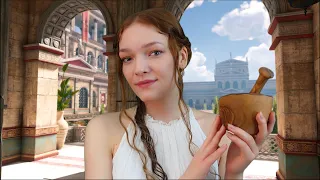
A very particular type of object, which so far has only been found in Britannia, is a mini-mortar, a pocket mini-mortar, which was most likely for cosmetics. The ingredients that had to be crushed were placed in this mortar, and they used a crescent-shaped pestle. The pestle was also used to put the makeup itself directly on the eyelids.
According to some authors, unibrow was very appreciated, and also false eyebrows. We don't really have any evidence based on iconography, an iconographic reference. But according to some authors, for example Martial, who was pretty nasty to some contemporary women, we can get this information.
Though, while you yourself, Galla, are at home, you are being dressed out in the middle of the Suburra and your locks are prepared for you at a distance; though you lay aside your teeth at night with your silk garments, and lie stowed away in a hundred boxes; though even your face does not sleep with you, and you ogle me from under eyebrows which are brought to you in the morning. Red for the lips and cheeks could be obtained in several ways . The brightest red was undoubtedly made from the minium and cinnabar, both toxic metals.
And so it was definitely a makeup that left its mark. If you didn't want to risk your health, other ingredients could be used and so we can find the red ochre, that Romans call 'rubrica', or red chalk. And why not?
Also the 'faex', that is the wine lees, the part that remained after the wine was made. Also rose petals and poppies are suitable, especially to prepare the blusher. And finally we have 'crocodilea'.
The name of this mixture reminds us of crocodiles. And in fact, some authors say it was a mixture made from crocodile's intestines. As we have seen, the Roman women of 2,000 years ago as nowadays, loved to put on makeup and take care of their bodies.
If you like the video, please put a like or comment so that even YouTube knows about it. I say goodbye and I'll see you in the next video. Bye-bye!