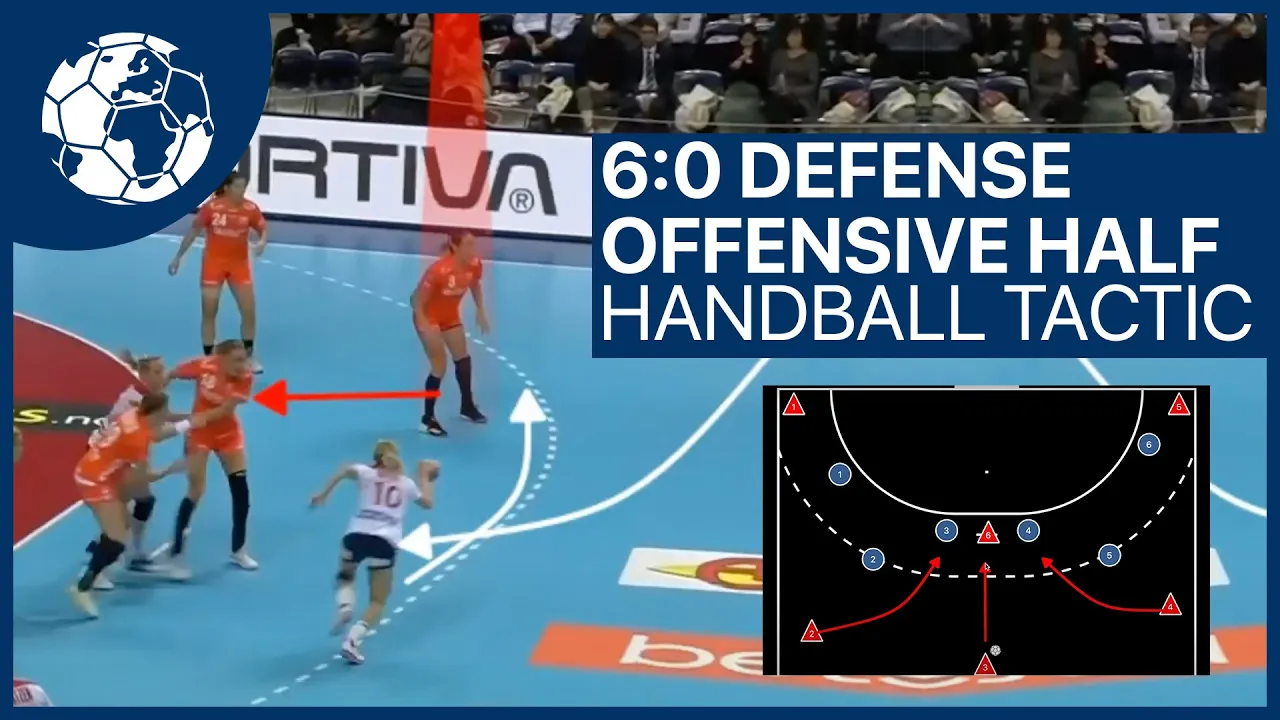
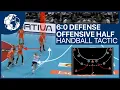
Hej, you're watching Handball Inspires. and together we will now take a look at the special 6-0 defense of the Dutch national women's team. The Dutchwomen are acting in thier 6-0 defense with offensive half-defenders.
And we will have a look at and analyze 3 elementary guidelines in her defensive play. In the end you will get 2 typical error patterns to implement this defense successfully with your players. You are at Handball inspires.
And this tactics video is all about it. Get ideas for your defensive philosophy from the analysis and let us talk about your suggestions in the comment columns. Stay on the ball and let yourself be inspired.
In the 6-0 defence with offensive half defenders we would like to welcome the opponent's back in the centre. Our half defenders always get help as soon as their opponent moves into the centre. There, a large inner block awaits the opponent, who can rely on his block qualities and the agreement with his goalkeeper in a tight space.
In the Dutch team the 2, the half right defender, is more defensive and we will see the 5, the half left defender more offensive. In the first clips, we want to convince ourselves of the importance of the block game and the agreement with the goalkeeper. Throws that come centrally from 9m or further back are solved with a double block.
As soon as the half-defense player has reached her goal, in which the back space player moves to the center, she lets herself fall back and the wrong throw decision against the numerical superiority is accepted. Here we can see the support of the central defender with a placed block for the 5 defender. A central defender steps out offensively in cross moves, we will learn more about this later in detail.
While her partner defends the circle and helps the 5. After many offensive actions both find together again in the center. Due to their attacks the Norwegians are now in the time game and have to rebuild themselves.
The pressure of the 5 defender increases more and more until at the end the throw in the center against the double-block takes place again. In this scene, we can see how the half-defenders repeatedly disturb the CB player by short attacks of the pass routes from the blind side during the game build-up. In this way, the game is once again concentrated in the centre, and with the help of the 2 defender, the following play to the pivot can also be taken.
If the opponent is in the time game, the pressure of the half-defender increases and they step out even more offensively. This means that there is again only the way to the centre for the back players, where the block is already waiting for them. The time game is not yet over and the pressure remains, thus provoking the TRF.
Should now be tried to push the half defenders backwards by a wide pivot and a transition from the wing. Do they still come out offensively against the ball and still want to force the back players in the centre to decide. It remains to be said that the goal of forcing the back area in the centre to make a decision through the offensive half-defenders is successful.
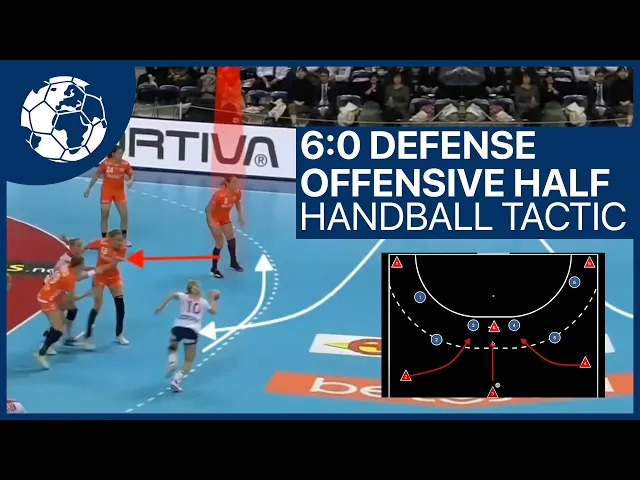
But how do we solve the way against the hand or outside from the halfbacks. The contact and the accompanying from the offensive position is crucial. The far defender will not block the space and sink to the wing player.
This creates a situation in which the wing player does not get any space for his throw and we accept the breakthrough of the half attacker with the throw from a wide situation and the resulting bad angle on the goal. Let us watch these situations from the dutch team. In this scene we can clearly see the two defaults.
The half-defender steps out offensively and makes direct contact as soon as the half back moves outwards. In the same move, the far defender sinks back and thus gives the space for the halfback, but not for the pass to the wing. Here we can see the implementation especially well.
Because of the many good cross moves and the coming out of the inside block, the 2 defender had to help far in the center and defend the pivot. Thus, he does not get into the necessary offensive position against the half back. The movement of the far right defender and confidence in the strength of the goalkeeper we can still see well.
Now we again do not reach the offensive position due to the fastbreak and the speed advantage of the attack. The wing player lets himself fall anyway and because of the size advantage of the defense, the only thing left for the attack is the heavy throw over the wrong leg. In the final scene we see all the defensive guidelines.
The attack of the half-defense player far from the ball, the offensive contact against the half-attacker, the sinking of the outside player, even if it allows the breakthrough, the renewed attack from the blindside and the throw over the compact inner block of 9m. If the far defender does not succeed in shortening the pass to the wing player or the angle sufficiently, the half back has reached his goal and created the free throw from the wing. Now we would like to look at the solution against the crossing of CB and RB.
As soon as the offensive half-defender notices this, she sinks back to the centre. Because the crossing is defended by the inside block player, first with an assignment against CB and then to RB. After the cross, the central defender tries to push the ball holder out of his sector and does not release the centre.
In the next scenes, we will see that. The offensive half-defender now recognizes the intention to cross and lets herself fall defensively. The central defender then attacks the ball holder and pushes it out of his sector, where a block is already waiting for the shooter.
The signal of the crossing is processed by the half-defender by the sinking and the central defender is again interested in the ball leaving his sector. As soon as this happens she drops back into the centre. We now look at possible error patterns, which you should prevent for a successful implementation of the defensive tactics.
Pull the half with the ball into the depth. Should the offensive half defender from the position away from the ball attack the blindside of the CB. It is important to make contact against the RM with ball or to prevent the easy pass from the half to the CB.
If there is not enough pressure and the RM is able to pass the ball to the other half, the attack will have created the necessary advantage on one-third of the field. The decisive factor is therefore the attack against the CB. Now let's see how the world champions could improve in this situation.
The signal is now the deep kick movement of the back left player with ball. Then the defenders far away from the ball attack the flow of the game. But with not enough energy and Norway can create the free throw on the wing.
Now we take the signal from the other side. Deep kick movement with ball from half back and the side away from the ball tries to destroy the flow of the game. But again, unfortunately, not with enough contact to stop the game from continuing on the outside.
The late help out of the central defender is then the necessary consequence. With this arrangement, the half-defender should process the signal first, because we want to play with offensive half-defenders. If the far defender acts rashly, there is no coordination and the wing player is free with a lot of space.
Should the pass now be played directly from half to half, it is important that this is difficult and the rhythm is interrupted. The fast running of the space is then the top priority, because the far defender leaves this space free and does not fall for the deception of the half-left. Decisive in this defensive formation is the offensive position of the half-defender.
If we advise a retreat or too much help defensively we have no possibility to prevent the breakthrough to the outside. The far defender gives this space and sinks to his attacker or she closes this space and thus gives the angle for the wing free. Especially the defensive bond with the inner block cannot be established sufficiently and direct passes to the pivot player are possible.
It is therefore crucial that the half-defender leaves the field offensively. We now want to learn from these mistakes of the world champions and complete our defensive strategy. Sinking into the defensive position now gives the breakthrough to the outside, because the far defense player continues to follow his rule.
But we could also give the outfield player the space with the signal of the defensive 2/5 and the deep half-left, because she takes the ball in the 9m, takes the opportunity to attack the ball holder. In any case, she should not stand too central and too offensive. Either she attacks the half or the pass to the wing via a sloping position.
Here we can clearly see the attack of the outside defender on the halves. But unfortunately, now the simple pass to the pivot is possible. The half-defender should always manage to get out offensively and thus put the back players under pressure or at least make the pass to the pivot more difficult.
I hope you could get a good insight into the 6-0 defense with offensive half-defenders and pick the most important points for you. For example, how would you attack against it or which topics I have misinterpreted in my analysis. Let's talk about this in the comments.
Because handball inspires.
![Offensive Defense - Collective Handballtraining - Till Wiechers | Handball inspires Rostock [1/3]](https://img.youtube.com/vi/I6nzGkcf3HQ/maxresdefault.jpg)



![How to play the Jugo Movement!? - Handball Tactic Express | Handball inspires [deutsch/english]](https://img.youtube.com/vi/xtLxeluQvp0/maxresdefault.jpg)