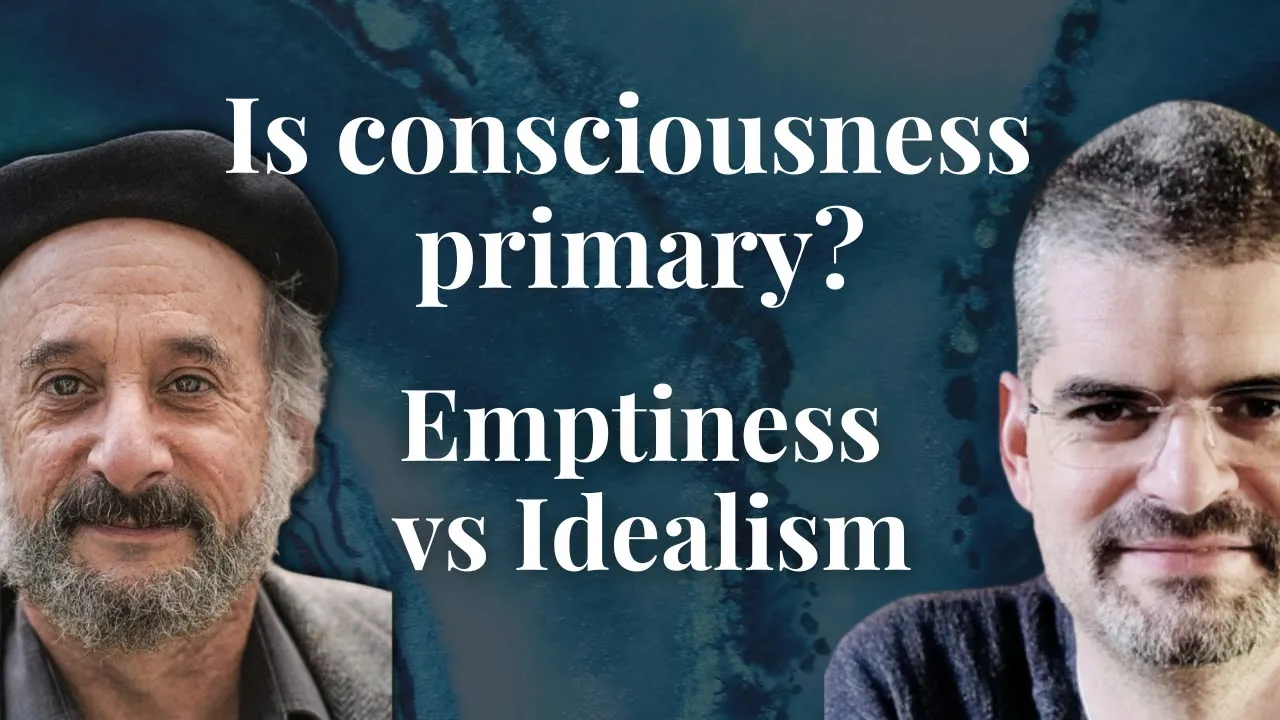
So this debate is part of a series of discussions that compare uh non-dual or idealist philosophies with some traditions of Buddhist philosophy with the idealist or non-dualists considering consciousness as fundamental to reality the very fabric of what existence is with Buddhist philosophies or some Buddhist philosophies that consider consciousness to be a dependent arising empty of its own inherent existence in Other words dependent on certain causes and conditions for it to exist. If you enjoy this conversation, you'll likely enjoy the follow-up that I will that I had with Jay uh that we'll be releasing in a
couple of weeks. We've also got several online discussions coming up on this topic that you can register to join live with people like uh Bernardo Castrop, Rupert Spir, Swami Savva, Priyanandanda and some very highly well- reggarded scholar Practitioners um from varying Buddhist schools. You can register to join these live calls and others at adventuresinawareness.com. [Music] Yeah, I've been working my way through your course. Didn't manage to get all the way through, but I've, you know, done maybe 20 hours of seeing your face on my screen for the last few days. So, Oh gosh. Which course
have you been doing? That's the one with The one, right? Yeah. Over co. Yeah. Yeah. Yeah. Really nice. I'm glad it's useful to you. I hope it's not too boring. No, not at all. Yeah, it's going right into all the ideas that I'm very interested in and have been less exposed to. Yeah. Lovely having the nuns there. Yes, they're really good. Yeah. Keeping you on your keeping you on your feet. Absolutely. Absolutely. Um, I just thought I'd let you in a couple of minutes before everyone else Just to see if that you have any particular
preferences um for the evening. I thought I'd do introductions and then um uh maybe have a more kind of formal chance for you both to present your perspectives and then we can go into dialogue and if there's time at the end get audience uh questions and comments. Sure. I haven't planned any particular talk or anything. I figured going to be more an interview and dialogue, but I But I can talk for a little bit if you if you give me a topic you want me to address. Yeah. Yeah. I mean the Are you familiar with
Bernardo a little bit or is No, not at all. He's um an idealist philosopher. Um and I've presented his perspective many times on this kind of channel to this audience. So, uh, there could be a lot of people that have joined seeing your name and familiar with you, but chances are there'll be more people Familiar with Bernard's perspective and maybe not so familiar, including me now. I've done some of your course, but it's obviously the tip of the iceberg. um for the kind of presandular view um and I was told I don't know if you
would agree with this assessment from from the course I picked up you're very humble but I was told by others that you might be the best person I could find in the west to represent the prasanga emptiness of consciousness oh Gosh I can certainly talk about it don't worry I don't think I'm the best person to do it but I can certainly do um that's not a problem um cool That's how how many uh viewers do you do you generally expect? Um so there could be anything between 50 and 80. Okay. Um and so when
it's time for questions, you'll moderate that. Yeah. Okay. So I don't have to worry about moderating a screen full of people. No, not Yeah. Are most Of them from the UK? Uh pretty international. One of the first things I do is I get people to put in the chat where they're joining from. And I'm aware that my invitation to you is like quite a tall order to initially give an overview of the whole prasangika uh perspective on consciousness within a 10 minutes or so. But yeah, just to get the the ball rolling and people exposed
to that. I'll say something for 10 minutes, but I won't give the whole of a person a Picture on consciousness. Yeah, that would be more like 10 lectures. Yeah. as I'm as I'm gathering from do you have another series because that one was more yoga that's exclusively yogara I have a general history of Indian Buddhism um well his a history of Buddhist philosophy that's on wisdom publications in the wisdom well I forget what they call it wisdom library or wisdom something Anyway that it's a video course um then I have a shorter video course with
Guy Nuland on wisdom called the three turnings of the wheel of dharma Uh and then lots and lots of miscellaneous talks of mine that have gone up on YouTube in various ways. If you just go into YouTube and punch in my name, you'll find a lot of things. And a lot of that is on Majamaka because people more often ask me to talk about Majamaka than Yoga. And when I say Prasanga, is that synonymous with Madyamaka or it's one of the two major divisions of Madyamaka. So Madyamaka divides into Prasangaka and Swatantrica. There's a lot
of debate about how that division goes and how different they really are. We're not going to go there. But yeah, I generally work in the prank tradition. Um though I've been accused of being a closet fatrica, which when it's said by a persona is Never said in a nice way. Great. Okay. So if you're okay, I'll let everyone in. Sure. Okay. Welcome everyone joining. um very excited for this evening's event and from the emails and questions that many of you have already emailed me, I'm aware that many of you are also equally excited. Uh it's
very gratifying for me because this is one of the events where I thought, oh, you know, maybe it's so niche and it might just be me and five other people Interested in this. very often we get um Bernardo dialoguing with scientists um and so to have the dialogue with a Buddhist scholar is quite different and then so I was very pleased uh to find this was actually one of the most popular topics that we've uh done. Thank you Hani I see you're here for recommending this great recommendation. Um, it's always nice for me and I
imagine for the speakers as well if you're happy to have no no Pressure at all. Just if you're happy to if you're happy to have your camera on, it just gets a feel of the community that we have here and the actual flesh and blood human beings that are tuning in. If for any reason that doesn't feel comfortable for you, please don't. But just just so you know, if it's all the same to you to have your camera on, it's always nice for me to see your faces. Um it's also nice to get a sense
of where people are joining from both Geographically and uh intellectually or spiritually or metaphysically. So if you feel like putting in the chat um where you're joining from in the world and then you might say for example I'm here from Devon in the UK and my background or what I've been more more exposed to is non-dual teachings or advita teachings. I'm uh much less familiar with the Buddhist perspectives on this and I've done a lot of stuff with Bernardo Castra as most of you know. But Maybe you come from a scientific perspective and you're joining
from a physicalist uh materialist scientific perspective with curiosity in this. Maybe you're joining from um a star-l uh connected cave in the Himalayas. Who knows? Uh maybe you're a scholar of some kind. Maybe you're just have a deep curiosity. So yeah, just getting a sense of that in the chat is always wonderful. And I won't read anyone's Names. Um you're anonymous as it were unless you for the recording purposes, you're anonymous unless you unmute. So please keep yourselves muted unless you want to kind of feature in some way. Uh potentially towards the end we'll have
some time for participant questions and comments. Uh, and there's people here from London, Los Angeles, um, a depth therapist, Bulgaria, background in art, philosophy, Boulder, Colorado, non-dual Shiva Tantra, New York, uh, nonduel and A Garfield fan. That's great. Um, Milwaukee, I'm not American, so excuse my pronunciation. Factory worker with enthusiasm for all philosophy. Anna, but okay, great. Lots of Americans joining in. Robert Spiro enthusiast. You familiar with Robert Spiro at all, Jay Garfield? No. No, I'm not. Learning something. Yeah, he's a much uh beloved um adviser, Vanta teacher or non-dual teacher in the UK. Um
and potentially his audience is more European-based. He runs retreats and gives talks. uh Portugal, Germany with academic philosophical background, uh London, Vancouver, Yellow Knife, Canada, adviser and student of adviser and Buddhist Buddhism here from London, a sort of Buddhist from London. Um Budapest, Hungary, um computer science and neuroscience and self-arning philosophy joining from South Africa. Welcome South Africa doing philosophy on and MA on idealist ontology of hallucination Edinburgh UK Buddhist practice and studying systems thinking and practice great wonderful group really really nice and often we get a bit of a side um conversation going on
in the chat which you're very welcome to do and you can private message each other if you find someone who's close to you geographically or intellectually and you want to make Contact and I believe in the email that I And there would be a link to the Telegram channel where you can keep the conversation going um after this event as well to keep connecting. So [Music] um just whilst we're waiting for Bernardo, I don't think he's joined yet. He's uh running two companies. You've got more people in the waiting room, though. Oh, really? Okay. I
need to disable the They keep coming. Fantastic. It's wonderful. Yeah. Oh, he's here. He's here. Had him held him in the waiting room. Um, so I'll read just a few more. Uh, oh, uh, I'm here apparently. Is this the wrong link, Amir? What happened? Because I was alone for quite a while. I'm sorry. I I normally first thing I do is disable the waiting room and I just forgot this time half the people in and then didn't see It was Jay that noticed that I'd left that closed. So great. Welcome. Okay. Thank you. Nice to
meet you, Bernardo. Uh where is he? Uh there you are, Jay. Hi. Pleasure to meet you. If this counts as meeting great and thank you both so much for being here. So, um, as far as I know, Jay, you weren't familiar with Bernardo's work until, uh, well, you haven't been familiar with him until now, till this moment. And Bernardo, is That is that both ways? Uh, yes. Yes, I I I know the name well, but I haven't had the opportunity to study Jay's work now. Okay, great. So, um, it's super exciting for me to have
you both meet. As I was saying to Jay, uh, I'm much more familiar with Bernardo's approach. We've done several courses together. I'm halfway through. Jay's uh if for everyone to know, Jay has an excellent course online with um how do you pronounce the Abby? Jay Shravasti Abby Shvasti Abby uh where he's teaching um nuns a uh yogara school of thought in Buddhism uh perspective but I believe tonight you'll be more representing the Madyamaka Prasangaka view. Is that right Jay? Well, if that's the view you want me to represent, I will represent it. Yes. Great. I
if I've understood that's the one that's most um critical of idealism that has the more uh the stronger critique of my Yeah. Okay. So, for me, I've always struggled To understand that and I and I from the emails I've received, I've understood that's the big curiosity for a lot of people here. Mhm. Um and I was excited to see in your lectures you talked about how in ancient India um debate was a kind of national sport. People really enjoyed uh heads of universities and schools in ancient and medieval India would seek out debate partners. Um
it was a way of gaining funding, gaining students, testing your ideas. Um and Certainly for myself I find that when two uh different perspectives are compared side by side respectfully I come away understanding both of them uh much more deeply. So I haven't seen much of these uh kind of things happen. Bernardo you've mainly debated uh scientist physicalists uh as far as philosophers too. Yeah but mostly physicalists otherwise it's not interesting right? Yeah, but but maybe less so those from that come from a Buddhist perspective and less less. Yeah. So there something a little bit
new and we've got a very international audience uh with a very diverse um set of perspectives. So what I thought we could do since you're both um uh uh meeting for the first time is maybe just uh go over a couple of things about your respective backgrounds just so you know where you're both coming from. um and then Give you both an opportunity to give a very broad uh introduction to your perspectives and then we can clarify whatever needs to be clarified, do questions and dialogue between you and then if there's time at the end
uh bring in the participants as well. Um how long do we have today? We've got uh two hours scheduled. Jay doesn't have a hard stop. Um my understanding and Jay can confirm or deny but this this debate between uh is consciousness primary is it depend a Dependent arising or is it fundamental to existence in India uh the greatest philosophical minds grappled with this for at least two and a half thousand years maybe longer um so I'm hoping two hours should be enough to finally put this to rest for all time but if we need 10
more minutes I think we can probably stick around let's have a We we will settle matters tonight. Yeah. Yeah. I think that would be great. A fourth. Would that be a fourth turning of the wheel or am I Yeah, something like that. Okay, great. Um, end of history. So, sorry. The end of history. The end of history. Yeah. Um, so if that's okay, Jay, since uh I think there's probably more people here less familiar with you, uh can you say a little bit about your your background and um understand you're a professor at Harvard Divinity
School? Is that and Smith College? Yeah, those are my two two bases right now. Yeah. Um So a little bit about me. Um I'm a professional philosopher. I plead guilty to that. Um, and I've been teaching philosophy for 45 years now, um, since leaving graduate school and I'll be retiring at the end of this year. So, you're catching me at the tail end of of a career rather than at the beginning. Um, I um, my PhD is from the University of Pittsburgh where my primary teachers were Wilfred Sers and Annette Buyer. So, a lot of
my thinking Uh, derives derives from there. But I was never really trained in Buddhist studies. because I was trained in cognitive science, philosophy of mind and logic which are areas in which I I still work. Um but I kind of drifted into an interest in Buddhist philosophy largely led by student interests and curricular needs at the college where I was then teaching. And so for most of the last three decades, most of my work has been focused on Indo-Tibetan and Sometimes on East Asian uh Buddhist philosophy and on trying to forge dialogues between um Buddhist
and Western philosophy, between um Buddhist philosophy and cognitive science um and just exploring the ways in which philosophy can globalize. Um, I've always urged that the unfortunate fact that most philosophy departments in the world, not only in the United States and the UK, focus exclusively on European or American Philosophy, is a deep problem. Um, and um, I've worked hard to make philosophy as a discipline more inclusive. That doesn't just include intention to Buddhist philosophy, but that includes attention to orthodox Indian philosophy, to Chinese philosophy, to Africana philosophy, to um Latinx philosophy, to indigenous philosophy. Um,
and I think that the discipline is much richer to the degree to which it represents the um the breadth of thinking in the world. So That's kind of what's motivated me for for the last few years. And importantly, you you do translations from uh Tibetan and from Sanskrit. Is that right? No, just from Tibetan. Just Tibetan. Yeah. And you've been to India and you've learned with Tibetan um I've studied extensively with Tibetan scholars in India. I've taught Western philosophy and Tibetan universities, Tibetan philosophy and western universities and tried and have run an exchange program In
India that I just left for 32 years. Um so during all of that time I was bringing students from the west to study at Tibetan universities in India. Bringing Tibetan students to study in the west. Bringing Western faculty members to teach in Tibetan universities. Bringing Tibetan faculty members to teach in the west and engaging in joint research programs and trying to set up a model for collaborative cross-cultural scholarship As opposed to cultural looting or tourism. Beautiful. Great. Thanks. Bernard, do you want to um say a few things relevant to your background and perspective? Yeah. Well,
I started out as a computer engineer of all things. That's what I studied at first. Got uh my PhD in computer engineering in 2001 at the Eintoven University of Technology here in the Netherlands. Um I have been in the high-tech world for Over 25 years now. I've just founded my second company. have done corporate high-tech strategy and all that. Um have started writing books on philosophy back in 2008 or nine, first publication in 2010. Um got deep enough into that that I started publish publishing academic papers as well. Got myself a second PhD in philosophy
of mine in 2019 at the Radba University also in the Netherlands. It's a classical university. Um and since then been Writing more books with a focus on ontology, metaphysics in general, philosophy of mind in particular and have dabbled in neuroscience and foundations of physics because physics was also the environment of my first job as an engineer. My first job was at CERN where I was exposed to you know foundations of physics standard model and all that. So I still have affinity with that to this day. Have you seen the crazy um documentary That Dutch TV
just put on about me and Carlo Ralli and the influence of Madiama on um on relational quantum mechanics? I am very interested in relational quantum mechanics. I think it's it's a correct approach. I haven't seen the documentary, but I'll tell you why. I haven't watched television in years. Okay. The Buddhist channel on Dutch public TV produced it and it came out about a month ago. It's kind of it's bizarre but it's kind of fun. I will Look for it. Thanks for the see my dogs that way and Carlos cat. I I will look for it
and maybe useful to say Bernardo you've um you're more steeped in western philosophy. You've uh studied western philosophers. Um yeah. Yeah. And you've had some uh exposure prestigious uh scientific um institutions like CERN and um was it the Phillips? Oh yeah, Philips research labs. The NAT lab as we called it in the Netherlands which is not National. It stands for physics. Uh I worked there. That's where the Kazmir effect of quantum field theory was discovered. uh but it it was a very pragmatic research organization but it no longer exists and but I I worked there
several years late last century and early this century and similar to Jay's had many dialogues with Tibetan scholars you over the last few years have become quite well known for defending your version of Metaphysical idealism and that seen you dialogue with many of the world's I'm not a scientist but from what I can tell um greatest uh scientists uh in neuroscience and physics and Yeah, lots of debates, lots of dialogues, lots of conversations. Usually with philosopher philosophers from the east, it's not a debate. Usually it's mutual reassurance uh and agreement. Uh usually that's what that's
what happens. We'll see may change one day. Yeah. Um and and I think Uh as far as I've understood, Jay will be representing um a view. So the the kind of non-dual view is very uh common through various traditions uh in India in that area but that was also a debate in that continent and and uh schools such as Majamaka Prasangika um again apologies apologies if I mispronounce any of this um were critical of some of those views and um to to what extent does the maybe you don't want to say which would be fine
to what extent does That view Jay accord with your personal uh conviction Jay or or or perspective. Well, the first thing I I want to correct is it's that the personic of view is not critical of non-duality. Um non-duality is kind of taken for granted as a kind of um correct understanding of ontology and epistemology throughout the Buddhist world. But there are different different accounts of just in what that nonduality consists. So what we are not going to see here is a Gigantic clash between opposing world views. What you're going to see is very fine
nuances and distinctions um being drawn um that are going to separate some views that might otherwise easily be confused with one another. Um so that's the first thing to say. The second is that yes, I find the persona view very compelling. Um and um I've defended that view um in print quite a bit. So yeah, there's no secret there. Mhm. Great. And then so just to set set the ground um Unless either of you have a different preference, I thought just give you a kind of formal 10 minutes or so. Obviously uh your intro course
is about 10 hours I think Bernardo. Um Jay, you mentioned probably 10 hours would be a a better amount of time to give an overview of uh Prasanica, but to the best of your abilities, a kind of broadstrokes overview of those positions. Um, and again, unless you have a different preference, Jay, Starting with you, because I think your view is the one that most of us are probably less familiar with. Okay, that's fine. Um, and stop me if you have questions or if something I say is unclear, there's no reason you have to let me
rattle on and just bore you to death um or confuse you. So when we look at the history of Buddhist philosophy, as many of you will know, having noticed some of your backgrounds, um it all begins in about The fifth or sixth century before the common era with the guy who's usually known as the Buddha, uh Sedartha Gautama. Um but about 500 years after his death, right around the turn of the millennium, um a new movement within Buddhism begins to emerge called the Mahayana or the greater vehicle um which is not discontinuous with early Buddhism
at all. I think it's a natural evolution of um earlier Buddhist thought but begins To emphasize some new ideas both in ethics and in metaphysics and epistemology. The the most important metaphysical view that starts become really moving to center stage um is the idea of emptiness and the understanding of that emptiness as an emptiness of all phenomena of intrinsic identity. Now the Mahayana within a couple of centuries um splits into two subschools. Matiamaka the middle way school which is the one that I'll be talking about and Yogachara The more idealistic or phenomenological school which is
um the school that we that is the topic of the uh the lecture series at Shravasti that that we've been mentioning before. But the Madamea school um emphasizes the emptiness of all phenomena whether those phenomena are on the subjective side or the objective side whether they are um mental or material and um emphasizes the need to treat all phenomena on roughly the same Basis um metaphysically and epistemologically. Now Madiama then splits. Uh so Madiama gets founded for those who care about the history by a guy named Nagarjuna um who lived in about the second half
of the second century of the common era in South India and his most famous text is the fundamental verses on the middle way Mulama karaka and that's where he really sets out and defends this doctrine of the emptiness of all phenomena. There's Other important texts as well. Leave those aside for now. But in India, as largely in the west, philosophy gets prosecuted largely through the vehicle of commentary. And so in the commentarial traditions on the Garjuna, we have two different ways of reading him. One is the one that came much later to be called Prasangaka
and the other came to be called much later. The termatantrica means somebody who defends their own position. Um and The term prasangaka literally means somebody who uses reductio arguments um and simply criticizes other people's positions. Footnote there's a big debate about whether those terms are actually appropriate about whether those schools are as different as they seem to be and we could go into that one forever as well. Um those who are interested there's a great book by Sarah Mccllintok and Tom Tibans or by George Strifus called um Prasanga what difference does A difference make half
the papers in that book argue that there's no difference between the schools half argue that there's profound and important differences that's not where we're going today um but the idea behind um in the school that really makes it uh special according to those who work within that is that it argues that prasangakas do not assert that there is any fundamental nature of reality because they think That the very idea of a fundament fundamental nature of reality is fundamentally confused. um that when majamikas when followers of the middle way school say that all things are essenceless
interdependent and nothing has any independent being um you can see why RQM came out of this by the way very quickly um what they mean is not that well there is a nature of things but um it's different from what other people thought but that the way to do Metaphysics is to stop looking for essences and to stop looking for the nature of things Um and so the term prasangaka really means that instead of asserting their own thesis about how things are they try to show that any approach to saying exactly how things are ultimately
is going to be fundamentally confused. So one way to put this as my colleague Mark Citritz put it very beautifully in a paper long ago from the prong position the ultimate Truth is that there is no ultimate truth. Um nothing is ultimately real. Everything is empty of any ultimate existence. Everything exists only contingently, only interdependently, only impermanently, and has its ontological status only in virtue of the ways we choose to um to do our ontology and the kinds of things we tend to recognize as entities. That is to say that everything is conventionally real. Importantly,
and I'll stop in a Moment, it's very important within the personic system to understand that being conventionally real is not a way of being unreal. It's not an alternative to an ultimate reality. It's the only way that anything can exist. So you can see prangaka in one way as providing an analysis of existence in terms of interdependence and that interdependence itself has many levels. We won't have time to go into all of them and all the details but part of that interdependence Is causal interdependence. Part of that interdependence is myological interdependence which goes both ways.
Holes depend on their parts just as parts depend on their holes. And part of it is conceptual interdependence. That is for anything to emerge as an entity as a thing in our experiential field to be um isolated as something about which we can talk requires a conceptual framework in which that part of the great um ocean of interdependent causal Phenomena um stands out as an entity. So that that's dependence on conceptual imputation. So when we say that all things are empty of um intrinsic reality, we mean that the only kind of reality anything has is
an interdependent conventional reality. I'll stop there. Great. That that was brilliant. Can you just clarify one more thing before we go to Bernardo because um and again all my questions are limited by my Understanding but that's probably um echoed by at least some people watching. uh my understanding of the idealism that was critiqued uh from yogara is an idealism that posits no external world. Yeah. So there there's several different versions of idealism on on tap in Indian philosophy as well as many different strains of yoga. And if you since you've been attending to my yoga
course, you'll know that I argue that yoga is not essentially idealistic even though there Are idealists within that tradition. But the particular kind of idealism that was prominent in the yoga tradition was an idealism that denied the existence of external objects but asserted um the fundamental existence of mind and that also asserted that mind was transparent to itself and known reflexively. So it gave the mental a very strong a much stronger ontological and epistemological status than the physical. And the persona persa critique Sorry the persa critique um is a critique not of the idea that
external objects only exist conceptually. they accept that um or dependently um but the idea that the mind has an independent existence and can be immediately known. So prankas tend to be coherentists, anti-foundationalists. Um they tend um to be um to have an a thoroughly mediated view of knowledge that the idea of immediacy is something that persons find really problematic. And one thing That does run through the yoga tradition whether we see it as phenomenological or idealistic is an emphasis on the immediacy of our knowledge of mind which is something that personists think is crazy that
we know our mind through the mediation of introspective faculties just as we know the external world through the mediation of external sensory faculties. Um for those who care about this I don't know I don't want to take more time than you wanted to allot Me. So um for those who care about this, I'll say one more little thing. Um if you have read the second edition of Khan's critique of pure reason and in particular the appendix to the transcendental deduction called um the reputation of idealism, you will see a really nice recapitulation of Chandra Kir's
7th century critique of yoga idealism. There Kant identifies idealism in the porative sense, right? Remember Kant was also an idealist of a different Kind. But the ide idealist that he takes to be the wrong kind of idealism. Always as a position that treats the mental and the physical as having different onlogical and epistemological status and giving pride of place to the mental. So and so Kant argued that the great virtue of his own transcendental idealism was that it gave the mental and the physical exactly equivalent status both ontologically and metaphysically. And that's an argument that
Shandra Kiri had Made in the seventh century um in India in his critique of yoga idealism. Great. That was literally exactly 10 minutes. So um I don't know if you rehearsed that to just precise. Yeah. Beautiful. So again, I'm sure there's lots of questions and dialogue to come, but perhaps Bernardo, you can introduce your um perspective for Jay's benefit and then we can Yeah. Yeah. So in in this specific case, I have to start with some primary Assumptions I make or concessions if you will. Um I assume that we can apply Aristotleian logic at least
most of the axioms. I'm open to giving up the the the principle of excluded middle. that u if if we are talking analytically we have to embrace most of Arisotellian logic I assume that it's valid to talk about an ultimate reality if somebody says well there is no ultimate reality and this person is correct then that is the ultimate reality that there is no Ultimate reality so I think uh it's it's valid to to talk about it and I also make the following assumption at least in the west we will always try to find out
what the ultimate reality is. Um, so the best game in town is to try to be less wrong about our guesses or inferences about what that ultimate reality might be. And that's the game I play. It's not the game of um pronouncing with full certainty that this is what's going on. We are apes, Bipedo apes that have been running around this rock for 300,000 years, only the blink of an eye. Apes are not in the business of automate realities. Uh but we can make better guesses. We can correct previous mistakes, previous inconsistencies uh in our
line of thinking. Now given all this, my position is the following. Uh analytic idealism is a form of objective idealism. Uh it grants that there is an external world. Not everything is in my Personal mind or your personal mind or all of our personal minds together but nowhere else. No. No. Um uh we I believe uh Barkley was incorrect when he said that to be is to be perceived. No, there is that which is perceived too. There is an external world that we all inhabit, we all share. However, I believe that the best guess we
can make is that that external world too is constituted of mental states or experiential states. Phenomenal states would be the technical word to use. Um, and you could think of it in the same way that my thoughts are phenomenal states. My fantasies are phenomenal states. My emotions are phenomenal states. But they are outside your mind from your point of view. My thoughts, my emotions, my fantasies, although phenomenal are also external. U my phenomenal states would still exist even if you were not there. And they will not change by a mere act of Valition by you.
And it's in exactly this sense that I would say the world too is really out there. We cannot change the world by a mere act of vition. The world would still be there even if we were not here looking at it. But the world is constituted of phenomenal states, mental states. And those external mental states appear to us upon observation as what we call physicality. And the intuition behind this is very direct. My thoughts, my Emotions appear to other people in the form of the matter of my body. My facial expressions, the tears in my
face, my patterns of brain activity, which certainly correlate with my inner experience. So all of these material things are appearances. They are what my inner phenomenal states look like when they are observed from the outside. The same applies to the universe at large. So not only my phenomenal states appear to external observation as matter uh but The rest of the matter in the universe too is the external appearance or the extrinsic appearance of phenomenal states that have a first person uh point of view. Um I would go ahead and and and propose well that's what
I do in analytic idealism that the difference the separation between my inner phenomenal states and those of the world is a dissociative boundary which is a well-known phenomenon uh in psychiatry. You know we become dissociated every time we dream because we think we are our dream avatar and not the rest of the dream. Well in fact we are the whole of the dream. We become dissociated when we forget something that we later remember and we become dissociated pathologically if we're suffering from dissociative identity disorder or multiple personality disorder. And the idea under analytic idealism is
that life biology is what a dissociation in a universal Field of subjectivity looks like when it's observed. And what is an observation? An observation is a cognitive representation on an internal dashboard. So we are like um airplanes under analytic idealism. An airplane has sensors that measure the real states, external states of the sky outside. The results of those measurements are presented to the pilot. Imagine that you're flying in the dark, very bad weather. So that you have transparent Windows does nothing to you. You can't see anything. All you have is your dashboard. So the results
of measurements are presented to the pilot in the form of dashboard indications. The dashboard conveys um accurate information about the real world outside but the dashboard is not the real world outside. In that same sense for an analytic idealist um we would say the colloially physical world in other words the contents of the screen of perception Are dashboard indications. They should be taken seriously because they convey accurate information about the real world real world outside. But they are not the real world outside. The real world outside is not physical in the sense of not being
exhaustively describable through physical quantities. What is the length in centimeters of a thought? What is the electrical charge in kulums of an emotion? Um that shows that mental states are not physical in That sense. And so if the world as it is outside is not physical because physicality is a dashboard of representation then what is left I would say what is left is mental states in other words qualitative states experiential states that present themselves to us in the form of the dashboard indications we call the physical world. Now um I do not support the notion
that um everything is relative. um the the extreme that Rolli Pushed his uh relational quantum mechanics RQM. Um he I think he correctly uh uh realized that under quantum theory you can have distinct but both correct descriptions of the same series of events. How can that be? The same series of events gets two descriptions that are different and mutually contradictory and yet they are both correct. Well, that can only be made sense of by saying all physical entities, all physical Properties, all physical quantities are relative to the point of view of an observation. That is
perfectly coherent. I think what is not coherent is then to say and there are only physical entities because now you cannot ground the relations. If everything is relational, uh then what is it that is relating? uh one would have to say well relations relate but that's infinite regress it's like it's like talking of movement movement is relational one thing moves In relation to another if there is nothing else there is no movement um but there has to be an absolute that moves we cannot say that what is moving is movement itself I believe that is
incoherent and in so far as we have to accept some form of logic allotellian logic I think we have to say that it is incoherent to say that all that exists are relations between relations between relations. It's a form of ungrounded uh Infinite regress. Uh relations must be grounded with something absolute. Even if it's only one thing, an analytic idealism would say it is one thing only. It's a field of subjectivity. Everything else are patterns of excitation of this field. Just like so atomic particles are patterns of excitation of underlying quantum fields. So you can
get all the variety of nature out of quantum field theory using 17 fields. Later maybe we get to one. Um but ultimately under Analytic idealism everything would be reduced to one field. But that one field subjectivity itself must be absolute. If everything is an illusion, there has to be a subject that is deluded that that that experiences the illusion. If everything is relative, there is to there has to be some absolute that grounds the relations and which is itself not a relation. I think to depart from this, one would have to appeal not to analytic
reasoning but to some form Of transcendental insight that cannot be captured in language. And then I would suspend my disbelief. But in so far as we are having an analytical discussion, I think it is not coherent to say that all things are just relations and there is nothing that isn't a relation. Brilliant. You're you're both so amazing at timing uh what you say exactly to the uh brief. It's quite impressive. Um I'll just drop one question and then and then let you both Ask questions or or counter each other's views. Um, so your journey, if
I've understood it, Bernardo, was basically initiated by grappling with what in the west is known as the hard problem of consciousness, if the fundamental uh re um fabric of reality is something that isn't mental, um, then how does it give rise to conscious experience? That's been a lot of what your work has been has been to show that's very incoherent. Um quick question for Jay. Was there an equivalent uh concern in um thinking at that time in India or in your own thinking of okay if there are things that aren't mind how do they give
rise to mind? Well, sure. Anybody who begins asking the question in virtue of what am I conscious of something else? Um, ends up wondering a whether everything is conscious or b whether I'm the only thing that's conscious or whether something else is actually what's Conscious. Right, Barkley? Um, and and worrying about that. So yes, and though often in somewhat different terms because there were different intellectual traditions and um in India than we find in um early Europe, but many of the same many of the same questions emerge. Um I I was struck as as Bernardo
was talking at how fundamentally we disagree about almost everything. Um, and um, I began wondering where where we actually Begin this dialogue. I mean, enormous respect for everything that Bernardo said, but you know, you can you can respect the position without agreeing with it. Um, and some of the fundamental um, orientations with which Bernardo begins are ones that I find very foreign, and I'm sure he'd find some of the ones with which I begin very foreign. So for example, he says that we have to begin with a fundamentally aristoilian logic. Um look, I work in
Parconsistent logics. Um and that's where where I've worked all the time. Um so but but for those who aren't into the technicalities, these are logics that tolerate contradictions and that um recognize the fact that there can be true contradictions. Um, so I'm kind of used to hanging out with paradox and I don't think of that as something that has to be given by mystical intuition. Um, I think of that as some uh something that can be the Result of rational inquiry. I opened the door to that. I said we can give up on the principle
of excluded middle and but you didn't say non-contradiction. And so you said that's the that excluded middle is all we can we can give up. I give up excluded middle but I also give up non-contradiction. And as you know those are different principles. Yeah, I wouldn't give up on the latter. Right? So that's that's a fundamental difference between us. Um you can be a Quasi aristoian and give up excluded middle and become something like an intuitionist in the end. Um but I come from a paracconsistent world um where we take truth values to assort independently
um and for valuations of sentences to be subsets of the set of truth values not members of the set of truth values. And so we see ways for contradictions to be true. So when you say something like at the very the very beginning when Somebody says that the ultimate reality is that there's no ultimate reality that's their ultimate reality. I say yes, but it's also the absence of ultimate reality and that that's perfectly coherent. Um, yes, it's paradoxical, but I don't have a problem with paradox because nobody ever whispered into my ear, by the way,
I'm the deity, and I want to tell you something, Jay, the world is consistent. Um, so I have no reason to believe that The world is consistent. um and good reasons to believe that it's inconsistent both on grounds of uh both on mathematical grounds and on metaphysical grounds. And I don't see that as mysticism. I don't see that as coming from mystical experience. As I say, I see that as coming from fairly rational reflection on logic. Um and it's not I'm not new to this, right? I'm not the first person to do this. Um we
have got a long tradition of paracistent Thought both in the west and in Asia. Um so it's not it's not something weird. Um so you also argue that you know infinite an infinite regress of grounding is vicious. I don't see anything vicious about those regresses. I mean remember regresses can be infinite and benign or infinite and vicious. And I have never seen a cogent argument for the viciousness of infinite um uh regresses of grounding. For instance, in set theory, we're all well Familiar now with nonwellounded set theories in which we often have infinite regresses of
set membership. There's no reason to believe that infinite causal regresses, infinite analytical regresses are in any way vicious. They may just be infinite. Again, nobody ever whispered into my ear and said, "By the way, the universe has a finite mathematical structure, and so I've got no reason to believe that it necessarily does." Um, you also I just I'm not trying to Criticize your views. I'm trying to indicate the places where we disagree and to show you just how profound those disagreements are. They're disagreements about logic. They're disagreements about about what regressives look like, methodology. Um
you also um in the argument for a kind of a phenomenal character of external objects leaned on an implicit distinction between the between the inner and the outer. Um and that's a Distinction that I find deeply problematic and one that personaga thinkers find deeply problematic. It's one that in the west you have to remember was invented very much by Augustine. um that one's not Aristotilian. Um importantly, it's Austinian and it was um invented as a way of trying to work out um a kind of um a solution to theodysies. Um and I think that it's
a deeply problematic one. Um it leads to this idea that There's something very special about a first-person perspective which leads people to say things like what you said that there's got to be qualities um that have an essentially first person perspective nature. I think the whole idea of a first person perspective that is conceptually different epistemologically different from a third person perspective is simply nuts. Um but I don't think that because of any kind of revelation again my tradition is Solarian. um you could have come up with this in the middle of the 20th century
by reading Haidiger, Sellers or Vickkinstein as well as going back to the second century and reading Nearer the seventh century and reading Chandra. But again the the the idea that there's a fundamental difference between the inner and the outer the first person and the third person is a different place that divides us. Um the last one I want to talk about is illusionism. um you Argued that if there are illusions, there's got to be some non-illusory thing that is the subject of those illusions. And I just kind of want to shrug my shoulders and say
why um why isn't it um not only possible but maybe obvious um that illusion is um pervasive and bottomless. Um one way to put that is to lean on which I like to do is to lean on the Indian the Sanskritic definition of an illusion. An illusion isn't something that's unreal. An Illusion is something in in for which there's a difference between of its mode of existence and mode of appearance. So we say that the Mueller liar illusion is an illusion. Not because the lines aren't real, but because there's a difference between how they look
and how they are. When we talk about a mirage being an illusion, we don't say there aren't really miragees. We say that a a refraction pattern looks like water. So it I think there's nothing problematic About saying that everything we ever encounter including our own minds, including our own sensory states are illusory. Illusory in the following sense. They appear as though, now this is getting to your dashboard illusion, your dashboard analogy. Sorry, I think it was an illusion. as the illusion that um the things of which we're aware are simply presented to us as they
are. That we are equipped with reality detectors that deliver us a reality when in fact All that we encounter is the way the world shows up as it's mediated by sensory and cognitive faculties like ours. The one place I really agree with you is we are evolved great apes and but we're evolved great apes who often walk around taking ourselves to be reality detectors when in fact all we are are um sets of open causal processes kind of um autopoetically um interacting with an environment um around us. So that's a long response. It's not meant
to be a Critique and it's not meant to be a defense of my view at all, but to indicate the many places at which we fundamentally disagree in our orientation. Of course, it's meant to be a critique and it's perfectly fine that it be so. I would be very disappointed if we if we wouldn't do that. Um, I'll try to address each of your points. I may not remember them all. So, I may ask for your help. Um, uh, just to remind me of what the four or five points were. I'll start with the last
because that's the one I have most fresh in my mind. Um, yes. An illusion is not Yeah. Yeah. Sorry, I thought someone someone wanted to say something. An illusion does not mean that there is an absence of existence. An illusion means that what seems to be the case in fact is not. In other words, if we say that um that that bird in the sky is an illusion, what it means is that it was not a bird in the sky but it was Something else. Um this works for almost everything with one exception subjectivity. This
does not work for subjectivity. When it when it comes to subjectivity and you say the subject is itself is an illusion then what the hell is it that is experiencing the illusion? You cannot get beyond this. It is absolutely incoherent to say that consciousness itself is an illusion because the moment you say that we we are saying that the thing That grounds the illusion is itself an illusion. So what is eluded? So I don't think that appeals to um the definition of illusion as something not being what it seems to be. uh hold in the
case of subjectivity um allows us to relativize subjectivity. I think subjectivity is the only pre- theoretical given of nature and even if it is not ultimately absolute because after all we are apes what do we know anyway as far as our cognitive system is concerned uh we Cannot just wipe it under the carpet and say well it's just more relations um let me think about the other point uh that that I wanted to address um the point about logic I'm very comfortable being an intuition I'm very comfortable getting rid of the principle of excluded middle
and say well to say that something cannot be false does not imply that it's true or to say that something cannot be true does not necessarily imply that it's False falsity and truthfulness are con are constructed you know if you want to prove something to be true you have to produce an example uh of it so I'm very comfortable with that but I'm not comfortable with contradictions being fundamental because that throws rationality out of the window. There are examples of true contradictions in in math and in logic uh um when it when they entail self-reference.
That's the root of the proof of God's uh theorem of Incompleteness. Uh for instance um and that's something reflected in statements like this statement is not true. So if it is true it cannot be true. So it's false but it's false then it cannot be true. So it's true. Um but these are toy examples that we play around at conceptual level that we play around with language. I think we have to guard against taking toy examples in language and saying and therefore this applies to the very ontological ground of reality. If we accept contradiction then
we accept internal inconsistencies and all kinds of nonsense are now fair game. I don't think that is that is appropriate. I think we have to guard against sophisticated academic thinking um hiding incoherence um and I think accepting contradiction at all levels uh is is just incoherent. It's the definition of incoherence uh when when one makes two Statements that contradict each other and and yet one wants to have both. There is somebody um who is not muted and I'm picking up a lot of Yeah, there there doesn't seem to be anyone not muted. Uh, I wonder
if there's some kind of background noise. Uh, your end, Jay. So, I'll mute you when you're not speaking. Um, okay. But just unmute yourself. I'm not hearing. Go ahead. Yeah. Yeah, I think it might be coming from your side because no one else is Unmuted. Um, if that doesn't work, we'll try something else. But just go ahead and unmute yourself when you uh have something to say. Yeah. Um, the point about ultimate realities, um, as I said, I take this as a as a starting assumption. It's not I I'm I I'm cautious enough to know
the limitations of ape intellect. Um but I think if we want to have a metaphysical dialogue to have a metaphysical discourse that does not um appeal to to U introspective insight that may go beyond logic. If we want to have that discourse to get rid of the ground of that discussion to to get rid of the at least the hypothesis that something is ultimate because we cannot have this vicious infinite regress and I think the infinite regress here is vicious. Uh but notice that I'm not saying that infinite regress in all cases is vicious. I
didn't say that. What I said was that um the infinite regress in relational Quantum mechanics um which arises if you say all physical entities are relational and there is nothing but physical entities that infinite regress I think is vicious because again it's the example of movement uh um the meaning of movement which is relational is a relation between two absolutes the things that move with respect to one another. If we say only movement moves, we rob the very concept of movement from its meaning. In other Words, it it means nothing. It's something we can say
but it means nothing. In exactly the same way, I think when we say all reality is is constituted of relations and they are relations amongst relations, we are robbing the word relations of meaning. In other words, we are saying nothing. It means nothing um to say that um I forgot your other there were other two points I wanted to comment on but u this will be exhaustive if we try to comment On everything so so I'll leave it at this I think I was provocative enough to keep the discussion exciting unmute and uh let me
just respond to those to those two points Um the first one I think is really important and I think that um I disagree very very deeply with uh your response uh with with your view about contradictions. Um you like Aristotle simply flatly say that to affirm Contradictions is irrational and nonsensical. Now you did point out that there are unavoidable contradictions in set theory, in semantics and in mathematics and that's right. Um they are absolutely unavoidable contradictions. Um now you then argued but to say that those contradictions occur in reality is completely insane. I don't think
you use the word completely insane. You said irrational. Um close enough. Now there's No argument for that claim. I just want to point out first of all you repeated it four times but you didn't argue for it. Um many people argue for it on the grounds that um exontradiction x contradiction quad limit but that of course doesn't work in a paricistent logic since not everything follows from a contradiction. It does not follow from the fact that some contradictions are true, that all contradictions are true, any more than It follows from the fact that some sentences
are true, that all sentences are true. Um, you need inference rules. And as you probably know in in parconent logics, the explosion rule that takes you from a contradiction to anything is blocked because of the way the conditional is defined. Um so that if you were to argue that the idea of contradictions in reality um is completely um uh irrational. You would need arguments and the argument would Have to be of the form that here is why we know that reality is entirely consistent. I have never seen anybody give an argument like that and I
didn't hear you even essay an argument like that for good reason because there aren't any. Um now you turn to the one right right there but okay go ahead go ahead go ahead your cat. No no no there's a book by uh Dmit D. U yeah Michael Dummit. Yeah, Michael Dit. Michael Dummit repeatedly asserts that He never argues for it. And the way the only argument that he gives is that if contradictions are true, then everything follows, but that ignores actually the way the parconistent logics work. So I that's just that's just off the table.
Um there I've never ever ever seen an argument for consistency that doesn't presume consistency. And if you have to beg the question, you've got to worry about your position. I can give it a try, But will you give me a chance to respond to this part before you go to another one? Please, please, please finish this point. It's just that I can't My stack is short. Okay. No, that's fine. That's fine. Go, go ahead. Okay. Um I I would make the following two arguments for um the irrationality of uh accepting contradiction. Um, one is by
mere linguistic definition. We can define rationality as a line of thinking that doesn't contradict Itself. Um, and I think that's a very reasonable uh definition that most most educated people on the streets would recognize. But note that that begs the question patently, right? If you want to simply say I'm going to define um irrationality in such a way that it's irrational to accept contradictions that is not an argument that it is irrational to to respect contradictions. Now you need an argument for the definition and the argument for the definition would Have to be that there
are no acceptable contradictions and you're arguing in a circle. Well, no, no, the spirit of but the point is what most people understand by the word contra by the word rationality is not compatible with uh accepting contradiction. So I'm not redefining the word. I'm just saying what most people understand by the word is not compatible with the fundamental existence of contradictions because otherwise it would be rational for me to Say um I feel very bad right now but I'm quite happy. Well, is this irrational? Is this rational? I think most people would say this this
is illogical. This is not rational. So the the the vulgar colloquial understanding that people have of rationality if I use the word in that colloquial vulgar sense but by the way for the rest of us vulgar here doesn't have a negative connotation. It just means what is commonly understood without extra sophistication. That That's all it means. So the vulgar understanding of rationality I think is not compatible with accepting contradiction. The other argument would be empirical. Allah the whole discussion about whether is logic empirical. I would say following Wner with his 1960 paper about the miracle
of the effectiveness of mathematics and therefore logic uh in describing nature. Um it shows that yes indeed nature doesn't seem to contradict itself. Every Time we thought it did, there was actually a solution like um information disappearing beyond the event horizon of a black hole. Well, we squared that circle. Now there is there is a higher higher understanding that now holographic theory. It seems that we can go very deep into the empirical exploration of the work of the world. Um and we always see something logical. Quantum field theory makes predictions to 12 13 uh uh
digits after the decimal Point and it's exquisitly correct. The logic of Einstein so seemingly uh counterintuitive in the early 20th century was so powerful pure logic that it describes now the cosmos. It describes essentially every observation not only in the solar system but things like gravitational lensing. Point your telescope to the sky to the right point and you see gravitational lensing right there. A body appearing as multiple images even though it's the same body. Um the logic of Hubert spaces which was a it was developed as a kind of a mathematical or logical toy. We
were just exploring the power of logic as expressed in in mathematics seeing how far we can go. and it was never meant to reflect something out there in nature. It was just an abstraction, a toy. Lo and behold, it's the foundation of quantum theory. Um it turned out that nature follows exactly that. I think we can say with a high degree of confidence Today that um there is no accepted science that embraces contradiction. All of science is uh not internally inconsistent. So I would make that empirical argument, not only the linguistic linguistic argument, but the
empirical argument that the world as far as we have been able to discern since we we started looking seems to be quite consistent. Even the the seeming break of logic behind quantum mechanics is actually not that there are ways uh that Being more and more discussed to make good sense of the seeming contradictions of quantum mechanics which aren't contradictions at all if you look at that from a different perspective. So I think empirically my my money would be on the bet that every time we think there is an inconsistency in nature it's we who are
wrong. Nature ultimately reveals itself to be fantastically self-consistent. So much so it can bring A scientist to tears because it's a symphony of consistency. You're muted. Yes, I've just I've just unmuted. Okay. So, I do want to stay on this topic for a moment. And I noticed that there are some people in the chat who are very impatient with this particular topic as they want us to finally get to consciousness. Um to which we will we we will get but I do think that that this is important as well. So bear with us for one
moment. Um the first thing to say um is to come back to your claim about definitions and about the mundane or the vulgar understanding of irrationality. Um to be and I think you're just wrong about that. Um you are certainly right that many people believe that no rational person accepts contradictions but they don't believe that that that definitionally because most people think that to be irrational is simply to be not rational to believe Things without reason or contrary to reason. Now some people believe that it you we never have reason and that it's always contrary
to reason to accept contradictions but we know that that is false. There are often very good arguments for each side of a contradictory pair. You gave us one very a very early one and that is the liar paradox where there's a good reason to believe that the liar sentence is true. there's a good reason to believe that It's false where you have good reason to believe A and you have good reason to believe B. You have good reason to believe A and B. And if B turns out to be not A, you've got good reason
to believe A and not A. So the the the claim about the very definition of rationality is effectively a non-starter unless it's totally circular. So I think we need to push that one off the table. The more interesting argument that you gave is the empirical argument for the Consistency of nature. Um notice again um two things about that argument that lead me to believe that it is not conclusive. The first thing is that it does not follow from the fact that something is consistent in many respects that it is consistent in all respects. Um that's
a that is an induction which can quickly beg the question in a context like this. Um as you know um the second is that that was an empirical argument not an Argument from metaphysics or logic. It was the claim that so far everything that you found that you think can be explained can be explained consistently. But but I think it's also worth pointing out that there are um approaches to explaining nature for instance um ideas in relational quantum mechanics and in basian quantum mechanics that appeal to frankly inconsistent states um and that hold inconsistent states
um as as possibly Each true. Now you claim don't worry it's going to come out consistent in the end and I say who has whispered in your ear that it's all going to come out consistent in the end. Coming back to your claim about motion now I want to talk about motion because that might take us closer to talking about consciousness in a moment. Um it does not follow um from the fact that we say that a thing is in motion. Um either that the idea of motion is Consistent or that even if we thought
that motion was simply a set of relations that there has to be something that is not a set of relations that is in motion. This is something that Bradley showed long long long ago that we've got a duality between relations and relata and any model that takes um certain things as relata and other things as relations can be reformulated in a model that takes everything that is was a relation in the first model as a Relatum and everything that was a rel a relatum in the first model as a relation. That is easy model theory,
right? And that's from 1905. Um so we know that there's no reason why thing why an ontology has to ground out in non relational verada. In fact there's good reason to think that no matter what your ontology is I can provide an model theoretically equivalent ontology in which everything that was a relatum in yours is a relation in mine. Um and There is that's not just not only uh not only a possibility but that's actually a model theoretic necessity and it's pretty pretty trivial consequence of the loenheim golem theorem. So the I again you're not
going to get from the fact that in order to talk about relations we need to talk about relata to the fact that those ratada themselves are not also sets of relations. Now, I don't think we're going to settle this one here. Um, what I want to point out is That if we begin with very very different metaphysical intuitions and logical intuitions, we're going to ender we're going to end up in very different places. But there are two the thing that you said earlier to which we haven't come back and the one that I think that
all of the various people who are tuned in want to hear about um is the idea that the one thing that can't be illusory is consciousness, right? Um because for instance in the Buddhist Tradition that's the place where yoga and majikas really um lock horns because yoga agree with you. They say look consciousness is immediately present. It's reflexively aware. It's the transcendental condition of anything else. So it can't be denied. and Majamiki could say sorry no it's simply one more construction one more superimposition on a reality that is in intrinsically empty and has has no
intrinsic um no intrinsic foundation so That's the place I think maybe we ought to go if we're going to keep people happy who are complaining in the chat that we're uh we're going down a rabbit hole of of logic and metaphysics um and I'd be happy to go there if you Oh, I mean the interest of winding down as well, but it's difficult not to at least give some brief responses to to a couple of things you said. And just to say there there are some people who are very happy with this part of the
Conversation, so I haven't done a vote, but I'm not sure it's evenly split. But if you're finding this useful, great. We still have time. Um, but certainly I'm sure there'll be time later to dive into the consciousness question. I'll try to start winding down by keeping my remarks shorter every time. Uh, I would say the following. Yes, relatin relations can be interchanged. I I don't think this is more than trivial in the sense that um every theory of nature needs for Instance a reduction base. Um and you can choose different reduction bases and reduce what's
out of the reduction base to that choice that you made. So yes, there is an interchangeability between relations and relata. That was not my point. My point is you always have to have some relata otherwise relations have no meaning. that you can swap it doesn't doesn't depart from that. Yes, you can swap the the relations with the relata always otherwise relations have No semantic content. They they mean nothing. That that would be my point. Um and very briefly on um when you said how do we know that and you suggested that I'm making a bet
on a future in which relational quantum mechanics and basian quantum mechanics would turn out to to um to to to not entail contradictions but right now they do. I would dispute that. I would say right now they don't. I think there is a way to to understand relational quantum mechanics that Entails no contradictions. uh what rel what RQM says is that all physical quantities are relational. But if physical quantities are just representations and what they represent is not physical, then you can have contradictions of representations because they're relative and still have the absolute ground of
what representations represent. So if you have two airplanes in the sky traveling different directions at different Speeds, they have different relational measurements of air speed maybe air humidity because these measurements are rel relational. But you can't compare one measure to another. You have to compare the measurements to that which is measured. So if if reality is mental um um relational quantum mechanics entails no contradictions whatsoever. Um and and I regarding basian physics I think if Chris folks were here defending cubism I think he would say no there are No fundamental there's no there are no
ontological or metaphysical contradictions in quantum basianism um because quantum basianism is about a bet it's about it's an epistemic approach it's about what we know about the world and yes there can be contradictions about our between betting strategies because we have different accesses to different parts of the world. So our betting strategies may not be mutually consistent but that has no metaphysical Or ontological implication because it's an epistemic thing. Uh uh cubism would say we we do not have no the wave function is not onic. We do not have a model of the thing in
itself. All we have is a betting strategy about what we are likely to see next. So contradictions between betting strategies have no metaphysical uh implications. So I would dispute that I have to wait for the future to say that there are no contradictions there. I Would say right now there are no contradictions in these two examples. Well, I am deeply um tempted to continue this line of argument. Um, I'm going to let it go and s simply with with the remark that whereas earlier you said you thought that the um that anybody who accepted contradictions
had to be um in the grip of some kind of faith um that I think I I didn't mean that and if I and if I said that I didn't mean and I apologize for that. Yeah, it's sounding more and more to me like anybody who believes in consistency has to be in the grip of some kind of faith given the obvious cogency of of of paradoxical theories. Um, but I do think that people want us to talk about subjectivity. Um, and I think it might be uh useful to take the conversation um in that
direction for a little while. Um, because I think things get interesting there as well. Um but but it's a natural segue because It has to do with relationality. Um, when I hear somebody talk about consciousness or subjectivity, I immediately, as I just did in speech, draw attention to the substantivizers um, at the end of those words. um as pronica theorists do in Sanskrit when they say hey you're talking about being conscious as though it's possessing something like consciousness or you're talking about Being a subject as though it means possessing a thing called subjectivity and what
reason do you have to believe in that? Now let me continue this for a moment. Um, when we talk about motion, um, it's quite natural to say that when something's moving, it's not moving because it has a a a thing on it called motion. The guardian pointed out the craziness of that. Rather, what we mean is that it's in one place at one time And another place at another time. That's what it means for it to be to be moving. That's a purely relational characterization of motion. So you can talk about things that move and
drop all talk of motion out of it. And in fact talk when you start talking about motion you open yourself very quickly to a whole set of illusions. But one illusion is that things move in virtue of having a property called motion. That's a non-reational property. Now I think we have a similar problem when we start talking about subjectivity or consciousness because just as it's natural to think of motion as a relation between a thing's position at one time and its position at another time from the standpoint of some frame of reference. It makes sense
to think about being conscious as a relation between an organism or a detector and an event. um not that organism possessing something Called consciousness. More moreover to say that somebody is a subject of with respect to an object is to express a relation between a cognitive structure and something external to that cognitive structure. Not saying that that cognitive structure has some monatic property called consciousness. So when people start talking about the hard problem, I usually think it's a really easy problem. Here's how you solve the Hard problem of consciousness. Start talking about what is the
case when something is conscious of something rather than asking what it is to be conscious or to have consciousness because I think that's a simple fallacy of reification that we've taken something that is purely relational and treated it as though it's a monatic property of certain kinds of things. Now that has a correlary in the entire discussion of first person versus Third person um perspectives. The corollary is the presupposition that if something is conscious then it is immediately conscious of the fact that it's conscious. Something that I think is a empirically false. We're very often
conscious of things without being conscious that we're conscious of them. Um that's that's an empirical question but also um requires us to think that there's a certain kind of transparency Or limpidity that mind has that other things don't have. And I think that's just crazy. I think that when we become aware that we are aware of something, we do so by using an introspective sense faculty which simply puts us in relation to ourselves as we are often in relation to external objects and that if we simply stop the substantivizing um we stop a whole range
of problems. This is Ferto Ferto ground. Um let me make just just a brief comment About the the movement part. Uh I understand the argument that um one could say there is no movement. It's an object that is here and then the object is there. Where is the movement? It's different positions uh um along the era of time. But if we do that we get rid of the relations and we refy the reala because it's the object. There is only the object. There is no movement. So what we are saying is that relations are a
kind of illusion. It's the relata, It's the absolute that exists. Um because there's only the object, right? Which grounds the meaning of movement. Um but moving on to to subjectivity, um I as an idealist um I don't think of consciousness as a property of something. That would be a pensy approach. uh there is matter. Matter has a certain structure and consciousness is a property of matter or even this the essence of matter but it Takes on the structure of matter. In other words, it's delineated. It's bound by the structure of matter by the boundaries um
of matter. Um that's not an idealist position. That would be a pensist position. So I don't see consciousness as a property. I see consciousness as the only um ontologically grounded entity as the only thing that exists. Um and now I'm using the word consciousness as um synonymous with Subjectivity. Um as opposed of course the existence of subjectivity implies the existence of at least one subject. But now it's a linguistic thing. the the the meaning of uh subjectivity under idealism or at least analytic idealism can be visualized as a field whose excitations are experiences. So you
can reduce experiences to subjectivity in the sense that there is nothing to the excitations of a field but the field itself. There's nothing to ripples in a River but the ripple but the the river itself. There's nothing to a whirlpool in the lake but the lake um itself. You can't take the ripple or the whirlpool, put it under your arm and carry it home with you. Excitations are not things. They are behaviors of a thing. They are um configurations of a thing. So under analytic idealism, subjectivity is the only thing. Everything else are behaviors, configurations,
foldings, movements of the thing which u which is A move that was made for the first time by by Michael Faraday in the early 19th century when he started talking about electromagnetic fields. It was a very powerful conceptual tool because it allows for a degree of reduction that was unheard of before. So under analytic idealism you can reduce everything to subjectivity and therefore subjectivity is not a property of anything. Everything is a pattern of excitation of subjectivity instead. That Would be the spirit with which I I I talk about consciousness or subjectivity. It's the one
thing that exists. It's not a property. If so, then I think that you risk trivializing the notion. Um because what you call a a universal field in which everything else occurs, I would simply call the quantum field. Um not and the quantum field is not by itself um obviously subjective. That is normally when one hears the term subjective or subjectivity you've got um there's a cognitive notion there a notion of awareness when we think about the relationship between a subject and an object so for instance I do not think of the table on which my
computer sits as the subject of the computer as an object though I think of them as in relation to one another so it worries me um that you're moving immediately by a kind of verbal slight of And from the Notion that we um have we we might have a unified field of I say might because we don't know whether there's a single field um or not. But suppose you believe that we do that there's a single quantum field that can make sense of all phenomena that there's something subjective about that field. To do that you'd
have to be introducing some notion of um cognition or awareness. And my view is that that that cognition and awareness are things that happen in Fairly complicated, wellorganized and unified systems for kind of evolutionary reasons that require that that kind of phenomenon for the autopoetic maintenance of those systems. And I think to simply presume that that is true of a quantum field is um well exorbitant. I don't think that uh I don't think that there there are higher level mental functions at the fabric of reality. I don't think self-awareness is woven into The fabric of
reality. I think metacognition, introspection, the ability to deliberate, the ability to re-represent mental contents, which is also called metaconsciousness. I think these are higher level functions that have evolved over four billion years on this planet. Um so they're not trivial. They are not there from the get-go. Otherwise, an amiibo would be swimming around thinking about the meaning of life, and we have no evidence that that Happens. And my my cat doesn't seem to do that. But we see external signs of that in people. So, no, I I'm I'm not trivializing higher level mental functions, but
higher level mental functions are also not what I mean by consciousness. That's why I kept using the word subjectivity. I'm trying to appeal to the potential for experience. In other words, to keep it as simple as possible, it's mere subjectivity is the potential of experience. In other words, Experiences are excitations of subjectivity. None of this implies um or entails higher level mental functions. It does not entail for instance uh uh metaconscious awareness. the know the explicit awareness of having the experience which requires re-representation as per per Jonathan schooler's uh seminal work um at the turn
of the century this century um but the fundamental potential for experience if That's not what I mean I think of quantum field as a model of that subjectivity a partial model I'm not attributing subjectivity as a property of quantum fields. That's not what I'm saying at all. I think quantum fields are modeling tools. All there is is subjectivity. That's what I'm saying. I'm not attaching subjectivity as a property to anything. And I don't define subjectivity relationally at all. Because you can be a newborn that we can Have this thought experiment. A baby is born in
an ideal perfect sensory deprivation chamber. Therefore will never have intentional uh uh experience and will never have experience about something other something outside but would definitely have endogenous experiential states which betray the presence of subjectivity. So I don't think subjectivity is relational. Intentionality may be relational but only tentatively tentatively because the Thing it relates to may itself be an excitation of subjectivity. But the point I'm trying to make is that I'm not trivializing subjectivity. um I I I see the the reduction base of nature as subjectivity because if I don't do that then either I
cannot be a monist or I have a reduction problem at hands like the hard problem of consciousness or the combination problem uh of pansychism. So I'm not gratuitously saying well it's all subjectivity. No, I'm I'm trying to Solve a problem that we otherwise cannot solve apparently or at least nobody has solved so far. um which is to reduce subjectivity to something else that is not itself subjectivity. It's very hard to do that and maybe fundamentally impossible maybe even incoherent to try to do that. This has been argued by by by some philosophers. So what is
the alternative? The alternative is to reduce everything else to subjectivity in which case subject subjectivity is Not relational and it is not a property. It is the one existent. Thank you. that clarifies things a little bit, but it doesn't make them more plausible to me. Um, it clarifies them because I now see what the motivation is for this um what I would see as a rather extravagant position. Um, but but it doesn't help. And here's why. There's another option um another alternative to reducing subjectivity. I mean again I Want to bracket the claim that I
think that the very notion of subjectivity is already a gratuitous um reification and that once we begin by assuming that that reification of being a subject into subjectivity is not illicit. We're off on a dangerous path that's also got to be interrogated. But let bracket that for a moment I'm going to give you subjectivity. Um the alternative to reducing subjectivity to something Nonsubjective is to not be a reductionist. Um and there again are plenty of ontologies um on offer that are non-reductive. One could simply be ontologically pluralist for instance or more modestly one could simply
be a supervenience theorist. Um, so just as it would be crazy to reduce a monetary exchange like paying €3 for a cup of coffee to a physical event, I mean after all, one could do that with coins, with paper, with electromagnetic devices by Saying, "Don't worry, I'll pay you tomorrow." All kinds of ways to do that. You can't reduce a financial transaction to a to a material uh substrate. That doesn't mean that financial transactions don't supervene on material substrates. Take all the matter out of the universe and nobody's buying a cappuccino anymore. And it's not
just because cappuccinos are material, but it's also because transactions are material. Um, now so similarly, one might think if one Believed in subjectivity as a non-reational phenomenon, and I find that deeply mysterious. Um but if one believed in that then one might simply argue that yes subjectivity is not reducible to anything biological or to anything physical but that it supervenes on things that are physical and biological. um just in the way that monetary transactions supervene on the behavior of people in cultures that have money that legal operations supervene on Physical movements, physical events in cultures
that have got legal systems and so forth. Um again, reductionism isn't forced on anybody for any reason. And reductionism is even a bad theory about how levels of um discourse in science work. We don't think anymore as we might have in the 1920s that psychology is reducible to neuroscience, that neuroscience is reducible to chemistry, that chemistry is reducible to physics. We recognize that we've got supervenient Phenomena that don't um don't simply reappear at other levels. That's part of what it is to say that there's um there's a kind of irreducible relationality and globality about things.
This is the idea that early Buddhists had when they talked about the net of Indra that we've got this we've got this notion that the universe is a huge number of of of momentary events each one of which is the is connected causally and informationally to all of The others but none of which is reducible to any of the others. Um, and I really don't think that um, the idea that we need to have some monatic property to which everything else has to or monatic phenomenon, you don't want it to be a property even though
it's got that grammar. Um, some monatic phenomenon to which everything else is reduced. When I hear reductionism, I kind of like hear echoes from Vienna long ago and not contemporary thought. Um far from me of being a logical positivist. Uh no no that sin I'm not guilty of. I may be guilty of many sins not that one. Um there is a sense in which to say that consciousness simply supervenes on something that itself not consciousness or subjectivity simply supervenes on something that is not subjectivity. There is a sense in which to say that is to
say that subjectivity doesn't really exist. Um because it's The same as the example of a financial transaction that you said a financial transaction supersede supervenes on certain material arrangements. Yes, it does so because it doesn't really exist. There is nothing about a financial transaction other than the switches in a computer going up open or closed or paper money exchanging hands. What we call a financial transaction is epistemic. It's it's a level of abstraction in our own cognition. It Doesn't really exist out there. It doesn't have metaphysical existence independent or distinct from that on which it
supervenes. Um and to say that about subjectivity I think one violates the only pre theoretical given we have because all theories are created within subjectivity and two it fails to address um the hard problem of consciousness. Now the other alternative as you explained is okay we part with monism and we part with reductionism but there Is a sense in my view now that's my opinion in which that amounts to just throwing one one's arms up and giving up on explanatory power because ultimately I could pretend that I am accounting for everything just by putting everything
in a reduction base and saying everything is a brute fact. If you do that, well, there is a sense in which you account for everything, but there is a much stronger sense in which you actually explained nothing because you're just Saying everything is a brute fact. Everything just is. And and to part from monism is also inflationary in the sense that postulates more theoretical entities than we might need. If we can get away with a complete more or less complete model tentative model but more or less complete uh of nature that has only one category
of existent that should be better should be considered better than an alternative account in which more stuff is postulated and That's Okan's razor and then I acknowledge that there is nothing written in stone in nature saying all truths must be uh um parsimonious. Um, but if we part with the principle of parsimony, then we have to open the doors to all kinds of things, not the least of which is the flying spaghetti monster, because that too is a coherent model. There may be a flying spaghetti monster in a higher invisible dimension of the universe, that
it's using its Noodly appendages to move the planets around the sun. And goodness knows, the empirical evidence supports that. The planets do move around the sun. Why don't we adopt the flying spaghetti monster? Well, because we don't need to. There are more parsimonious explanations. So, in that same spirit, I would say monism should be preferred because if we don't do that, we open the gates to all kinds of things. And uh and by the same token, I think reductionism Should be preferred because it has explanatory power and to to to uh to give up on
explanatory power in a sense is to give up making sense of things. I think you gave up the game when you told us that financial transactions aren't real and legal operations aren't real. Um, I kind of think that the normative dimensions of the world that we live in, the worlds that make the world that makes us persons, that makes Us able to speak, that makes us able to read, that makes us able to think, that make this dialogue possible, our participation in that world of normativity. Um, is what makes it possible for any of this
to happen. So, if you want to argue that none of that is real, then you've given up on the possibility to explain what we are doing right now. I'm going to come back to something that I said at the very beginning when I was explaining prasa to Madamaka on the prasa madyamaka view being conventionally existent being interdependent being dependent on other things is not an alternative to reality. It's the only way that anything can be real. Now if if you have as a consequence of your metaphysics that no financial transaction that no legal dispute was
ever real then you also have as a as a consequence that the words that we're speaking now which are only Words because they supervene on linguistic conventions and are only right now our communication supervenes on a vast electronic network that's making Zoom possible that none of that's real. So, it strikes me that you're the one who's put yourself in the position of having to deny the reality of a world that is manifestly there. Now, you say that there's this thing called consciousness that's me or subjectivity that is manifestly there. I've never Seen it. I've never
heard it. I've never felt it or touched it. But I have seen financial transactions. I have heard people speak languages. I've have seen legal disputes and I know that those things are real and I know that the way that they're real is that they supervene on lots of other stuff that's real. Supervenience does not deny explanation. Supervenience is not a recusal from monism and supervenience is not a recusal from um admitting the reality of Supervening levels as well as supervenient levels. It's a way of understanding what it is for multiple incommenserable levels of reality to
be real and to interact in complicated ways. Sometimes top down, sometimes bottom up. Um J, can I get you to just define what you mean by real? Yeah. Um by real, um I mean something that is causally efficacious that we recognize as part of the world, the world in which we live. Um, and Honestly, if you're if if you're forced to deny the reality of the everyday world, um, then you're forced to deny way too much. And if you're denying the reality of the everyday world in favor of an absolute consciousness, then gosh, that really
feels like religious faith to me. I of course I don't deny the existence of financial transactions. I You just did. You just did. No, you misunderstood me. um I think you're using real in different ways. So I think But yeah I think understanding how you're both I'm happy to say financial transactions are real but they are aggregates they are reducible there is nothing to a financial transaction but the flips of switches in a computer the feelings of a person who got who is the beneficiary of that financial transaction or the paper money that is used
in the exchange or the the motions of the mechanisms that underly a financial transaction. A financial Transaction is an aggregate concept that we use to refer to a set of things. There is no such a thing as a financial transaction independent from the things that constitute it. In other words, a financial transaction is reducible. It is not a a fundamental. It's not an ontological primitive. It can be accounted for in terms of other things that are simpler and which themselves don't get the label of financial transaction. you wanted to escape from Vienna, but you've just
returned because the fact that it's explicable in those terms does not entail that it's reducible and in fact it's not reducible. Um it is supervenient on but not reducible to and the reason is because the same financial transaction can occur with wildly different um instantiations. And it's also true that it can't it has got no local supervenience space. It's got a it's got a global supervenience base. So Reduction isn't even on the cards here. And no serious no serious economist has ever said time for us to figure out how to reduce economics to physics. I
think most scientists more than 99% would tell you economics is reducible to physics just as chemistry is. Um I think you you're you're going back to a problem that has been with us since the beginning of the western tradition. Um which is the problem of Generalizations. I mean is there something to dogness other than individual dogs? Dogness is an abstraction that we make. Even the distinction between two species is an abstraction that we make. Um there are perfectly good grounds to say that two human beings with different genetic codes could be said to be different
species because what distinguishes species are differences in genetic code. So we find a gradation that Linguistically makes it useful to use the concept of a species and we apply that that that that that boundary uh to the world. But that's an epistemic move. It's it's our abstraction making. it's our concept making um to allow for communication and reasoning in a way that is efficient and and useful. So I would say for the same reason that the only way to say that there exists dogness beyond individual dogs which is the same thing that you're Trying to
do when you say there exists a financial transaction that can repeat under different substrates at different moments in time. It's an abstraction. Um to say that that exists you must say that it's archetypal. You must say that there is some some primordial template in nature and that's with Schopenhau and not only Plato in which individual dogs are imperfect expressions of that fundamental template. I can go along With that but that's not what you're saying. No you're saying supervenes. So if in saying that you're basically denying this this avenue um and and when you say it
supervenes and therefore it's not archetypo then I would say well then there is no dogness there is no financial transaction there are only dogs you you're deeply confused here um there's nothing plonistic about supervenience theory and I'm certainly the last person to be plonistic about That's what I said that's what I said because you appeal to supervenience then you are not appealing to Plato that's what I That's right. And but that does not mean that individual financial transactions are unreal. This is a way of demonstrating they are real but they are reducible. There's nothing to
A they are real but B they are not reducible. Um the idea that there's a reduction there. Um and so you you want to tell me that 99% of scientists Believe that economics is reducible to physics. I challenge you to do that poll. Um I have never seen a single scientist, never met a single scientist who believed in that kind of reduction. And very few chemists will tell you that chemistry is reducible to physics. They'll tell you that it's explicable in terms of physics. Meaning that it's it's basically um supervenient on physics. What it is
to say what is the difference between saying that you can account for It in terms of something else because you're talking about relations. You're talking about relations between global domains rather than relations between particular predicates or particular laws. Um, this is just real elementary philosophy of science. Um, reduction you apparently I'm an idiot J. You don't need to be a reductionist to be a monist. Um, and if reductionism is the motivation for the belief in some kind of um fundamental entity of Consciousness, then I think that there's no leg left for it to stand on.
But I have a question at this point. We only have a few minutes. Do other people in this in this group want to direct questions to one of us? Because we've taken up so much of the time in this this debate. We might I'm thinking people could if you have a question you could put uh just put J col in the chat colon and your question Bernardo. I'm sure there'll be more questions we have Time for and people can use the emoticons to um to upvote as it were your top questions because we'll probably only
have time for a small amount of um questions. Um maybe I'll I'll put one in for now. to to what extent is uh does this debate mirror some of the debates within Buddhism? Uh hugely um this is what debates between Majamikas and yoga looked like in India. Um and most of the moves that each of us have Made um were made a couple of thousand years ago um with slightly different language. Nobody was talking about quantum mechanics. Nobody was talking about supervenience. But but everybody was talking about the same issues. And just whilst I'm waiting
for more questions to come in, I'll put Oh, here's one that just came up. Um, this is to both of us. Is spirituality applied philosophy and how can we apply these ideas? I'm just going To let people Jay I'm just going to let people put a few more questions in and Oh, sorry. Okay. Okay. And upvote them just so we go to the ones that are most Okay. But there was a a couple from earlier which I uh resonate with which a lot of people uh kind of indicated was uh would be useful which is
you have used the term emptiness a couple of times here but also elsewhere. Um, I probably could totally misunderstood emptiness because what I Thought Bernardo was saying when he was saying um that a financial transaction doesn't exist and because it depends on a bunch of other things for it to uh happen is another way of saying what you would call emptiness. Have I totally misunderstood Bernardo emptiness or Yeah, that's not what I meant. Um to say that it's empty is to say that there is a sense in which it doesn't exist. I didn't mean that
a financial transaction exists in the same way that a molecule Exists, but a financial transaction can be reduced to its con constituent dynamics in the same way that a molecule can be reduced to atoms and atoms to elementary subatomic particles and those to to fundamental fields. So I'm not saying it doesn't exist. I'm saying that there is nothing to it but what constitutes it statically and dynamically. So it's not empty. And can you contrast with that Jay what you mean when you say something's empty Because you would agree that it's you would say that it's
empty if I've understood. Yes. So um I'll quote Nagarina on this where he says we do not say that because things are empty they do not exist. We say that the only way that they can exist is to be empty. Um that emptiness is the fundamental mode of existence of all things. Because what emptiness is is not non-existence or unreality, but rather emptiness of independence, emptiness of essence. Um, Emptiness of intrinsic identity, that things only exist exttrinsically in relation to other things. Um, and so I don't see emptiness as an alternative to existence. I see
it as the only plausible analysis of existence. Emptiness also in that tradition is characterized as groundlessness. Um so the view that there is no fundamental ground. Um there simply are networks of interdependent things. And I think the biggest disagreement between us, the Biggest disagreement is the disagreement over whether there is um a need for there to be a fundamental ground. Um, I think that the notion of a fundamental ground is largely incoherent and Bernardo thinks that it's necessary. I think that to say that everything only exists relationally has no meaning. It's not even incoherent. It
means nothing. And I I haven't heard anything from you that adds any plausibility to the notion. It's it's a claim. But since I'm profoundly confused and I don't know the basics of philosophy of science, maybe it's just that I'm very confused. Yeah, I I have trouble understanding how um why it would be mysterious to say that everything exists only relationally. I mean it the meaning of relations is grounded in the existence of relata. Yes. But it's not but it's not grounded in the idea that those relats are not also systems of Relations. If they are
then you have infinite regress and it is and there is nothing wrong with an infinite regress. You the burden of proof is on you to show that that particular infinite regress is vicious. No no the burden is on you to tell me what it what does it mean to say that everything is movement and there's nothing that moves. Oh, but wait. You You've just granted that I can do that, but you said that if I do it, it's regressive. And I say, and I say, "Yes, it's regressive." But what's wrong with being regressive? What's wrong
with it is that it means nothing. It means nothing to say everything is movement, and there is nothing that moves. Oh, what moves are is movement. Well, but what is that meta movement? Oh, it's more movement. and and and you can't ground this recursion in something that grants meaning retroactively to every step of it. It it's it's literally like saying there is only movement and Nothing that moves. What the hell does that mean? It means not tell me what that what that means. Nobody ever said that there was only movement. There is nothing that moves.
Well, if you if you say there's only relations and no relata, that's what you're saying. I'm trying to just illustrate that. Um, notice that I didn't even say that. I said the only kind of existence things have is relational. So that nothing exists except in the sense that it's Related to other things. Now that posits both things and relations, but it argues that things are dependent upon the relations in which they stand and relations are dependent upon the things that um that they relate. The interdependence goes both ways. Um the diff the big difference between
us is you're asking where's the ground and I'm saying there's no ground. Um and I think that it's really important to see that the we can have cogent ontologies that Are ungrounded ontologies just like we can have cogent set theories that are nonwellounded set theories. But you're making that move again. you're coming from epistemic conceptual abstractions and and you're making a a movement in which you project all that into ontology that that's not obvious that's not trivial at all. Um no it's not it's not trivial but what it demonstrates is that there's nothing incoherent on
its face about infinite regresses. Oh that's what It demonstrates. Now once one has demonstrated that then it becomes relevant in any case where you want to treat an infinite regress as vicious to have an argument a specific argument for its viciousness. You're inverting the not just its infinity. You're inverting the burden of truth. Let let let me try to articulate what I'm saying. I do not question that in your mind at the level of conceptual abstraction you can come up with all kinds of uh formal Systems um that are fundamentally relational in which relations and
relata can exchange places and you can define existence within your conceptual abstractions as such that it requires a relation everything is relational. What is the ground the absolute ground of that system since you have constructed it to be purely relational? Well, I'll tell you the ground of that system is your mind which created that system. Now the Moment you say but this creation of mind is in the world. You have to carry the ground with it and say well that can only be coherent if there is a mind out there that can ground and sustain
that conceptual system. You cannot move the system outside and then forget which ground it had when you created it and then say well it's all relations and there isn't even a mind to ground this purely relational system in some conceptual abstraction that that's the Movement from epistemology to ontology. No. Um I think that was a real nonsequator. Um it does not follow from the fact that in order to articulate a formal system there has to be um one needs a mind to articulate it. I agree with that. It does not follow that if that formal
system is an accurate model of reality that reality has to be experienced by a mind that sees that. That's that's a nonsequittor. Now, but then the burden is on you to articulate Pretty obvious non secular. Now, notice my point in giving you the analogies of groundless and inconsistent formal systems was to point out that there's nothing specifically wrong with being groundless. There's nothing specifically wrong with being inconsistent. There's nothing specifically wrong with being regressive. So that if you want to use any of those as arguments for there being something wrong with an ontology that takes
those to be fundamental, you Need an additional move that these are burden of proof shifters. And near as I can tell, your view can't bear that burden. My experience of it is these three statements you just made um are not justified. you made the statements and you're shifting the burden of proof to me to prove them false in some by by well I can't even use contradiction to prove them false. My point is I don't know what it means to say the three things you just said. So I don't have The burden of proof when
you say you can shift abstraction without ground that we admittedly we can conceive of in our minds and you say well but that's reality outside mind. I don't think I have the burden of proof. I don't think I have the burden of of of argument when I say I don't see the meaning in stating that there is only movement and nothing that moves. I I I don't perceive myself as having any burden here. I think you have to give substance to that claim. If You say that the world out there beyond the mind that conceives
this is such that there is only movement and nothing that moves. Well, tell me what that means. You keep repeating that, but I've never said that. I've never said that. I've said that anything that moves depends to be a mover on being in different places at different times and so that motion is defined relationally and I've said that we can also define the entity the re the relata of the Relation further in terms of their relations to other things and that that def that um regress need not ground out that's what I said and what
I did was I also showed you um I didn't show you but I bet you agreed because it's just it's pretty simple to find out that we've got abstract models of groundless um relations that are not vicious that are not problematic conceptually. So the way that the burden of proof gets shifted is by saying if you want to say this is Problematic because it's groundless, you need to be able to show me that being groundless is a problem in this case. No, my claim is that they are not groundless. You conceive them as groundless, but
they are grounded in the mind that conceives them. They are not floating in some kind of ether. They are not equations floating out somewhere. Even then they would be grounded in something in some script. So my claim to you is that what you conceive of as Groundless systems uh are they are not grounded. They are grounded in the mind where they are conceived and where they have their existence. They cannot be abstracted away from that mind. To try to do that has no meaning. For instance, the circularity of the statement this statement is true. Um
therefore if it's um this statement is not true. Therefore if it's true it's false and therefore if it's false then It's then true. This is grounded in the mind that conceives the problem. That doesn't even make sense. Um there's actually I mean we the what it's grounded in is the semantics of the truth predicate. Um and that semantics is grounding in the mind because that's where meaning exists. That's where all semantics. No, actually semantics is probably grounded in sets of conventions and not in individual minds. Um that's something that we Learned mid 20th century, right?
Conventions exist exist in minds. No, they don't exist in mind. They are constituted by networks of minds. They do not exist in any single mind. Reread the private language argument. There is nothing to networks of minds but minds. They're always grounded in minds. You said earlier that you have no acquaintance with your subjectivity, your consciousness. I almost fell off my chair because what that told me is that What you're talking about when you talk about subjectivity and consciousness cannot possibly be what I mean by it because it's the only thing you have ever been acquainted
with unless you're a philosophical zombie. Oh, I I'm absolutely convinced that we're all zombies in that sense and I've I've I've certainly been about that. Um the discussion will go nowhere. There are beings who are conscious of things including conscious of our own states Who then suffer from the illusion that we're somehow conscious of that consciousness. Um okay. Well, yeah, I cannot pursue this. Um this is too much for me. Okay, this may be a good place to stop. Yeah. Well, I am disappointed that we didn't resolve this um two and a half thousand year
debate. Maybe more. At least we showed how it how it goes and we've showed that it's still alive. And one of the cool things About philosophy is that, you know, 2,000 years later, we're still asking the same questions and making the same moves that our ancestors made. Uh which kind of demonstrates that they're moves worth making. Do do you have time, Jay, to take a couple of questions from the from the chat? Couple of real quick ones. I'm gonna have to go pretty soon. Sure. Um, so there's a question coming around. Yeah. This similar to
what Bernardo just Said that you've never had you've never seen subjectivity. Maybe I can rephrase that as but you acknowledge there's something that it is like to hear these words. No. No. And I think that's a terrible fallacy. I think I call it the Nagel fallacy. When he introduced that phrase into um English philosophy, he introduced a confusion that is just still rattling around because it's a terrible fallacy to go from there is something that the sunset Is like to there is something that is like to see the sunset. When I see the sunset, the
object of my cognition is the sunset and I can describe it. And then if you ask me, oh yeah, I don't want you to describe the sunset. I want you to describe your awareness of the sunset. There's nothing more to say. Um the fallacy is going from there's something that an object is like to there is something that it is like to see the object. And that is nonsense. I Think that is philosophical nonsense that trades on the illusion that we're primordally aware of our own awareness. Um shall we do the one that you were
going to uh answer before from pal uh is spirituality applied philosophy and how can we apply these ideas and if it's okay I'll direct that mainly at you Jay because most of this audience have been exposed to Bernardo and and how he uh sees we how we can apply those ideas. Yeah, I never quite know what the Difference is between spirituality, philosophy, relig I feel like spirituality is a term that we've kind of introduced to allow us to be religious without agreeing that we are. Um so um I do think that philosophy can be spiritually
transformative in the same way that religious traditions can be spiritually transformative. that is philosophy can fund or or religious practice but each of them can fundamentally transform the way that we Um experience um ourselves in reality and I think that really is the goal. I think it's one thing to see reality as a world that confronts me as a subject and another thing to experience myself as part of a world that I partially enact. Um, and I think that a real fundamental illusion that we're all to which we're all subject is the one that you
know Vickinstein describes in the tractatus that our sub that as subjects we stand outside of a world of objects instead of Seeing ourselves as interdependent parts of a world we inhabit. And I think philosophy can take us there. philosophy and spirit as well as religious practice can take us from a reflexive egoism to a kind of um kindness and um and and concern for others. Um philosophy and religious practice can take us to ask questions that we might not have asked otherwise that can be of deep importance to us. So I think these aren't trivial
things and you know Bernardo and I have Been arguing but we have been arguing in a way that has been um aimed at shedding some light and coming to understand each other's positions um a little more and coming to help other people understand the structure of these debates. Um and that's different from a class political argument where what we're just in trying to do is to get votes or to score points in a debate. And I think that philosophy and religious practice can take us to the point where we can have nice lively Arguments from
which we learn rather than lively arguments that are that are um aimed at u at victory or causing somebody else to to lose. Honey, do you want to do uh one last question? Uh yes. Um, hi Bernardo. Uh, Professor Garfield, thank you for joining us today. Um, and apologies for me being the reason why you got this headache, uh, I guess from argumentation today, but I I guess I just wanted to connect It to modern philosophy of mind. Does the persona composition effectively correspond to the illusionism that um proponents like uh Keith Frankish? Does it
basically come down to that? Well, I mean there's a lot more to the prong system than that and of course a lot more to illusionism than than prasangaka, but they do they each agree that um our experience is shot through with illusion. Now this isn't just Prasangaka, right? It starts this is the fundamental idea in Buddhist philosophy. Um it's right there in the four noble truths in the second truth when we talk about the origin of suffering, right? this attraction and aversion that are grounded in primal confusion about reality. And that primal confusion is meant
to be a pervasive innate instinctive misunderstanding of our own nature of the nature of reality and of the nature of our experience. So that's Puts illusion at the center of everything. And I think that modern illusionism has begun to see that as well. And the difference in the prasaka system and in this debate with the yogicara system is that many yoga sharans think yeah yeah but that illusion is about external objects not about the mind and persona say no no no it's about your own subjectivity and about the mind as well. Um and when you
move to the Chon tradition and the Zen Tradition that gets even that goes even deeper, right? The idea that illusion is absolutely bottomless. That the moment you think you understand the nature of your own mind, that's the first false step, right? I mean, a modern way of putting that would be if illusionism weren't true, psychology would be really easy. But if I could just one last follow, it's a complete non sector. Sorry, I sorry I But you see one thing I think You you both agree even Bernardo I think agrees that our understanding of the
personal self this narrative that we consider self is false does not exist is an illusion. Yeah. Yeah. Buddhists all think that the self is an illusion. Right. Yeah. So he he agrees I agree I think we all agree that that self is but I think even within the Buddhist tradition the argument would be that this nature of uh ultimate mind is not conceptual in nature it's not propancha It's not a conceptual proliferation and therefore doesn't come under the attack of deconstruction uh that nagarjuna right and so that if you believe that there is an ultimate
mind like an alia vignyana um a foundation consciousness right which is a very close cousin to this position then you think that there's something that escapes that the personaka say no um that doesn't escape it either that it's illusion all the way down that's the rad the radicalism of The persona tradition but the other side of that coin is to say but that doesn't mean these things aren't empirically real Um because illusions can be empirically real and the world that we live in is a world of conventionally real phenomena that masquerade as ultimately real phenomena.
One of those phenomena is the phenomenon of being conscious of something being aware of something which masquerades as a manifestation of consciousness when it's Just a relation between a mind and an object. Jay, what is it that's having the illusion? Um, cognitive states. What are cognitive states? Cognitive states are psychophysical events that occur in in in in the continuum of sentient beings. So psychophysical events are real. Yes. As real as anything else, dependently originated, empty of any essence, um, and causally conditioned. That's right. But then they Are illusions too because everything is an illusion. Psychophysical
states are illusory. The way as they appear to us they are illusions. Right? And what is having the illusion? Because psychological states are part of the illusion. So what is having the illusion? Remember to be an illusion is to exist in one way but to appear in another. So the point is very simple point I think that psychophysical states appear to one Another as though they exist intrinsically as though they have an identity as though they've got some intrinsic properties but they don't and that's their illusory character. Are the illusions experiential? Do they have qualities?
Um I'm not sure what you mean by that. Is an illusion fundamentally qualitative? Is there something it is like to have the illusion? Well, oh, oh, there's something that illusions are Like. It does not follow if there's something that it's like to have an illusion. That notion of something that it's like to experience is a very contemporary notion that's kind of like naggal and postnagal or maybe horosural and post. There is something illusions are like yes like in like looks a lot like water but it's not. To what is it like? Because likeness is a
quality. So what is the dative of that quality? So a mirage for instance um looks like water. The lines in the Mueller liar illusion look like they are of different lengths. So to whom does it look like that? Um to an observer. To a human observer in this case. Okay. So the observer has precedence over the illusion. I didn't say that. I said the ill the observer is the subject of the illusion. So there is a subject. Yes, of course. Is the subject illusory? Yes. So How can the subject of the illusion be itself illusory?
Because who is having then this meta illusion? The illusion of the subject. Um again to be illusory is not to be non-existent. To be illusory is to exist in one way and appear in another. I understand. Follow me. I look at a car. It's an illusion. Who is have the illusion? The subject that looks. Yes. But the subject is an illusion. A math illusion. Who is having the math illusion? A meta subject. The subject Only becomes an illusion with respon with respect to another subject. So for instance to a higher order consciousness that's directed upon
that consciousness. Ahuh. So subjects are fundamental. No, nothing is fundamental because the illusions are relationships between subjects. You just said it. No, I did not say that. It followed from that that subjects are fundamental because subjects are also um illusory. They are Also interdependent. They are also momentary. Each of these things and the network doesn't give you a foundation. I know that you want there to be some foundation. No, no, no. I'm not driving to something I want. I'm I'm trying to explore the the the the inner logic of what you're saying. So, an illusion,
who is the dative of an illusion? Is a subject. But the subject is an illusion. So, it must have a dative too. So, it's a it's another subject. Remember, an illusion is I'm just going to keep coming back to this because you keep eliding it. To be illusory is to exist in one way but appear in another. Subjects exist. We grow that. What makes something illusory is that it is experienced by a subject in a way that is contrary to its to the way that it in fact exists. That is also true of subjects. That
when they are when they appear to other subjects, they appear in ways that are different from the way That they exist. There's nothing weird about that. How come not? Because something if if an illusion is an appearance, it has to appear to something to someone. Of course. But that that's there's no problem with that because what you're taking me to do is to deny the reality of subjects and I am not. I am simply saying that subjects are as conventional and as illusory as anything else. Yeah, I I think I Understand what you're hitting at.
It's turtles all the way down. I do not think that is coherent. I think that denies the only pre theoretical given of nature. I think all of this theorizing you're doing is happening within a subject within subjectivity and that's the ground of it. It's that subject and that's where we disagree. But now I really do have to stop because way over time that I Thank you. So yeah, just to before you leave, just deep gratitude, Jay. Thank you for for coming and thanks for having me. It was really nice to meet you, Bernardo, and really
nice to talk these things through. I don't think we're ever going to agree, but it's at least it's very valuable to me to hear the arguments and the reasons that you have for the position that you have. Thank you. Thank you. Uh very briefly, I I do not now that Jay left. I do not now I don't want to start now criticizing him that that he left or countering his Position. He just left. So I'm I'm happy to stay here for a few more minutes, but then to answer questions about my work. It's not fair
now that we've had a contentious discussion. He left. So now I'm not going to go behind his back and start making arguments. I think you've seen enough. I think we've all have seen and heard enough. Yeah, that's very uh kind kind of you and um it's not kind basic academic respect. Yeah. Yeah. Respectful um courteous Yeah. of you. Uh maybe just one and really appreciating your ability to navigate that and be part of that um debate. Uh, I have to say it got just an apology from me if anyone felt like I didn't moderate that
as well as I might have. I'm not used to more heated. No, it's okay. We were both adults. Uh, we are not going to get hurt, so don't you worry. Yeah. Okay. So, um, yeah, just to say that that took me by surprise. And um my main question to you Bernardo is To what extent if any were any of his arguments or positions to the extent that you understood them familiar to you or to what extent are they like oh that's a different perspective than one you've been exposed to familiar let's say from western very
familiar very familiar I've seen this before a few times it's it's it it may be impossible to debate it because every debate presupposes some initial common foundation like um in my case um Um to this initial common foundation has to be I don't want it to sound like a criticism it's not I'm just listing these conditions independently of J but u you cannot embrace contradiction otherwise it becomes impossible for me to debate because I cannot make an anal an an analytic argument anymore reduction to absurdity doesn't apply anymore because you embrace contradiction. Um you have
to recognize that there is exactly one pre- theoretical given of nature and that's subjectivity. If you deny that then I feel okay now now I I can't I can't continue the the discourse and you cannot think that um infinite regress is coherent. If you think that then okay then then it turtles all the way down and there is nothing for me to say and you have to grant that something has to be absolute because otherwise it's Infinite regress. Yeah. And obviously I'm not a great moderator for this debate because I have a bias which is
quite heavily exposed in one direction which is kind of evident from the title of my um adventures in awareness. Um if if it's okay, we'll let Hani make a comment because it was Han's idea to uh have this. So thanks Honey for that. It was Yeah. Really. Hi Bernardo. Hi honey. Good to see you. You too. I I suggested this uh discussion to Air because I'd heard you refer to Buddhism before and in a sense that it kind of agreed with idealism and there certainly are schools that uh do agree with idealism. uh but I
thought this is interesting to hear because this is definitely in fact this is now this is mainstream this is the most traditional mainstream view of uh Buddhism uh and it it really does kind of clash in that sense of just having very fundamental uh differences I thought it would be Interesting to show that you know it's a kind of ancient equivalent to you know the hair illusionism hair pulling exercise with with the illusion. Illusion illusionism makes what in my view are even more unsustainable claims than what Jay made today because illusionism does grant validity to
logic and rejects contradictions and and then you try go ahead and try to defend illusionism that way trying to not contradict yourself Trying to be logical. So it's worse. I think there is one piece of consistency I think in Jay which is um he he probably is aware that it's hard to defend his point of view without infinite regress with rejecting contradictions and he's clear and then he says well I embrace contradictions I embrace infinite regress so at that level it's it's to me to my subject to my mind to my philosophical opinions in so
far as My intelligence can bring me I that is less bad than illusionism. Um, but I never I I never really thought that idealism is totally consistent with Buddhism. Um, my experience so far has been that idealism is very much consistent with advita advita vanta and vic traditions not necessarily Buddhism. Buddhism jumps through some logical hoops that I can't follow. And it may be that I'm just like Jay suggested, it may be true. I I may Be just simply too stupid to to to understand it. That may be true. Yeah, it would be unfortunate if
that's true because it doesn't leave much hope for a lot of the rest of us. Um well speaking for myself um uh and just to say what I am aware of though um which I which I was thankful that Jay did acknowledge the debate was alive and well even from early Buddhism there are strains of idealist Buddhism and and that as far as I've understood Them that do see consciousness or awareness as ground and and they do take that perspective. So, um, yeah, I, um, really appreciated having a modern version of that debate that could
bring in some, um, Are you okay for one more comment before you go, Bernardo? Sure. Cliff. Hi, Bernardo. Hi, Cliff. I I think where there's a difference here and I do have a question for you uh is that in this type of Buddhism there isn't a possessor of awareness. There isn't anything outside of it. So there is not a subject object duality at all. I agree with that. Yeah. And I think that's where the the problem is. Uh there isn't a there isn't and this is my opinion awareness without someone or something being aware. You
stated in the tape that was attached with this uh that uh experience is always moving. So there's one thing that is always moving uh as an excitation That is equal to consciousness. uh then you stated conscious if consciousness came to rest it would be consciousness without experience and I think that's where again we have this uh possessor without a possession a dancer without a dance a sitter that's standing and we just kind of reify this and say okay there's no experience but the experiences still exist awareness no awareness but the awareness still exists by itself
as a Ground and I think that Buddhism says says it doesn't. So how do you have consciousness without experience? You define this may seem linguistic but it's not. It's it's a it's a sound conceptual move. We can instead of saying define I will use different words. To say we can understand experience as a pattern of excitation of the experiencer just like a ripple can be understood as a pattern of excitation of The lake. Just like a choreography can be understood as a pattern of excitation of the dancer. Just like spin can be regarded as a
pattern of movement of the top. So experience is not a thing. experience is a doing. It's a configuration of something. It's it's it's a it's a state of something. Now, if you understand experience this way, then Experience is reducible to the experiencer and there is only the experiencer. Just like a ripple is reduced to the river. You can't take the ripple and take it home with you. Uh the ripple is a configuration of the river. The dance is a series of configurations of the dancer. There is nothing to the dance but the dancer. There's nothing
to the ripple but the river. There is nothing to spin but the top that spins. There's nothing extra. Right? So if we Regard experience this way then everything comes together in a conceptually very coherent way. Uh there is only one subject. That's how we make the reductionist move which in my mind should be preferred. It's a it's a philosophical value. Um there is only the one subject. Everything else are configurations or patterns or or or topologies or patterns of excitation of that subject. Now because of that because experience is reducible to the Subject it is
coherent to say you can have a subject without experience. Just like you like you can have a dancer without the dance, like you can have a river without the ripples. Uh you can have the top without the spin. So that's the move. Uh it's non-dual there. I lost you on the screen now. Oh, I found you. I found you again. Let me pin you because otherwise it would dance around. Uh uh let me pin you. Yeah. Um I I pinned you now. Don't you worry. Um so it's from that perspective that it's that I can
be a reductionist ammonist and still say you don't need experience for there to be something and now and now you have to define that something that in a way that doesn't depend on experience. How can I define subjectivity without experience? How can I define experience without um no sorry how can I define consciousness without experience? Well, it's not too difficult. Uh, you can say Subjectivity/consciousness is the potential for experience. It is the imminent intrinsic potential for experience. And that's as far as we can go because all knowledge exists in experience. Knowledge is experience. So, we
cannot visualize that which remains behind when consciousness is not excited. It's nothingness from an experiential point of view. And that is the cosmic itch. That is the inability of consciousness to define itself Positively in the absence of its own excitations. It's like a guitar string that it all it can do is to hear musical tones. Its only sense are ears. The guitar string. It's a thought experiment. And play along with me. If the guitar string only had ears, all it could hurt, it could do, could experience were sounds. How can it define itself when it's
not excited? when it's not playing a sound. It doesn't mean that it doesn't Exist independent of the sound. Obviously, it does, but it can never know it because all it can perceive are its own excitations. So, it cannot know what is left behind when it's not excited. It does not have a sense to to capture that. Uh our dilemma, the dilemma of the cosmic mind is that of the guitar string that only has ears. uh and it's a fundamental epistemic limitation. That's why it's the cosmic Itch. It's the it's the itch you can't scratch but
everything else is coherent. I I think that uh this highlights the difference between uh I think you're much closer to advita the difference between advita and Buddhism particularly manavika Buddhism uh is got the advita is more to that line but I like what you said when you talked about the doing it's the doing that defines it uh and I soon as you said that I like oh yeah that's that rings a bell here but when We this I think it's the same analogy though with the dancer What makes the dancer the dancer is the doing
of the dance. If the dancer jumps into a pool and starts swimming, the dancer is no longer a dancer. The dancer is a swimmer. So there isn't anything that goes along that has some kind of inherent dancer, inherent swimmer. It's the doing that defines it. If I take the guitar string and I put it on my Ukulele, it would be a ukulele string. Guitar string might not like that. might not sound good but it would still be a ukulele stream because that's the doing of it. Uh so I I just see it different that there
is no remainder. Uh conscious this is again this is my opinion the consciousness is the doing of consciously awaring is the doing of a wearing. There is no awareing it's the aing of it the process of the doing. And you know I think that that's where a lot Of this difference is. Uh, but thank you. I I I really appreciate what you said. Uh, I'm going to play back this uh tape. I can't wait to get to the recording and go over some parts that you speak so eloquently and quickly that it's just like you
got to be a genius to keep up with it. So, I'll play it back a couple of times and and really uh savor the deliciousness of all the interesting things that were said. So, thanks again. Wonderful setting this up. It was the soon as I saw it, I said, "Oh, wow. I got to be here for this." Wonderful. I'm I'm not a genius. I just have been talking about it for long enough that I can say things fast by now. That's all. Great. Bernardo, um, one more question or how how you doing? Yeah. Yeah, sure.
Let's do the following. I see only one hand raised. So, I I'll take the question from the hands that are raised. It happens to be only one. Uh, if you haven't raised your hand now, then I say let's let's do it next time. as as air said the previous time we came together uh we will be doing this next year on an ongoing basis so there will be next times many next times yeah there's lots of other nice questions and we'll come back to that and I would personally love to come back to this conversation
and uh there was plenty that I didn't understand from both sides and my Experience has shown that if I haven't understood something there's probably other people in the participants who haven't understood and you might given that you've um been exposed to these arguments before you might be able to explain some of them to us even though you don't agree with them and then we can better understand um how you responded to them because not not everything Jay was saying I understood. Um Jack, Hi Bernardo. Um I'm a therapist um with a background in philosophy and
I've really enjoyed following your work. So I just wanted to say thank you first up for all the wonderful discussions. Um thank you. Um, one question I've been really interested to ask you is, you know, assuming that I'm on side believing that I really feel, you know, there are mental states out there and processes. It's perhaps a little speculative, but I Wondered if you could say more about those processes. Are they, you know, emotions, ideas, thoughts perhaps similar to those? And for example, in a thunderstorm, is is that an emotion that that the storm is
an appearance of? Love to just hear your thoughts. Well, the honest answer is I I don't know. And analytically, I can't know if I don't want to make the mistake of anthropomorphizing the rest of nature. The rest of nature didn't have to evolve In a small planetary ecosystem competing for resources, running away from threats. So, its inner life stands to be in commensurable with ours. All we can infer, I think, with high confidence is that whatever it is, it is of the same kind in the sense that it is subjective. It is qualitative. It is
experiential. It's not something that can be exhaustively described through a list of numbers. No, it has inherent qualities. There is something it is like To be uh nature or mind at large. Uh which is the very point that Jay disagrees with. He thinks it's incoherent. Um there are traditions um but they are intuitive traditions. There are traditions um um in in in in history throughout humanity um in which people have tried to make the jump you're making for instance in in the west uh Swedenborg tried to do that uh Swedenborg tried to do that he
Tried in his theory of correspondences um uh psychology analytic and archetypal psychology have tried to do that and they do that by saying okay what is the archetypal meaning embodied in a certain element of nature if I know that I can guess what it is like to be in that state. Um what else? um if I had to choose one part of the western tradition to go to to try to get a grip on that, But knowing that it's not analytic, it's not rigorous, it's purely intuitive, um and it can be shot through left and
right, if you're approaching it with an an analytic mind. But if you approach it with a symbolic mind, if you approach it with an intuitive mind and you don't try to shoot holes in it, just try to to absorb where the writer was when he wrote that and then I would indicate the corpus of uh Swedenborg which is an enormous corpus. It's a lot to read. The Theory of correspondences is spread over many thick volumes. He was beyond prolific. He was a a manufacturing line at a high scale of of of symbolic insight. Um but
you will find a lot there and he will also inevitably conclude that he was an idealist through and through. Um but that that's the the jump he tried to make. I can't do that. I I don't have the mind for that and I police myself too much. So the answer I could could give you is well I don't Know. I don't know. It is qualitative. It is experiential. But beyond that, I wouldn't risk a guess. Great. Thank you. Great starting point for further reading, too. Cheers. Thank you so much. Great. And uh thank you everyone
that was here. Obviously, this wouldn't happen in quite this way without you all supporting and joining it. Uh we'll leave the Zoom room open if any of you want to stay and continue to discuss. I'm still hopeful that by the End of tonight, by midnight, we'll have put this question to rest forever. Um, and Bernard, just thank you so much. We'll uh convene over email, I guess, and figure out stuff for next year. Yeah, I I have to reply to your emails. Um, we are in the midst of dealing with first round of financing for
synthetics. So, I I thought I had I will come back to that before the end of this year. Amir, I promise you it. I I didn't forget it. Um I I'll do I'll Follow the steps you recommended in that email. I've read it. I have just have to do that. Yeah. And we'll let the dates for this year go then and we'll we'll set some dates up. Yeah, let's do it next year. Yeah. Okay. Great. All right. Thanks everybody. It was a great pleasure. Thank you. Thank you, Bernardo. Thank you. Thank you. [Music]