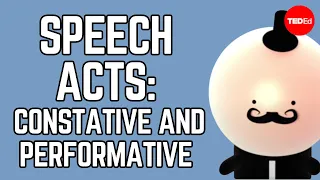
welcome back everybody mike here once again with the second part of the video lecture series on jl austin's book how to do things with words in the first video we talked about lecture one and lecture two today we'll be covering lecture three so let's continue where our discussion left off in lecture three austin wants to add yet another distinction he says there are explicit performatives and there are implicit performatives now to austin i pronounce you married is an explicit performative when it's pulled off correctly in a highly conventionalized setting it's a performative utterance that does
exactly what it says it's going to do now let's think of an example of an implicit performative utterance so let's say we're walking and we get to a crosswalk and i turn to my friend and say there's a car coming a couple things happened here i defined or described the situation there is a car coming a true statement but also when i said that my friends suddenly stopped walking they realized oh i don't want to be hit by a car right now because that hurts and i don't have health insurance so that's a problem so
i described what was happening in the world but also my statement acted as a warning to my friend to be careful which had the effect of them looking up seeing a car coming stopping and then having a whole bunch of thoughts and feelings that's how my performative phrase affected the context and acted upon the world so notice the difference between the performative phrase i pronounce you married which is explicitly acting upon the world in the way that it says it's going to act upon the world but according to austin in the phrase there's a car
coming the performative aspect is implied or that this phrase is an implicit performative because according to austin you can draw out the performative aspect of this piece of language which might be something like stop walking there's a car coming but what if my friend had already seen the car coming or just thinks that i talk way too much did action take place yeah was it happy action wait though to be happy doesn't the performative utterance have to be highly conventional and ordinary and explicit did the phrase there's a car coming fulfill all those conditions if
my friend already saw that there was a car coming so we're kind of seeing a pattern here every time austin introduces a new distinction they end up relying on assumptions made elsewhere in his theory and in this case we end up getting into this whole long conversation about what is conventional and here's what i mean if i'm at a crosswalk in new york and someone yells at me there's a car coming i know to stop walking which kinda tells me that this is a highly conventionalized performative on the other hand if i'm at a crosswalk
in new york and somebody yells at me you are to stop walking immediately i'm probably going to end up walking really fast away from that person so how would we categorize this is it an explicit unhappy unconventional performative because that performative phrase had the opposite effect of what it was supposed to do precisely because it was used in an unconventional context between strangers on the street oh boy there are a lot of words piling up at this point but you see how we kind of start talking about all of these side things for example how
conventional does something have to be to be considered conventional with happy effects like what if i don't even notice the implied parts of the implied performative is it still there does it matter because it's not there to me but it is there to the speaker or which one is more important to this theory in general so we got all these little scenarios that are described by austin and honestly it's kind of what makes the book a bit long and a little bit boring we are constantly getting into problems when we try to say this is
explicit this is implicit this is a happy performative this is not this one's a little bit of both like what if i were to say i really apologize if you don't like these videos that is an explicit and conventional apology but we both know i was being implicitly but highly conventionally sarcastic so is that a happy utterance now austin knows that tons of problems are arising and in lecture 3 he says i didn't actually describe all the exceptions and the exemptions oh and also sometimes we might actually disagree on what is happy or unhappy or
whether or not somebody's intentions are actually important or not or maybe this is explicit but more implicit to this person eventually austin kind of just admits that his distinctions and his categories and his rules don't really work a lot of the times but austin is also saying that there is a lot to language that goes far beyond thinking about whether or not some given statement is true or false or accurate because really something being true or false or being represented accurately is only one of the things that language does austin kind of wants to say
language is always simultaneously describing and representing and also performing action in the world language participates in building reality plus we can expand this idea of the performative far beyond spoken words for example we had twitter ban a president from tweeting in that banning there is an implicit recognition that language acts upon the world that his tweets all of them are performative in some way language performs action tweets perform action tweets help build reality cause language helps build reality now perhaps the big grand lesson that we can learn from the book how to do things with
words language and use is always performative somehow somewhere it is performing action in varying degrees of intensity in varying degrees of explicitness and also different people experience the exact same piece of language differently now there are two more vocabulary words that have been institutionally elevated to the official academic classification of totally super duper important mainly those two terms are illocutionary act and per locutionary act and real quick remember how at the beginning of the first video austin was saying we can move beyond this conversation about how to define and categorize things with words we can
move on to another conversation about how to do things with words well by the end of the book after all those new vocabulary words after all those definitions after all those rules and exemptions and scenarios you kind of realize that austin himself is very much stuck in that conversation of how to define and categorize even while he is critiquing that conversation it turns out that this book is largely interested in defining what a performative is even though at the end of the book he kind of just says all of language is performative and to me
it feels like the vocabulary words illocutionary and per-locutionary they are distinctions that break down just like the other distinctions that he proposes and on top of that the conversation starts sounding like oh this is perlocutionary no no this is illocutionary or maybe it's both or what about when etc etc etc and at that point we are back in the conversation of defining things with words instead of thinking about how to do things with words all of that is just to say that i ain't going to cover the words illocutionary and prolocationary but i will put
a link down in the description below to another youtuber who does cover them but to me personally this book is important because it got me to think about how language is always performing action in other words language is performative well that's all for today everybody i hope you enjoyed that two-part video series on jl austin's how to do things with words as usual i'm mike you can follow me on twitter look me up on academia.edu for all my current publications and don't forget about the patreon that helps immensely this is mike with the social life
of language and we're done