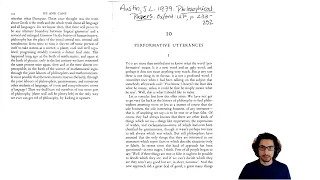
welcome back word nerds mike here with the social life of language making complex theories simple but never simplified if you think that sounds cool hit that subscribe button now and today we got a two-part video series on jl austin's book how to do things with words in the first video we'll be covering chapters one and two also called lecture one and two and in the second video we'll be covering lecture three by that point we will have covered the main concept of the book and you can decide for yourself whether you want to read the
whole thing but in these two videos we are going to be focusing on what are called performatives also called performative utterances now this idea helped shift the whole conversation about the study of language in this new direction even the title of this youtube channel the social life of language kind of hints at the idea that language is always performative so what's a performative let's find out as usual we are going to narrow down the meaning to performative really tight and then over the two videos we're going to slowly complexify it but i kind of want
to make something clear about what we are not talking about we are not talking about that popular phrase oh that's just performative where we might be thinking in our head oh that's an insincere act or that is an insincere performance that phrase is actually super freaking complicated and kinda needs its own video so let's start super simple blur simpler simple simpler let's start simple in the phrase performative utterance that word utterance we can think of that as any piece of language in use because technically we speak in utterances we text in utterances we tweet in
utterances so attempting to define what an utterance is will kind of take us in circles so because of that let's just think of the utterance as a piece of language in use with that said i'm gonna try to not use the phrase performative utterances and just say the word performatives cause oh boy there's a lot of big words in here okay so in lecture one austin wants to focus on language as both performance and as performing action at the same time as in acting upon the context or having an effect on the context now keep
in mind this book was published in 1964 based on a bunch of lectures that were given at harvard in the 1950s and one of the main purposes of lecture one is to kind of tell us the backstory of what is happening at the time and that in turn kind of sets up the whole book so i'm gonna retell that story now but i'm gonna make it way way less boring what don't don't say that shouldn't not professional okay in this era of scholarship particularly in white language scholarship and white philosophy language was imagined as mainly
used for representing things with words that was the general conversation representing things with words for example the concept tree could be represented with the word tree the letters t-r-e-e represent sounds in the world so we might say that we were hyper-focused on having two kinds of conversations how to represent things with words or how to define things with words now here's the thing when you narrow the conversation to language being primarily about representing and defining things with words this led language scholars to become fixated on whether particular statements were either true or false for example
i could say trees are green i'm defining trees as green which is true sometimes at this point we might spin off into this whole philosophical conversation going in circles talking about when my statement about trees being green is true and when it might be false and then we'd be able to list all of these exceptions to the rule but what's important to remember here is that underneath this conversation was that hyper focus on the idea that the main reason language exists is to accurately define and represent things in the world plus also part of this
conversation was defining what language was with words as in we used a whole bunch of words to define this thing we call language as in grammar and grammar books which of course defined and classified all the different parts of language so that is the general backstory of lecture one the general background conversation so also in lecture one austin introduces his main idea of the book he says you know language doesn't just define stuff and not all statements are really about being true or false or being accurate for example if i said i bet you 20
bucks that by the end of these videos you will know what a performative is is that statement really about being true or false or being accurate about something i mean maybe but there's other important stuff happening there so austin says what if we focus on when language is more about performing action like for example establishing a bet or a verbal contract or in austin's fancy vocabulary what if we think of language as full of performatives so as both performance as in you performed the act of saying words out loud but also as performing action or
acting upon the context or having effects on the world so let's think of a more explicit performative phrase or performative utterance let's think of the phrase i now pronounce you married all of a sudden people clap people kiss the mood of the room changed it's official that phrase i pronounce you married literally helped shape reality or at minimum it acted upon the immediate context so yes that performative phrase did define two people as married that's true language described and defined something but austin also says we need to focus on how that phrase acted upon the
context to make it true because not everyone can just go around marrying people so austin would call that phrase an explicit performative utterance or let's just say an explicit performative because it acted upon the context in the way that it says it's going to act upon the context so austin is directing our attention to stuff like why did everyone start smiling why did people clap who gets to marry people why is the marriage official now but then he also starts wondering about when might a marriage pronouncement fail when might it not work so austin is
kind of saying instead of focusing primarily on how to define things with words or how to represent things with words austin's like why don't we focus on how to do things with words see what i did there i made that connection to the to the title made that can nobody cares so moving on to lecture two austin makes an important distinction here he claims there are happy performatives and there are unhappy performatives or in the big fancy words he says there are infilicidous performatives that don't really really count as performatives according to austin so felicitus
is happy and in felicitus is unhappy oh boy okay we are just going to use the phrase happy performatives or unhappy performatives because nobody cares about those big words what don't say that don't don't say that either oh okay at this point austin begins writing out a list of rules and says if these conditions are not met the performative is not happy or is unhappy so let's clarify the difference between happy and unhappy a happy performative performs the action it was meant to perform it does what it was supposed to do for example in that
highly conventional situation a minister says i pronounce you married yay kiss clap people married happy story forever okay bye but what would happen if i were to just walk up to a bunch of strangers on the sidewalk here in new york city and was like i pronounce all you all married you five people right there you're all married to each other you're married don't look at me like that you're married according to austin's rules that is an unhappy performative because the act of marriage did not actually happen so basically lecture two is austin trying to
establish this really long list of rules and really long list of classifications that describe specific unhappy performatives he calls certain examples misinvocations or misfires or misunderstandings or misapplications or mis-executions or just simply abuses of language and this is where we kind of get into trouble with trying to define a performative as either happy or unhappy you basically have to imagine this perfect scenario with a perfect performative utterance or what austin variously calls ordinary circumstances or a conventional procedure or a ceremonial act these are all moments that he sees as highly conventional and then he says
we should probably exclude all of these other very specific scenarios for example he says that when the phrase i pronounce you married happens in let's say a play or today like in a movie or something no one really got married there and that wasn't the intention so those don't really count or if i yell it in the street no one really got married there either but does that mean that my language didn't change what was going on that my language and use didn't directly affect the context because if i yell the marriage pronouncement to a
random group of people on the streets of new york i'm pretty sure people would start walking away really fast for me or maybe they'd laugh or maybe they'd call the cops the point is my marriage pronouncement whether it got people married or not did act upon the context it changed stuff but he says that's not really a happy performative but wait didn't we just say that my language acted upon the context right yes no maybe so this is where it starts getting really interesting and here austin introduces a new distinction he says there are explicit
performatives and there are implicit performatives but it looks like we need another video to go a little deeper into what a performative is so i'll see you all back for part two of the video series on how to do things with words i'm mike with the social life of language don't forget to look me up on academia.edu and you can also support this channel on patreon i'll see you guys very soon in part two what do they buy