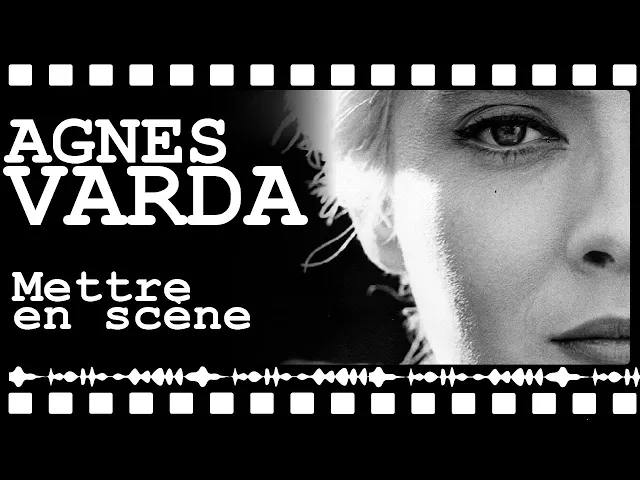
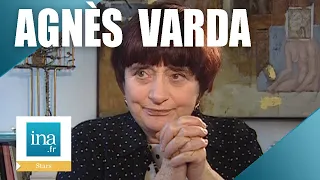
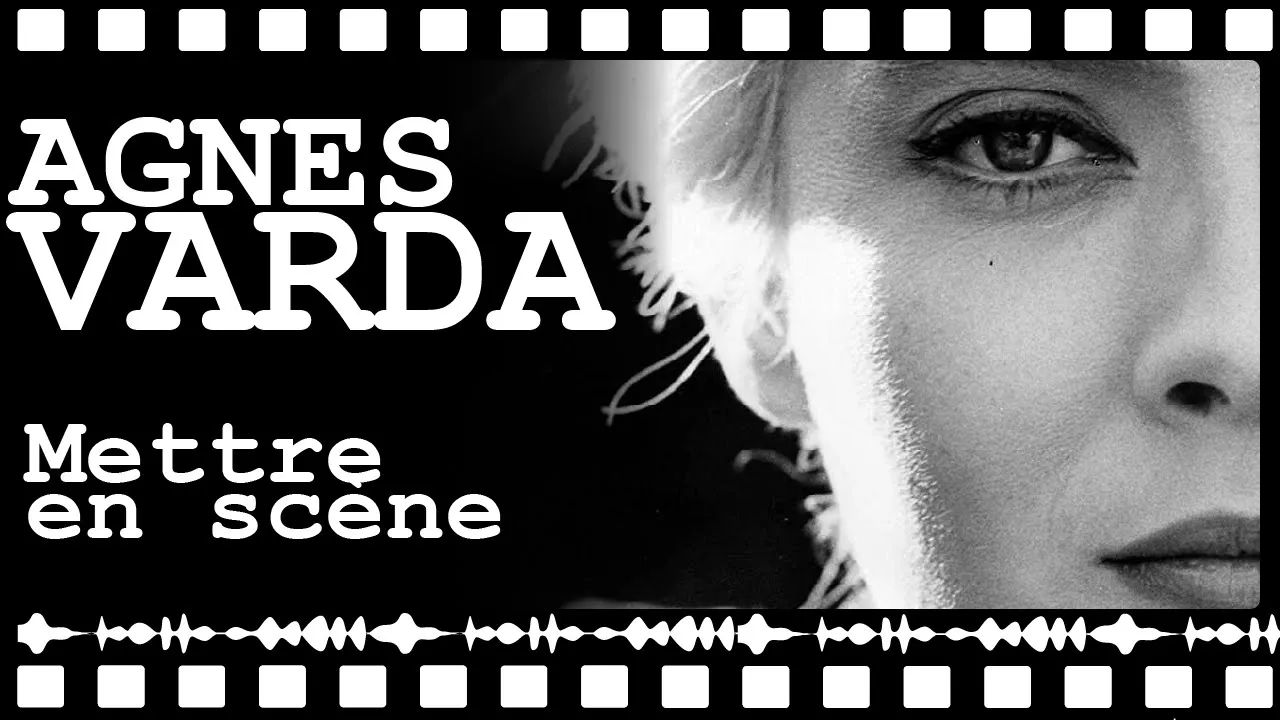
If Agnès Varda gradually becomes an essential artist, with a known and recognized feminist commitment, particularly across the Atlantic, she is above all the author of an immense and protean work often less known than that of her male comrades of the New Wave but which also contains its share of masterpieces, motifs and theories . So between the avant-garde of the New Wave and the grandmother with potatoes, welcome to this new episode of UFO dedicated to Agnès Varda, as always, guaranteed without spoilers. A quote is a more reassuring way to start, and when she says that an alphabet book is a more reassuring way to start so we play along with Agnès Varda so as not to panic too much.
First letter: A for Arlette, because Agnès was born Arlette in 1928 in Belgium to a Greek father. In 1940, her family fled the war and took refuge in the port of Sète where Arlette met her great friend, Valentine Schlegel, known as Linou. It was in 1946 that she became Agnès to reconnect with her origins.
She even made this change official. She then lived in Paris but felt cramped with her family and in her studies and therefore carefully prepared to run away. When she was 19, in 1947, she fled Paris in a spirit of liberation and emancipation that would never really leave her and found herself in Corsica for three months working on fishing boats, among sailors as well as in her future profession as a filmmaker, the only woman among men.
This time she calls herself Dominique while she goes back to Paris. Today, in 2024, this Paris has changed a lot but Varda's mark remains. The images from her films permeate the place and I therefore followed in the footsteps of Cléo in Varda's eponymous film, to rediscover this city which inspired her so much.
We come to the letter B like Bachelard and DIY. In Paris, Agnès' life initially revolved around the Ecole du Louvre, where she studied the history of the arts. This teaching only suited her half but still allowed her to follow Gaston Bachelard's courses at the Sorbonne which would have a huge impact on her.
In the theories of the end of his life, he proposes reverie as a return to oneself which Varda easily extends to art in general. Even if she never really read him, the philosopher will remain a reference for her, starting with his rereading of the myth of Jonas that Varda cites several times in her films. But the main influence of these youthful years on Varda is certainly Linou.
It was she who allowed him to emancipate himself from his family, and to see things differently. It was also she who pushed her to seriously study photography at the Ecole de Vaugirard. Agnès therefore began a career as a photographer where she alternated between purely food work and art photos, very staged which already attests to a particularly sharp eye.
This look remained famous through the portraits of the actors of the Avignon Festival and then of Jean Villar's Théâtre National Populaire, which she did from 1948, with for example her famous photos of the star of the time: Gérard Philippe . But B is also B for DIY. Varda's world is studded with this desire for DIY, odds and ends, debris and collage, starting with her love of games with languages and word games.
His practice of photography and cinema is at this intersection of art and DIY. It’s about both experimenting and making do with the means at hand to bring meaning and aesthetics out of the material. At the start of her career, she bought a house on rue Daguerre, which she renovated and transformed throughout her life into a studio and production house.
But the real start of Agnès Varda's career as a filmmaker took place in 1954 when she made her first film after receiving an inheritance. The budget was extremely limited, prompting Varda to create a cooperative to edit the film. However, the result is a film with a magnificent, almost magical aesthetic and a touching story.
We feel the eye of the photographer that is Varda with splendid compositions, but perhaps and above all her appetite for movement. What stands out from the film in my opinion, is this thirst for movement that a photographer can have when arriving at the cinema. The spectator himself is caught up in the filmmaker's game and each movement of the camera or the bodies in the image becomes a real pleasure.
In a sense, everything Varda is already present in this film: the blurred line between documentary and fiction, the exploration of new modes of expression, the aesthetics of the image and even the play with the children. However, at that time, the director was far from being a film buff; moreover, she knew neither the Cahiers du Cinéma gang, the future leader of the New Wave, nor Italian neo-realism, from which she adopted the codes. and which marks a revolution in post-war cinema.
Entitled La Pointe Courte, this film is inspired by William Faulkner's Wild Palm Trees and is filmed in Sète. Varda convinces Alain Resnais, another avant-garde of the New Wave to produce the film with her and she will also have the help of Anne Sarraute, daughter of Nathalie Sarraute, an author of the new novel who, like Varda, breaks the established rules and will have launched one of the most influential artistic movements of the 20th century. The film Sant roof ni loi would later be dedicated to him.
Okay, but what about the new wave in all of this? The new wave, to summarize, is an artistic movement that took place in France between approximately 1959 and 1965. During this period, many young filmmakers arrived and delivered films that broke with more established cinema, notably with a great influence from American cinema and Italian neorealism.
Among these young filmmakers, we find for example Jean-Luc Godard and François Truffaut, both critics at Cahiers du Cinéma. Truffaut notably theorized his politics of authors, which establishes the director as the true author of his films. But the new wave is also an aesthetic in which we find, among other things, the following points: films shot on real locations and not in the studio, which speak to the concerns of youth, and in particular sex, which can be quite documentarizing, where the actors are often non-professionals or from a new generation and where the filmmaker is also the author of the screenplay, a screenplay which is regularly taken from literary works commonly neglected by cinema.
All these characteristics are present in Agnès Varda's first film, released five years before the first films of the new wave. She is therefore part of the avant-garde of this movement with Jean-Pierre Melville and La Pointe Courte now appears completely premonitory. A few years later, when the new wave was well established, the producer Georges de Beauregard, who had previously produced A bout de souffle by Godard and Lola by Demy, proposed to Varda to direct a film with a limited budget but which would become one of the masterpiece of the new wave and of cinema in general: Cléo de 5 à 7.
If you discover Varda, in my opinion this is the film that you absolutely must see. This film is touched by grace. Not Christian grace, but a secular grace that Agnès describes as the success of communication with the spectator through a film.
In other words, the fact of being “inhabited by a film”. The image then becomes the object of a self-revelation. This almost spiritual feeling is difficult to explain but it is exactly what the spectator feels in front of Cléo from 5 to 7.
This grace is also for Varda an “active relationship to chance” which operates in the very staging of the film , by being open to chance events during filming. This way of being in production will follow Varda more and more throughout her work. Cléo was a success and was followed in 1965 by the film Le Bonheur which seemed on certain points to respond to the previous film.
Indeed, these two films deal with death, which will be a recurring theme for Varda. However, this theme is never treated in a dramatic way, even if it brings its dose of tragedy to the film. Thus the two films respond to each other in the treatment of death through a relationship to color that is the opposite of usual representations but each has its own characteristics.
Thus, Cléo is a black and white film but the color of death is white and not black. The result is a particularly luminous film which reinforces the complexity and depth of the story. Happiness is in color and embraces this characteristic.
Varda gives the entire film a shimmering aesthetic that is constantly reminiscent of impressionist paintings. In this eminently tragic film, we find one of the most colorful images in world cinema. These films, like all of Agnès Varda's works, also bring into play the artist's gaze.
For example in Cléo, the second character in the film is Paris, seen through the eyes of the filmmaker. We discover its left bank district but also all the antique dealers and art dealers on rue Guénégaud, the Parisian brasseries with their mirror games, or even the sailors with pompoms at Montparnasse station . Varda thus shows us what she sees and above all how to look.
We discover a new way of approaching the city and life, by being open to beauty and coincidence. This very particular look also applies to sociological and political reality, and the second major phase of Agnès Varda's career is based on numerous films with political and feminist themes. Already at the beginning of her career, political questions did not escape her, since she went to China in 1957 for several months, to photograph Mao's new China, notably in the company of Marc Riboud and Cartier Bresson.
Likewise, in Cléo, despite censorship, the theme of the Algerian war is omnipresent, and of course that of feminism. Thus, from 1963, with Salut les cubans, then with the collective film Far from Vietnam in 1967 or even Black Panthers in 1968 filmed during her trip to the United States with her husband Jacques Demy, Varda took on burning political questions of the sixties and gives his perspective on American imperialism, for revolution and the emancipation of minorities. She also directed L'une chante l'autre pas in 1977, which focuses on the feminist struggle for abortion.
Varda had supported this bill in 1971 by signing the manifesto of the 343 and by helping Delphine Seyrig, founder of the MLF, to recover the signatures of famous actresses. However, L'une chante l'autre pas is not a militant film, according to her, it is a women's film, not a feminist film. And in fact, where Varda has become an icon of feminism, particularly across the Atlantic, she has always sought to show that she could do the same job as men, with a team of women, and on subjects that concerned her.
That didn't stop him from being angry. “I was trying to live a happy feminism, but I was actually very angry. » Even after this period, with his subsequent films, there will almost always be a political aspect, whether he is talking about AIDS, the homeless or food waste.
The political vision is never programmatic and is rarely militant in her films, but it is truly her view on a social issue that Varda brings. It must be said here that Varda has often been ousted, such as upon returning from her trip to China where Cartier Bresson dissuaded her from publishing her photos, to get the first look in magazines. Likewise, where Demy is omnipresent in Varda's works and autobiography, she seems to have been forgotten in his biography, crude love or not, in fact, Varda did not have the right to her biography when 2023 and the number of works concerning her is desperately lower than that on all the other boys of the New Wave, showing that the battle for equality between men and women in cinema is still to be won.
After her separation from Jacques Demy, Varda returned to Los Angeles in 1981 to shoot two twin films: Documenteur and Mur Murs, the first is a fiction and the second a documentary. But the documentary never ceases to enter into fiction and the fiction into the documentary. Documenteur, for example, includes a stolen sequence of a real couple arguing and the main actress is unprofessional and plays with Matthieu Demy, the son of Agnès and Jacques.
A French television team even asked the protagonist of Documenteur to record the voice-over of Mur Murs. This porosity between the documentary and the fiction continues to be explored in Sans Toit ni Loi, Agnès Varda's only real commercial success . There are still many non-professional actors, the presence of a voice-over, passages of testimonies from people Mona meets on her way, etc.
Then in 1988, we again find two twin films in Jane B. by Agnès V. and Kung-Fu Master, replaying the same duality as in 1981.
Generally speaking, Agnès Varda never stops taking us on a journey between dreams and reality and likes to showcase his world. However, his films can be uncompromising, even when they remain entirely descriptive, like Le Bonheur, strongly criticized for its immorality, or Without roof or law which does everything to make Mona unsympathetic to us without good sure to succeed. Generally speaking, it is in this radicalism that Varda produced her greatest films, like Documenteur.
This particular relationship between fiction and reality also allows us to evoke an inspiration from Varda which we find very clearly in her films, particularly towards the end of her life. This inspiration is that of Bertol Brecht and his famous Brechtian distancing. Even if we are talking here about a German playwright from the beginning of the last century, nothing very complicated in truth.
[Filming the teleprompter] Distancing is simply the attitude of the actor who distances himself from his character and the attitude of the spectator distancing himself from the dramatic action. In other words it is about breaking the fourth wall, neither the character nor the spectator is fooled by the fact that he is participating and attending a show. Very concretely, it is a question of direct addresses or winks to the spectator as in The Thousand and One Nights of Simon Cinéma, a film by Varda, released in 1995, a sort of premise for the third major phase of the career of 'Agnes Varda.
Indeed, the illness and then death of Jacques Demy from AIDS marks a new Varda era. At the end of the life of her ex-husband, she directed Jacquot de Nantes, between fiction and documentary, which traces Jacques' childhood and the creation of his films. Then after his death, Agnès made two other documentary films on Demy.
This memorial work will also apply to herself and her creations since she wrote her autobiography Varda by Agnès in 1994. At the same time, she bought the rights to her films and those of Demy to restore them. Until the end of her life, she will never stop, after having put the world and the lives of others on stage, to tell the story of her own life.
Which parts come from romance, which parts come from facts. Which ones are silenced and which ones are said over and over again. Here again the border is blurred but Varda creates her bowl-cut granny character and continues to create.
Thus, she became at this time the grandmother of the New Wave, an expression that she uses regularly. For her, it is about asserting her career, looking back on her films and creating her own legend, like many filmmakers before her. Her latest creations will therefore put her at the forefront with Les Glaneurs et la gleneuse, Les plage d'Agnès, Agnès de ci de là and Visages Villages.
One of the ways for Agnès to assert her presence in her films is her voice, and one thing always strikes me since the first Varda film that I saw: whether it is live or re-recorded, written or improvised, the Agnès' voice always has the same tone of voice-over, of written voice. She handles language with elegance and with a voice that is always soft and equal to itself. Here again fiction and reality mix and we never really understand where his voice comes from.
It’s also a way of telling stories. Listening to him is like reading his autobiography. This self-story also allows us to better understand our production techniques.
Among other things, in 1985 she invented the concept of cinematography with Ulysse and Without roof or law. This term is intended to describe the same thing as style in literature, for example. It designates the gesture of production, which means exclusive to cinema are put in place to tell the story.
An example to be clearer: in Varda's films, particularly at the end of her life, mirrors are everywhere. The mirror is a purely cinematographic tool which allows us to see the director, the off-camera and the camera. It also allows you to change your point of view and form a frame in the image, that is to say a screen.
Varda then uses this cinematic tool to tell us a story. The film is reflexive, so it has mirrors. The concept of cinwriting could almost be read as Agnès Varda's version of Truffaut's auteur politics.
The director is an author and has the tools at his disposal to create specifically for cinema while emitting a recognizable style. In a sense, it is these tools and this style that I seek to bring out in this video series on influential filmmakers. The arrival of the 2000s also marked Varda's arrival in new artistic practices.
In 2000, she directed The Gleaners and the Gleaner, made possible thanks to a small digital camcorder for the general public. She then begins to play with this new way of creating and discovers in the process the heart-shaped potatoes which will continue to return in her work and which will allow her the gateway to the plastic arts with her exhibition Patate utopia at the Venice Biennale. Until her death she continued in this field, notably at the Cartier foundation in Paris where you can still find the tomb of her cat Zgougou.
In 2017, she revisited the medium through which she arrived in cinema: photography. With the artist JR, she created Visages, Villages, a touching collaboration between two artists with complementary worlds. And in fact, Varda never stopped collaborating with artist friends.
Thus, it was Alain Resnais who edited La pointe court with her, Anna Karina and Jean-Luc Godard appeared in Cléo, Chris Marker opened his studio to his camera, hidden behind the Egyptian cat. But it is also Viva, Andy Warhol's muse who filmed Lions Love with her. Varda was able to bring together in her works the greatest actors, the greatest artists and the greatest anonymous people.
She will have photographed Fidel Castro and Chinese children in factories, all in a protean work but which is each time imbued with the presence of Agnès, who casts a joyful and touching halo over her films where inventiveness is king. In my last stage of my Parisian walk, I passed by the Montparnasse cemetery where Jacques Demy and Agnès Varda, who died in 2019, are buried together and I wanted to write a letter. Dear Agnès You got into the habit of coming to the Montparnasse cemetery after the death of Jacques to decorate his grave with one of your letters.
Today you are gone and it's up to me to do the same. Nothing exceptional or grandiose, simply a thank you in the form of a letter, in the form of a video. Thank you for your films which sometimes shook but which always moved.
Thank you for your vision and your perspective which still allow us to see the world in another way. And thank you for your courage which shows that you have to dream hard enough and never stop loving. Thank you for watching this video to the end, which I hope you enjoyed.
As usual, one or two book references, in this case Varda's biography by Laure Adler and Varda's autobiography. Go see Varda if you haven't already and if not, go watch it again! See you soon for the next video and don't forget to subscribe!