Europe has been through a period of great change over the last 17 years after World War two much of the continent devastated and there was widespread desire for lasting peace so that Europe would never again witness war on such a scale the process that started back then led to the formation of the Common Market which in turn became the European Union today we tell you the stories of some of these momentous events as we present Europe from World War two to today's European Union [Music] [Applause] [Music] the european union is a unique economic and political partnership between 27 different countries it has around half a billion citizens and it's combined economy represents about 20 percent of the world's total it gives European countries a place to talk you know for most of our history we've been fighting things out on the battlefield so it's really important that we have a single forum where we can all get together sit around the table and fight these things out with words rather than with bullets and bombs taken together the EU is the world's largest economic grouping accounts for about 20 percent of all global trade it has got a considerable share of the largest multinational corporations in the world and has got many of the most developed countries in the world the EU we know today works as a single market with free movement of people goods and services from one country to another there's a standardized system of laws and most of the EU countries now share a common currency the euro many of the countries have also signed up to the Schengen Agreement which means they no longer have border controls or passport checks between Member States the EU of Phil speaks is one voice representing all its member countries at the UN or the World Trade Organization and it has developed a sophisticated regulatory structure this is the European Parliament in Brussels although the EU has no official capital in practical terms Brussels has acquired that status here you'll also find other important EU institutions such as the European Commission and the European Council but there is also a parliament building in Strasbourg and to find the European Central Bank you'll need to go to Frankfurt the location of these buildings owes much to the nature of the European Union itself for the past 50 years nobody could decide where to put the European Parliament in banking so on so they've kind of fudged it they found political solutions which have not really seated everybody but they're the sort of least worst scenario the EU we know today is a vibrant community but its origins can be traced back to events that dominated the 20th century to the legacy of World War two this was how Europe looked in 1945 the continents economic structure was ruined and millions of people were homeless widespread devastation meant that many were starving and freezing to death all of the transport systems had been completely bombed in France they only had a quarter of the trains that they've had the beginning in Italy that destroyed a third of the road network so although the Allies were sending in a lot of food they couldn't really distribute it to the places where it was needed most for example in the French zone of Germany people were living on eight hundred calories a day all the way through 1946 now you can't survive healthily on those sort of rations many people believed that some form of European integration would prevent the extreme forms of nationalism that had caused the war and the resulting devastation the genius of the people who decided to create the European Union was that they saw that it was nationalism that had created the second world war in the first place so they wanted to promote a more integrated society where people wouldn't have to fight each other they promoted the idea of trade because of course if you're trading one an you have to have a diamond industrial production in 1945 was considerably lower than hacking in 1938 agricultural production similarly devastated and of course was a considerable number of people who didn't have jobs hidden of employment so the economies were in a bad way out of that in fact as a desire to find a new way not just for peace and security but in a new way to build these economies in the future the first steps to achieving European integration happened at the Potsdam Conference of 1945 the participants at the Potsdam Conference decided that Germany and its capital Berlin should be divided into four zones they were to be controlled by Britain France the USA and the Soviet Union and under the terms of the Potsdam agreement Berlin itself was completely surrounded by Soviet territory the idea was if he split Germany up into little sections Germany wouldn't have the power or the strength to be able to start yet another war so the creation of the administered zones was there to have a bridging gap for the German people it worked in the sense that the western part of Germany flourished and became the dominant economy in Europe within a matter of her decades but America also had an important part to play in rebuilding war-torn Europe the US was at that time the only major economy that had not been significantly damaged by the war under the so-called Marshall Plan it set out to remove European trade barriers modernize its industry and make Europe prosperous again Marshall Plan was really a piece of quite enlightened self-interest to buy the loyalty of Western Europe by giving them these huge aid packages with the proviso that they all started cooperating with one another America also hoped that by supporting the European economy it would help stop the spread of Soviet Communism even though US Secretary of State George Marshall who initiated the plan denied that this was the case [Music] and 800 or dr. but against hunger poverty desperation and chaos perhaps unsurprisingly the Soviet Union did not see it that way it completely rejected the plan describing it as dollar imperialism and the Soviet leader Joseph Stalin started to exert ever tighter control over the Eastern Bloc countries such as Hungary Poland and Czechoslovakia the division of Europe into two halves was well and truly under way the Marshall Plan ran for four years from 1947 during that time America gave some 13 billion u. s.
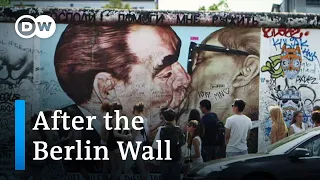
dollars in aid to help the recovery in Western European countries the Marshall Plan benefit to the United States in terms of providing it with markets to trade with in terms of expanding economic opportunities and that clearly benefited the US economy in 1948 the countries participating in the Marshall Plan officially came together to form the Organization for European Economic Cooperation most of those countries are members of the EU as it exists today but as Western Europe began to take shape so too did the Soviet bloc the suggestion that these countries might be democracies rapidly disappeared and the Soviet Union began to exert its influence they were very cynical about the way they took power one of the first things they did was to infiltrate all the print unions that way they could control the media if any of the newspapers wanted her to publish a story which was anti-soviet all the print workers would go and strike they also made sure they had control of the police forces the armies the justice system and eventually this led to control of the government Britain's wartime leader Winston Churchill coined a phrase that would famously describe the growing division of Europe from Stettin in the Baltic to Trieste in the Adriatic an Iron Curtain has descended across the continent behind that line lie all the capitals of the ancient states of Central and Eastern Europe Churchill had always been very skeptical about the Soviet Union and he coined this wonderful phrase the Iron Curtain which was coming down across Europe this was really the first time that the idea that there would be a split in Europe was voiced by anybody Stalin described Churchill's speech as a declaration of war and the phrase Iron Curtain was destined to become part of the English language as the Cold War strengthened it gained popularity as a convenient way of describing Europe's division at the same time the relationship between Western Europe and the USA grew stronger in 1949 the u. s. formally aligned itself with Canada and its Western European allies to form the North Atlantic Treaty Organization NATO its member states agreed to a policy of mutual defense in response to any attack by an external party the founding members established a transatlantic bridge between Western Europe and the United States and that became the security guarantor for Western Europe in the face of Soviet threat throughout the Cold War Stalin retaliated by creating a union with his Eastern Bloc allies the Council for mutual economic assistance or comecon and in the same year the Soviets exploded their first atomic bomb stopping headlines flood the American press following news of the atom explosion within the borders of the Soviet Union when the Soviet Union detonated its nuclear device it was not a huge surprise to the West because there was no where nostrovia Union was working on its own nuclear programs but clearly it brought about anxiety you had a country which had a different view in the world and an expansionist view in the world and that created problems faced with a perceived growing threat from the Soviet Union European leaders decided it was more important than ever to create some form of Union they began to create a series of treaties and agreements which ultimately led to the European Union as we know it today let's take a look at some of the key events along the way the very first of those treaties dates back to 1944 even before World War two had ended that was when the governments in exile of Belgium the Netherlands and Luxembourg agreed to form the Benelux economic union it was designed to promote the free movement of workers capital services and goods throughout the member countries it was to create a tighter economic bonds as in the model of a customs union which gets rid of in effect the tariff barriers between countries to low goods to move more freely to improve economic productivity to try and create a tighter economic market to expand their economic well-being the early success of the Benelux deal encouraged other countries to consider the benefits of political and economic Union on May the 9th 1950 french foreign minister robert schumann presented a proposal for the creation of an organised europe it became known as the Schumann declaration he is regarded as one of the founding fathers of European unity and in his honor May 9th is still celebrated as Europe Day Schumann's initiative led to the founding of the European Coal and Steel community this had six member states the original Benelux countries as well as France Italy and western Germany then a few years later in 1957 came the Treaty of Rome this created the European Economic Community see or common market the Treaty of Rome moved European integration on from corn steel into other areas and the view at the time was that integration would move forward into these these areas to bring the countries more closely together the Soviet Union did not intend to be outdone by the West so they formed a military alliance with our Eastern Bloc neighbors the Warsaw Pact then on the 13th of August 1961 the East Germans under instructions from the Soviet Union began work on a construction that would come to symbolize the Cold War it was the Berlin Wall the East German government gave explicit orders to shoot and kill attempted defectors in the years that followed over a hundred people were killed as they tried to escape to the West in 1963 American President John F Kennedy came to Berlin and made one of his most famous speeches [Music] [Music] Kennedy's speech was a great morale boost for West Berliners they were living in an enclave deep inside East Germany and they feared an East German occupation could happen at any time but of course morale was even lower on the other side of the wall for nearly 30 years with a few exceptions the people of East Berlin would be prisoners back in the West moves to create an economic union were gaining momentum in 1973 six became nine when Denmark Ireland and the United Kingdom formally entered the EEC 1979 saw the first democratic elections to the European Parliament up until that stage there was no opportunity for the citizens of the Member States to cast a vote of influence on the decisions of Europe it was all an indirect process then in the early 1980s Greece Portugal and Spain so joined the EEC the map of Europe stayed pretty much unchanged for many years but in 1987 another American President Ronald Reagan came to Berlin to make a groundbreaking speech in that speech he issued a direct challenge to the Soviet general secretary Mikhail Gorbachev if you seek peace if you seek prosperity for the Soviet Union and Eastern Europe if you seek liberalization come here to this gate mr.