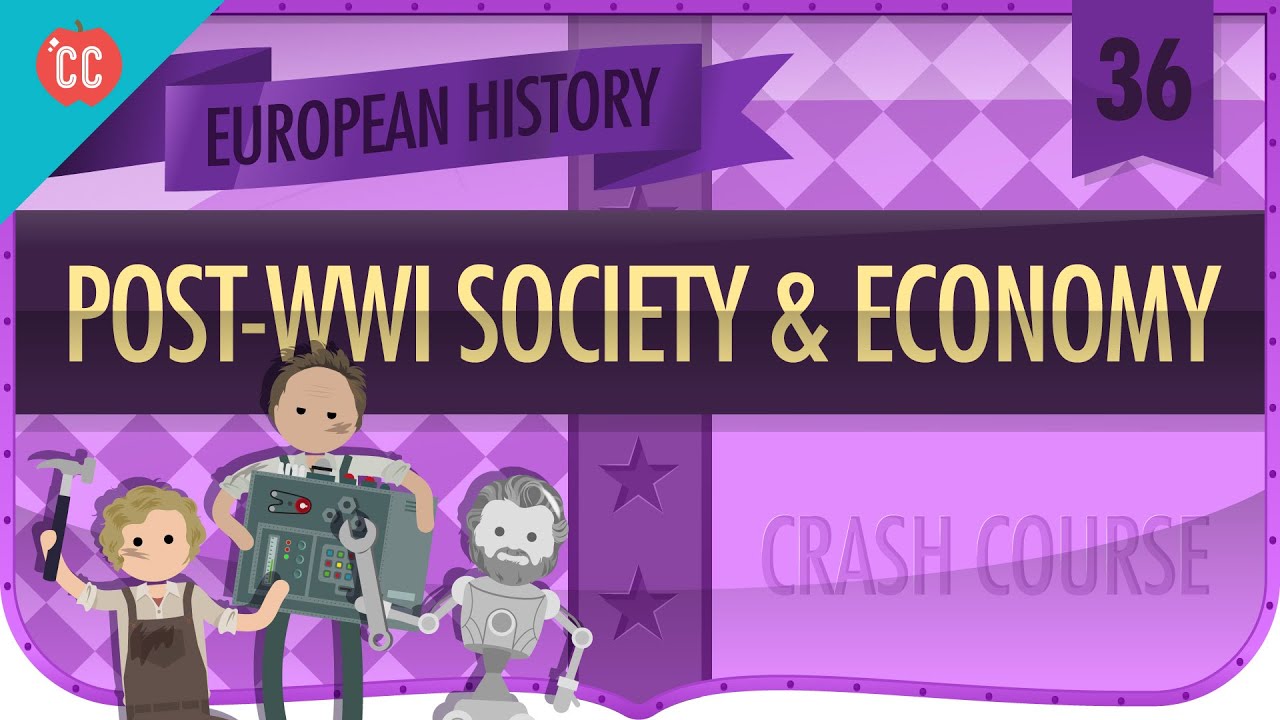
watch our videos and review your learning with the crash course app supplemental content is now available for these courses hi I'm John Green and this is crash course European history so we've made it through the world wars and into the second half of the 20th century but now we are faced with some really big questions about how humans should organize themselves what are the responsibilities of a government to its people and of people to their governments should we create large international marketplaces that allow for the free exchange of goods services and ideas or are we
better off in smaller economic and political groupings to what extent should government shape the economic output of a community and what say should individuals have in the nature of their governance all these questions were being explored by people on both sides of the so-called Iron Curtain as indeed they are still being explored today [Music] so after World War two communist governments embarked on rapid industrialization like for instance take a gander at the massive steel works at Nova hooter outside Krakow in Poland starving people from the devastated countryside flocked to these industrial communities because they initially
provided food and clothing and a place to sleep small farms both in the east and in the West were merged and industrialized with chemical fertilizers and machinery like tractors which raised yields and required fewer workers so from Russia to Spain the amount of wheat grown per hectare grew dramatically between 1950 and 1970 even as the number of people who worked in farming decreased in communist countries people generally lost ownership of their land and had to join collective farms whereas in Western Europe government's helped larger farmers buy out smaller ones but farms remained private property cross-border
trade revived sped along in Western Europe by the financial-aid used to restore roads railroads harbours and other transportation and officials also undertook the creation of state sponsored institutions that promoted health and education and much more these reforms came to be known as the welfare state Sweden had pioneered programs that encouraged population growth during the Depression of the 1930s like because families had cut their fertility the Swedish state sponsored a raft of programs for maternal and child health for childcare and also for financial support in the form of payments for raising a child the idea behind
this was known as economic democracy that is the belief that there could be no democracy when people were living in poverty through no fault of their own but just because there weren't any jobs democracy it was argued demanded that all citizens have enough to live on and enough to raise healthy children and also enough education to vote wisely in other words democracies thrived best when people weren't impoverished or illiterate so as the war ended the British government adopted elements of that plan a National Health Service was instituted in 1948 providing medical care for all citizens
the government invested funds paid by citizens for their age healthcare accident unemployment and disability insurance and also other programs and among those programs in most European countries was publicly funded daycare for infants and children whose mothers worked which was sorely needed because women's labor was sorely needed to rebuild shattered Nations how many of these programs were not entirely new Bismarck had started some of them back in the 19th century but today it is taken as a given in most European countries that the government should take in enough taxes to pay for the health care of
its citizens and also to pay unemployment and disability benefits as part of the so-called social safety net and the scope of those programs dramatically expanded after the war one British woman reflected on how the welfare state had changed her life in the 1950s she got glasses as a child and public libraries allowed her to become a reader I think I would be a very different person now if orange juice and milk and dinners at school hadn't told me in a covert way that I had a right to exist was worth something for her this wasn't
some private charitable program offered by the rich but rather part of living in a benevolent state where citizens contributed to one another's physical mental and emotional well-being in communist countries these welfare programs were different because under communism the programs were accompanied by the confiscation of private property in land and Industry this was part of the collective ownership of the means of production and the elimination of all private property like the massive farms and industries that had previously benefitted mostly the wealthy in Western Europe where individual businesses were being restored the program strengthened both the public
sector and private industry alike as workers and citizens became healthier and more fit similarly government-sponsored public schools to develop more competent citizens and governments also built excellent public transportation like air shipping and trains to facilitate the mobility of the workforce and the trade of private businesses and as these systems got stronger they created a series of virtuous cycles especially in Western Europe lives got longer illiteracy rates plummeted as did rates of malnutrition and stunting among children planner were central to these developments just like they had been in guiding the war effort the ideas of several
of them Jean Monet and Robert Schuman of France for example led to the creation of a key institution that helped rebuild economic growth and security in Western Europe the European Economic Community or AEC also known as the common market the common market had two important predecessors the organization for European Economic Cooperation for the joint distribution of the Marshall Plan aid in 1948 and also the European Coal and Steel community in 1952 oh my god these people are so bad at naming things I mean maybe the European Coal and Steel community sounds good and Flemish or
something but in English is there anything more boring they should have named the European Union something awesome like captain Marvel's get-rich cooperation zone who would dare to leave Captain Marvel's get rich cooperation zone by the way Europe I am available for branding consultation but right so back in the initial post-war days France especially needed coal to get its citizens through the difficult winter of 1946 1947 while Germany and other European countries needed a tariff free zone for the exchange of lots of different goods after the destruction of so much industrial capacity so the European Coal
and Steel community helped solve that problem and made Europeans think that broader free trade agreements might provide even more benefits the Marshall Plan also helped as a condition for receiving funds and Technology European countries agreed to consider closer economic and political ties perhaps even a political union ro-bear Schumann who was the French prime minister in 1950 announced that the European Coal and Steel community would quote lay the concrete foundation for a European Federation which is so indispensable for the preservation of peace so in the end an idea of Europe or a united Europe arose from
practical considerations how will the French get coal how will the Germans get the industrial supplies they need in 1957 six European countries France Germany Italy Belgium Luxembourg and the Netherlands signed the Treaty of Rome creating the common market it will tariffs and aimed for the free flow of labor and common trade policy among the nations and for former con yak magnate diplomat and EU founding father Jean Monnet the goal of the common market was to make quote a genuine step toward a United States of Europe in the next ten years trade among the common market
members grew 400% now not every European leader was totally on board of course Charles DeGaulle who became president of France in 1958 and was a French nationalist opposed supranational ideals de Gaulle called the group running the common market from Brussels a technocratic body of elders stateless and irresponsible and Scandinavians did not join the common market nor did Britain at least initially because joining meant giving up the country's special trade provisions with Commonwealth countries and its pride as an island power with a colonial empire as one conservative leader put it but as Britain's prosperity lagged compared
to the EEC members they eventually did join the thriving Common Market in 1973 let's go to the thought-bubble so thanks to cooperative agreements and in Western Europe Marshall Plan aid post-war scarcity and instability receded and prosperity returned this unleashed a burst of consumerism across Europe motorized bikes and household appliances topped the list of desirable goods in Austria the number of refrigerators went from thirty thousand to five hundred ninety one thousand between 1953 and 1962 and for almost the first time teenagers became a well defined consumer group they began to use the rebuilt train networks to
travel Europe performing their part in integrating the continent they were also unruly we want our old Kaiser Wilhelm we want rock and roll East Berlin teens shouted calling for new tunes and sometimes rioting young men wanted blue jeans and aviator jackets imitating pilots and new celebrities many of them bad-boy Americans like James Dean and Elvis Presley adults meanwhile worried about loss of European identities and Americanization there's a German word for that of course coca cola zera the French Communist Party even tried to block sales of Coca Cola a sign that the cold war Julie was
everywhere in Eastern Europe prosperity was not as robust but still consumerism flourished especially after the death of Stalin in 1953 when it became apparent that wartime stringency just had to give way uprisings across the Soviet bloc revolved around having more food and goods available so Stalin's successor Nikita Khrushchev began the process of what came to be known as goulash communism that improved standards of living thanks thought-bubble oh I think the center of the world just opened and there's a coca-cola in there I'm about to experience a little bit of my own coca-cola zero in sorry
my German isn't very good listen crash course isn't here to sell you on consumer products except for whatever was advertised at the beginning of this video but so much of the United States's post-war power was in the form of popular consumer products like coca-cola Andy Warhol famously said you can be watching TV and see coca-cola and you know that the president drinks coke Liz Taylor drinks coke and just think you can drink coke too a coke is a coke and no amount of money can get you a better coke than the one the bum on
the corner is drinking all the cokes are the same and all the cokes are good Liz Taylor knows it the president knows it the bum knows it and you know it in short it's a kind of democratized luxury a luxury that almost everyone can afford and that doesn't get better if you pay more for it so we really want to emphasize how much the cold war affected everyday life in terms of what you were drinking and also in terms of what you were sitting on I mean in Eastern Europe a distinct communist style emerged in
household furnishings which were made modern and streamlined to allow the busy working homemaker to clean quickly a renowned East German plastics designer explained in 1959 that capitalist products were nothing but cheap and shockingly kitschy mass wares unlike the Woolworths goods designed to sell in great numbers and make huge profits communist items were based on industrial refinement that sought nothing but beauty and utility in products now anyone who's ever seen a Soviet block of apartment buildings or indeed a Lada might disagree on the beauty front but I suppose it's all in the eye of the beholder
and indeed these competing ways of looking at the world shaped people's understanding of beauty and also their understanding of value in 1959 US Vice President Richard Nixon and Russian leader Nikita Khrushchev engaged in a famous and heated kitchen debate over whether the communist or capitalist bloc offered the most consumer benefits and recent history especially having to reckon with the horrendous past were also shaping philosophy in Europe philosophers like Albert Camus jean-paul Sartre and Simone de Beauvoir became celebrities as they sought out the meaning of being or existence in a post holocaust world their philosophy came
to be called existentialism because it claimed that merely being born did not mean one lived a purposeful or moral existence spiritual goodness did not appear automatically with birth but instead individuals created an authentic moral existence through actions and choices Simone de Beauvoir applied existentialism to women stating that womanhood was assumed to be a product of nature but in fact culture fashioned most women into a stereotype they were simply an other to the male norm to live an authentic life women had to escape their condition as an other and instead take considered action so this period
of European history is often referred to as the thirty glorious years because there was a lot of growing prosperity and people had access to many new things from refrigerators to motorcycles but the legacies of Nazism and the ongoing anxieties of the Cold War continued to have a huge impact on European life and while many wanted to just move on from the past there were also some attempts to reckon with it Germans and others were forced to go through denazification training and some of the leaders were imprisoned and hanged most notably after the Nuremberg trials which
saw Nazis punished for the charge of crimes against humanity but was that enough did it deal adequately with what happened did the welfare state and new abundance help in healing or did they simply paper over suffering and unspeakable cruelty and it wouldn't be accurate to say there was a clean break from the past anti-semitism continued as it does today in much of Europe which people continued to be demonized and baseless conspiracy theories even argued that the Holocaust had not occurred at all meanwhile West Germans mostly insisted as the Nazis had that women should not work
and that men should remain dominant in fact female unemployment was a well-publicized distinction between West Germany and East Germany and other communist countries where women were much more likely to work outside the home in the East it was felt that women had to work to repair the vast devastation to make up for the massive loss of male life and also to adhere to communist values of equality in contrast West German women were usually fired when they married and received far fewer and lower benefits if they were employed also it's not as if post-war Europe with
some utopia of justice for instance the continuing effects of colonialism was supporting European economies the tractors that increased agricultural yields ran on palm oil from asian colonies and the drills that helped rebuild Europe were tipped with West African diamonds next time we'll turn our attention to the dismantling of those empires and the new nations that emerged thanks for watching I'll see you then thanks for watching crash course which is made here in the Jaden Smith studios in Indianapolis and thanks to all of our patrons at patreon.com slash crash course who make it possible we have
many other crash courses for you to enjoy thanks again for watching and as they say in my hometown don't forget to be awesome [Music]