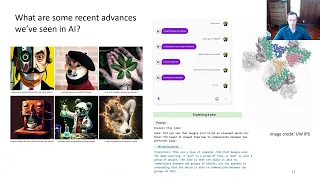
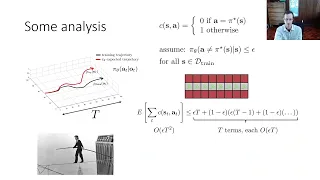
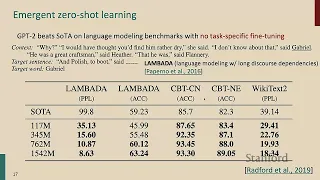
but why should we study deep reinforce learning today well as I mentioned earlier recent progress on data-driven large-scale AI systems has led to some pretty impressive results but the methods that are trained to Simply copy data produced by humans they're mainly impressive because they produce things that look like human generated results but in many cases we actually want algorithms that will do better than the the typical human data either because the human data is not good or because it's hard to obtain or because we really do want the highest possible performance like in the case
of alphago we want solutions that are impressive because the machine didn't need to be told how to do something because it discovered it on its own because it discovered a solution that was better or because I discovered a solution in a situation where it didn't have the benefit of human foresight to provide the kind of training data that it needed so recall that a lot of these very successful data driven methods work on the basis of density estimation which has particular implications it means that that these methods will produce the kinds of data that humans
tend to produce but it also means that they in some sense won't go beyond uh good human behavior they might be much better at indexing into human data as a certainly the case with large language models they have a lot more knowledge but not necessarily better at utilizing that knowledge to solve concrete problems if you tell a large language model for example to persuade somebody that it's uh you know in their best interest to go see a doctor the language model probably won't be able to persuade them much better than a person would despite the
fact that it has this huge uh repository of Internet knowledge to draw so where does that leave us well we've got these data-driven AI systems that learn about the real world from data potentially huge amounts of data but they don't really try to do better than the data in any meaningful sense and we've got these reinforcement learning systems and they can optimize a goal with a merging behavior and that seems like something that should address one of the major shortcomings of these data-driven AI methods but of course we need to figure out how to use
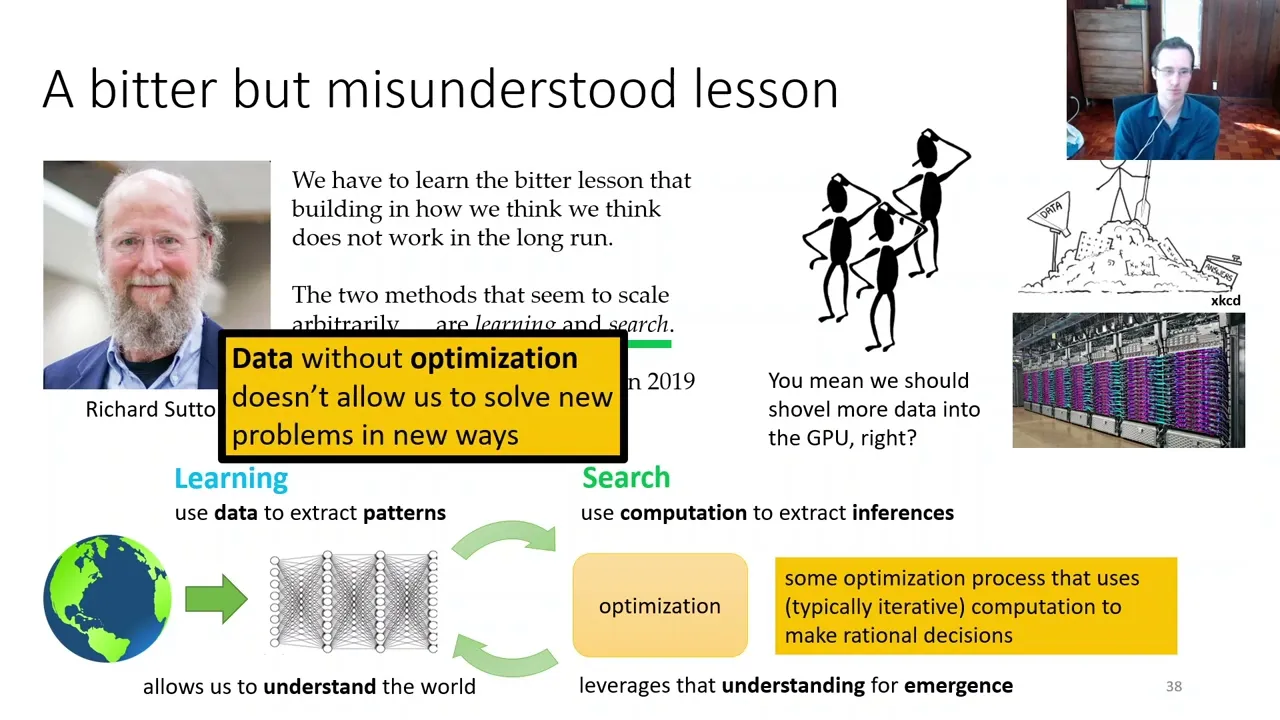
these reinforced learning Methods at scale we need to combine them with the kinds of huge models and huge data sets that have been so successful and that's really where the Deep part in deep reinforced learning comes in so data driven AI is all about using data reinforcement learning is all about optimization deep reinforced learning is about this kind of optimization at scale and data without optimization basically doesn't allow us to solve new problems in New Waves it might allow us to be very good at indexing into large data sets to figure out solutions that are
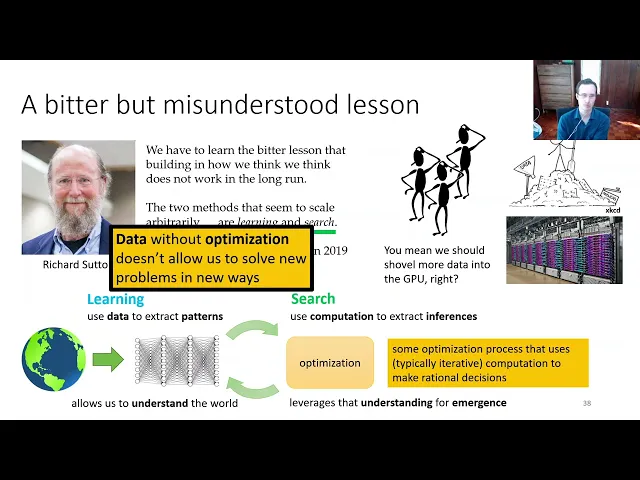
human-like but not necessarily solutions that are superhuman something that I I often like to bring up in the context of this discussion is an article written by Richard Sutton so Richard Sutton is actually one of the pioneers of reinforcement learning he was basically the person who popularized reinforcement learning and computer science whereas previous to that it was really a subject of study primarily in psychology so in many ways he sort of founded the study of reinforcement learning in CS Richard Sutton wrote an article in 2019 called The Bitter lesson for those of you that haven't
read it I very strongly encourage you to um to read through it it provides a very concise and very clear explanation or why we've seen this revolution in data-driven AI over the last few years and in that essay he writes that we have to learn the better lesson the building and how we think we think does not work in the long run the two methods that seem to scale arbitrarily are learning and search what he's arguing here is essentially that if we want very powerful learning machines we should build machines that are very good at
using data and very good at being scaled up and not necessarily worry so much about engineering these systems so that they solve problems the way that we think that humans solve problems as an example we might imagine building a system for detecting cars by somehow engineering some detectors for like wheels and uh and headlights and and things like that and then try to program in that well a car someone has four wheels and like two headlights on the front and two in the back so if you see some wheels and some headlights well that's probably
a car and we can basically program that in and that's actually how people used to build computer vision systems um maybe about a decade ago but these days we very rarely build perception systems that way instead what we do is we get lots of examples of cars labeled them as cars and let the computer figure it out and that's basically what Richard Sutton is saying that let's not worry so much about building in how we think the problem should be solved and let's instead of focus on scalable learning machines the machine Learning Community has had
sort of a Perpetual debate about the degree to which we should be building in these kinds of components and that's why this this article uh was so influential but a lot of people who read this article take away kind of a funny uh impression Maybe that the emphasis is really on just scale and not really on the particular algorithm that is being scaled up so maybe it's okay if we just take let's say supervised learning methods and as long as we can figure out how to basically Shuffle more data into gpus or build larger server
Farms that's really all that matters data plus lots of machines lots of computers and not not worry about how the problem is solved but that's not actually what the essay says notice how it says learning and search it doesn't say learning and gpus it doesn't say learning in Big Data so it says learning and search and there's a very important reason for that learning is about extracting patterns from data you look at the world you pull in some data and you train some learning machine on that and it finds the patterns that are in there
search is about using computation to extract inferences Rich Sutton is using the term search in a very particular very technical sense that it's commonly used in reinforcement learning search doesn't mean like a star search necessarily search means some kind of computation or optimization that you use to extract inferences so search is not about getting more data searches about using what you've got to reach more uh interesting and more meaningful conclusions search is essentially optimal Center some kind of optimization process that uses typically iterative computation to make rational decisions and it's important to have both of
those things because learning is what allows you to understand the world and searches what allows you to leverage that understanding for interesting emergent Behavior and you really need both if you want to have flexible and rational and optimal decision making in real world settings you need to understand how the world works and then instead of just using your understanding to regurgitate what you've seen before use that understanding to find a better solution than what you've seen before that's basically what deep reinforced learning tries to do data without optimization doesn't allow us to solve new problems
in new ways optimization without data without experience it's hard to apply in the real world that side of things like simulators where you can write down equations of motion but if you have both of those things then you can start to solve real world problems in more optimal ways foreign here where this view is not just about how to control robots or how to play video games I specifically emphasized in the previous section that deep reinforcement learning methods have been applied very fruitfully to arrange our other domains too and there's actually a deep reason for
this to try to understand this reason let's ask a very basic question let's ask the question why do we need machine learning and as an aside to help us answer that question we can ask an even more basic question why do we need brains the neuroscientist Daniel walper who knows quite a bit about brains had this to say on this topic he said we have a brain for one reason and one reason only and that's to produce adaptable and complex movements movement is the only way we have affecting the world around us and I believe
that to understand movement is to understand the whole brain now it won't surprise you to know that Daniel walpert works on the Neuroscience of motor control but I think this quote is very thought-provoking and I think we can apply the same intuition to machine learning and formulate this posture load perhaps we need machine learning for one reason and one reason only and that's to produce adaptable and complex decisions that makes a lot of sense in the same way that your brain is only useful to you so far as it moves your body because that's the
only way that it affects the world around it the machine Learning System is only useful insofar as it makes good decisions because that's the only thing it's outputting and now we can start to view all machine learning problems to this lens not as a problems of prediction but as problems of decision making this is obvious if you're controlling a robot your decision is how to move the joints it's obvious if you're driving a car your decision is how to steer the car but even something like a computer vision system in the end of the decision
making system if I make a decision which could be the image label but really the decision has implications what happens Downstream of that image label maybe this perception system is detecting how many cars there are at an intersection and that label will be used to determine how to route traffic so it has long-term implications maybe the computer vision system is detecting people in a security camera and it's going to call security if it sees someone where they shouldn't be well that's definitely a decision that could lead to some very complex and very difficult to model
outcomes if you view all of the outcomes of machine learning problems as decisions then it becomes clearer that all of machine learning problems are really reinforcement problems in Disguise it's just that in some cases we have the privilege of supervised label data that can Aid Us in solving and while this perspective might be a little bit reductionist I think it's important to keep in mind because it really tells us those building blocks learning and search are not just special things that we want for robots and video game playing but they're really General building blocks of
AI systems and that brings us to some big questions like how do we build intelligent machines very general intelligent machines not uh just machines that can detect objects and images but you know things like this or this or this or if you are more um an affairsync line things like this right the kinds of intelligent machines that were popular as in science fiction that capture the imagination maybe they're quite a ways away but how do we start taking steps towards this kind of thing um I think deeply enforced learning forms a significant part of that
and I think if we study it now we might put ourselves on the path to eventually answer some pretty fundamental questions so why should we study deep rainforced learning today well part of the answer is a big end-to-end trained models seem to work quite well if we use large data sets and large models like Transformers we can solve some pretty impressive problems and at the same time we have RL algorithms that we could feasibly combine with deep neural networks we've figured out a lot about how to implement RL algorithms so they can be used to
train these kind of big end-to-end models and yet learning based control and truly open world settings remains on a major open challenge there are some initial results including the robotics results I presented the results in other domains that show the inkling of the capability of these systems but a lot of potential has yet to be realized and I'll talk about some of that potential in today's lecture and also over the course of this uh class and also discuss how some of these ideas can maybe bring us closer so it's a very exciting time I think
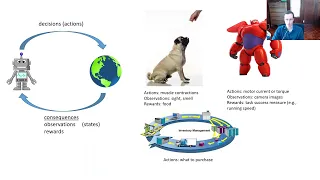
to study this topic because in some ways many of the puzzle pieces are falling into place and yet major questions remain which could be questions that you yourselves could answer in your own future work but before I get into that I want to discuss a little bit about the broader picture of the reinforced learning field besides the basic problem of maximizing reward functions what are other problems that we need to solve to enable real world sequential decision making because this course is not just about reward maximization it's also about a variety of other problems that
crop up and we study decision making and control in realistic data-driven settings and the kinds of methods that could address it for example basic reinforcement learning deals with maximizing Rewards but this is not the only problem that matters for sequential decision making we'll cover more advanced topics like learning reward functions from examples which is referred to as inverse reinforcement learning transferring knowledge between domains like transfer learning and metal learning learning to predict and using prediction to act and so on here's one question where do rewards come from if you're playing a video game it's pretty
obvious maybe the reward function is the score in the video game you kind of don't have to think about it very hard but in other settings you do what if you want to get a robot to pick up a jug and pour a glass of water well any child could do this but just figuring out the reward function is the water in the glass is itself a complex perception problem there's a there's a paper that was published by some folks at UC Berkeley on exploration actually about four or five years ago and had this nice
quote as human agents we are accustomed to operating with rewards that are so sparse that we only experience in them once or twice in a lifetime if at all what this means is that a lot of the things that humans do that are very impressive their War might be so delayed that it's very difficult to imagine learning just from that reward signal for example the reward that you'll receive for um let's say completing a PhD degree uh you'll only get that reward once and you maybe experience some satisfaction the real outcome might be what you
do afterwards with that degree and yet you might set yourself on the path to do that clearly it's not something that you learn through trial and error by attempting many many PhD degrees in the past this is actually a quote that was posted on Reddit where the comments are applied with by writing I paid the author so we know that there is actually a structure in the human brain the basal ganglia which is actually responsible for the reward signal that the brain uses for reinforcement I mean this is actually something that's been studied quite a
lot and it's a non-trivial structure you can see it you know it takes up quite a bit of space so clearly it's doing something sophisticated and it's not hard to imagine that for example for a cheetah that it needs to chase down a gazelle well if the cheetah learns through trial and error receiving the reward only when it caught the gazelle that's a pretty ridiculous image of a learning system if the cheetah just runs around on the Savannah randomly hoping to randomly stumble into a gazelle then randomly eat it and only then realize that kitchen
gazelle is a good idea well that cheetah will probably die of starvation of course cheetahs don't learn in this way they might learn from observing other cheetahs they might learn from their their parents they might learn from all sorts of other signals but clearly they're not learning from rewards obtained only from eating the meat of the gazelle at the end of a successful hunt right so there's a lot that goes on into these reward signals uh and you could imagine extracting other more uh useful forms of supervision you could learn from demonstrations either by directly
copying The observed Behavior or even inferring rewards from sort of behavior by something called inverse reinforcement learning you can learn from observing the world learn to predict what will happen next even if you're not sure what you're supposed to be doing and then leverage that knowledge later once you're more aware of what your task is you can employ unsupervised learning on supervised feature extraction things like that you can also transfer Knowledge from other tasks you can even use metal learning where you learn to adapt more quickly from your past experience of solving other tasks and
these are all things that we could try to leverage and these are all things that we'll actually learn about in this course here's an example of imitation learning this is actually a fairly old example at this point from about 80 years ago from some work from Nvidia showing a purely imitation based method of poor autonomous driving now this method tries to directly copy the actions with the observed human driver but of course you could do a lot better you could for example in further intent and we know this is something that humans do this is
a psychology study uh here the test subject is the child on the right hand side now you can see the child here is not going to try to imitate what the experimenter is doing because clearly the experimenter is not doing something very smart what the child will do instead is in further intent and then taking a very different sequence of actions that is better for fulfilling their intent rather than simply copying them this is really the Hallmark of human imitation when we say that a person imitates somebody else they're not literally observing someone's muscle activations
and Performing the same muscle activations at some level they're always inferring something about what that other creature or person is attempting to do and then doing it in their own way it might be very literal where they still carry out the same motions but figure out the commands to their muscles that will create those motions or might be even more abstract like it is here where they carry out entirely different actions but that lead to the seemingly desired okay inverse enforce learning algorithms can be actually used with robots this is again work that's at this
point pretty old it's about eight years old that shows an inverse reinforcement algorithm or this robot infers the intent of the human demonstrator showing this poor emotion figures out that the point is to really seek out that yellow cup and to pour the content of the orange cup into the yellow cup and once it inferred that intent then it could perform the task in a variety of settings foreign is a really big part of control prediction is separate from how we typically think of model free reinforcement learning but there's ample evidence in neuroscience and psychology
the prediction is very important part of how humans and animals learn about their world we could imagine predictive models in a very literal sense where you could actually predict your future sensory readings and you can Implement real world predictive models so here a robot plays around with objects in its environment collects some data and then learns to predict what it will see in response to different actions so the different columns here show predicted future images in response to different motor commands this is quite a while back this is seven years ago so you can see
that the predictions here are not a very high quality but they capture the gist of what the robot is trying to do and they can be used to control objects so you can tell it move this particular object marked in red to the green location it'll imagine the movement and then it will actually actuate the arm to move the object in that way so predictive models can allow you to solve new tasks you can use this as a very powerful tool for emergent Behavior you could for example command the robot to move some objects and
might figure out that it needs to pick up a tool to move those two objects together uh here's another two use example here it figures out that L-shaped tool can slide the the blue object and here there's an emergent tool use scenario where it figures out to move these two pieces of trash the uh water bottle makes for a nice uh improvised tool and predictive models have really come a long way so in recent years they've gotten a lot better with modern advances in general modeling it is a diffusion based video prediction model that is
being used to synthesize clips of driving videos the first three frames here are real the remaining frames are actually synthesized and you can see that the model will actually produce a realistic camera movement it will introduce new objects as the car turns it will um even um predict the motion of the other cars with some Reasonable Doubt in these in these examples by the way the left video inch pair is the real one the right one is the synthetical and here are the same uh model is being run on robotic videos similar to the ones
that I showed before just so you can see the contrast from 2017 to 2022 you can see that now the arm is clear and crisp the objects move in realistic ways and so forth there's also a lot of interesting progress especially in the past year on leveraging advances in pre-trained models so when we do reinforcement learning we typically don't have to do it from scratch what we could do is we could use a model pre-train on large amounts of internet data and then use it for control this is actually an imitation learning example it doesn't
do well it actually does direct indication but it is doing a learning based control this is the rt2 model which uses a first a language model that is a pre-trained on language then a visual language model that uses that language model to process internet images for things like question answering like what is happening in the images say it's a great donkey walking down the street so now the model understands pictures it understands text and then that model is further fine-tuned to upload robot actions so that when it's told what should the robot do to pick
up the chips it'll output the numerical values for the actions that'll actually pick up the ships so now it can bring in knowledge that it learned from the internet to perform this task more effectively here are some examples of the kind of intelligence tasks that this model can pass so it can be told to move the banana to the bottle the robot data has examples of moving bananas but to understand what it means to move into the bottle that's leverage internet data here it's asked to solve a math problem by putting the banana on the
answer of the math problem here it's told to put the strawberry into the correct Bowl to figure out what correct Bowl means it needs to recognize the fruits in each of the bowls and figure out that strawberry Bowl is in fact the correct one foreign here's some more examples pick up an object that is different from all the other objects now it knows how to pick up obvious in the robot data but it doesn't know what different from all the others means from that but that has to leverage internet data and it figures out that
the bar is the different object because all the other objects are bottles you can understand instruction in other languages even though the robot data is only annotated in one language and so on okay so these are some examples of the kinds of problems that are that we might study in the context of learning based decision making besides the 4rl problems but to conclude this lecture I want to end on maybe a somewhat more grandiose point I want to come back to this question how do we build intelligent machines and really argue that the basic building
blocks of deep RL might be very good building blocks for answering this question this will force a controversial statement I don't expect everybody to agree with me on this this is a big part of why I'm excited about this topic and I hope to convey some of that excitement to you so imagine they have to build an intelligent machine something that as intelligent as a person where would you start well in the olden days the way we would think about this is that maybe we need to understand the brain and the brain has a lot
of parts so let's understand what those parts are figure out how each of them work and then write computer programs to emulate the behavior of each of those parts uh of course our modern understanding of the brain is more advanced than what it was in the 19th century but parts of the brain more closely reflect their actual function but this is still a very difficult problem because each of the parts is very complex and if you we have to do a bunch of programming to code up the behavior of each of the parts and do
a bunch more coding to wire them together we might be at this for a very long time that might just be a very very difficult way to implement an intelligent machine it might actually take a lot more intelligence on our part than we actually have so if we hypothesized that learning might be the basis of intelligence that might actually offer us a much easier way to address this problem and here's an argument of why learning might be the basis of intelligence there are some things that we can all do like walking so it might be
reasonably argued that maybe those things are sort of built into our brains somehow but there are also some things that we can only learn like driving a car clearly driving a car is not built into our brains because cars weren't around when our brains evolved and we can learn a huge variety of things including very difficult things so therefore our learning mechanisms are likely powerful enough to do everything that we associate with intelligence it may be that in practice we don't actually use our learning mechanisms for some things like walking but we might hypothesize that
maybe they're powerful enough that if we didn't have those things built in we could figure it out anyway that may or may not be true but I think uh there's a pretty good reason to believe this might be true it might still be very convenient to hard code a few really important bits but let's not get distracted by that part we can further hypothesize that not only is learning the basis of intelligence but in fact maybe there's actually a single learning procedure that underlies all that we associate with intelligent Behavior now that's a more radical
statement it basically says that the way that we learn how to see and the way that we learn how to talk and learn how to hear is at some level the same instead of having an algorithm for every module I think we have a single flexible algorithm that placed in the right context increments all of the modules everything that we need in the brain and there are some uh circumstantial evidence to indicate that this might in fact be the case for example um and this these are some slides borrowed from Android you can build an
electrode array that you can put on your tongue attach that array to a camera and learn how to perceive visual process through your tongue you can take an animal a ferret you can disconnect the optic nerve from the visual cortex and plug it into the auditory cortex and after a while the ferret will regain some degree of visual Acuity which means that its auditory cortex can essentially learn to process visual settings so these things kind of indicate that perhaps there's a degree of generality or homogeneity to the brain at least for the neocortex such that
it can adapt to whatever sensory input is provided which might indicate that there's one algorithm and if there is one algorithm what does this one algebra need to be able to do well it needs to interpret Rich sensory inputs and needs to choose complex actions and to do both of those things we need large high-capacity models because that's the only way we know how to deal with risk sensory inputs and we need reinforcement learning because that's the mathematical formulas we use to take actions so why deep reinforcement learning well the Deep part provides us with
scalable learning from large complex data sets and the reinforced learning gives us the optimization the ability to take actions the combination of learning and search deep is great for learning reinforcement learning is the way that we do the search and in fact there is some evidence in Neuroscience for both these things there's evidence that uh the kinds of representations acquired by Deep neural networks have some statistical similarity to representations that are observed in the brain that doesn't mean that the brain works the same way that deep Nets do it just means that at some level
when you process lots of data and extract suitable representations they end up looking similar which could have more to do with the fact that a large enough learning machine just pulls out those patterns in the data because that's what the data is made of we're going to say something about deep learning that's I think a much harder question to answer but the evidence suggests that some kind of representational similarity exists for visual percepts for auditory features and even for the sense of touch and the experiment's done done to ascertain the structure a little bit creative
where the brain signals indicating the kind of features that in this case monkeys use for touch are obtained from recordings from Monkey neurons the Deep learning experiments done by actually taking a glove dusted with um white dust you getting a person to touch objects and then using a deep neural network to discover patterns in the the dust patterns on the on the glove so interesting experiments suggests that maybe the Cisco properties of features extracted by sufficiently powerful learning machines resemble the Futures in the brain and there's plenty of evidence in favor of reinforcement learnings at
least one of the mechanisms underlying decision making in humans and animals in fact uh reinforcement actually emerged as a study of animal intelligence but we know now from evidence that percepts that anticipate reward become associated with similar firing patterns as the reward itself which is exactly what we would expect from a temporal difference learning process uh the basal ganglia appears to be a kind of reward system and that model 3rl like adaptation is often a good fit for experimental data of animal adaptation a lot always but the picture is not complete right so all of
these uh kind of bits of circumstantial evidence might suggest that the tools of deep learning and reinforcement learning might be good tools for tackling the problem of intelligence but the problem is clearly not solved we have great methods that can learn from huge amounts of data by using deep learning we have great optimization methods for RL we don't yet have amazing methods that both use data RL has been made much more scalable in recent years it can tackle things like real world robotics problems but the kind of huge scale language model in general modeling applications
still primarily use supervised learning so there's still some algorithmic building blocks that are necessary and furthermore humans learn incredibly quickly whereas deep RL methods typically require large amounts of data and humans reuse past knowledge whereas transfer learning URL is still an open problem it's not always clear what the reward function should be and it's not always clear what the role of prediction should be it seems like these methods can be very powerful but how do they fit in with model free methods are they just different things or can they be reconciled in some way so
all these question marks I think give us uh ample space for additional research that we can do in this area and perhaps if the tools of deep learning and reinforcement learning are the right tools for building enormously powerful artificial intelligence systems that may be studying these questions can allow us to make some Headway on that problem and ultimately I think that we can get away from this picture thinking of uh intelligent systems as a collection of modules to implement and instead as a very elegant and simple framework where we have a general learning algorithm that
can figure out whatever problems is posed to it in fact this idea is Not By Any Means new it's not something that was created in 21st century it's not even some of those created for deep learning or even in the age of machine learning here's a quote that I think very nicely exemplifies this perspective instead of trying to produce a program to simulate the adult mind why not rather try to produce one which simulates the child's If This Were then subjected to an appropriate course of Education one would obtain the adult brain who said this
I'll try