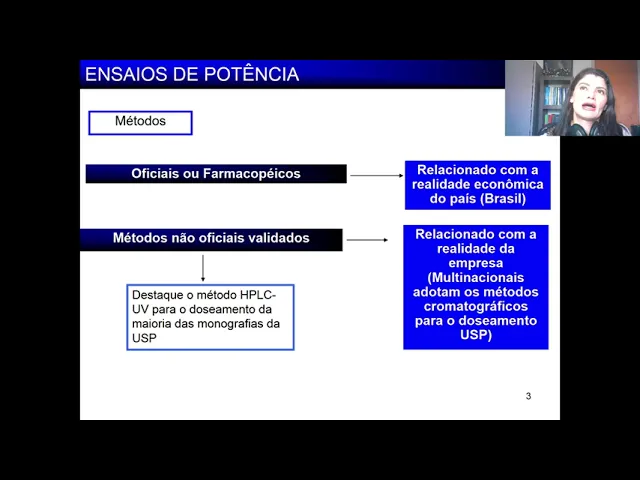
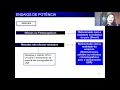
I want to Hello everyone And today we are going to start the other block of the course talking about the potency tests that would be these potency tests are the quantitative tests where we have as main objective to quantify the active principle whether it be in the raw material or in the finished product And then we are going to give an introduction to the greater focus in this first stage on volumetric methods, emphasizing this in this first sequence the classes in acid-base volumetrics is well then a power Insight also called dosing These are those whose objective is to quantify the content of an active substance and medicines so these tests they will be common in the quality control of the raw material when we receive this input it's nice to see here in the case show it here for you right What would be my raffle But I treat it right in the dry extract I'm showing you here, what it would be like for a herbal medicine , it's also in quality control in process, that is, in the mixture so when my active principle is my raffle and it is mixed with the other excipients in the formulation I need to ensure that I also have dose uniformity for the chemical in my finished product my final product I have no problems regarding quantity and good prince so these potency tests dosage tests they are commonly used in these three stages in the quality control stage of the raw material because if my raw material does not have an adequate content I will not be able to use it there in production to avoid problems futures in quality control in process and many times you will have a back-and-forth within production because you are in a mixture if you have a mixer with the powders, right ? it has to be adequate she has to give me a compliance report So there comes a show of production right that's why warming up sampling is very important she has to be representative of what is there in the mixer And then the control of and goes and does, for example , the humidity dosage among other quality control tests, a process once yours is not within the range that will happen within the quality control process there is still the possibility of correcting this mixture before you finalize that pharmaceutical form this correction can be or add more active ingredient if this dosage is with the dose below the specified or even dilute a little more, let's assume that the active ingredient is with the dosage above the specification limit so this correction can be made by adding more incipient until correcting then this can go back and forth several times until this product the process Is within the fa to stay sane so pharmacist he keeps calculating on top of yours he goes decide if everything is already right if he will have to increase the amount of active ingredient he will have to do a calculation to find out how much active principle he needs to add to correct the cttu or if he will have to add more excipients to correct this terror if it is above the specification limit then quality control process it is sometimes complex not only for solids but also for liquids so if I have an oral solution in the suspension formulation the same way, a sample of this mixture will come to be analyzed in the quality control and then it will be verified before bottling the product if it is within that specification range so once in the quality culture in process my one dosage Is adequate and the and the other parameters that are relevant to the quality control process that we will see a few more classes ahead I will finalize the pharmaceutical form if it is compressed I will take it and send it to compressor and compress if it's a capsule I'm going to capsule if it's a coated tablet I'm going to compress it I'm going to analyze this reverse tablet and then I'm going to coat it if it's a liquid pharmaceutical form, like a suspension oral solution, I'm going to bottle it Hi, and then it doesn't end, it's this finished product, it comes back for another sample, right, for quality control to check if the final product is within all the specifications not only for dosing but other specifications that are relevant to that product So you have at least this this material and it is to analyze you have with these three steps raw material process and finished product then once the finished product final product is approved he leaves the quarantine he can be released to the other apartments, it can be attributed to one if this product happens , right, that is what the industry does not want, it is a very big loss if it arrives in a capsular form if the pill arrives and it is out of specification there is a lot of the watchman Imagine you take a huge batch of pills there and crush it again so this really is very complicated, right or you have leaked a large amount of vials of a particular suspension or oral solution and you have to empty all of them and correct them so sometimes really depending on the rework it is better to discard so that is why the quality control process it is fundamental to avoid this waste because after you compress the pill after you put it inside the capsule after you pour it out it's really very difficult it's very complicated to correct a whole batch So I'm here showing you, from a practical point of view, how this happens, okay ? to the methods, right, which is our focus in our class, so many times the company can opt for pharmacopoeial methods or methods Ah ok, but sometimes that product that raw material is not always registered in the pharmacopoeia if it has been written in the pharmacopoeia And the pharmaceutical laboratory company is by a non-pharmacopeic doctor, it's easier, you're there validated by an official method And like me I had already commented nothing on the pharmacopoeia, it is the monographs that are included in the copeial form of each country with my case Brazil is related to the epidemiological issue with the issue of the economic reality of the country so in the Brazilian pharmacopoeia you will find volumetric methods with a higher frequency than in the American Pharmacopoeia due to this issue of instrumental limitation that not all laboratories are so well equipped in Brazil is one of the pharmaceutical than United Laboratories in countries that have greater resources so here we will see that we also have methods that are more accessible when we compare with the American Pharmacopoeia, for example, they practically use hplc for almost all quantitative analyses, so it works for him if it predominates well and then it can happen that drug or that pharmaceutical ingredient does not it is inscribed in the pharmacopoeia those that are recommended that are accepted in Brazil and or else the company resa, she chooses to develop an analytical method, for example, she may think that pharmacopoeial method may not be very advantageous because it takes time anyway.
Sometimes the company wants to automate it, it has more resources, so it can validate this method, which is very common this validation mainly by chromatographic methods, right by hplc and bo what we see this a lot in the monographs of the American pharmacopoeia or the laboratory itself can develop its method so it is very common and multinationals adopt chromatographic methods that are inscribed in the American pharmacopoeia or develop similar methods right there I'm going to show you, we have a sequence of classes just for this part of validation of the analytical method and you'll see that it's not something so simple because then to say the question, right, but how am I going to trust a pharmaceutical company that uses own methods how am I going to prove this so you have some validation parameters that we see We're going to have a class just talking about validation that will ensure that this method is reliable and And that happens a lot or when you don't have any pharmacopoeia a new innovative product then the company Edi was concerned, you're going to have to develop this method in mine in case I work with herbal medicine, there are no methods for the plant that I work with calipial we who had to develop everything to develop and validate the methods Oi Bete So the quality specifications of the pharmacists range from the input, you know, I said that you used in the manufacturing of all forms to final packaging. And these specifications are important, many times we use the pharmacopoeial grandchildren because why do they regulate the issue of Foreign Trade of import and export when you establish minimum quality requirements within the Sanitary Surveillance then sometimes a product is not to be approved here in Brazil Anvisa analyzes, among other documents, the analytical methodologies that were used and if these methodologies are written in some pharmacopoeia, this brings greater comfort to Anvisa , right, approving this method when the method is already very well established . several issues before selecting the analytical method is the dosage of our product, right, our raw material, work first of them we take into account the cost of this method the analysis time that sometimes the issue of analysis time is fundamental for routine from the quality control laboratory, which often has a large number of samples to be run , so especially when you have the possibility of automation, even better for the industry, so if I have a method that I have a half-hour run and it has taken place every 10 minutes for sure the 10-minute race for the Pharmaceutical Industry is quite advantageous and then we will come to the a hplc class, right there's a hplc those h for it to be ultra-fast where the analytical methods don't reach a maximum of 10 minutes so the Pharmaceutical Industry has been using this technique, right investing in this type of equipment because of the time because while control of quality does not release that batch and the production is, let's say, stopped that product cannot move forward so if I have fast methods, right, and this is quite advantageous because time is money within the industry, we also take into account the quantity and volume of samples that are analyzed, right if I have a large volume more than ever the question of the analysis time of the automation ends up being crucial for you to choose a method, besides of course the structure that the laboratory will have for analysis and if it will have a I make an adequate infrastructure for those equipment to use those techniques with the precision and accuracy that are required for it to be analyzed So I need very precise values So we will understand this a little in the validation class the nature of the information we are looking for is the concentration of the constituent analyzed in the sample I am analyzing samples or drugs of the order of milligrams of the order of micrograms so for example if I I'm analyzing hormones that in men are very low doses in the order of micrograms, probably the volumetric methods won't be useful, they don't have enough sensitivity for that kind of rush concentration of being breath so now if I have, for example, analyzing the acetylsalicylic acid pills that have of of of of 500 mg then I can right in this case because of the sensitivity right in this matter the volumetric methods can be adequate and then also the types of analysis that we use right what we have to think about think about these techniques I have to think, for example, if I'm going to use volumetric methods in reproducibility, right?
If it's because the volume method trico it needs what a reaction of a reaction that has a very well defined stoichiometry and obviously if I have if I use reactions that don't have a good spectrometry I won't have a good reproducibility and that compromises a lot my analysis for example If I have methods that are based on electrical measurements, potentiometry conductimetry, I need to see this issue. There is a greater attention to the structure of my laboratory, with attention to electrical installations . as it was mainly ultraviolet and visible, which is very common, or other methods such as chromatographic methods will measure what is an area, right, of a peak within a displacement on the chromatogram .
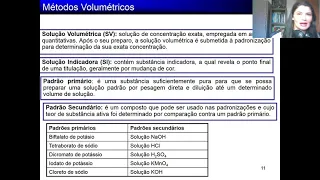
because it uses chemical reactions that are basically volumetrics and gravimetry, right? a little bit of electrical measurements in potentiometry and conductometry of spectrophotometry which is one of the flagships right in the pharmaceutical area for this type of method and especially in chromatography right basically translated there hplc which is extremely used well and we have some divisions right that the we can classify these methods as the classic methods that will be based on chemical reactions and we enter with the volumetric methods, right within the Masters of the classics where we use acid-base volumetry of precipitation complexation and redox And then it enters within the classical methods, gravimetric methods, what do you end up seeing a lot in pro - killing in the pharmaceutical area ? there will be potentiometric methods UV vis spectrophotometry or spectroscopy also of f fluorescence if I have drugs with a very low concentration, the fluorescence detector is much more sensitive than the virgins polarimetry in the case of inserting the shoulders refractometry conductometry and obviously we have the techniques taught there, right, Unos usually a separation technique an identification or quantification technique so that's where we see mainly the use of high performance liquid chromatography coupled to visible ultraviolet which is the most common, also gas chromatography coupled to masses but it is not so common in the analytical routine and it has been spelled out high-efficiency liquid spectrometry coupled to mass spectrometry that has been emerging has been gaining ground in recent years also in the analytical area also in the area of quantitative analysis of drugs but without a doubt this one here, right, is coupled with the times it is the most used at the moment so it's the volumetric methods, right, it's a method a technique that's still very last of the elements of dive rss drugs EA titration right It is a method of chemical analysis that is carried out where you go with the determination of a spent volume of a solution of an exactly known concentration will react quantitatively with a known volume of a substance that you want to determine the concentration that you they have already done this a lot in analytical chemistry and there is the amount of this standard solution that is required to complete this reaction it will stimulate it is the purity will estimate the amount that I have of my analytical our case the medicine our infa infa then yeah there are some analyzes that really the procedures that we also have of metric chips are irreplaceable they still have their space despite a high efficiency liquid tomography of greater field gain in recent years well and then the requirements for you to use the volumetric method, right?
reactions have to be simple ok Expressed with an equation that should already have a complete reaction, preferably faster ok and there has to be a well-defined stoichiometry because otherwise I won't be able to establish this concentration . pass the end point because the reaction is still processing, I'm there, it only falls deciolo, so it needs to be fast, it must occur at the equivalence point, change of some physical or chemical property, right ? it will produce a precipitate in the acid-base volumetry What we call this one we put an indicator there and you will have a change in color is it a change in PH and this sudden change in PH it will be and the indicator in the presence right there, when there is this change in the blouse with this indicator, it will change color and it will teach me to smooth out that there the titration has already been completed, the same thing , right, the reaction of redox So you have the potential difference there, you will want the reduced oxidized state of the indicator, and of complexation, also the metal, right, connected and the free metal .
we are going to discuss each one of these volumes separately, ok then and as I just said, besides this change in the equivalence bread, there is some change in physical or chemical property PH is like I said with the formation of a precipitate the question of the potential difference in it the oxidation-reduction process anyway and then we usually use the indicator the substance that will present different colors from these changes in these physical-chemical properties with pH alteration that we will talk about in this first class of acid-base volumetrics And then obviously here we have advantages and disadvantages of volumetric methods advantage low cost right so it's quite accessible any laboratory t in condition of having an infrastructure to carry out the tests, that's going to make it have greater access, right, so greater availability a relative precision of 01 percent then it will obviously depend on the type of analysis you are doing what is the precision Simplicity is also required for you to carry out situations are you need to evership so much time in training an employee who goes from one on the list to an analyst who will operate the hplc, for example .