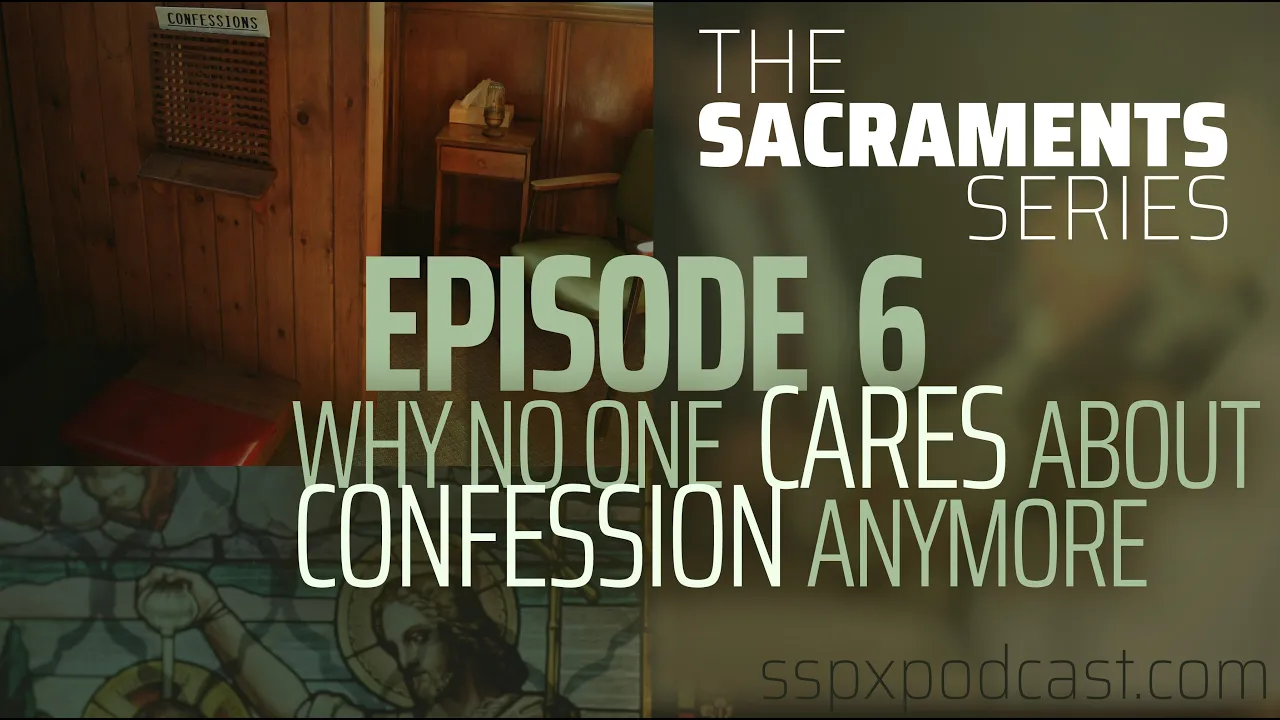
[Music] you're listening to the sspx podcast and welcome to our sixth episode on the sacraments where we'll look at the new understanding of the sacrament of penance or as it's most commonly referred to in most churches today as to do that we're going to take a step back and see how much of the hierarchy in the church today sees sin differently or if they don't see sin differently there's definitely a different emphasis then we'll see how that impacts the sacrament of penance we'll also take a moment to see how the right has changed perhaps most
strikingly in its physicality that is where is the priest and where is the penitent and finally father will give some advice on how to get more people today to take advantage of the great sacrament of penance as we move forward in this series we're looking for help if you like these series and want to have more of them you can help us by leaving a rating or a review wherever you're listening to this podcast and you can share it with someone who you think would like it appreciate it or maybe they just need it that's
the best way to help us because you're helping us with this apostolate to reach as many people as possible with the beauty and the truth of what it means to be a traditional catholic now let's join father sherry for episode six of the sacraments right now although sherry thank you for joining us again today for this second episode on the sacrament of penance last week it was snowy and our connection was a little bit a little bit hairy but uh things are a little bit better today it seems like yes we we have a very
very beautiful uh sunshine today so uh hopefully everything will go well very good well father um last time we went through we went through the sacrament of penance we looked at sin we looked at the necessity of penance we looked at all of those things today we're looking at the um the new rite of penance of reconciliation as the church calls it today um where would you like to start in this discussion father thank you very much andrew uh for having me back for this second discussion so i thought we might start this week by
looking at the difference in the way that catholics and the let's say the the official church uh looks at sin so we saw last week that what cities is is a disobedience against god's law and we saw that a mortal sin is something which in fact severs us from god because it entails the loss of sanctifying grace which is what unites us to god and in the church since since since vatican 2 you can say there's been a definite loss of the sense of sin whereby we see in practice that catholics tend to have uh
changed their ideas of what sin is and what sin does and this uh has meant that in fact the sacrament of penance has gone from being something which was frequently used and frequently encouraged to be used by catholics to something which has come well not completely but has very much fallen out of use among catholics and uh i'm wondering you know what is the reason for this loss of the sense of sin and i think there's there's a couple of things there uh first of all there's the uh the sort of great uh outcome of
vatican ii which was that well the catholic church is uh is the true church in a certain sense or the the true church subsists in the catholic church but there are also uh other sort of means of salvation so uh even outside of christ now uh clearly this is not uh literally said in in the council that uh you know that's fine every every religion is is okay every religion is uh is equal in that sense but there are uh let's say ambiguous at least uh things in the council which uh lead uh people to
believe well you know my my protestant uh neighbor he's you know he's just as good as i am which let's say morally speaking uh it is true that any any person uh we can look at and say well i cannot see his heart therefore i can't sort of judge and say well he's worse than i am and that's true in that sense but in the reality it is that the catholic church is the one true church because it was founded by our lord jesus christ and is in fact the mystical body of our lord jesus
christ and all who are outside of the catholic church may be trying their best in which case god will certainly lead them to faith in christ and to membership of the catholic church whether that be by baptism of water blood or desire but in their in their false religion they do not have the truth and they may not have the sacraments i say may not have the sacraments because of course there are valid sacraments uh outside of the catholic church in uh protestant denominations such as baptism in itself baptism marriage in the orthodox so-called churches
where there may indeed uh and is in fact there is in fact the valid mass uh these these sacraments may well exist but the uh the the the the truth and the unity of the catholic church has been uh has been lost and so uh this this has fed into the idea among catholics well actually you know it doesn't doesn't really matter all of all that much uh everybody's pretty much making their way to heaven and um therefore you know sin is not that big a deal and uh we see that in the catechism which
is which is uh being taught to children uh all over the world um taught or sort of thought taught to children all over the world there's almost very little instruction on the the nature of sin on the nature of mortal sin on what happens to those who die in the state of mortal sin and on the sacrament of penance i myself attended a novus ordo catholic school uh for for you know 12 13 years and we had the experience there of what actually was passed on in terms of sin and the sacrament of penance so
every every once in a while the priest would come into the school and then everybody would go to confession and i remember when i was in high school my classmates you know laughing and joking among themselves as to you know what are we going to what are we going to make up to tell the priest there was not a sense of of real sin and there was no instruction as to what sin was or what sins should be confessed i remember my sisters went to a convent school run by the uh the order of our
lady of loretto and some similar thing happened the priest came in and the the girls were all instructed that they should go and tell one sin in confession and so my sisters came home and told this to my mother who who called up the reverend mother and said reverend mother what would happen if a girl you know by hypothesis had two mortal sins to confess to which the reverend mother replied oh we don't talk to the girls about mortal sin we don't want to frighten them and uh this is anecdotal but it's it's a reality
is that there's almost no sense of what sin is what mortal sin is and what the sacrament of penance should do and this has been also accompanied by a sort of a change of emphasis in the actual rite of the sacrament of penance the key to really understanding in my opinion the changes in the sacraments was what was said by archbishop bonini regarding the change in the mass it is that the intention was to remove from the mass anything which was the shadow of a stumbling block for our separated brethren in other words we want
to remove and you know let's say watered down those things which the reformed sects uh find to be objectionable so in the mass that was the notion of sacrifice and the notion of the real presence of our lord and therefore those things were watered down in the sacrament of penance it's the idea that actually it is the priest the man who forgives you your sins because you go and mechanically in a way now clearly as we saw last week it's not enough to just confess your sins but in a sense it's mechanical that you confess
your sins and the priest gives you absolution if he judges you to be worthy if he judges you to be sorry for your sins and in the new right we first of all got a change in the name of the sacrament so just like the sacrament of extremism uh was renamed as the sacrament of the sick so also the sacrament of penance was renamed the sacrament of reconciliation now you can say that uh some uh reconciliation can be penance uh for example if i i'm in the state of mortal sin god forbid and i go
to confession and i confess my sins and i'm forgiven then i am indeed reconciled with god however not uh all reconciliation necessarily involves penance because let's face it uh you know in today's day and age one of the ways that pressure is being put on people let's say stuck in the past you say well you've got to accept the change in society accept the change in the way that people behave and let's imagine that your son or daughter quote-unquote comes out as gay well you should accept that and be reconciled to that and that's a
different type of reconciliation um you see how i'm not saying that that's what the sacrament of reconciliation means that you just accept sin but it it it makes it more ambiguous and so you could say well a reconciliation with god could also be god simply saying well in in a protestant sense okay i know you can't help sinning and uh there's nothing we there's nothing that can really be done about that but uh i'm going to to accept you as you are and uh and that's uh that's what the idea which has got into people's
minds again anecdotal uh examples of people who go to confession to to priests let's say who are uh ordained in the in the novus ordo or have that mentality at least because of course there are priests who are in the novus order who do have a traditional mentality towards the sacrament of penance um i would say that they're probably in the minority but they do exist but an anecdotal example somebody confesses the same oh that's not a sin uh you don't need to worry about that uh that's uh you know you can't help that uh
it's it's it's you know normal for you you've been abandoned by your first wife so you've found a second relationship what can you do and uh and this has led to uh again as well to a certain acceptance of sin you know uh this is the way that things are now uh i remember an old lady who was a neighbor of ours saying things such as well i remember when that used to be a sin but now things have changed and you see what happens there is not so much that the the theory has changed
the theory uh exists still that mortal sin is what condemns you to hell but the theory is not known and the practice has changed going back to my school days again i remember a visiting priest who was an older man he was probably in his 70s and i remember him asking us well what sort of sin is it if you uh if you deliberately miss mass on sundays nobody had any idea nobody knew that this was a mortal sin he said yeah did you know that's a mortal sin and everybody was was sort of shocking
what's a mortal sin and uh it's i know i'm i'm laughing at the sort of you know unbelievable nature of it but of course it's not at all funny it is that uh sin is the one obstacle which stops us from achieving our goal the goal of life which is to know love and serve god to be unified with god and it's it's sort of fallen out of favor and that's led to all sorts of of practical consequences in the way that the sacrament of penance is used okay so that's that's the way that sin
sin is seen um i almost said that's the way sin is today but that's that's not it at all uh that's the way sin is seen uh today you know the sacrament of of penance like you said it looks different um i i've grown up in a traditional catholic family and right near a traditional catholic church my entire life i was away from a traditional catholic church for a time during college and so i went to confession at a novus ordo church um and it was very different and it's probably different in all different churches
um but there were two chairs there instead of a kneeler and father sitting in a chair there was it was a conversation i guess we'll get into that but it's striking how much it has changed right yeah so i mean let's let's look at it in two parts because there's a lot of uh a lot of uh stories let's say uh or experience which you have obviously in which which i have as well from from growing up let's say in the novus ordo and from you know just hearing from from lots of people um let's
look at the the actual let's say uh right of the sacrament which was changed in the early 1970s so um what is the change here well the thing about the sacrament of penance is that the the matter and form so um what it is that makes the sacrament you've we've already seen that in baptism for example the matter and form are the the water and the words uh said by the minister so in the sacrament of penance the matter is referred to as a quasi-matter and that's the sins okay if our blessed mother uh were
to go to confession but a theology fiction here uh the answer is she couldn't because uh she did not have any sins to confess so she was uh the most humble of uh of uh women but her humility did not extend to lies because that's of course a form of pride and so she couldn't say bless me father for i have sinned she hasn't sent and she she thanks god for that uh that he has regarded the humility of his handmaid but for the rest of of of mortals uh we can all uh after we
reach the use of reason uh we can all go to confession and say father i have sinned and this is the the matter of of of the sacrament and then the form that is which which uh actually uh operates the sacrament is the priest absolving and in fact it is sufficient for the priest to say i absolve you from your sins okay so this this is what happens of course in in cases where there's a a very short uh period of time i remember one time uh being called to uh a man who had actually
died already before i arrived um he was in a in hospital and when i got there i got into an argument with the hospital about saying can i see him even though he's dead because i still have the window after someone dies before the soul will actually leave the body so you've got a window of approximately two hours the uh the the moral theologians say or maybe four hours in the case of a sudden death where you can still go and give conditional absolution and even conditional extreme motion to that person so after uh the
providential intervention of a filipina nurse who was a catholic and who believed me when i said that there's still time i was able to go to the morgue and i was able to give conditional absolution to this man and so what do you say in that case well you keep it very very simple you say i absolve you from all censures and sins in the name of the father and of the son and of the holy ghost and that's it there's there's nothing else you can do that's the great reality that you know this is
not sort of simply something symbolic okay that's the the great uh sort of argument of the modernists is sacraments are symbols uh they're something which talk to our faith and which express our faith but they're not real they're not actually operating uh something supernatural whereas in reality the church knows that they are real that a sacrament is a sign but it's a sign which confers grace and um this is this is sufficient for the sacrament of penance now the good news is uh for for those who have been frequenting uh confession in the novus ordo
church is that that essential form i absolve you from your sins is still there so it has not been removed however all of the things surrounding it a bit like you might say in the mass all of the things surrounding it have been changed and watered down or made more ambiguous so uh if you look at all of the formulas which have been changed in the traditional formula you could fit the uh you could fit the actual formula for confession on the back of an index card like this in fact you might see that in
confessionals where the priest has uh the formula for the blessing at the beginning the absolution and then the prayer at the end which is the priest saying that whatever good works the person does may be used as penance for the sins that they have committed but in the novus ordo right there are in fact 88 different ways of uh doing confession so there's uh two formulas to welcome the person so it's not a blessing so that you may that you may well confess your sins but it's rather in the words of the ritual which i
don't have in front of me right now but it's basically welcoming the person and inquiring about their circumstances in their life now these are things which which the priest may need to do i know for example priests will say well when someone's going to confession for the first time uh it it's important to put them at at their ease you can't they don't know what to do they've never been in a confessional before so you're going to need to put them at their ease but this is sort of a change in emphasis and then there's
a whole slew of scripture passages which can be used uh eight or nine different formulas of uh active contrition which may be used some of which are more clear than others and then various other formulas and the actual formula the precise formula in the traditional rite says may the lord jesus christ absolve you and i absolve you from any pain of excommunication suspension or interdict insofar as you have need and i am able and then i absolve you from your sins in the name of the father and of the son and of the holy ghost
in the new form it's uh effectively does not mention anything to do with the the centers of excommunication or suspension because if somebody let's say where actually excommunicated they can't receive the sacrament of penance they need to be first of all uh absolved from their excommunication which is a man-made penalty uh sort of a a penal law as it were before the the actual stain of sin can be removed okay there's no mention of that and it says that god through the ministry of the church uh is is going to grant you peace that's true
it's through the ministry of the church but again it's the that's something that protestants can accept they can say well you know confession is not a man giving up solution it's you know the faith of the church uh showing that anybody who is who is uh sorrowful for his sins regrets his sins uh will be forgiven because of that faith expressed by the church so it's it's a way of ambiguity and that has also been shown in the the the place where confession is uh given now i'm i'm generalizing in all of this uh andrew
because you know there are once again priests and churches where there is a sort of a traditional view of the sacrament of penance and i've had this from uh from from many people who who tell me you know that s such a such and such a priest uh so-and-so you know he's got a he's got a principal uh he's got a view rather of confession which is very traditional and there's a there is a confessional and he uh he insists that you confess your sins and then he may even use uh some of the formulas
from the traditional ritual now i'm not sure if that's allowed anymore but uh but he may do that just like exorcists uh who actually are exercising uh possessed people do actually use the traditional ritual even though that's not really technically allowed um so so i'm generalizing but let's say okay general way that confession is developed is first of all it's moved away from the confessional so a confessional for those who may not not have ever seen a confessional it's not a scary place uh perhaps when you're when you're a child uh for the first time
you know you might need to go in before your confession and i know teachers do this and parents do this right okay we're gonna just have a look at the confessional uh on a nice sunny day where you can see everything priest sits here you go around this side you kneel down nothing to be afraid of there's a grill between you and the priest what that grill does is it gives you anonymity uh the priest does not need to know who you are and he may not inquire who you are uh he may he may
pose questions relevant to the confession for example if you go to confession and uh let's say you confess um you know disobedience well he could well ask you well you know is that disobedience towards your parents or perhaps towards your boss or towards uh the pope in other words are you are you a child are you married what is your state in life okay i can ask those questions but he can't ask you your name and the fact is that he can't see you which makes it much easier for you to confess your sins because
you know when you're looking into somebody's face and you have to uh you have to confess perhaps you know sins which which may be big sins maybe you know very shameful sins he's not looking at you he's listening to you the church says a priest can hear men's confessions outside of a confessional but he must hear the confession of women and girls inside a confessional why is that it's not because there's uh there's a presumption on the part of the church that you know the this hidden uh discrete place is going to be used for
something bad but it's because nobody could suggest that it's being used for something bad because it's out in the open and there's a physical separation between the priest and the penitent and so it's obvious to everybody that this is the way that things are in a different life uh before i went to the seminary i was a civil servant in uh in dublin and the world were the relics of various rules from the catholic past in the civil service and one of the rules was for example that if you were to pursue a religious vocation
uh that you got 12 years to come back if you wanted to so if your religious vocation didn't work out you could come back get your job back because the government was actually encouraging people to try out religious vocations and another one was it was forbidden for a man and a woman to be alone in an office without the door being opened in other words uh what why is that are we expecting that uh that there's you know something strange going on not at all it's prudence it's well if the door is open then it's
obvious to everybody that everything's perfectly normal now this rule of course was done away with and then we arrived you know 15 20 years later and uh okay well it's it's you know uh you can't trust any men etc etc etc these are things which which the church has known in a correct way which is that you can trust men but you should also have certain things in place whereby there's openness and there's a culture where there's no sort of promiscuity let's say between men and women right and okay that's one element of the confessional
you go into your your uh your novus ordo confessional insofar as if this has happened and it's happened in a lot of places but not in all places is you've replaced the confession uh confessional with a reconciliation room so this is often uh simply two chairs facing each other uh in a room and usually it is again from uh from a perspective of uh of um you know prudence you usually you know this you can see into the room which maybe is not the best thing for somebody who's going to confess his sins that people
can look into this aquarium and see him confessing his sins and you sit down and you you tell your your sins to the priest remember that was one of the ways that uh we would go to confession at school is that the priest was in a room on a sitting on a comfy chair and you sit on a comfy chair opposite him you're a 12 year old boy and then you have to look you sit down look at him and confess your sins not very psychological uh the the best way to do that is to
actually kneel because you are confessing your sins to god not telling him i did these things and i'm happy it's i did these things and i regret them and i'm sorry i asked for mercy uh the classic way of uh of posture for asking for mercy is to kneel down before god um also the individual sacrament of confession has often been replaced by sort of reconciliation services okay and the idea here is that penance becomes a sort of a communal celebration for example christmas easter you know there's a time set let's say a couple of
hours where maybe there'll be four or five priests and then everybody's supposed to come and then there will be certain gospel readings etc and then people will go and individually say their their sins in tandem with that times for individual confessions are have largely been done away with now once again there are churches and there are priests who do have these times but largely it has been done away with if you want to go to confession you have to make an appointment with the priest there's no that's a set time where uh anybody can go
and confess is six what that has brought about is the idea that you don't need to go to confession as soon as possible when you commit a mortal sin right whereas in fact uh if someone does commit a mortal sin uh the correct thing for him to do is not to despair and not to say well you know i've committed one mortal sin now so what's the point it is get down on your knees make an act of contrition and say i'm going to go to confession as soon as i can uh maybe father is
available for hearing confessions tomorrow at 6 30 before rosary i'm gonna go uh or maybe it's at the weekend father hears confessions for half an hour or three quarters of an hour before mass i'm gonna be there or else in the new way of doing it is well you don't go to confession except once or twice a year um and you do that as a sort of a of a communal thing again very much uh opening the interpretation of the sacrament up to a modernist idea which is faith community expressing their faith yes we are
sinners we sometimes do things which we shouldn't do and so we are sorry but it's not the individual guilt on the soul which i must put uh under the blood of christ to be washed by his blood so that i can once again resume the path uh towards heaven and uh this i mean again you may have seen this andrew or you certainly may have heard of it but go to a traditional church and you have lots of confessions uh you have in general you know let's say you've got i know church or maybe 100
people you're going to be hearing confessions for an hour before mass on a sunday you've got a church of maybe uh you know three or four hundred people you're probably looking at three or four hours of confession every sunday and a few hours during the week um i i know i've never actually visited st mary's myself but understand that there's you know there's lots of confessions there's a big parish and the priests are available pretty much every day for some hours for confession maybe you can confirm that andrew i believe that's the case it's funny
though father the the the communal aspect you know we just finished looking at baptism episode four we were talking about the new the new rite of baptism there's that whole communal community aspect the community welcomes you same thing with what you're saying here with the sacrament of penance the other thing that reminds me of baptism is when you're talking about there's not this you know come whenever you need to to to confess your sins it's let's wait for this time and place now the church is not saying that you shouldn't go right away they've never
to my knowledge father they've never come out and said don't go to confession wait for this time but by setting up these set times for confession when the whole community comes and does it it's sort of the same thing as baptism where the right the new rite of baptism says as many people as possible should come for the baptism the the parents should be there the family should be there the friends the community they're not saying don't get your bat baby baptized right away but they're also you know there's this there's this blurring of lines
of the importance of doing the sacrament right away both in baptism and independence right which is a a subtle change in emphasis uh you can't say that it's wrong for for you know lots of people to come together for the baptism but the subtle change in emphasis is that well you know it's not that we need to have the child baptized relatively soon because if god forbid the child were to die uh the child would not be able to go to heaven the child would go to limbo without baptism uh whereas now the idea is
well you know everybody's going to heaven and uh you know gold is not going to stop a child going to heaven which is in fact really based on a misunderstanding of what heaven is you ask people who say well i can't believe that god would send an unbaptized child to limbo and i said well what's your idea of heaven oh heaven is a happy place where you know things are things are good you know there's no suffering etc well that's limbo okay so don't worry the child is going to to this place of natural happiness
don't worry anymore what is heaven is a place of supernatural happiness because there we have the beatific vision which is the vision of god but of course that's that's something which is above our nature that's why it's called supernatural it's it's a lack of of understanding of the catechism for which i do not blame people for which i do blame the bishops and to a lesser extent the priests lesser extent the priest is of course it's the bishops who are the teaching church it's the priests who are their assistants and who do in fact follow
the lead of the bishops and popeyes the tenth in his uh in his uh i think his first encyclical said the greatest difficulty which is facing us is lack of instruction in the faith and that's that's really what it is when you when you have that uh clear instruction in the faith which comes from the catechism removed then you get a mixture of half notions and uh sort of unclear things and some superstition and it's all coming together and you lose that uh clear path which the faith shines upon us and i think that's what
uh what you're referring to there andrew when you're saying well instead of a clear understanding your child should be baptized as soon as practicable certainly not any later than a month the church actually and in many places the church says okay after a month uh parents could be looking at serious sin if they've delayed unnecessarily depends on the circumstances maybe there are reasons why the child's in great health and the priest is not visiting for another six weeks you know maybe that's that's okay um but then it's no let's wait six months until uh the
child uh you know has uh has started to grow his first beard and uh let's uh let's let's do it at that stage so we can have a community celebration um it's a similar idea with with that change in the sacrament of penance yeah and uh the the sort of going hand in hand with that is a growing tendency as well to general absolution okay so difference between general absolution and what's called an individual confession or auricular confession confession into the ear of the priest is that a general absolution is when you get a whole
group of people together and you the priest simply says i absolve you from your sins now that can be valid if there is a grave necessity for example you are let's say in a you're in an aeroplane and i always get nervous when i'm in an aeroplane and there's another priest on the aeroplane because then i know that i too can receive absolution therefore god may in his mercy be providentially setting me up to be able to receive uh the last sacraments before i die if i'm on my own then i can give the sacrament
to everybody else but i can't give it to myself so uh right in any case uh you're on an aeroplane and let's say the aeroplane is looks like it's uh it's a goner and the priest stands up and he says okay for all those who are baptized those who are not baptized uh you must believe in uh in god and the blessed trinity and believe in our lord jesus christ the savior repent of your sins uh we got time to baptize we got some bottles of water here for those who already baptized uh i absolve
you from your sins that's all you need you don't have time to hear confessions okay that's perfectly legitimate however if there's no reason for that um then for the priest to say okay i absolve you from all your sins is you're actually getting rid of the matter of confession which is the the confession of sins and you need that confession of sins except if there is an impossibility either physical or moral and this is a growing tendency which again lessens the uh the understanding of the general man and the pew about confession and i say
the man and the pew but of course there aren't very many men in the pew and there's uh probably a few more women but not very many either and certainly a lot of young people never go to confession they never go to confession but if the time comes for them to go to mass either at a marriage or at a funeral everybody goes to holy communion now i am not making any judgment on the soul of another person but i do know that if you're not frequenting uh the sacraments you're not going to mass on
sundays then objectively you have committed a mortal sin now they may not know that because nobody ever told them but there are in the world in which we live which is uh pagan in general uh which has sort of uh returned to all of the uh preoccupations of paganism such as the seven deadly sins um one of my confereers whom you've interviewed father mcgillivray was telling me last week about the seven deadly sins are murdered by seven internet companies so you've got pride that's linkedin covetousness that's amazon lust is uh tinder uh anger is twitter
uh gluttony is one of these delivery uh food things uh envy is uh instagram facebook and sloth is netflix uh there's a certain truth in that it's that our whole our culture is uh very much focused on the let's say immediate pleasures immediate gratification or if you go beyond that or perhaps to a delayed gratification but not much more than that now we are living in this culture and many catholics are not praying uh not forgetting the sacraments chances are we've fallen uh it's it's it's a pretty good uh thing to to assume go to
confession no it doesn't come to their idea because it just disappeared from their idea and so uh the tragedy real tragedy of the novus ordo's springtime is that the faith and the life of the faith and those means which ease our way towards heaven have disappeared for the vast majority of catholics and so they're left without uh without a compass and without a means of saving their souls and god is very very merciful and so he can uh he can operate he can operate his grace perhaps you know when a time comes to death and
i've seen this so many times as a priest is you know people come out of nowhere you're visiting a hospital to visit somebody and then out of nowhere somebody else shows up uh one of my colleagues here in quebec was given permission to to visit a dying person last week and uh you know it was quite quite something because it's very dangerous here in quebec for anybody to visit a hospital um and then when he was in there you know he got left alone for a second the next thing is he was around the corner
uh ministering to another person who needed the sacraments so you know god works uh things out to those who do what is within them god does not deny grace and so that's why we have to as our lady fatima said pray the rosary for sinners because they're going to go to hell you know in the current circumstances in the world in which we live and in the great uh the great crisis within the church where the means of sanctification have been effectively withdrawn in many circumstances how are they going to save their souls we need
to pray we need to do sacrifices god can do it and bring them to him before they die because that's all that matters really right well it's striking father um you saying pope saint paul's the 10th recognized that one of the greatest difficulties facing the church and this was more than 100 years ago was the lack of catechesis and as we've seen through the crisis series and now going through the sacrament series the lack of of knowledge of the majority of catholics throughout the world they don't have it they don't have that catechism they don't
have a basic understanding like you said from your own experiences of your classmates and it's undoubtedly gotten worse now right oh absolutely yeah so i mean i do have that experience of um of undergoing the the nova sort of catechesis myself as a boy and as an adolescent and uh i would say maybe on maybe four or five days of those 13 years you know the teacher who may have been you know an older person because of course the they they were formed in the traditional uh traditional faith and so they may have come out
with it with a gem you know uh um i remember uh one of our teachers at high school who was just teaching us for a few days as a replacement and he uh put the thought of the idea to her head very simple who is my neighbor my neighbor is all mankind okay that's what the catechism says say well that's that's a good thing to learn but uh snappy it's true and this is how you love your neighbor it's not by uh picking and choosing there is an order in charity for sure but i need
to have charity for all mankind great but most of the time in fact all of the time almost it was just nothing it was just uh in in in primary school it was you know caricatures almost of the of the faith uh sort of a a dumbing down of everything uh some stories in the gospel but really not an awful lot that you could uh you could actually say oh yeah that that that's how it works this is this makes sense i need to i need to do this i need to live my life like
this and so effectively then what happens well there is no faith being passed on and whose fault is that it's the bishop's fault and it's the it's the pope's fault uh because he's the he's the head of the visible head of the church uh you know obviously it's the pope's fault obvious clearly the pope uh if he's a if he's trying to uh do his job properly there's all there may always be those under him who do not do what he says but what the pope should be doing is saying okay like pope saint pius
the tenth uh catechesis uh knowledge of the true faith this is what we're going to do we're going to preach the faith we're going to uh we're going to teach catechism every sunday and holy day holiday you might remember the story from the life of saint pius the tenth when he was a bishop in mantua visiting one of his parishes time for catechism came up priest is having a siesta back in his house now of course um warm italian weather you can understand why somebody want to have a siesta but you should be doing catechism
so he rings the bell and he gets up into the pulpit the bishop does and he starts preaching catechism and the priest uh hears the bell and arrives over who's this in my pulpit oh it's the bishop and uh uh bishop sarto didn't uh he didn't give him a lecture there's nothing more to say it's hey there's nothing more important than preaching the faith teaching the catechism and i think that's a great lesson for catholic parents um it is that today more than ever your children need to know the faith and when they're let's say
you know they're younger children um until they become adolescents then that's you know fairly simple as it's always been you learn the catechism off by heart why do you learn the catechism off by heart it's because you can't rely on google to give you the catechism that's why and when you learn something off by heart at that age it stays with you for life and it feeds you and if like has happened long times in the history of the church you get locked up in prison you can feed yourself by reciting the catechism in your
mind and by reciting it to perhaps your fellow prisoners not saying that's gonna happen but it could because it's happened a lot of times in the history of the church and then as adolescence it's a deep understanding of the faith so we send our kids to high schools and they get into you know mathematics that i couldn't even begin to understand and we send them and they get into physics and chemistry great stuff not a problem and then when it comes to religion you know uh well that's not you know that's not important we'll do
a little bit here there no you need to give it to them uh meaty stuff uh based on the teachings of saint thomas based on the uh teachings of the church reading uh books and give them a true understanding so not only can they uh understand themselves the faith understanding as best as humans can under the light of god but also to defend the faith when i was a school principal we used to do this thing at the end of each year the graduates in grade 12 myself and the other priests would temporarily don the
masks of atheists and we would we would pretend to be atheists for a couple of hours and it was up to the students who were about to graduate to uh de-mask our fallacies and to show that these atheists in fact were not really uh telling the truth at all and it was it was good because it uh it showed the idea to all of the students that you know when you leave school you've got to be able to give a reason for the faith which is within you and that's the the the uh the role
of parents to insist and to make it possible that not only they have the knowledge of the faith but beyond that today the ability to defend and to vindicate the faith absolutely father thank you so much for your time thank you for going through this with us um like you said still valid but there's so much that's missing and that emphasis is just right just a quick caveat on that uh andrew which is that it's still valid some priests do not say the words i absolve you from your sins okay so that i've i've had
many cases people coming to me and saying well uh the priest said your your uh your sins are forgiven uh well that's that's at the very least that's doubtful uh the the moral theology sacramento theology tells us the priest has the power to forgive sins he must at the very least say these words i absolve you from your sins so uh so that's why in itself valid and uh you know people should not start becoming scrupulous and saying oh my goodness were all my novel sort of confessions valid you know maybe if you're finding tradition
you'd get an opportunity at some stage to make a retreat make a general confession fine but don't worry in the meantime um god also sees that maybe many of the things that you're looking back now and you're saying oh my goodness that was a sin oh i was receiving communion in the hand i was standing for communion i was uh you know not going to mass on sundays god sees your heart if genuinely you didn't know and it wasn't any fault of yours you know look at just leave it all in god's hands and thank
him for leading you through to tradition to the clear understanding of the faith and the sacraments of all time father thank you so much for your time we appreciate it so much thank you everybody all right [Music] you