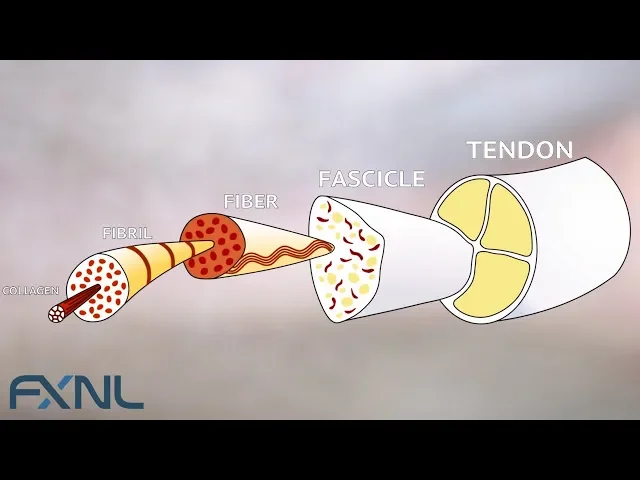
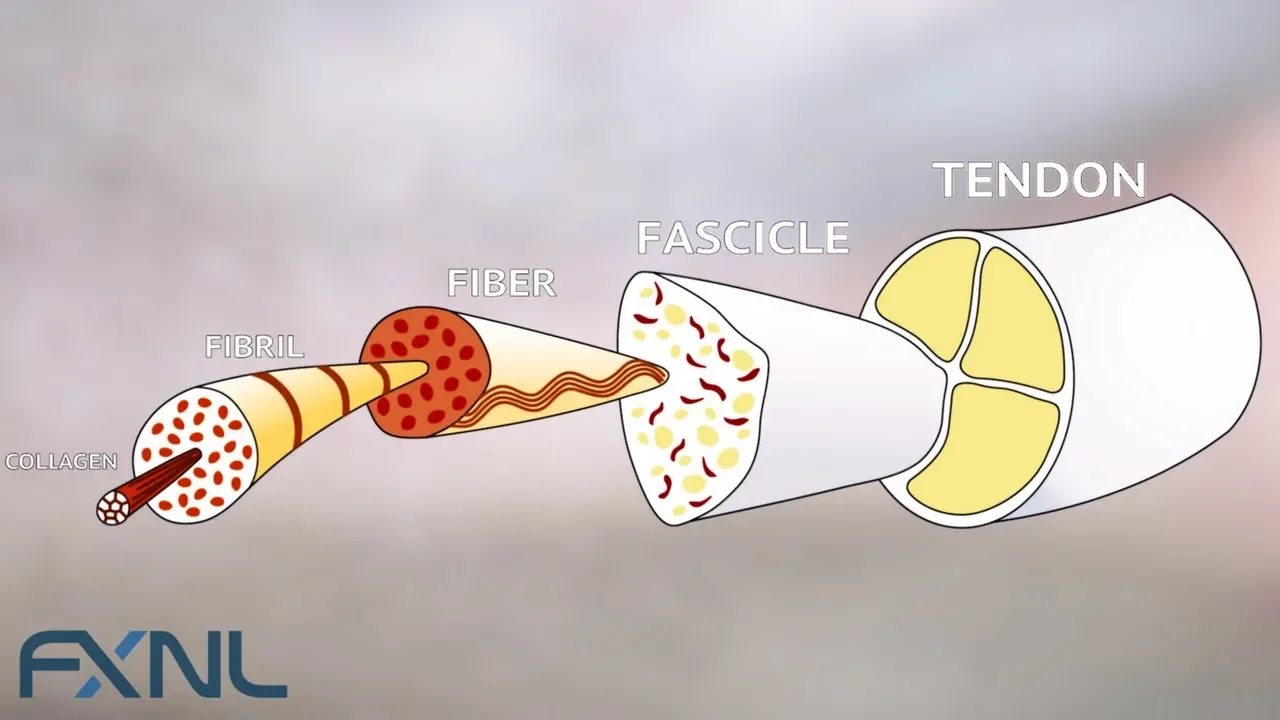
so people think of tendons as relatively simple things that just transmit the force between the muscle and the bone it's really not like that at all it's much much more complex and the most important thing that tenders do is store and release energy to allow us to propel ourselves or to be athletic with much less metabolic cost so sprinting down 100-meter track most of our propulsion forward of our car comes from the spring behavior of the Achilles now to do that a tendon has to have a really complex structure and there's some fantastic new work
by hazel screen to show that between the tendon fascicles that they slide and rotate which allows the tendon to to really literally act like a spring [Music] so there's about 10 different hypotheses from for how you develop the tendon pathology but what it appears is that there's some sort of overload that is too much for the tendon that somehow affects the normal tendon matrix and you get changes in the matrix that are progressive that eventually lead to attendant degeneration which we know pretty much can't recover it's a pretty much a at issue that will never
act like a tendon again so you can have profound pathology found a generation and you intended and have no pain so the converse is not absolutely true it's very hard to have tendon pain when you don't have pathology but you can have a lot of authority without tendon pain so what our physiotherapy intervention is our loading interventions do is change the capacity of the tendon make it tolerant to loads regardless of the pathology that takes away the pain but it actually doesn't alter the pathology very much at all we very rarely clinically image tendons anymore
really it's a clinical diagnosis and you're imaging really doesn't change very much at all in terms of how you're going to approach that tendon what we do know is it's not prognostic and it's not a great outcome measure that is what your tendon looks like at baseline doesn't give us any information about how it's going to respond to treatment neither does serial imaging of tendons actually tell us anything about the tendon recovery so you can actually be fully recovered from your pain back at your sport and your tendon can look exactly the same as it
did at baseline people are often told they have a tear or they have degeneration you'll get very frightened of those terms and unnecessarily because the reliability of imaging is relatively poor and we know that you can have the worst looking tendon on imaging and actually still have a very good outcome so what happens when you have a portfolio we develop a pathology in your tendon is you get a response in the tendon and you end up somehow and we don't know how you end up with as much normal tissue as a normal tendon so even
though you have the pathology you have a thicker tendon and most of that thickness in the tendon is comprised of good tendon structure so we explain to our patients that even though you have an area of pathology you actually have a lot of fantastic tissue that we can work with and our job to load you in as physiotherapists and with exercise is to actually get the load tolerance up of the normal part of the tendon we don't care about the pathology that much so tendons are only loaded with fast activity so maximum tendon load is
a fast eccentric load that's the energy storage part of the spring behavior that they do any low-speed activity is not going to be provocative for a tendon so someone can do slow heavy weights and actually not provoke their tendon at all and in fact it's a very good differential diagnosis sign tendons talk to you 24 hours later so what happens is if I put a load on a tendon today it will tell me tomorrow here it's been happy with the load so we educate our patients about that relationship and they very quickly learn what activities
are provocative for their tendon a very quickly learn to reduce those if somebody stops having pain when they've loaded the tendon to the maximum they want that's an indication of full recovery what you see with people is you're right they get halfway through a program and think that they were recovered go back to too much activity their pain comes back doesn't take very many times for that for them to realize in fact they actually have to put the time in to get it fully recovered and if they do that they can be pain-free or virtually
pain-free in their activity which is what became to you in the first place for you