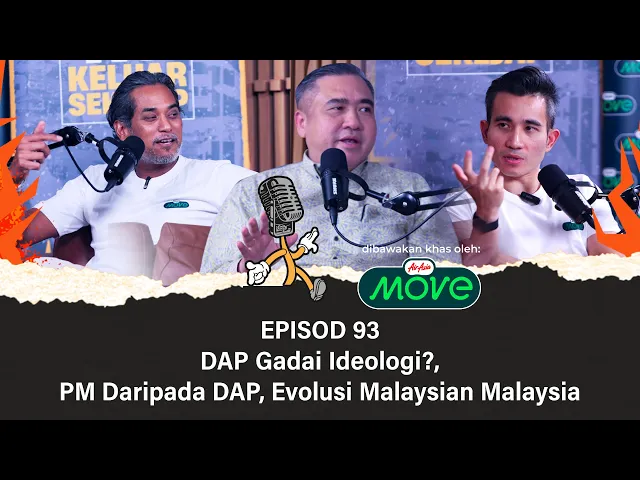
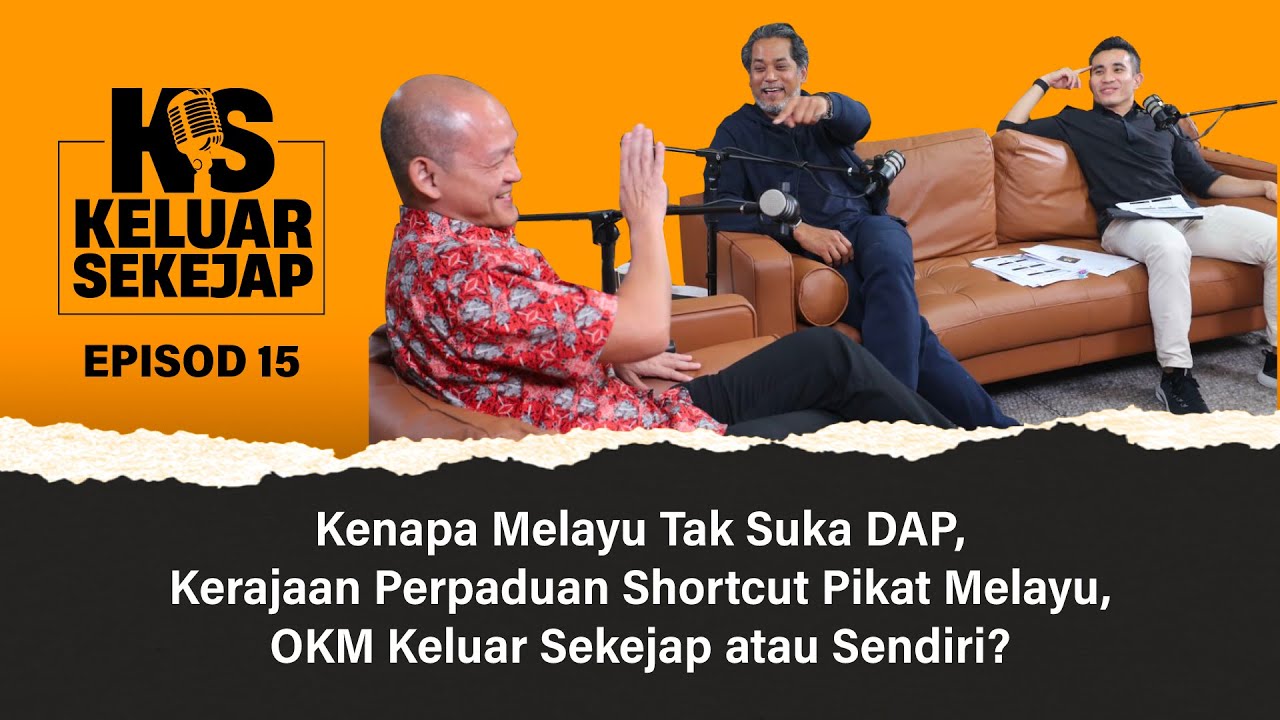
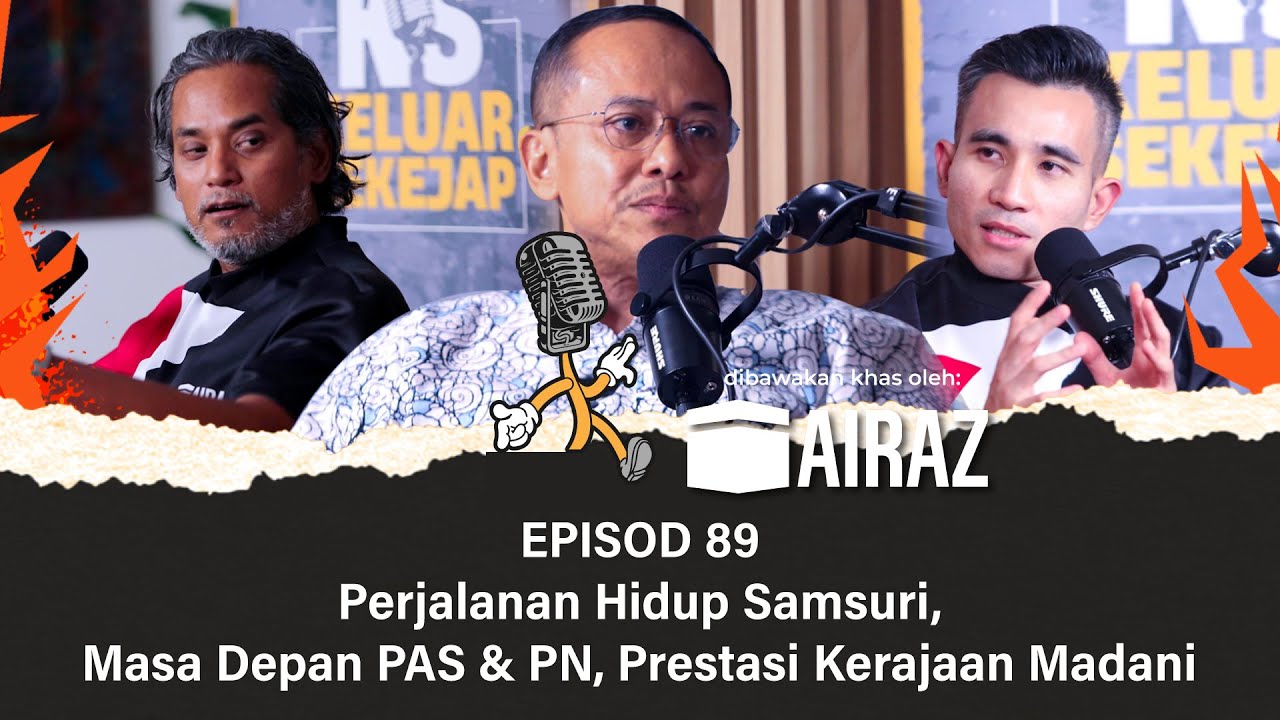
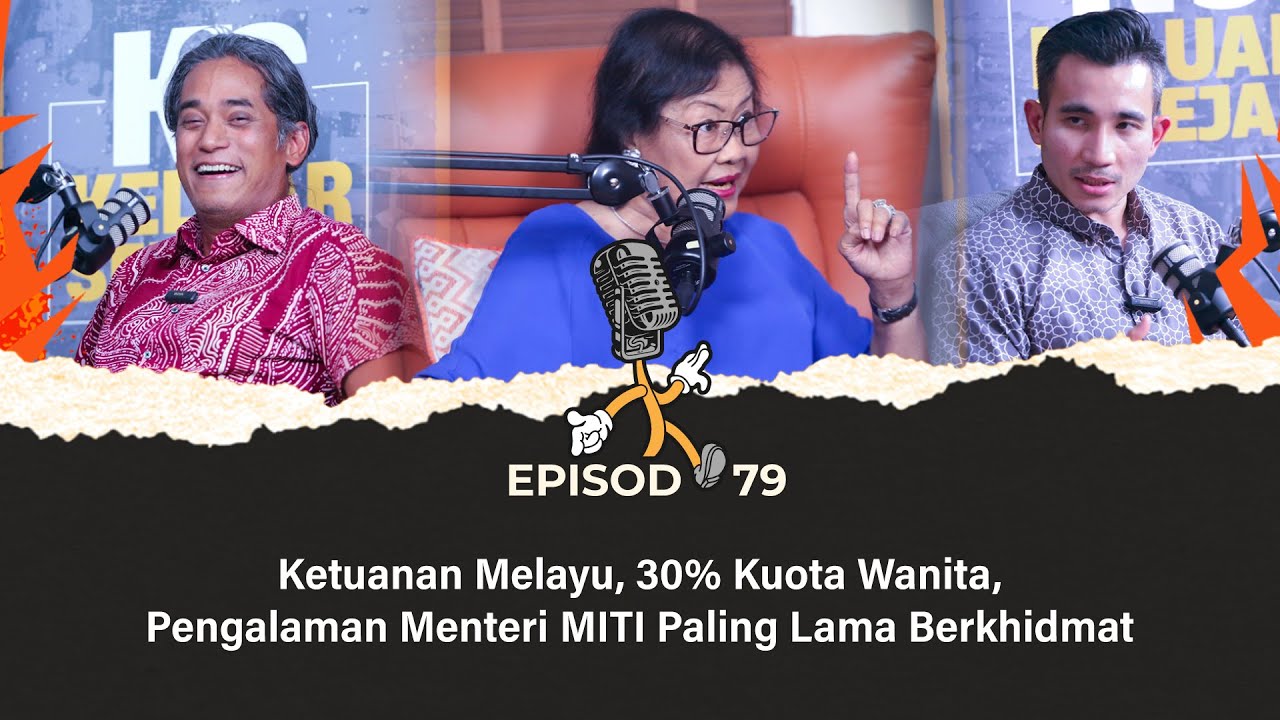
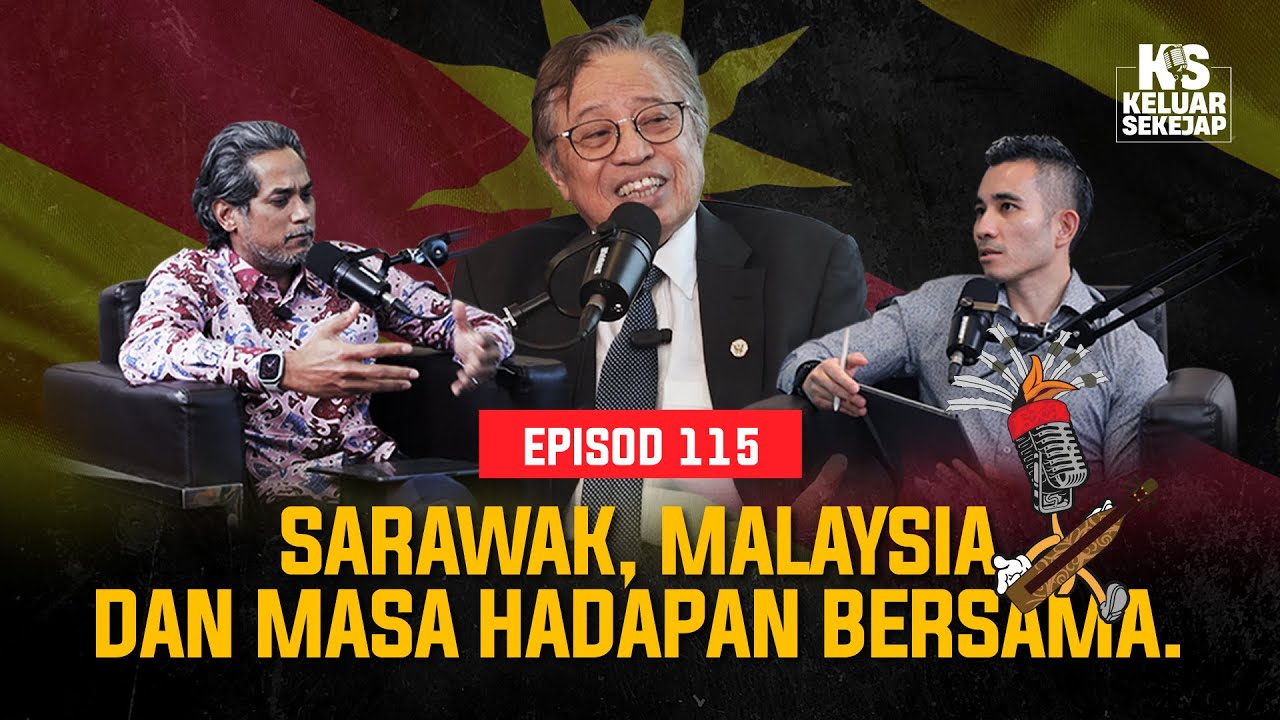
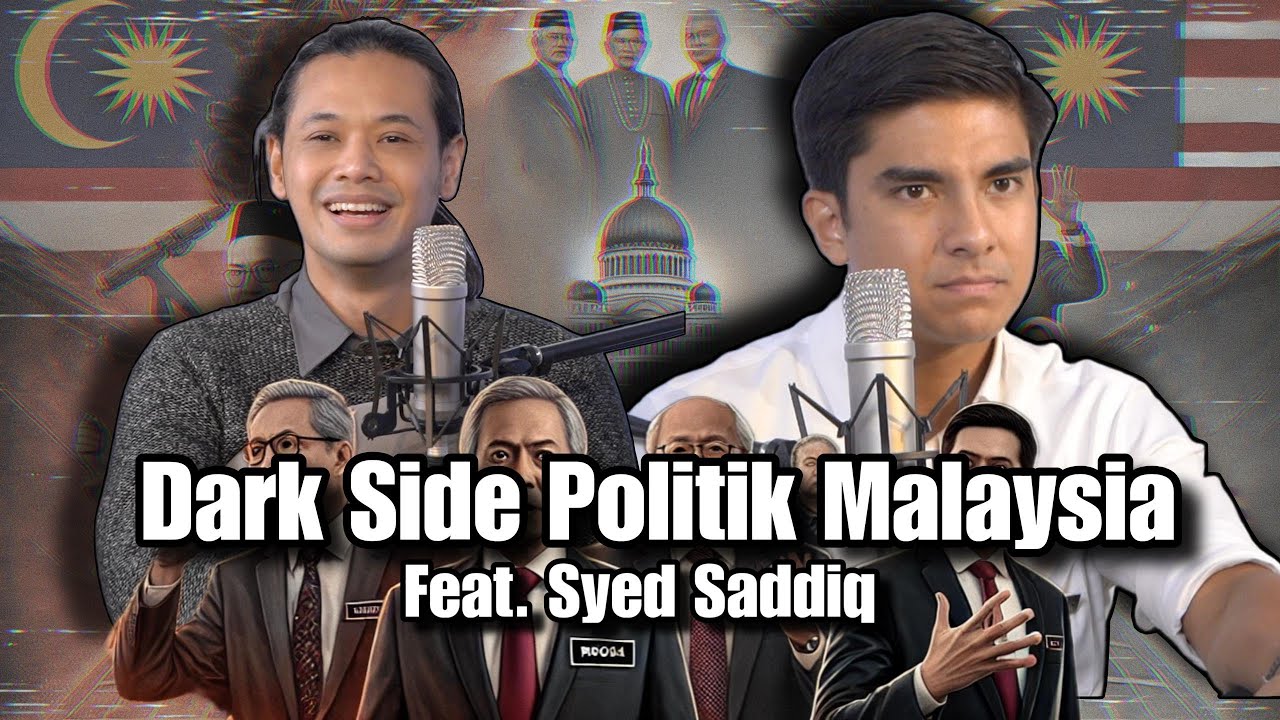
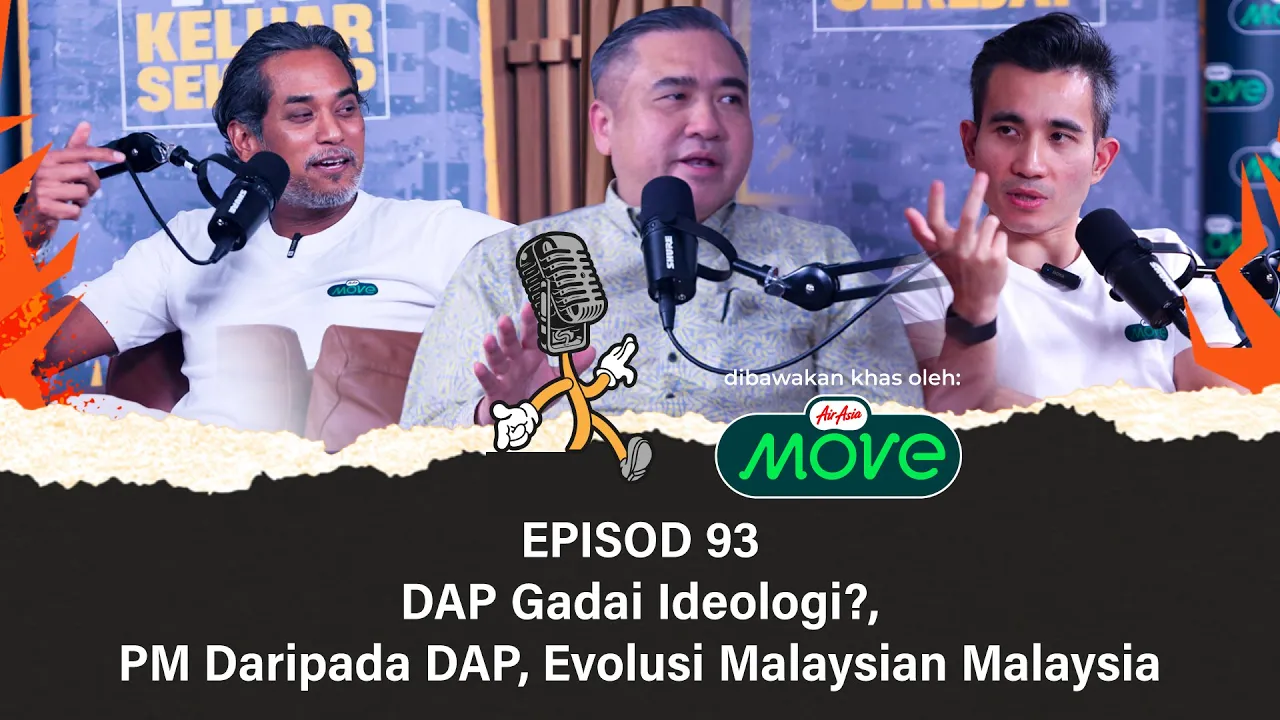
I said, yes, there is dissatisfaction on some issues. But what is our decision now? Do we now, call it a day, we quit government? Assalamualaikum and welcome to the 93rd episode, Get Out for a Moment with me KJ. I am Shahril Hamdan. Shahril, today we want to talk about transportation. Transport, everything that moves and also the ASEAN region. Things that move and also the ASEAN region. I know Shahril is a fighter for the ASEAN concept. Because Shahril believes that together we can achieve more. That's right, even though I think the ASEAN institution is sometimes me...
The institution is nothing but... The idea of ASEAN. The idea of ASEAN where almost 700 million people of ASEAN countries is a fairly large market. And if we can create a seamless, integrated market and so on. It is certain that Malaysia and also the ASEAN countries can, not just compete. But progress in the state of geopolitical tension that exists now. Yes, totally agree. And in that context I think Malaysia has a big role to play. In creating or realizing the potential of ASEAN. ASEAN chairman right? Chairman of ASEAN for the year 2025. Correct. Will be
Malaysia later for next year. But it's not just about the government. Not just state actors. But businesses. Certain companies may also be based in Malaysia. Originating in Malaysia. Can be a champion for the ASEAN region. Right, right. And we see how the ASEAN agenda is. As Shahril mentioned earlier. Not only fought by the government. Sometimes I see the government's move is a bit slow. And actually a lot of it is led by the private sector. If we look at the banking sector. Many of our private financial institutions are even GLCs. Has already become an ASEAN
company. That's right. The same is the case with transport and airline companies. Yes. And this episode is specially brought by AirAsia Move. AirAsia Move. AirAsia Move is AirAsia to Move? That's right, Move. He is moving. This AirAsia Move may be a new direction or pivot. It is an OTA. Online Travel Agent. I see. So not just airlines. Not just airlines. But capital A is the company that owns AirAsia. Now this has created AirAsia Move. Yes. Which is a complete end-to-end travel booking experience. It means that not only we can book a plane or flight. But
also the hotel and also the things we want to do at the destination. Ride hailing, insurance, shopping, everything. And it has a loyalty program. It has rewards. And also actually this is a very, for me, ingenious pivot. Because they already have I think monthly average users of 15 million. 15 million. 12 million downloads on the app itself. Right. So this is the way to drive ASEAN connectivity. And to champion Malaysia as the focal point for ASEAN. Malaysia as the hub to connect all of ASEAN. Especially with AirAsia as an airline. The airline that is one
of the keys to the idea of the hub. Many more global airlines which are also on AirAsia Move. So this AirAsia Move is not just for one company. But for other companies. Which is also involved in the experience. To experience to do the entire travel destination. It's good that AirAsia is starting this now. AirAsia Move. Because 2026 is the year to visit Malaysia. And of course we want to see more Malaysian businesses. To gain from tourism. And we have mentioned a lot about tourism. With a relatively weak ringgit. How tourism can be encouraged again. To
drive the national economy. So we will come back to AirAsia Move. Maybe after another break-up. But definitely new product. New colour. Not the usual red from AirAsia. And we hope. Many people can check it out. Download the AirAsia Move app. So talk about tourism. Is our guest today the minister of tourism? Our guest today is not the tourism minister. Definitely not. I will not invite the tourism minister. Our guest today. Minister too. Minister in charge of moving things. But we have to clarify. We have to clarify that the existence of this minister. Not at all
giving any endorsement to our sponsors today. He didn't even know the truth. We did an ambush earlier. This is a temporary sponsorship nothing to do with our guest. But by chance. Our guest is a very important person for us to have a conversation with. It's not just about the portfolio he holds. But also his big position in the party he leads. Who is that individual? That individual is none other than the boss or the secretary general. Democratic Action Party. Wow. Rocket Man. Mat Sabu said there are people who do zikr. DAP. DAP. DAP. So we
call. We call. We call the boss to DAP. DAP. DAP. Nothing else. No it's not. YB Anthony Loke. Welcome to Quick Exit, Anthony. Thank you, KJ and Shahril. I want to mention the first one. This is not a condition of my being invited. Today. It 's not a condition that I'm invited. Nothing to do with this invitation. That's up to you. Thank you for the invitation. YB Anthony Loke is the Minister of Transport of Malaysia and he is also, as I mentioned earlier, the Secretary General of DAP and also a Member of Parliament for Seremban,
Negeri Sembilan. Once upon a time a neighbor. Neighbor to a Member of Parliament who is not currently in Parliament. Shahril, why don't you kick it off? Yes. YB, thank you for coming. Wait... There is a POP Quiz. There's a POP Quiz, Anthony. YB. When did we first met? 1998. Where? At HPAIR. The Harvard Project for Asian and International Relations Conference. I will tell you about my meeting with KJ later. In 1998. Not bad. How old were you at the time? In the 20s. I am 22 years old. Oh, 22 years. Yes. YB same age? He
is younger than me. Yes. It was an international conference and was organized by students from Harvard. In Kuala Lumpur. It is called HPAIR, Harvard Project for Asian and International Relations. Kuala Lumpur was chosen that year to be the host. I happened to be active in a student club. His name is Isaac. Isaac. So Isaac is part of the Co-Host. And I joined the conference. Coincidentally, I think KJ is also an activist. It's clear that you two... You left an impression on each other, I guess. To remember... But I don't think he remembered me at that
time. Actually he... In my memory, it was a little later. I see. At an art gallery in Bangsar. I think it was the second time. I think it was the second time. Wow. All right. All right. Let's reverse first, YB. I always start an interview like this... By wanting to get to know a little bit of the individual's side... The one sitting on the KS sofa. Which may be public. Outsiders may not know much. Maybe YB can tell... What is not in the Wikipedia page. So, you know. Backstage. Grow up where. And also the experience
of growing up. The dynamics in the place where YB grew up. Your parents. Family. Take it away. Thank you. First of all, I am from Seremban. Born in Seremban. Growing up in Seremban. Even studied in Seremban. People of Negeri Sembilan. Like KJ. People of Negeri Sembilan. Indeed we are neighbors in terms of area. Before this I was in Rasa, Rembau. After that I was in Seremban. Still Rembau. Until the last general election. I think there might be something possible... ...many people don't know. Or not in Wikipedia. My family opened a restaurant. So, when I was
born. Since I was a baby. My family can't take care of me. Because they do business. So, they sent me to the nanny. I go home maybe once a week. Until I was in third grade. And when I was little. My nanny sits in a squat. So, I grew up that. My childhood, was in the squatter. That may shape my view... ...of poverty, slums and so on. Wait a minute, Anthony. Before that I want to ask about this restaurant. Some say, the Anthony family created Yee Sang. Right? I don't dare to say right or wrong.
There are people who dispute the history of who opened it. But indeed my grandfather, Popularized. Bringing this culture, in Seremban. Yes. Whether he is the first in the whole country or not, I am not sure. But in Seremban indeed. And this Lou Sang is not from China, It has a little culture from China. But brought here and created as a Malaysian culture. So now in China it doesn't exist. If you go to Beijing, there is no Lou Sang. In Malaysia, only Kuala Lumpur available. Yes. And that becomes a culture. That was popularize by your family
right? Okay, my grandfather. I studied at St Paul's School. Up to the fifth grade. Then entered SMK Seri Ampangan. Study STPM. Studied the national curriculum. Then entered UKM. Universiti Kebangsaan Malaysia. Study in Developmental Science. Until I graduated, in 2000. That's a little background. And YB knew from the beginning that YB would become a politician. Know that YB will be Rocketman. Or that thing comes a little late in life? I, political awareness started quite early. I think in maybe third grade, fourth grade, I started to have a little bit of an image of politics. Because my
nanny's husband is a DAP member. And my father is also a supporter. And also take me to lectures and so on. So, it's a bit of an image of politics. And since I was in school, I like to read current issues. So, read newspapers, read magazines. All political issues, current issues. So, I think that from a very young age, I started to have an interest in political issues. YB, one thing that may not be in Wikipedia. It's not like Wikipedia is an authentic thing sometimes. However, before becoming a representative, YB was on duty as a
SecGen. SecGen to YB Lim Kit Siang. No, Kirk. Sorry, Kirk Kim Hock. So, YB already has experience in the DAP party as an activist. Did YB directly from university degree, directly entered as a political activist or stopped at any business to do something else? No, actually after I graduated, I opened a company. Internet. Oh. Want to be an internet entrepreneur, so to speak. But, internet boom became internet gone. So, at that time, in more than one year the company was closed. I see. So, after that I want to look in which direction. Do not know
what to do. So, it just so happened that I have a friend at DAP Headquarters. I said, can I join as a full-time staff? With the intention that if possible, the next election, I want to be a candidate. So, indeed at that time, DAP lacked young people. Young people just graduated, want to enter. It was welcomed because the party was quite weak at that time. Not many young people. And anyone who has a degree, has a university background, is welcome. So, I went to the DAP headquarters at that time as a staff member. Staff to
the Headquarters and political secretary to the secretary general at that time. So, about 2 years. And when did it become clear to YB that YB really wanted to be a frontline politician? Quite soon after that? Yes, I think quite soon after that. After I moved to the Headquarters, and indeed at that time, for DAP, if you want to hire full-time staff, as an assistants. With the intention that it will indeed be highlighted as a candidate. Because for us, this is one of the ways to build up a candidate. And I chose to go back to
Negeri Sembilan. Because Negeri Sembilan was one of the weakest states in DAP at that time. In 1999, we lost all. There is not a single seat, all are lost. So, the organization is very weak and there is no new talent. And I chose to go back to my hometown. If I want to be a representative, I want to choose my hometown area. The late Kirk Kim Hock. Is he educated like YB, is he Chinese educated? He is Chinese educated. He is Chinese educated but he studied at Monash. Okay, but he's from a Chinese school. So,
I want to take it there. Maybe YB is the first DAP secretary general to go through the national stream. Because if Guan Eng, he is English educated. If I'm not mistaken. Kerk Kim Hock, he is Chinese educated. YB, maybe the first. Which goes through the national stream. SK, SK, SMK, STPM. Because many people praise YB. Among other things in terms of eloquence In the national language. Is YB's worldview, Anthony, a little different? Because of the national school background. I'm a little weird. My family is traditionally Chinese. So, coming from a very traditional Chinese background. All
my siblings from my parents, my brother, my sister, are all Chinese educated. I was the only one sent to missionary school at that time. So, at the time of course, it was thought that it was English educated. English school. But when I entered primary school, It became a national school. National stream. So, I do follow the national stream. Never studied Chinese school. I picked up Mandarin after I became a representative. Oh really? Yes, I can't speak, I'm not fluent in Mandarin until I become a representative. After becoming a representative of the Chinese people, you have
to go to associations, you have to go to school, sometimes you want to give a speech in Mandarin. So, I went to take tuition with a teacher to learn Mandarin. So, now I can speak fluently in Mandarin. Not from school, but through tuition. So, if you say my worldview is different, maybe the background is, as I said, background of education. And my view or my understanding of current issues was greatly influenced by the mass media at that time, if I watched TV, TV3, Buletin Utama, Majalah 3, Berita dunia RTM1, read Utusan Melayu newspaper, Berita Harian.
So, these are among the media that I read, my reading materials, Dewan Masyarakat and so on. So, perhaps in terms of understanding the issues that may be close to the Malay community, I also read. And maybe from the beginning, I already have a little understanding. And YB's association with multiracial friends, maybe more? Because you went to national school? Not really, because at that time, When I was in primary school, even in the national school, but it was a missionary school. There were also many Chinese students at that time. Seremban. In my class, maybe in only
2-3, my friends are Malay. Many of the Malay friends that I may have were during my time at UKM. So, UKM because most of them are Malay. The faculty is mostly Malay. And I am also involved in student activism. So, there are also mixed with groups of Malay students. And close to UMNO at that time. Isn't YB's experience and also perception Anthony Loke as a DAP leader who is very friendly with all communities. And I think even the Malays have no problem With YB, with Anthony. Isn't that proof that we need to prioritize the national
stream in terms of education? Because YB yourself, you are the proof. I have been asked this question many times. I don't think it's the only factor. It is also mostly in terms of understanding or personality in terms of our environment. We cannot generalize and say that from vernacular schools, they are not friendly. Or they doesn't mix with other people. Or they'll be not so well-rounded or will be accepted by the community of various races from the people. We also see that many politicians may be from a vernacular background, they are also accepted by the general
public. Including from the Malays. So, I think we cannot generalize. We cannot take a general statement that we must follow this stream to get this product or to become something like this. So, I think a lot is our own awareness. And also our understanding and our desire for how to contribute to our society. I agree, we cannot generalize, take a general attitude towards the issue. But the tendency when you have socialized a lot from the beginning compared to people who may not have the opportunity or chance to socialize maybe because he went to a vernacular
school or he went to a religious school, for Muslims and after that maybe... I always make a comparison there is a teenager that after he finished religious school, he went to the Middle East, he did not meet peers from the Chinese community, There is also a Chinese teenager who just finished Chinese Independent High School, he went to Taiwan, their tendency is more difficult for them to understand the worldview than we cannot generalize, but when we get along from the beginning we do see that it is the tendency that there may be a few contributing factors
to such a situation but we inherit an education system that is already _ so that is something that I think, if we want to say that is the reason that national unity cannot be achieved so I think there will be no end so I think for us to move forward the important thing is that the first thing we accept is the fact that we have these various streams history from the formation of our country until now And how can we bring these various streams to understand each other other so I think that integration is very
important yes for sure and we will discuss later maybe in the next segment how we can further increase the meeting point between all the races in Malaysia because I agree, we may not want to change the existing education system this multi-stream but how can we increase the touch points and coming back to the scene setting yes, I think it has been a good first segment for us to get to know YB a little bit more and like KJ said maybe we will return to the topics regarding DAP in relation to politics, maybe expand a little
on what YB said earlier about multi-stream schools, does Malaysia need to just accept the fact of legacy or do we have to dare to make changes because I may come from perspective that Yes, this multi-stream system is a legacy that we inherit, that we inherit but that is not necessarily a reason to forever not want to change and maybe that is the theme of compromise, between compromise and idealism that we might want to touch on later KJ yes, before we break and we want to summarize the segment of your background, YB, I want to ask
you a basic question earlier, YB mentioned that after UKM there are friends, friends who have contacts in the DAP Head Office and so on, but I don't think that is why YB chose DAP, YB may have graduated in the late 90s, 2000 so in the homeland at the time, reform is getting at the peak, the question is why DAP? Why not MCA? why not Gerakan? may be laughing because looks at MCA, their fate now, but at that time MCA was top, at that time I joined DAP, I was active in DAP when DAP was at
its Worst, weakest state, not many members, not many seats, no strength that when I became active, but my involvement in DAP or my interest in DAP was formed early on. Like I said, my childhood, that environment, there was a DAP branch in the squatters, so maybe that had a little influence on me. regarding my choice of DAP, I became a DAP member at the age of 17, not after I graduated, I have finished SPM, legally old enough to be a party member, I joined as a party member but why? The question is why? there are
DAP people there is one thing, but why DAP? Does Anthony believe in DAP's struggle? Is it malaysian malaysian? Is there a vision where we see the Malaysian Malaysia and is it because I think the value that may shape my interest is in terms of DAP's image, bringing the value of justice fighting for justice, fighting for the oppressed if there is any issue of the oppressed then DAP is in front so you are standing with those who are being bullied that's the perception the perception that may shape my interest and also my ideology towards DAP so
it's a matter of social justice, that's what made YB choose from childhood, in my school days so already synonymous with the rocket logo, So I have a friend who supports BN, we will fight, I bring a rocket poster, he brings a scale poster, so we fight in class, sometimes that way, but that has shaped my interest and also my perception of the party so it have never been crossed in my mind to enter MCA, never even at the university, we know that the student group is more pro MCA, I deliberately do not want to enter
that group because I know that they are pro MCA, sorry KJ, if I can ask a question that is a little opposite from what KJ said why DAP, that's KJ's question, but why not BN? what did YB not like about BN at that time? Is it Mahathir, with such an administration, that keeps YB away from MCA and BN? no, I think the factor is MCA I don't like MCA, Not that I don't like BN, I don't like MCA what do you think of MCA? image MCA that they don't care about the interests of the people,
especially the Chinese community, I mean that perception it's a taukeh party, a party that is only for the rich, people in positions and so on, so the perception, I'm not saying it's right or wrong, but that's the perception because now that is a perception and I have said it many times, in my life I never thought of joining MCA that never crossed my mind when I was in university, when I left university even though DAP, Headquarters paid me a salary, not even RM2000 Graduate , not enough to eat to work in the DAP Headquarters but
never intended to join MCA at that time even though MCA at that time was at the top they had many seats in parliament, there were many ministers, deputy ministers and so on okay, we will take a break for a while and back together with YB Anthony Loke, Minister of Transport, DAP Secretary General and Seremban Member of Parliament Welcome back to episode 93 Keluar Sekejap Sponsored by AirAsia Move KJ, when KJ wants to make a booking to go anywhere In the past KJ was a minister, might have an officer to do it right? Now KJ has
nothing, you did it yourself right? Will KJ go to any website, google directly or do one by one? Hotel go to the hotel website, flight go to the flight website or how was it? I do it separately and I am interested if there is a one stop There is an online travel agent that can do everything according to my wishes Because there is a website that says it can do everything But I don't know if I feel dissatisfied Or I doubted their service I think, I understand what KJ is doing So I aggregated myself You
don't fully trust that the platform really captures the whole But what we have at the moment with AirAsia Move is Maybe they didn't do it for the whole world But they did it for ASEAN region They can give options for flights from 700 global carriers So actually, there is a global angle to this 700 airlines, 900,000 hotels, ride-hailing, insurance, duty-free shopping So it's really an ecosystem that has an existence that very, very extensive From a suitable or necessary service provider For anyone who is traveling We continue And there may be other questions We can ask
regarding the role of online travel agent To help seamless travel in ASEAN We can ask the minister of transport himself Those who are in the KS studio today. Earlier we discussed a little about the background of YB Anthony Loke Who I've known for more than 20 years now It's been a long time Clearly you've succeeded in politics and I have not So maybe we want to talk about your ministry and your brief. I think it's fair for us to conclude that when we ask people, who are the performing ministers, who are the effective ministers, I
think YB Anthony is in the top 3. Anthony Loke is there because he has experience. as transport minister during Mahathir's time I think many people recognize YB's competence as transport minister Maybe YB Because there is a lot of this transport Public transport YB is also the regulator for all other modes of transport Like aviation, shipping, etc. So maybe YB wants to tell a little bit What is the biggest challenge faced as a transport minister? Because this transport, Before I was kicked out when I lost. I was the minister of health. Ministers that reveived the most
highlight were health, education and transport because it affects everybody's life So maybe YB wants to talk a little about transport This transport includes many and many operational issues Why there many complaints or close to the heart or the people because it has many operational issues From us moving from one place to another, to other places I received complaints in various ways Someone texted me, saying the toilet near the KTM station is not working That's also want to text me He also complained to me Operational issues Toilets near the clinic biggest issue among them is the
expensive flight tickets During festival season, expensive Back to Sabah-Sarawak thousands of ringgit That's a common complaint every festive season and also the issue of public transport Buses not arriving, late buses, late trains LRT Card, full pack of people and so on So these are all issues related to the effectiveness of our system And also what causes the people's lives to be affected But there are another aspect that I think is very important in transport Apart from service to the people, mobility services It is in terms of the role of transport in the economy The reason
our economy moves is only possible with efficient transport Because of our exports and imports, if there is no transport You cannot have exports import Port, a major factor to our economy Airport If there is no efficient airport Or if our airport is not of international standard Then it will affect our country's economy In terms of tourism, you need to have connectivity You need to have a lot of flights coming into our country Then only you can boost tourism So everything is related to the economy That's what I see that the role of transport Especially the
ministry of transport It is an economic enabler If we don't function well Or we don't have a good policy and also regulations and also a legal framework Then it will affect the entire ecosystem our country's economy YB mentioned earlier about facilitating or enabling the economy Economic development And YB give an example about the airport If we can go straight there YB Because recently there was a website businessfinancing.co.uk I didn't even know this website had credibility or not But this website has already said that KLIA is the 8th worst or worst airport in Asia And not
many people dispute that ranking Or even that ranking Because it is felt by anyone who has been to several airports in this region That KLIA seems - it is an old building and also an airport which does not provide the same comfort as perhaps our neighbors YB yourself said this is the gateway for many tourism and economic activities YB, why do KLIA and KLIA 2 get so many complaints from people? The first thing is that I don't want to feel defensive Or even defensive. But we have to look at the survey. The first thing is
that it relates to business travelers. So that's the first thing. Credibility, in terms of methodology, we don't know. For airport rankings, we look at Skytrax, which is a body that more credible in terms of airport ranking Indeed we have gone down in terms of our ranking KLIA used to be number 2 in the whole world At least in Asia this is one of the best, the airport But over the years, it has been 26 years now There are systems that outdated. There's no good maintenance and so on. Among them, the aerotrain is broken. You can't
move between the main terminal and the satellite. You have to use the bus. Our baggage handling system is currently being upgraded. You have to wait a long time after the flight lands to pick up the luggage. You need to wait up to 1 hour I do admit that there is a weakness in our system that needs to be improved MHB is improving it They are currently carrying out upgrading works And in terms of look and feel Actually our building is not a bad building If we look back this KLIA is one of the most sophisticated
airport buildings In 1998 At that time So it's not in terms of the building that it's not beautiful and so on. It's just in terms of the system and also in terms of the efficiency of the airport. It does need to be improved. We do admit that there are many improvements that need to be made. And in terms of the airport as well. It's also related to how we move passengers. So the movement of passengers When going through immigration, through customs Baggage handling system Check-in, boarding and so on All of that needs to be faster
So it's a process that Where airports and airlines need to work Need to work together To increase the level of digitization to be better So that we can use Various digital software To solve our problems So that's what we need to focus on In terms of KLIA Terminal 2 Terminal 2 is actually not too bad In terms of the building It is indeed there Far, far YB now We are ordinary people I also use AirAsia I also use low cost airline also I know that it is true In terms of the distance But that was
built During the year 2014-2015 Airport design is indeed One of the most complained about Airlines that also complain That it is far and so on But that has already been built So what we can do is how to improve the system So I think the most important thing we need to focus on right now is to Make sure that the aerotrain can function again And I have put pressure on MHB Aerotrain, the baggage handling system The look and feel about the airport And also the environment around the airport Just a bit on aerotrain. Why 2
YB year? People don't understand, people don't understand. They think it can be fixed, it can be solve tomorrow. They changed the whole system. So, the train was indeed decommissioned. Train set? Train set decommissioned. And when we change the train set, it's not just changing the train set. It had to change the system, electrification. And also the structure has to be improved and so on. So, that takes about more than a year. Anthony, I want to ask a little because maybe some people don't understand. I sympathize with YB because everyone complains to YB. But they don't
realize the transport minister has no operational control over many of these transport assets. For example, the airport. Airports are not a government department under the ministry of transport. It is a company, yes okay that company is a GLC company. However, everything must go through the company. If you want to make CAPEX or infrastructure expenses, you must go through MHB. YB is the minister who regulates, who takes care. So, maybe YB wants to tell a little about frustration when receiving all these complaints. Because you have to go through MHB. Yes, that's what I said. Sometimes I
say, this MHB has to work with me. The one who took the bullet is me. Because whatever the issue is, people will not complain to the CEO or the management or the board of directors of MHB. They complained to the transport minister. The one who answer in the parliament is me, the minister of transport. But it is true, in terms of operations, it is under the company. But there are also bodies or companies directly under the Ministry of Transport in terms of operations, such as Prasarana. I can't run away from that. Prasarana is under the
Ministry of Transport. airport does have a system where we appoint operators through an operating agreement. Many do not know that, for example the PSC concept. Many do not know what PSC is. People say this is the airport tax. Airport tax collected by the government. Nope. PSC means passenger service charge. It's a charge, not a tax, not a tax. It is paid to the airport operator. Because without that charge, they cannot operate. The source of revenue for airport operators is PSC. The most important, the biggest. And also aeronautical charges and also rent shops and so on.
So KLIA has gone up from RM35 to RM73 if I'm not mistaken for ASEAN. Has MHB told YB Anthony what they want to spend with the increased income? The first one is aerotrain spent by MHB in terms of the whole project. Baggage handling system is indeed spent by MHB. It is not by the government because in terms of software, the system software is the responsibility of MHB. And recently we have already signed a new operating agreement. Have already discussed many times in the cabinet. Finally we have finalized the new OA with MHB. Which gives flexibility
to MHB to invest in CAPEX. But we have an approach where they have an investment recovery model. Where if they invest CAPEX in say, to enlarge the airport. They have invested so much in the cost. So over time we will probably reduce the user fee to the government. Because of our concept of appointing MHB as this operator, the assets are still owned by the government. This is why many people do not understand that we privatize. Yes indeed in terms of operation, it is private. But that asset, the airport is indeed a government asset. But we
don't operate, we don't have government officials going to operate the airport. It used to be under DCA... before we have Malaysian Airports. So that model we do allow the private sector or in this case, the GLC to operate and they get revenue. And part of that is returned to the government in terms of user fees. So now we say, CAPEX MHB can spend. Let's say there is now a Penang airport expansion project. The funds are not from the government. It is not through DE. It through MHB's internal fund. So over time they collect PSC and
also reduce the user fee to the government for them to recoup their investment. YB, just want to wrap up the issue of the aviation sector before we go to land transport which may also have very hot issues. First, will the merger between MAVCOM and CAM continue so that this regulatory body is one. Because recently we were surprised by an issue regarding an airline company that has passed in terms of all its licensing. But finally closed down because there is no financial strength. And maybe there is a little weakness in terms of monitoring from the regulatory
body. Yes, that direction will continue. We will combine CAM with Mavcom. Among the reasons, we see that most of our neighboring countries only have single regulator. In terms of technical and also in terms of economic regulators. So MAVCOM is an economic regulator. CAM, is a technical regulator. So all over the world, the aviation authority is of course the Civil Aviation Authority. So we combined MAVCOM with CAM, but the role of MAVCOM remains there. It's just that it will be below the CAM, so let's enlarge the CAM. And this MAVCOM from its inception, it has been
a separate statutory body. So MAVCOM was independent before. It does not need government funds because it collects 1 ringgit from each passenger. Regulatory fee. Every time you use the airport or take a flight, you will give a ringgit to MAVCOM. So MAVCOM is independent on that. As for CAM, although it has been incorporated as a statutory body, it has not yet been completely separated. So the payscale, it is still subject to the government's payscale. So that is one of the reasons why at one point, we were downgraded by FAA from Category 1 to Category 2.
One of the reasons is that this CAM does not have a strong financial source to appoint experienced technicians or assessors to be their regulators. So when will this merger... This merger we expect this year, will be merged. And after merging, then it will become one bigger entity. There are two functions in one body. And we expect that this will lead to a higher efficiency for airlines. Last thing about the flight from me. That is, we always hear feedback and complaints from people, especially those who are used to traveling. Which says that there is not much
connectivity in our country. And we have various airlines, we have of course our flight carrier, but we have AirAsia, we have Batik Air and so on. What is YB's view regarding Efforts to improve connectivity and also the role of these so-called low cost companies, not the flight carrier but the other airlines. It is certain that they also have a role to increase connectivity. One reason why tourism may not take off is flight connectivity. But to be fair to our airlines, especially low cost airlines and so on. Our connectivity in Asia is very good. In the
Asian region, it is very good, from terminal 2 in particular. And the connectivity that we lack, especially from our carrier, is to Europe. Europe is very lacking in terms of flights. None to America. So, we only focus more on the regional. That may be our weakness that we need to improve. And that is also one of the factors that we are looking at how we want to attract more airlines back to Kuala Lumpur. For example Lufthansa, they have stopped. British Airways stopped. So, we want to pull back these airlines to return to land in Kuala
Lumpur and fly from Kuala Lumpur. But there is indeed an increase and I am sure that in the next year or two there will be more airlines that will return. Are they interested? BA has announced that they will return. But are they interested in coming back to Kuala Lumpur? There is indeed a willingness to return to KLIA. Including Lufthansa. And we really hope they will come back so that our connectivity to Europe will be better. Now this is because the competition is very great. Because most people go to Europe for example. They use companies from
the Middle East that have a lot of options and in terms of prices are quite competitive. But how can Malaysia improve our position as a hub for ASEAN? Okay they come from Europe, come here. But Malaysia, KLIA, maybe KLIA 2 is known around the world as the hub in ASEAN. We actually have some advantages. Especially in the low cost segment. I frankly said that AirAsia and Batik Air have.. MAS also has good connectivity with our region. For example Batik Air, Batik Air is based in Indonesia. It also has many networks in Indonesia. But KLIA is
an important hub for Batik Air as well. So it also brings many passengers to KLIA. One segment that we may not see enough is Batik Air, with its extensive network in Indonesia, it brings many passengers from Indonesia to KLIA. For example for Umrah packages. Many Indonesians use KLIA as a hub to go to Umrah or Hajj. So this is one of the segments that we want to see how we want to develop. So that Malaysia that has a good relationship with Saudi Arabia as well, we hope we can also become a center or a hub
for Umrah and Hajj, especially during the Hajj season. Okay, maybe want to go to another transport. So, land transport in brief, we want to ask about P-Hailing. P-Hailing, E-Hailing. We know that it is always a political issue because there are parties who will champion the rights and interests of those who are active in the gig economy. Perhaps YB can tell after the legal regulation that has been made about E-Hailing, PSV license and so on. What is the government's plan for P-Hailing? Are there any plans to make it a new legislation? In terms of the law,
it already exists, we have passed it in Parliament. It's just that when you want to control it, when you want to start the rule, it hasn't been finalized yet. But what we see is the first pushback before. that they feel that if these riders have to be controlled, they will go through many processes, costs and so on. So what we see is to make it easy, as easy as possible for them. What is important is that we want to have a control framework ready. So that the first one, it has insurance coverage, there is coverage
in terms of SOCSO and so on. That's what we want to see. And so that the database is on the list of regulatory agencies as well. And so that any industry we want them to operate Under a legal framework. But we understand that these gig workers do not want too much control or too many rules that will cause their costs to increase and so on. We understand that and we try to make it as easy as possible. How to get this PSV, now YB is proposing to do it online. Have you started yet? Indeed, we
have simplified a lot. The first one was last year, after I returned to the Ministry of Transport, among the big changes I made after discussing with the officials. Is that we facilitate PSV. Now PSV doesn't have a test. There used to be a test. Written test. So now just sit in class. Six hours, listen to a talk, then immediately get a PSV license. We want to make that even easier, we want to do it online. Not yet? That is being integrated now. Okay. YB, there are actually many issues but I want to go to the
hot issues. HSR. Yes or no? To me, yes. For me, this is an important project. Which may be an economic changer for our country. And I see no reason why we want to reject this project. If it can meet some principles that have been outlined by the government. The first one, not a government led project. So it must be private sector. So we want the private sector to put their capital and you carry out the project. Land acquisition, land acquisition, will the government help? Land acquisition is being discussed. I don't think we've gotten there yet.
Because yes, the private operators say that if they handle everything, YB also knows the argument, it is not feasible. There are some aspects they will ask the government to help. For example, land acquisition. That is something that is not a deal breaker. Let's say they say they need the government for land acquisition. For me, that's something that can be discussed. And if in terms of value or cost, it does not burden the government, this is something that may be considered. But a project as big as the HSR is not just a matter of the Minister
of Transport's decision. It has to take it to the Cabinet to be decided. But from my perspective as the Minister of Transport, I don't see any reason why we can't have this project. If it can be implemented by the private sector through concessions. If our highways can be build through concessions, HSR may also be able to use the same concept through concessions. They operate, they build, operate and transfer. I want to discuss a little detail about this HSR to YB. If we look at the model that was proposed before, which has been canceled and maybe
the one that wants to be revived, it is a new line. What is the view of the Ministry of Transport if using the existing line? Because of the existing line. In Malaysia, if the KTM line is meter gauge. and if this is HSR, it will use standard gauge, a little wider. Is it possible to be more cost effective if it is made dual gauge and can be built or expanded on the existing track? Is that possible that could lower the cost? But first, this existing line, it is not the shortest line. It is from Johor
and went up to Segamat first. After that, Segamat to Gemas. Via Gemas, go up to Negeri Sembilan. So the range may not be the closest or the fastest. And the second, when a new project, it also wants to lead to development, especially to new areas. Because most of the line that KTM is going through now, it is the old line. There are already existing cities. But the new line of HSR may want to look at new areas that can be explored. Because that is also one of the important development models. Because when there is a
new station in an open area, a large area, It can become a transit oriented development area. Which is also an investment value or return value to the project proponent. So I think in terms of the lineup it is not a big problem to have a new lineup. I don't think it makes much difference. Because if you use the old line, there are also many challenges. Because in terms of maybe the area is not big enough and so on. As KJ said, if HSR, must be a dedicated lane. It cannot be used together with lane track
by KTMB. It must have its own dedicated lane. Because the speed is very different. still about the line-up before maybe Shahril wants to go into another topic. Recently there was an interview in the news. His Majesty at that time the Sultan of Johor, now he is YDPA, Sultan Ibrahim, gave a suggestion, his wish, that the HSR line, if, if this HSR is revived, can pass through an area in Johor known as Forest City. Is that something being looked at? First of all, we are currently evaluating proposals from proponents or some companies that have submitted proposal
papers. We have not finalized yet in terms of lineup. The line to go through which area and so on, has not yet been finalized. But of course, this HSR area or route must also pass through strategic areas. Forest City is one of the areas, whether you like it or not, there are thousands of residential units nearby. And Forest City has indeed been placed as one of the special financial zones in Johor Bahru. And one of the things we want to see is the Johor-Singapore Special Economic Zone which also includes the nearby area. So, in terms
of its range, it must capture these areas. But, we have not reached a final decision, it must go through, where, and so on. So, that's my answer. YB, one of the reasons why HSR was originally terminated was because Malaysia under the government at that time did not agree with the division of company assets between Malaysia and Singapore. Will this now be renegotiated so that it weighs more on Malaysia or is it still 50-50? We can get more. Because they are only 10%. I think KJ in this chapter, he is very wise. Because of the timing
of the HSR decision, KJ Minister. When it was cancelled, KJ Minister. I am in the middle of that. I was not there when the decision was made and the decision was terminated, I was out of government. But for me, now there is a fresh negotiation. The contract has expired. Compensation has also been paid to Singapore. 100 million SGD. We have already paid 300 million ringgit to Singapore because we canceled the contract. So we are negotiating now a new chapter. So the new chapter has to look at the new model. So the old model for me,
it's not relevant anymore. So we don't need to say that we want to go back to the old model. So we want to bring a new approach where for me, which should be in terms of the assets, the control must be in our hands, in terms of the assets. So let me give an example, such as a project that I was involved in in terms of renegotiation. RTS Link in Johor Bahru. RTS Link is based on the concept where the Malaysian part is built by Malaysia, the Singapore part is built by Singapore. So we join
in the middle. But in terms of operations, there is a joint venture between Malaysia and Singapore. Opco joint venture. So maybe, maybe I say, among the models that can be seen or that we can think about, is for example how we operate RTS. That is one of the suggestions that may be thrown. Okay, maybe a few, one or two more, from me. Just to wrap the segment up. Maybe rapid questions, YB. First, we have heard the announcement regarding the Penang LRT, Mutiara route. Congratulations. A good announcement because I think, push aside the question of political
issues and so on. But Penang is indeed a place in need and we are looking forward to the details regarding the route. What are the plans for other cities? Another example, not because we mentioned HSR earlier. For example, for example, Johor Bahru. Been asking for a long time. They used to look at the BRT system, which is bus rapid transit. Now this is another order from Ke Bawah Duli Sultan, he wants LRT. So, is that also in the planning? reason for this is CAPEX. CAPEX must come from the government. Indeed we are looking at it
too, one of the main cities we are looking at is Johor Bahru. Because, Johor Bahru has a very urgent situation. Because this RTS will be completed in 2026. And will be operational in 2027. Three years from now. How is it dispersed? In terms of dispersion in Johor Bahru that is very important. So, we want to see an approach where a fast transit system can be implemented within three years. Whether the combination of BRT with other systems, that is being studied. And indeed decisions need to be made this year as well. Maybe in the next few
months. There should be a policy decision from the Federal government. And this project is urgent. And I agree that Johor Bahru needs a transit system. But in what form, whether LRT or BRT, some people say ART now. Instead of just BRT with LRT, there is a third option. ART can also be considered. So, we are looking and indeed there are some presentations to be made. And in a little while, we will go to the cabinet to make a decision. So, will there be two good news for the state of Johor? Johor is not two good
news. Lots of good news for Johor. Because Johor is indeed one of the states that is seen as an economic front line state. Because its geographical position is close to Singapore. And the spillover from various sectors now is very good. There are many data centers in Johor. A lot of logistics go into Johor. And with it having RTS link integration and so on, Johor will indeed progress economically. Last from me, YB. In the Klang Valley, most Malaysians in the Peninsula all work or have migrated to the Klang Valley. But public transportation is still at an
unsatisfactory level. And one of these problems is the last mile. So, Minister of Transport, once and for all, what is the answer to this last mile? There is no answer that can be said to solve all problems, KJ. I think KJ also knows as someone who has served in the government. This last mile is not that there are no options, there are many options. But of course there is a cost. for example, e-hailing is one of the last miles that is also an option. But in terms of cost, if you use LRT, MRT and e-hailing
every day, the cost is high. So, we are now also introducing vans on demand. So, we will introduce, we have already procured, there are 100 vans that we will use in the areas where there are public transport stations and this will be implemented by Rapid, by Prasarana, to act as an intermediary, between the stations and residential areas. So, for example if you want to go to the station, You can use the call van on demand application. So, they will pick up. Where there is no bus route. Yes, that's one of the ways we do it.
There is also an opinion that, KJ also asked this question, when I was in 2018, just became a minister. I still remember KJ asking, at that time Rembau asked, is the Ministry of Transport ready to adopt a concept like Gojek? Indeed we allow one time. We have a pilot project in 2020, but it did not take off. The response is not very encouraging, but there are proponents of the concept. There may be a need at this time to look back at this concept. So, be open to it. Yes, I am open because the first thing
is, it solve the first mile and last mile issue. It's just that we are a little reluctant about this motorcycle. Security issues, that's what I'm most worried about. I use Beam YB, Beam e-scooter. Can't right? It is possible if there are special areas. If used on the road. I saw him using it on the road. So, I want to tell the transport minister, he uses Beam on the road. Have to sue for that. Huh. Last, from me YB. But I am interested in this issue, this issue of cabotage. What has YB decided recently? Meaning, Sarawak
and Sabah seem to have taken separate paths. I don't want to take too long on this matter, but maybe YB can explain the rationale behind the withdrawal of the exemption for Sarawak. It is at the request of the Sarawak government. Simply put, the factor is because the Sarawak government wants to have a policy to protect the shipping sector in Sarawak. Because many shipping industries are in Sarawak. There are shipping companies, there are ship repairing industries and so on. They want to protect so that trade between the peninsula to Sarawak is only allowed for local shipping
companies. So, cabotage is protectionism. So, this cabotage is so that foreign companies cannot operate in those waters. It is not that foreign companies or foreign ships cannot enter Sarawak. It can. If say from China, from India, from anywhere, you can go directly to Sarawak. Only between the peninsula and Sarawak, it must be a local ship. So, have we cover the air, land? Yes, just a quick question. Thailand has recently announced a land bridge. It is said that they want to create a land route that is said to be able to bypass the Malacca Strait, Malaysia,
Singapore and so on. Are we worried that... before this they wanted to cut the land, but they couldn't cut it, so now they want to make a land bridge. If Thailand builds this land bridge, will our logistics, our ports be affected? I have followed KJ many times talking about this issue, in KS. I have heard it 2-3 times. It's me, my first answer is, I'm not worried. Because I think that many people don't understand the concept of land bridge first. That there are many challenges, many problems. If you want to build a land bridge, that
means there have to be 2 ports. And if for ships using those 2 ports and the land bridge, how many days can they save if they use the Malacca Strait? The answer is no more than 3 days. So, by saving 3 days, you want to do double handling. And from 1 port, if you want to send the cargo to another port, you have to use a truck, you have to use a train, how much do you need to use? So, that in terms of operation is not easy. But what I have thrown in the National
Assembly recently, is that we want to convince the country of Thailand, the government of Thailand, to also see how we connect to each other. We don't need a zero sum game. We don't need to have a port, Thailand makes a port. They have a land bridge, we also have a land bridge. Actually, the land bridge already exists in Malaysia. If the ECRL is a land bridge between Port Klang and Kuantan. So, we already have a land bridge that is being built. So, what we want to convince Thailand is to look at the connectivity between Malaysia
and Thailand and then go to China. Using the train line. So, we already have ECRL to Kota Bharu. So, we continue a little further until we reach the border of Thailand. So, if Thailand builds the railway from the Malaysia-Thailand border, and it can go up to the north, we can have a fairly good connectivity. So, YB, you don't think that will happen, this land bridge? I dare not say it will not happen. Even if it happens, it will not harm us. So, firstly, we must have confidence that firstly, our port is quite competitive, quite efficient.
And the second one, of course ships still want to come to Port Klang and also PTP because we have a lot of local cargo. We have many industries. So, foreign ships will want to enter our port. Because we have cargo. It's not that we don't have cargo. Although transshipment is important, there is also a lot of local cargo. Okay. Thank you, YB I feel complete. We have touched all types of transport. We have more or less touched all types of transport. We break for a while and we come back with a hot segment. Earlier, we
talked about the Minister of Transport. Now the secretary general of DAP Welcome back to an episode together with a special guest YB Anthony Loke, Minister of Transport, DAP secretary general and also Member of Parliament for Seremban. We in this episode are brought specially by AirAsia Move. A Vision For The Future. This AirAsia Move, Shahril, I looked at the app during the break, the app has become Move and I feel very confident that for my next trip I will do it end-to-end. I want to try end-to-end. Because I'm too lazy to do it separately. sometimes take
a long time. After taking the hotel here, then you have to rent a car here. We want to try to do it in an integrated way. YB, not now but then, now you have officers. But before, you know, did you use an app for booking flights? Yes, I do most of it myself. Make it yourself. And even now if I want to go anywhere, I will first check what the options are. Then I called the officer to make a booking. I'm like that even though I've never been a minister. But in political team before this,
I want to see the flight myself. Because sometimes we don't. Want to see the time, want to see which option. We want to decide our own time. I think the airlines that heard KS right now, they are scared because YB himself checked the price, the time. Do you complain about the flight? Of course, sometimes. I give you an example, there is an airline company that last year we set a maximum price of RM599 during the festive season. There was one night, I happened to see the prices. An airline company, they have inflated prices. I directly
called the CEO. Eh, I think something happened, something wrong with your system. You better deal with it immediately. Because we have announced the maximum price. But in the system, in Google, more than RM2,000. So, of course I have to make a complaint. I think moments like that make YB Anthony one of the most liked ministers, because people see it. The people like it, not the airline CEO. Anyway, thank you to Move, AirAsia Move for bringing this episode to you. Okay, so. I want to start, KJ want to start? Go ahead, go ahead. Let's raise the
temperature a little, YB. Earlier YB, the first segment of the story about DAP, why join DAP and so on. DAP as a party that fights for justice and so on. But, YB, KS will be watched by many people. But there are also many voters and Malays. Which for them, DAP is a party that is still, in their minds, difficult for them to support, difficult for them to accept. This is a fact that I think YB yourself recognized. Is this because there is a perception that DAP is not only a place like YB Anthony entered because
he wants social justice, but also a home for those who are actually uncomfortable with the status quo, who want to change the social contract, who do not feel that the current Malaysia, the Malaysia after Merdeka is the Malaysia they dream of. They want to change Malaysia fundamentally. Is that accurate? No, not accurate. First of all, we never said we want to change In terms of the social contract, what is said to be the Malaysian social contract, even though it is a concept. What is this social contract? A social contract in a political context. The first,
the Malay leadership. I think that one, more or less, DAP has always accepted the fact and reality of politics. YB accept? To be fair to Lim Kit Siang, since he became the secretary general, he also accepted this. I give an example, DAP already works together with other parties before, not only right now. As early as 1990, we already had a coalition called Gagasan Rakyat at that time to fight Barisan Nasional. Semangat 46. The candidate for Prime Minister at that time was Tengku Razaleigh Hamzah. So, Lim Kit Siang became DAP secretary general. So, Lim Kit Siang
accepted the fact that if Gagasan Rakyat won at that time, the Prime Minister would be a Malay. Malay leadership. That is accepted. The political reality. The second, in terms of the federal constitution, we have reiterated many times. In terms of what has been enshrined in the federal constitution, there is no problem for us. The position of the Malay Kings, the position of Islam as the federal religion, Malay language as the national language, items 153. Those are the things I have repeatedly said. And there has never been an issue, Any DAP person say that they want
to change the landscape, change the constitution. Do not have. So, in terms of the so-called social contract, which the Malays fear that DAP wants to change the status quo, that is a concern that does not exist. One concern, like it or not, this has been played out. Of course, whoever fights us, they use this issue. UMNO used to play with this issue. Now, of course, PAS and also Perikatan Nasional are using this issue. To say that with DAP in the government, they want to change the status quo. But my answer is no. Read our statements,
see our actions and so on. And in terms of reality, it's impossible. At most, we have 40 seats. The strongest was 42. These 42 seats, how do you want to change the federal constitution? And the reality we accept in DAP is that DAP cannot do it alone. If we want to be part of the government, of course we have to have alliances with other parties. So in that context, Anthony, YB, what does this mean, I ask the DAP Secretary General, what does YB's own description of the Malaysian-Malaysian concept? What does it mean? It means to
be a Malaysian nation. That we see the first, with the existence of various factors and also the background of our country, the construct of the country, but at the same time, we have to see each other that is more integration and respect for each other. What I want to see is, even if I accept that if I was born Chinese, I have limitations. For example, I never had the ambition to become Prime Minister. I know the political constraints for me, is almost top already. Being the Minister of Transport is one of the senior ministers. Even
the highest DAP secretary has only ever been the Minister of Finance. Nothing more than that. The same goes for leaders from MCA and so on. So, in terms of political reality, we have accepted it. Not a problem. But what I hope as a politician, as a political leader that I also contribute to the country, is that I am not seen on the basis of my race. Not because of my party. But our abilities and also our contribution to society should be evaluated by the voters. YB thinks there has been an evolution in terms of the
Malaysian-Malaysian concept that YB explained earlier. With the concept of Malaysian-Malaysian which was for example in 1967, we are always reminded by the DAP's manifesto in that year and also the declaration made in Setapak so-called. It is said that DAP will oppose racial segregation between Bumiputera and Non-Bumiputera. And that is actually the original Malaysian-Malaysian DNA. So that there are no longer different races, only Malaysians. Because of that, it means that all the privileges that certain races have, no longer exist. Right now, what YB mentioned earlier is an evolution from the original Malaysian-Malaysian, which is quite harsh.
The perception that the Malays have, to the current one. That is correct. We have to look at the context. In the 60s. At that time, Malaysia was just formed. And the separation of Singapore from Malaysia just happened. So in the context of history at that time, of course there may be arguments and ideologies and views at that time that may be quite harsh. But in terms of evolution and society changing, demographics have changed. And in terms of the political reality, I think that at this point the DAP leadership, not starting from me, but even starting
during Guan Eng's time, has gone in a more pragmatic direction. Who accepts the fact that there are constraints that we need to accept. There is a reality that we have to accept. There is a reality that we have to accept that the first in terms of the Federal Constitution. That is something we clearly state in the Party Constitution. That we support the Federal Constitution. There is no objective that we want to change any status quo in the Federal Constitution. What we want to see is good governance. Issues in terms of combating corruption, making our country
more integrity, more efficient government, that is our desire now. The current issue is The term Malaysian-Malaysian used. Because it comes with all kinds of history, old historical baggage old historical baggage. Some people once suggested to just drop Malaysian-Malaysian. Maybe introduce a new idea, Malaysia for all. Once upon a time the Labor Party in the UK, they threw out their clause 4. Clause 4 is socialism. And Blair came, New Labour, they threw it away. Because they want to show that the Labor Party, the Labor Party in the UK Has become the new Labor Party. There is
also a proposal from UMNO asking DAP to drop Malaysian-Malaysian, Malaysia for all. Why can't you do that? Because I have seen a slight change in ideology. First of all, I think the Malays' perception of DAP is not because we have Malaysian-Malaysia in the constitution or our slogan. I asked, if right we change the slogan today? There is no more Malaysian-Malaysian, we drop Malaysian-Malaysian. Will the perception of the Malays change overnight? I do not think so. But signal, signal. But the signal is actually, we have already made some ammendment. The DAP party's constitution has actually been
changed. Maybe many people don't know. Our ideology used to be democratic socialism. Take a more leftist approach. But we officially, in the party constitution, we state as social democracy. So, we are a social democracy party. That's in terms of ideology, we want to go in a more middle direction. More to the middle ground. To the center. So, this Malaysian-Malaysian issue, for me, the first one, We actually no longer even say that is a core to DAP. There was also someone in the DAP congress who said that we adopt Malaysians first. Prioritizing Malaysia. Put Malaysians first.
But for me, that is polemic. Polemic in terms of slogans. But what I want to bring, is to prominence in terms of not only image or slogan, but our approach, our work, And our contribution in the government. That's what I want to bring. YB, YB is trying to illustrate that maybe DAP was not the same as DAP now. Maybe in the 60s, there was a movement that maybe now will not be brought by DAP. But, YB, the questions negate the reality that until today, there will be, there's a core, there is a foundation in a
party, including DAP, which becomes a place of expression so that there is a big change in the fundamentals of Malaysia. YB cannot deny that, among YB members, there will be those who do not like the Bumiputera status. Are you denying? There are groups like that, indeed there are. I don't deny it. I don't deny it. It is true that in every party, there is a hardcore group. There are groups that may feel they want something to the extreme. Or the maximum. The most maximal approach, or the most maximal line. But as a mainstream party, like
it or not, we have to take a middle path. Or a more centrist approach. I think all parties that want to become mainstream, or want to be part of the government, you have to come to mainstream. You have to come to the center. Even PAS, sometimes they will also take such an approach. When they want to go to the middle path, Or accept the reality that they want to be the government, part of the government, you have to have the support of everyone. Then, like it or not, they also have to go a little more
in the middle. But YB as a secretary general In DAP, informtion for listeners and viewers KS. In DAP, it has a slightly different hierarchy. The senior person in terms of management of the party is the secretary general. Not the chairman. So the secretary general is the boss. As secretary general, how can YB control the situation? Because Shahril asked a question earlier, there are members who still hold to perhaps a more chauvinist view, what we used to call chauvinist. But sometimes, not just members YB. Sometimes leaders. Sometimes the mask, it slips. The moderate mask, it slips.
And maybe there will be people who say, this is the real face of DAP. Example, let me give you an example. When there was a suggestion from a senior leader in DAP, member of parliament, Ngeh Koo Ham, regarding the committee to look at sharia law. He suggested that there should be non-Muslims in the committee. Although he knows the sensitivity, but he still wants to press that thing. Or Nga Kor Ming, he knows the sensitivity of Kampung Baru Cina. He still wants that thing to be proposed as UNESCO. We don't want to discuss the merits of
the case. But how do you handle when that happens, after that you have to put, play fire fighter, have to put out the fire that has started to spread. That is one of the roles of the leader. Becoming the fire fighter, in terms of being the leader of the party, you have to have that role. And you need patience and also the ability to play that role as a leader, especially in the context of DAP. Because it is true, in the past 2 years that I have been secretary general, especially in the past year, being
part of the government, there are many situations where I have to play the role of a fire fighter. In the case of Ngeh Koo Ham, I corrected immediately. I called him and said this is something that was wrong, because your context was wrong. I called the Minister of Religion, I asked what the context was? What is the role of this committee? And I understand, this comes from MKI, not from the government. Ngeh Koo Ham, felt that it was a committee to amend the constitution. Okay, to advise the cabinet. So there must be different views. But
I said no, this involves MKI, not the cabinet. So that was corrected and he retracted and apologized. So, for me the first thing is that we sometimes have different understandings or perhaps different views of the leader, He has a different approach. He wants to show that they may have their own views. There may also be concerns that if he does not speak up, he may be said to have forgotten their base, our base. Or forget the voice of non Bumiputera or non Malay. Where there are many also hope that DAP becomes the voice of any
issue that involves their interests. Indeed, I said it is not a problem for us to speak up. But in what kind of approach do we want to bring the issue? or how do we want to articulate the issue? so that it is understood that, where are we coming from. Because sometimes, the way we deal with an issue May be in the context of various races in our country, not understanding that when a statement was put out in a way, that lead to more critical thinking. YB gave your view as a person who might try to
bring the image of a statesman. But YB yourself mentioned earlier that perhaps one of the motivations for taking actions like the example KJ gave is because of the DAP base itself. The DAP base, even though there are many things that DAP tries to do, it is still a single race base. How do you want to change that thing? As long as the thing does not change, there will be fringes or voices that are seen more or less. To continue a little bit on Shahril's point. I do not reject the reality that DAP is a multi-racial
party. You know what I mean? Multi-racial party. It's not like our old party, the Malay party. But that's in terms of intent. But reality, you are not a multi-racial party. So, how? Indeed, in terms of reality, most of our supporters, even our members, are not made up of one race, but two races. Most of them are Chinese and Indian. We cannot forget the Indian community either. Because DAP is one of the preferred parties for the Indian community. So, to put that into context, yes, we accept reality. In terms of demographic base, DAP supporters are non-Malays
in our country. Including possibly non-Malays in Sabah and Sarawak. So, what we want to bring is an approach where we also want to convince our base, what we are doing now, is actually for the good of the country, to lead to progress for the country. What I think the non-Malay voters, the non-Malay community, want to see our country, first, remain as a pluralistic country. In terms of our nation building, in terms of our government policy, taking into account inclusivity, taking into account diversity. That is very important, as a fundamental to our country. And I did
not run away from the DAP struggle. DAP's struggle is for us to ensure that our country Remains a multi-racial and multi-religious society. So that's the point. But at the same time, I know that to get the Malays in accept DAP is not an easy thing. That takes time. That's what I'm saying, through our work, especially when we are in government, we want to prove that our role in government is not just to serve our community. As the Minister of Transport, I made a policy without looking at race. Yes, you can say that for any minister
for that matter. Yes, that's what I said. What we bring in the ministries we lead And also our role, our contribution in the government must lead to an image that this DAP party is a party for Malaysians. Whether we receive support or not from Malay voters, that is another story. But the bearing is very important. Okay, YB. But what are YB's ambitions for this DAP? Does DAP just want to be a party with good ministers or does DAP have its own ideology? Okay, YB has explained that the ideology is not extreme and so on. But
what is your aspiration? Ambition must be there. Does DAP want to become Prime Minister one day? Even if the prime minister is not from a non-Bumiputera race, maybe there will be a Malay PM? Yes, this is a rather tricky question. No matter how I answer, I will die. Shahril is a little bad, a little naughty. Today he is naughty, today he is naughty. Yes, first, as I said, I am a pragmatic person. I don't want to say things that may be far from reality. Because the reality of today is that we depend on non-Malays in
terms of support. And in terms of the demographics of the seats we are competing for, at this point it is the maximum, we have already won 40 seats. That far ahead may be quite difficult in the current demographic context and also in the current political context. So, as a political party, the first thing is that we want to be in power. So that we can also contribute and also implement what we believe. Make sure that the policy brought is inclusive, the policy brought is diverse. And we can contribute to the progress of the country. That
is our ambition. So, this political party, it's hard to say, it evolved. And in terms of reality, the Prime Minister, I think KJ and also Shahril have said many times. Our 10 Prime Ministers are all from one party. There is none, in terms of reality, there has not even been a Prime Minister from a party other than UMNO. In terms of their background, even if he is in a different platform. In terms of his background, he came from UMNO. So, in terms of wanting to be Prime Minister or not, that for me is not the
most important objective. Most importantly, what is our contribution? I want, when I retire later, a history book or a political historian will define me as a person who contributed to Malaysia, remaining as a country that includes inclusivity, includes various races, a government that is moderate in terms of its approach. So, if that can be contributed by DAP, for me we have already achieved the ideals and objectives of our country. We'll break for a while, and we'll come back with the last possible segment, but there's a lot more we want to talk about after this. Welcome
back to the 93rd episode, Keluar Sekejap, with special guest, YB Anthony Loke. This episode is sponsored and brought specially by AirAsia Move, which is the latest online travel agent that is a one-stop travel platform from Capital A, where you can make a complete end-to-end travel booking involving 700 airlines, 900 thousand hotels, and also ride-hailing, insurance, and duty-free shopping. YB, we had a long discussion regarding the direction of DAP. I want to shift a little to the Madani government. How is PH's relationship with BN now? A more accurate relationship might be, it is not PH-BN, it
is PH-UMNO. Because in the government, BN's representative is only UMNO. PBS may have a Deputy Minister. MCA and MIC are not in the frontbench. So sometimes I feel the statements of MCA and MIC as if they are not in the government. Although they may want to play the role of check and balance and so on, that's up to them. But our relationship at the cabinet level with PH-BN, especially with UMNO. I said our relationship in the government so far is going well, there is no big problem or big difference in policy. Flow in the cabinet
is quite harmonious. We have no major disagreement on any issue. And we try our best so that the cabinet speaks as one voice. So that is very important in terms of image, in terms of public confidence in this government. Which is not easy, because we are building this government, forming this government fresh from election. Although there may be people who say that there was a discussion before that and so on. But the fact is that official discussions, official negotiations to form a government take place after the election. Within 3-4 days, the government was formed and
it took time to get to an understanding. But I am sure that in more than a year, we have already experienced or gone through these obstacles and it is not a problem. YB, earlier YB mentioned that YB is a pragmatic leader. A few episodes ago, Datuk Sri Saifuddin Nasution, Secretary-General of the PH Secretariat used the term flexible. More or less the same practical and flexible. And YB just said in terms of the Cabinet, functional government, working well. But to what extent is the flexibility, flexibility and pragmatism of DAP members, when they have to accept some
things that may previously be considered a red line. For example, the 47 cases of Deputy Prime Minister Zahid Hamidi that have been dropped by the Attorney General. Najib pardon, half of Najib pardon. Yes okay, Datuk Sri Saifuddin and maybe YB himself will give the textbook answers. That's the Attorney General, that's the Board of Pardons. So is DAP's grassroots now flexible, pragmatic and for the sake of power, for the sake of YB continuing to be Minister of Transport, just accept whatever? It is not just accept, the first thing is that there are voices, there are also
statements From not only members, but there are also individuals who are big names in the party. Among them is KJ's best friend, Tony Pua, who is also very vocal in this matter. But I am always guided by our collective decision. What happened on November 19, 2022, after the election. When the results came out, many DAP members, DAP supporters, people who voted for us, gave us feedback. The best way is to work with UMNO. Find Zahid, find Datuk Sri Zahid, work with Datuk Sri Zahid. Cooperate with GPS, to ensure that Datuk Sri Anwar Ibrahim becomes Prime
Minister. And not the other alternative. So it was a collective decision. On November 20, the day after the election, I gathered all the members of parliament who won at that time. All gave me a mandate to do everything, negotiate in any way. The decision must be that we want to ensure that Datuk Sri Anwar Ibrahim becomes Prime Minister. Including working with UMNO. And I told them frankly, the next day I would go to PWTC to hold a meeting with the BN leadership at that time. The decision is a collective decision from all the leaders. So
I returned to them. I said, yes, there is dissatisfaction on some issues. But what is our decision now? Do we now, call it a day, we quit government? I always say that the decision is not under me. As KJ said, the DAP system is a collective system. The secretary general is not a position elected by all members. We go into a committee, from among the committee choose the secretary general. So the decision has to be made collectively. That's collective among the CEC, the committee. But among the voters, your base, have they accepted that there is
no longer a redline, we accept. that there is no redline. We accept, Najib's pardon. I think not, we have not reach that level yet. As said, it is true that there are voices or issues, or sentiments that are very dissatisfied and so on. But is our alternative out of the government? And if we leave the government now, what happens? If we say that DAP withdraws support, the 40 seats withdraw support, which means that the government will also lose its majority at this time. And you have to go back to the drawing board again. So is
that what we want as a country or as a party at this time? The answer is no. And I'm sure our base doesn't either. But of course we also face pressure to ensure that our support does not fall. How do we make sure that what they support, we can fight for. In terms of good governance, in terms of fighting corruption and so on. So the performance within government is a KPI for us. That's what I said. Yes, it is true that we have shortcomings in terms of possible issues that are beyond our control. We cannot
deliver what our supporters want. But we try our best to deliver what we can. YB, what differentiates DAP from MCA before, if that is the answer? What differentiates DAP today from MCA in the past? Because MCA used to give similar answers like this too. We try but we can't... but we are just one party from the larger Barisan Nasional coalition. The first is that now we are not in the Barisan Nasional coalition. This is a coalition government post election. This is not a pre-election coalition government What Shahril said, you are sounding like MCA. I of
course deny it. First of all, I believe our performance is better than MCA. That's a first, I'm sure. There are things that we will voice out but there is a channel. It's not that we don't state our position. I don't know how MCA conducted themselves in the government before. But for us, there are things that we will direct with the PM. But there is a way, there is a channel. What differentiates us now from before is that we used to be the opposition, now we are the government. I always say to our members, there must
be confidence in the secretary general. This secretary general is like UMNO, it is like the president's chair. There are sacredness. This secretary general. Historical man. For the first time, the DAP secretary general said the position was sacred. Because UMNO members say, KJ also said, the president is an institution. The UMNO president is an institution. I used to say I have heard KJ talk a lot about that. Shahril is a little less, but KJ is a lot. As a former youth leader. Old times. But the secretary general is an institution as well. Because SG is the
party leader. We are the first among the equal. But he is the leader of the party. I always say, recently in DAP, I said, if you don't believe in me, tell me. I can resign You look for someone else to lead the party. I think that is different from UMNO. That part is different from UMNO. I said, if you don't have confidence in the secretary general, for me to maneuver, for me to lead the party in the current situation, you change to somebody else just let me know There is a collective voice. Sorry Anthony, we
lost confidence in you. Please go. I have no problem. I can just walk away So, for the sake of the collective decision made, and for the sake of remaining in the government, can you accept what has happened? Not. I said, if we say that we have reached a point that, collectively we cannot be in this government. I am ready to let go at any moment. So, basically, you all accept what happened? Because you have not pulled the trigger yet What happened is, as said, the first, it is not a full pardon Datuk Sri Najib was
not released. Of course, you can say that. Fair enough. So, accept it or not, it's up to you. For us, that consideration is, I say, the first one, what is expected from our supporters, of our members. So, if the sentiment outside says, DAP can no longer be in this government. And the collective decision by all DAP members, by all leaders, that is the way to go I said, okay, I'm ready. There are views that say that DAP can take this approach. That is, it is a matter of accepting or not, but in terms of on
the surface, accept what has happened because, indeed, DAP's support will not be challenged. you have a near monopoly, over especially Chinese votes Even if you have to accept 47 cases dropped, even if you have to accept half of the pardon given to Najib, go to the next election, the Chinese will still support DAP. No, I... That's why, you take for granted, you said, it's okay. We just accept anything. As a leader, we never take people's support for granted. I don't see that we take them for granted. Because I come from, as I said, I started
in DAP when DAP was at its worst, at its weakest. We want to appeal to our voters, To appeal to our supporters, to buy tickets to support our dinner party. I went through the process. And I know that the sentiment of these voters can sometimes change. In one election, it can change. 2004, BN won 95% of the elections. 2008, BN lost in five states. So that sentiment can change. The same goes for DAP. We never take that for granted. But what I want to assure our supporters, Our voters, we are doing the best in the
government. Under all these circumstances. So there are constraints, there are issues, right. I admit, there are people who are not satisfied, there are people who may not agree with our approach. But under the current situation, we are trying our best. Another one from me, Shahril. Saifuddin Nasution uses the term partners in struggle. When he refers to UMNO. That's more than the post electoral coalition. Partners in struggle. Is UMNO, DAP's partners in struggle? First question. And secondly, will DAP cooperate with UMNO for GE 16? First, partners in struggle. I will not use that term. To be
honest, we haven't reached a stage where we have integration or a chemistry that gets there. Because there are fundamental differences between these two parties. Indeed, in terms of leaders, especially at the grassroots level, at the middle level there may be many more differences. At the leadership level we are okay. I think a pretty good understanding. If in the cabinet, in the cabinet, there is no problem at all. But at the state level there may be problems. For example, your successor. Youth leader now. Oh, we'll talk later. Okay. That might make a big difference. So I
don't use that kind of term. But we are the first, DAP's relationship with UMNO is not direct. We go through the merger. So UMNO entered as a coalition of BN. They represent BN. DAP is part of Pakatan Harapan. So we are not in a direct relationship. So by coalition. This coalition is something that we feel is necessary after the last election with its results and due to the current political reality there is a need. So we are partners in government. So that's what I want to say. YB, I think that was a pretty good answer.
At least you're frank and candid. But YB, one of the things that might make it easier for anyone to accept a compromise is when the see that their party has a positive effect or impact in the government. And not just follow purely for power. So here YB may be able to explain what DAP's fingerprints in civil government are after these 12-13 months That make DAP's involvement in this government and the compromise DAP made worth it. What are your fingerprints? So that's what I want to assure as I said. Through the performance of our ministers. All,
not only me as secretary general but other ministers, deputy ministers. Whether they can be effective in their work to solve issues that are close to our voters. For example, some ministries that we lead. What is our performance other than what may have been before our influence or our work that led to better policies, policies that are more open to the country and so on. Even if the examples are small, for example in the ministry of transport. I managed to bring about the termination of concessions or monopolies, PUSPAKOM for example. An issue may not be big
but it is a difference. The issue of vernacular education, there are many issues. There are not enough school teachers, the transfer of schools, that needs to be resolved. So, the involvement of our deputy minister in the education ministry is expected to help resolve the issues. So that's in terms of practicality, we want to show practical examples that we can solve old issues. So we want to set a good example and our involvement in this government which ultimately, the most important thing is to be able to take our country's economy in a more advanced direction. So
we want to increase the economic pie. We want to make our country a great country that has good enough potential. So if we can do that at least show that there is a significant improvement in five years, then we are confident to go back to the voters YB, I understand because I also put a lot of emphasis on the effectiveness of the government when I was in the Cabinet. But unfortunately, for both of us, elections are rarely won on work competence. It is won over perception and political sentiment. And I think in the interview with
Saifuddin he admitted that communication and perception management are among the worst things in terms of the government's performance at the moment. I want to bring to the case that is being hotly discussed. YB said earlier, is it okay if I move to, yes? Regarding the issue of socks. Because this sock issue, it appears that there is a cleavage, There is a very, very big gap between UMNO, which is pioneered by UMNO youth, but YB knows that the green light was given by the UMNO high council for the youth to do what they did. Which puts
the government, especially DAP, which receives a lot of support from the Chinese community, in a difficult situation. How do partners in government now, that want to find compatibility, but when faced with this kind of issue, we know that the reality is that you are completely opposite. That's the reality. I do not deny that is the reality. It is not a matter of one person or one voice. But the problem is that in our society there are indeed differences in terms of views and maybe even an overview. Perhaps the understanding of each other is Greatly reduced
in our country. So how do we build this interfaith understanding? Perhaps one of the biggest challenges to our country. And more and more, I think this is one of the biggest challenges in our society because we are proud to be a pluralist country. But the reality is as it is said, the understanding between our pluralistic society is somewhat reduced from each other. So the views about each other may be greatly reduced. So things like this, we do know as leaders, as politicians, I know that it is very sensitive to the Malays, to the Muslims. But
the main issue is that when there are attacks or harsh statements, Actions, boycotts and so on, issued by a leader, to non-Malays, it is seen as a bullying tactic. It is not seen as they want to champion his religion. But as a bullying tactic to a non-Malay trader. That perception, I will not say that is right or wrong. But the perception of non-Malays, especially the Chinese, is that this is an act of bullying. That's why many people may be very affected with that action. But Akmal, he just recently, he has made another statement. Because a
video went viral, I don't know if YB knows or not, there is a Malay businessman named Dato' Alif Syukri. Making obscene music videos. And Akmal wants to show that he has no intention of turning this into bullying for Chinese traders. He asked that the Malay trader named Dato' Alif Syukri should also be boycotted. It is, I know, I follow. He texted me too, I know. Okay. He said, show Anthony, we don't want to defend our own gang now. Yeah, that's not the problem. The problem is, we as leaders, I say, my counter statement, my response
statement to this issue, it starts like this. I said, as political leaders, our role should be to build bridges. We have to build bridges. So in this matter, I have given credit to KJ. I think, of all the statements, KJ's statement came at the right time, very thorough. And because of your position as a former UMNO youth leader, to the current youth leader, it is very timely. And that's what we want to see. Because I know that sometimes, if I'm the one who says that, of course Akmal won't accept it. Yes. I know. But when
it comes from KJ himself, and we want to hope that there will be more political leaders. Who built the bridge. Were you disappointed, the President of UMNO, the Deputy Prime Minister did not say anything when Akmal did this. The Prime Minister himself was quite silent. Were you a bit disappointed with the silent? I wish more people could speak up. In terms of building bridges. What I'm saying is, we need to build bridges. So if we, when there are things that are not understood By each other, we as leaders, we need to come together and build
a bridge. You can reprimand, you can tell, this is not right. This is a very sensitive matter. Can teach, no problem. Can teach. But in the concept of our pluralistic society, give guidance. There is no need to give a warning or an action that is seen as perhaps an excessive action. I think like PM Anwar, Zahid, everyone, they are worried because of the Malay support. So that's why they are quiet. Yes, as we mentioned in the 'Semua House' episode, we expect more aggressive leadership from them. But YB, I want to build on this conversation. It's
not just about the socks issue, but the issue of polarization in Malaysian society. Because I am sure that when those who watch what YB mentioned earlier, there will be some who cannot accept it. They will assume that YB and also DAP still do not understand the sensitivity of the Malays. I think KJ and I understand what YB is trying to convey. And we very much agree, The need for political leaders who become bridge builders. Instead of taking advantage of any confusion or differences in terms of political identity. So I totally agree. But what is the
role and what is the plan of DAP and YB to solve this polarization problem? Because if these political elites, this is a serious question YB, if the Malaysian political elites can't sit at the same table, can't think about what we need to do in the next five years, ten years, no matter who the Prime Minister is, The problem this will get worse and worse. I am not saying that one person or one DAP party can solve this issue. It requires all cooperation from various parties. But in my small way, I try to contribute to that
contribution, to that direction. If Shahril remembers, I was one of the proponents after the Sheraton move, I was one of the first proponents to hold peace or cease fire between the government and the opposition. KJ knows this. Lead to CSA. I am one of the proponents of going to see everyone. Many are unable to meet. I saw Hamzah too. I also met Dato' Ismail Sabri. All I met. I also met Takiyuddin. I met them, I said, Let's sit down, sit down and talk. You have differences of opinion, you have your own political interests. You have
a base to take care of. You want to have showmanship outside. But, does not stop us from sitting down and have some discussion So, what I have done and what we have done and implemented at that time is a good example. If we can accept that, we can take such steps, I hope more political leaders can do that. If more Malaysian political leaders are willing to sometimes sit down and discuss. You can have an opinion, no problem. There is a discussion like this. Not everything you agree with me, not everything I agree with you. But
it's okay, we sit down to discuss and find a middle ground. That is what I hope we can contribute. And I want to drive DAP in that direction. So, whether it will be successful or not, I don't know. Because I, as I said, have pressure too. But, I tried to avoid the pressure. Even though I know, many people say that the DAP Secretary General is currently silent. There is a leader, a former DAP leader said, has become a mouse. But, if I don't have confidence that what I am doing is right, I will respond to
that. Want to show me as a hero, want to show I am strong, want to show I am brave. Have to respond to everything, have to speak louder. If things like that, we will only cause this polarization in the direction of more, more, worse. So, I'm trying to pull back, to stop with this polarization. I know it's not easy, but try to bring it to the middle. YB, I have two more questions. You've been very generous with your time. Maybe Shahril has one or two more. I have two more questions to ask. First of all,
YB's role as secretary general. You have a big shadow that is dominating in DAP. Let's be frank, I mean, this is the Lim family. The dynasty. So, how is YB, and we are have friends in DAP who tell us a little bit. It's Ong Kian Ming, I know, good friend. How does YB navigate, because there are two big figures, Kit Siang still around, Guan Eng is still there and still a member of parliament. How do you manage? To be fair to Kit Siang, since he retired, he has never interfered, he has never called me to
reprimand me for anything, or give me any views and so on. If I ask for an opinion, he will share it. But I lead DAP as my own leadership. If there is any decision, we have to discuss. But I bring a different approach. Whether the shadow is still there or not, that depends on the public's perception. I can't control that perception. Guan Eng? Guan Eng, to be fair he also played the role of a chairman. He also knows that his role as chairman. He said an extraordinary statement. He would sometimes have his statements. If you
want to completely call him without talking, you can't. He's the chairman too, he's a member of parliament too. So he is still politically active. And not fair to ask him just to keep quiet. But he also has his adjustment. He knows his adjustment. Now I am the secretary general, he is the chairman and most of the policy issues and so on he respects. And one thing that Guan Eng and Kit Siang also quite obey, is as I said, the institution of the secretary general. Sacred. I'm not saying it's sacred, but the institution of the secretary
general is important in DAP. And everybody recognizes that is the number one position. And that has The final say in terms of the decision and the direction of the party. So I think that Guan Eng also accepts that fact and he is very cooperative. And Kit Siang is not involved in anything now. Indeed, I rarely see him. Cabinet arrangement and so on. The reason is publicly known Steven Sim, Guan Eng's protégé. And the younger brother of Guan Eng became the Deputy Minister of Finance. So there is a perception that there are still invisible hands. During
the discussion in the cabinet, we did have the top 3, top 5 that we discussed. And we also have to take into account the representation from the state. Not only in terms of who should be and so on. Of course the party hierarchy is considered and also the authority and ability of a person must be there as well. But there are also representatives from the state and so on. Like Penang, they must have a representative in the cabinet and so on. So that what is considered. Indeed, we cannot escape from the perception that there are
influences and so on. That for me is normal in politics. You want to say that there is no influence of Guan Eng and Kit Siang, that is not correct either. And to be fair, both of them have contributed a lot to the party. You said I didn't listen directly to their point of view, I can't either. As secretary general, I say I am an inclusive secretary general. I accept all factions, accept everyone. Who can contribute to the party, no problem for me. YB, earlier I asked a question about the future of DAP which I asked
a bit naughty. I'm asking this without being too naughty. But also serious about the future of DAP. YB is still in first term as secgen, there are 3 terms. But the future of DAP, how does YB see the generation that may be lower than YB? Will DAP become one party? Because KJ, I think DAP from before, even though we were not one, when they were against us, when we were in UMNO. DAP is seen as a party that has figures who have policy ideas, who have a relatively high intellect. Perhaps compared to other parties in
Pakatan Harapan whose rhetoric may be strong, but in terms of policy brains, there are many in DAP. That may be our perception. Does YB Anthony see that this will continue? Or will DAP's tenure in this government make DAP itself change in terms of character? Indeed, our desire is to move towards a more principle-oriented party. Or party oriented policy. So that we have figures, our members of parliament, our ministers and so on, there are policy thoughts that can bring and contribute to the government and we are on the lookout for new talents. And every election, we
want to encourage or recruit new people in the party. And promote candidates who have become assemblymen, go up to parliament and so on. So that we have this big talent pool. And indeed we welcome people who are interested in contributing to the policy. There are people who are capable like Shahril. If you want to join DAP, we welcome you. Why only him? Because I know KJ will not join DAP. Haha. I focus on Shahril. Because maybe Shahril, not many people invite him in. I invited him to join DAP. Haha. I did not invite KJ because
I know KJ did not choose DAP. I can show the message you sent me. Haha. Anyway, Anthony, last from me, You've been very very gracious as a minister tonight. This is an important question that I think many people want to know. Let's say, in the run-up to GE 16, DAP made calculations, UMNO can't contribute to victory. And to form a government, whether before or after the election, the way to establish that government is to cooperate with the largest Malay party at that time. And at that time if the biggest party is the biggest party now.
That is the PAS. Is it possible for DAP to work together With PAS again to establish a government one day? I don't think there is an answer to that question. Because politics is an art of possibility. It looks at the situation, looks at various factors. Of course at this point, as partners in government to UMNO, I cannot say now we are working with UMNO then we are looking at your rivals to work with. If that is the case, this government will not work. For me, at this point, we are in the government, our hearts must
be one. Our heart must remain that, we want to make this government works. So if we think about the next election as well, Who do I want to cooperate with and so on. Then we are not going make this government works. Because you have a lot of misunderstandings. There will be suspicion of each other. That's what we learned in the first PH government. There are too many suspicions of each other that you can't trust each other. Even sitting in the same cabinet, you don't trust each other. For me right now, we want to give a
commitment that we want to make this government works. So we cooperate wholeheartedly with our friends in the government. Tomorrow if anything happens, it's up to that moment. How do we want to handle, how do we want to cross that bridge when it comes. So for me now, our priority now, our focus now is to make this government work well. That's my answer. YB, there may be a message, because this episode will air a few days before Hari Raya Adil Fitri as Minister of Transport. Maybe to listeners and also loyal viewers who drive their vehicles back
to Kampung Or take planes like AirAsia and other companies, back to the kampung. Have a special message? Yes, I want to wish all the listeners a happy Hari Raya Adil Fitri . Also to all Malaysians who will be celebrating Hari Raya Adil Fitri soon. Those returning to the village driving, please be careful. Even though there are no KPI to issue how many summons. But be careful on the road. Those who want to return to Sabah Sarawak, I will also go to the airport to set off as usual with AirAsia. Indeed they have given good cooperation
to the government. Offers additional flights and so on. I really appreciate that. And what I hope is that this Hari Raya Adil Fitri will bring happiness to all. And the biggest hope is that Malaysians continue to be united. Although we have differences, but I hope we respect each other. And the last one to maybe to Shahril and KJ. Out for a while, but please come back. Enter where? Politics. Oh this is two? Both Just now it was only Shahril. I said politics. The choice of party is up to each individual. But sincerely from me, I
hope that people like Shahril, people like KJ, can continue to contribute in the Malaysian political world. Thank you. Thank you YB Anthony as Minister of Transport Secretary General of DAP. Thank you also to our sponsors AirAsia Move, A Vision For The Future, The Newest Online Travel Agent, One Stop Travel Platform Business of Capital A. A seamless end-to-end travel booking experience that we can use from now on. Not just for the festive seasons, but also beyond the festive seasons. Once again YB Anthony, thank you so much. Thank you very much for your time. I think an
interview and a conversation that really brings meaning to the audience Keluar Sekejap. Thank you. Thank you. Thank you very much.