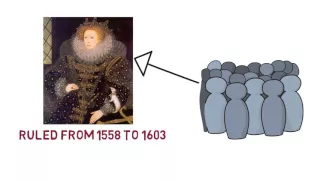
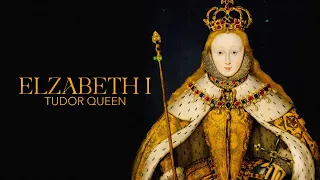
All of the sixteenth century was ruled by the Tudor monarchs in England and Wales, and Elizabeth I was the last of the Tudor monarchs. It started in 1485 when you had Henry Tudor, who became Henry VII, and his son Henry VIII and then Henry VIII's three children Edward, Mary and Elizabeth. Elizabeth came to the throne in 1558 and she inherited the throne at really quite a difficult time, you had some major questions about religion and about the economy.
There were an enormous number of changes, social and cultural changes, in the Elizabethan period. Perhaps first and foremost were religious changes, because Elizabeth I brought the whole of the country over, first of all in theory and then pretty much in practice, to the Protestant faith. Elizabeth did something really quite clever with the Church of England by creating a Church of England that almost pleased no one, but had enough of the reformed ideology to keep the reformers happy and enough of conservative ideology to keep the silent majority also happy.
So it was a very clever trick and sometimes the Church of England is called of a sort of 'mongrel beast' in some ways because it had all of these elements of both reformed religion and, to a degree, some elements of Roman Catholicism, and it did something incredibly clever which allowed the country to stay really faithful to the Queen. There were other sorts of changes too. In particular, the rise of the middle classes: you have a great growth in population, but also particularly a growth in the city of London; London gets much bigger over the course of Elizabeth's reign.
Elizabeth reigns for forty-five years; you have this wonderful period of economic stability, but also an opportunity in terms of the economy, which grows enormously at this period. So there are changes to do with a scaling-up of people's interest and desire in luxury goods, and therefore you get more and more merchants who become more and more successful and over time they need all sorts of other services including legal services. So the number of professional people and the number of merchants really goes up in the course of Elizabeth's reign.
Another really important feature of Elizabethan life was of course that the known world itself was expanding, and that was mapped through cartography -- people making new maps of the whole of the globe -- but also of course Britain, as a really important maritime nation, was exploring different parts of the world, and we had the beginnings of fledgling colonies in the Americas, but also the huge development of trade with the rest of the world; so it wasn't just Europe, all European nations were trading with different parts of the world and we had an enormous expansion of trade in this period with luxury goods coming from really quite far away, particularly from the Far and the Middle East.