Hello and welcome to this edition of joint action [Music] this podcast is dedicated to all those out there who have osteoarthritis on the show we unpack the truths and demystify the myths about the disease and its management if you have joint pain and want to know more about how to manage it from the world's best experts you've come to the Right place without further ado it is time to welcome your host david hunter hello and welcome to this week's edition of the joint action podcast where we have the opportunity to talk about is osteoarthritis and
inflammatory disease now traditionally osteoarthritis has been thought to be a non-inflammatory disease however we know that inflammation plays A critical role in the development of osteoarthritis in both the joint and synovium synovitis which is the inflammation of the synovial membranal lining of the joint is a classic characteristic of inflammatory arthritis such as rheumatoid arthritis but is now being seen in many people with osteoarthritis the presence of inflammation in the joint is thought to play a role in the different pain experiences of Osteoarthritis and disease progression research into inflammatory pathways of osteoarthritis may lead to the
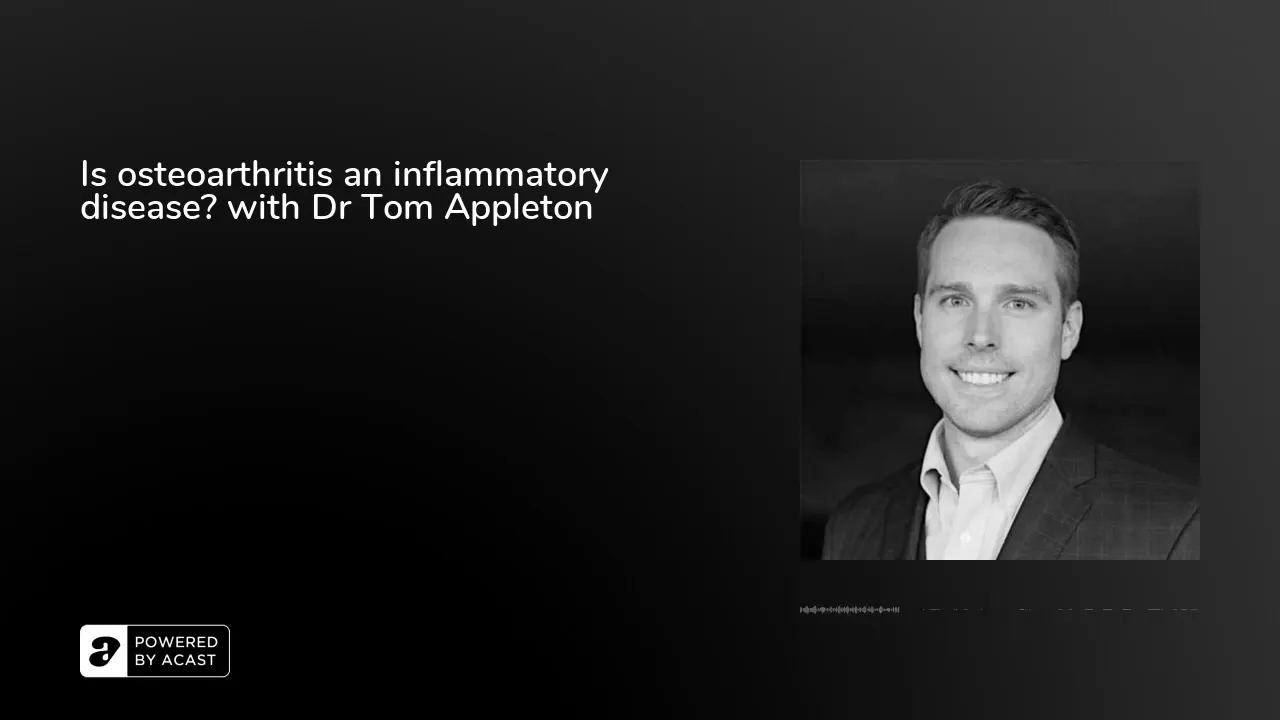
development of targeted therapies on this week's episode of joint action we're joined by dr tom appleton to discuss inflammation and its role in osteoarthritis onset and progression dr tom albertson is an assistant professor of rheumatology and clinician Scientist in the department of medicine with a cross-appointment to the department of physiology and pharmacology and the health and rehabilitation sciences program at schooling school of medicine and dentistry western university in canada dr appleton leads the appleton lab which is focused on understanding the role of synovium in the onset and pathogenesis of osteoarthritis His ongoing research is aimed
at understanding the pathophysiology of synovial cell types involved in osteoarthritis associated synovitis and how these mechanisms contribute to osteoarthritis symptoms and disease progression hello tom welcome to the show hi david thanks for having me oh it's absolutely my pleasure it's a great privilege to have you along and it's a really really important topic That i think our listeners will be really really enthused about but before we get into the topic of the day i just want to ask you a little bit more about yourself largely selfishly just to get to know you a little bit
better and i guess also to learn that the tips of the trade because i'm i'm always learning from others about what they do and what inspires them but in the first instance can you just tell us a little Bit about your background and what a typical day might look like for sure so maybe i'll start with the present i'm a clinician scientist practicing rheumatologist so the day-to-day is actually quite variable depending on the day of the week and as a clinician scientist rheumatologist yourself you'll empathize with this so you spend some time in clinic seeing
patients which i absolutely love And then other time with students working on active research projects i also run a basic science or translational biology lab where we do some exciting discovery research and so a lot of the trainees are based there and so i travel back and forth between hospital and university sites and then of course there's the other time spent doing grant writing reviews paper writing committee meetings all These sorts of things so i guess the question is why would you want to do something like that and obviously i love what i'm doing and
love the chance to work with both patients and do research on the problems that my patients are facing but i actually started out really interested in in a clinical career and i think like a lot of people was just sort of you know tunnel vision About that and when i met frank beyer who is another prominent osteoarthritis researcher internationally in my undergrad i really was quite naive to what research could offer and and so that opened up a whole world for me of creativity and discovery and got me interested enough to want to do a
combined md and phd program so for us a true clinician scientist track which takes you know seven years to do that Parts and then all the postgrad training and fellowship and so on and so forth so you know it was a winding road to get there and i met a number of rheumatologists along the way who really inspired me to to be interested in inflammatory disease in other musculoskeletal diseases and really just about complex chronic diseases and their research and challenges in general so just really feel so fortunate to have so Many mentors along the
way oh it's wonderful to hear that story and thank you so much for sharing that and the parallels there between what you do and what i do are really interesting and i might just probe that a little bit for a second roughly what proportion of your time and i know it's going to vary but what proportion of your time do you spend on research versus clinical work and how do you i guess quarantine and protect one or The other yeah that's probably a a whole talk for an entire podcast or a mentorship session or something
like that and i don't know who's mentoring who in those social circumstances sometimes but i think there's the parts that are really truly discrete like you have the research time completely separate from the clinical but there's also a lot of it that really is overlapping so a great example is you Know doing clinical trials and seeing those patients in clinic you may also be providing them care at the same time but you're collecting research data cohort studies these sorts of things where they truly are you know two for one in terms of the hour to
hour time commitment a way to break it up i think that makes sense is just days of the week so i i run the osteoarthritis program at st joseph's hospital in london on monday mornings and then The afternoon is usually spent doing a bit of administrative time and some research focused time as well i do general rheumatology practice for a full day a week and then the other three days are really focused on either being in the lab meeting with the trainees giving talks going to conferences meeting with collaborators you know all that sort of
stuff so i think a day and a half a week clinical is a good way to summarize it but you know the clinical Work never fully stops just because you're not in the clinic too yeah no it's something that again like you i really enjoy but it is pervasive and it does tend to erode into times where you're otherwise trying to focus on other things do your masters so to speak so so for example at the hospital versus the university and the university versus the hospital do they respect the roles that you have in each
of those other places and not try To intrude on those times where you're in those other places i think for the most part yes and and one of the things that i'm often asked by people who are interested in in a similar kind of career path or at least contemplating it at some point you know is how to go about protecting that time and you know there's there's sort of two concepts around protection part of it is you know are you are you actually able to afford the time to do that can Somebody provide you
a salary to be able to do that work but just more pragmatically are you in an environment where people understand that there's time where you're spending time in the clinic or know there's other time where you're spending time in the in the lab and i think when you choose a place to go and set up you really want to think hard about the environment and and who's there who's going to be there to support you Who really wants to champion that that success and so i've been very fortunate to to have an environment here there
are other great places around canada and north america but i would say that not not every single university is is really focused on that particular model there are lots of different models that can work and so you have to find that one that's a good fit for you yeah it's great advice and again no one-size-fits-all advice that is likely To come from either of us i don't think here it needs to be flexible and cognizant of both what your needs and desires and objectives are but also those those around you that are working with you
that you know like you the opportunity and experience to interface with people who live with osteoarthritis on a regular basis and to understand what their needs are and what you should be focusing on in Research is it's just a huge privilege now before we get too distracted when you're not doing your day job what is it that you like to do well actually just before you and i came on here we were chatting about family life a little bit and so i have four children and um one of my favorite places in the world to
be is at home with them and seeing what they're into learning about their interests and Excitement and how they're all such different people so you know that's that's one of my preferences is just when you get the time to get home and see what's happening there i also like to spend time reflecting a bit and preferably that would be in a canoe if at all possible like to camp and do those sorts of things outdoor winter time is great in canada we have lots of good winter months so i like to spend time being Active
doing that sort of thing or cycling so yeah lots of physical activity stuff too superb so that's kayaking on the lakes around you or rivers or what what is that or canoeing sorry yeah actually or canoeing it or kayaking love both you know own both there's a tremendous system of rivers and lakes throughout ontario but ontario is the province we live in in canada but you do have to travel a little bit to get there And we're also surrounded by the great lakes which are almost like small oceans unto themselves so those that's a very
different canoeing experience too depending on what size of water you're interested in so if you're willing to get in the car put the car of the canoe on the roof and go and and put in somewhere you can have a really uh really exciting time communing with nature that sounds absolutely wonderful when You get a chance to come down here we'll take you out on our lake called sydney harbour and in one of the kayaks that i have in the backyard it'd be a wonderful opportunity now tom if you had to describe yourself in five
words what would they be well i alluded to the first one i'll see myself through the lens of a father so you know have to remember that one sometimes i would say ambitious Engaged sometimes in too many things practical and i think optimistic yeah so superb qualities and i i love the way that you put father first i think keeping keeping that as a priority is so so important now obviously the topic of the day is you know is osteoarthritis and inflammatory joint disease and it's obviously incredibly controversial but before we Really dig into it
i just wanted to get your take on what does inflammation look like in osteoarthritis um and what is the synovium and synovial inflammation in in terms that the general community might understand this is a question that comes up in clinic probably almost every visit if not at least every day you know what is inflammation anyway and i think it really it's in the eye of the Beholder depending on what we're talking about in in rheumatoid arthritis we're often talking about systemic inflammation so inflammation that can even be measured with indicators in say routine blood work
in osteoarthritis we're we're really thinking more at the local joint level but of course in in rheumatoid arthritis and other types of autoimmune arthritis there's still inflammation at the joint level So i think we're often focusing that question in on okay is there inflammation within the joint itself if it's a knee or if it's a let's say a hand joint is there inflammation in the lining and so clinically just at the at the most basic level that just means a swollen joint but i think we also appreciate as rheumatologists and other musculoskeletal health providers that
There are nuances to the amounts of inflammation and the different features so when we talk about this with medical students and residents and people were training for how to examine joints we're sort of asking them to consider multiple different things so is the joint puffy is there thickening around the lining of the joint is it warm to the touch or even hot does it appear to be red or purplish or somewhat discolored or does it look the Same as the skin around it so those sorts of clinical features are really important to the joint exam
and we see that kind of inflammation also in osteoarthritis and a lot of that is because of inflammation that's happening in the lining of the joint that thin membrane inside the joint called the synovium that you mentioned it becomes bigger and can become boggy and thickened and we can also see Fluid which we call an effusion inside the joint as well that you can even squish around with your hand when you're doing the joint exam that's a great explanation and you you touched upon this and obviously the great contrast that many people refer to here
is that related to rheumatoid arthritis which obviously is clinicians we see not infrequently as well but how does the inflammation in osteoarthritis Differ and what are the similarities between that we see in osteoarthritis it's really interesting as a scientist that this comparison has actually survived many decades of investigation in fact often find tremendous insights into inflammation and osteoarthritis just by looking at the rheumatoid arthritis literature because oa or osteoarthritis is often used as as the comparator With rheumatoid arthritis and so most of the things that we have learned about rheumatoid arthritis have actually come from
those differences uh comparing against osteoarthritis as opposed to say a healthy joint and so so there are quite a few things at the molecular level the cellular level that sort of thing what i like to describe it is just at a high level is rheumatoid arthritis is an autoimmune Disease so we've got parts of your immune system which are now starting to recognize yourself meaning tissues in the joint for example as something that's maybe actually foreign and should be attacked so this is an autoimmune phenomenon that's happening and we don't see autoimmunity per se in
osteoarthritis so i think that's a key difference is rheumatoid arthritis Is autoimmune osteoarthritis is not autoimmune and then there's the different parts of your immune system that become activated as a result and so one of the big changes that we see in rheumatoid arthritis is your adaptive immune system so different cell types that would be engaged in rheumatoid arthritis we don't see as much in in osteoarthritis in osteoarthritis the inflammation is More of an innate immunity so that basic uh evolutionarily conserved immune system that has been just triggered by exposure to all kinds of things
that we might run into in the environment bacteria viruses these sorts of things and you know that that triggering happens in osteoarthritis happens in ra too so there's some similarity there but it really dominates in osteoarthritis that's a great explanation and i think As you mentioned a lot of the historical rheumatoid arthritis literature used osteoarthritis as a comparator or control but probably with the understanding that this wasn't at that point in time and a an inflammatory joint disease which you know i think that understanding has really evolved over the over recent decades now for a
person who has osteoarthritis and You touched upon this from an examination standpoint in terms of what signs might be elicited at the time of physical examination what might a person experience if they did have some inflammation in the joint and again you touched upon this from a clinical exam perspective but are there are there other ways that we can actually measure those inflammatory changes in the joint i think i've had a really blessed opportunity to Work with patients and and hear their stories and talk about their experiences nobody can express it better than they can
but i'll really do my best to relay what i hear on a regular basis obviously pain comes to mind but there's different pain experiences and people will describe pain during activity as a classic feature in osteoarthritis so let's say they've got knee osteoarthritis they might experience more pain while walking that gets a bit Better maybe doesn't go away completely when they sit down but gets a bit better at least when they're doing less activity that's actually a bit different than the experience we typically see in rheumatoid arthritis where the pain actually tends to get a
little bit better if you go and move around and then you stiffen up and get a bit more pain when you're when you're not moving so that's one of the contrasts But a pain comes in so many different packages and sizes and features and i think that's a hot area of research these days is trying to understand not just what those experiences are shooting pain burning pain aching pain stiffness these all these different features and there are many others that people describe trying to understand not just who gets them but also maybe what the underlying
Biology is so that we can start tailoring some of the treatments for those symptoms to those different pain experiences that that people report i think that stiffness is a big feature that it also comes up and that also makes us think about inflammation we see joint swelling and i describe that in the examination patients will also describe their own experiences with joint swelling it feels swollen as opposed to i actually see it swollen the Knee being larger one side to the other and often extremely accurate with their with their explanations of that you also asked
me about how we go about measuring that and and one of the ways obviously especially in in routine day-to-day clinical practices is examining the joint and trying to feel and characterize those features of the inflammation but with a little bit more precision especially in research Really often relying on imaging to be able to do that and so some of the imaging tests that have really stood the test of time i think include mri and we wouldn't use mri routinely in clinical practice it's really important to point out because it's an expensive modality and most of
the time it really doesn't change what we're doing today you know in your clinical appointment today are we actually Changing management based on that but as a research tool mri is phenomenal it gives you sort of a three-dimensional overview of all the different tissue structures but including the synovium and you can see that thickened lining of synovium with mri quite nicely you can see fluid accumulation and you can see not just that it's there but also what parts or regions of the joint where it's accumulated ultrasound has really come along a lot lately too and
that's an Area that my lab and my clinical research program has been adopting and using in our clinical research as have you david and really nice to be able to use that at the point of care and apply it without having to go into a long mri tube and spend a long time doing it it's quick and it's affordable and it's easy for patients to have done yeah it's a great great explanation and i think a really important distinction That you made there is between what happens in research and what happens in clinical practice and
there's obviously a number of tools that we might use in a research context to better understand inflammation and that you know obviously ultrasound contrast enhanced mri occasionally arthroscopy occasionally blood tests but at least in clinical practice as you mentioned unless it's going to change what we're Going to do as far as management's concerned and particularly do so in a favorable way and there i'm particularly thinking about imaging identifying abnormalities which otherwise drive up rates of surgery but don't necessarily improve outcome unless it's going to change clinical practice probably best that we don't do that on
a routine basis that's a great explanation and i think Leads well into the impact of inflammation on the joint so if a joint is inflamed and let's let's assume that the vast majority of people with osteoarthritis have some degree of inflammation but we can obviously in the research context measure its severity what impact does that have on pain And progression of the disease so one part of what you just said too made me think you know the majority of people having inflammation and say osteoarthritis and i think that's become more generally accepted now although there
was quite a long time throughout history where that wasn't necessarily always thought to be the case i also think that it's important to point out that patients with Osteoarthritis live with this disease for a really long time and whether that's years or decades in many cases and so in the earlier stages there can be periods where you know inflammation resolves and otherwise asymptomatic and doing reasonably well and that may continue and we may never become more severe than that may have some intermittent symptoms that kind of come and go Maybe otherwise living better the joint
heals and i always want to remind patients that this isn't an inevitability that you're going to you know continually progress a lot of people do there's no doubt about that but some people are able to to rehab and get better and and it's not necessarily an inevitability of aging sorry for the tangent but i i think it's important to just keep that spectrum of disease in mind as well but you asked About you know does inflammation matter does it relate to anything that's clinically important and i think that there's been a lot of epidemiologic research
that's been done that shows that inflammation in a joint synovial inflammation is really what we're talking about here there are other features we could talk about bone marrow lesions for example which some people consider to be inflammation other people think of it as more of a vascular Feature micro fractures that sort of stuff but you know in terms of synovial inflammation there have been well-designed studies that have shown that this is associated with more pain and other features that relate to pain something called pain sensitization so where you perceive pain to be more than it
would otherwise have been so sensitivity to pain neoji has shown this is associated with Synovial inflammation or synovitis yourself david ali germazi and others have shown that even the risk of developing future joint damage is higher if you have inflammation at an earlier stage of disease so you're more likely to progress in terms of structural changes structural damage cartilage loss you know these sorts of things that we classically think of as oa getting worse and then there's also data showing that The risk of having a joint replacement is higher if you have synovial inflammation so
there are lots of clinically important features that people experience and outcomes that are associated with inflammation which really makes us think that inflammation is an important driver of the disease but there's a really important caveat there there's a really important but and that is we haven't yet shown that Treating the inflammation can stop that progression from happening and i think that's a a big question mark for us in the field i really want to be able to show that but at the same time i think we can still learn a lot about the disease just
by studying the inflammation as well yeah great points and i i love the the tangent there and i think it's really important everybody out there with osteoarthritis Understands that you know generally the trajectory and the prognosis for this disease is a very favorable one and for most for most people who are considering that this is a joint disease of continued decline and functional loss and deterioration that that's by far and away the minority people have a course and a prognosis like that and we'll touch upon treatments a little bit later because i really want to
get your Take on um i guess some of the failures if you want to call it that of biologics and other traditional treatments that we've used for inflammatory joint disease in the context of osteoarthritis but before we go there i just want to again dig a little bit further into the pathophysiology of inflammation and particularly the role Of overweight and obesity and excess weight and that the role that plays in driving inflammation um and you know historically i think for people that are carrying excess weight we've traditionally thought about the impact of that as far
as excess load and mechanical changes that occur within the joint but how much how much of that potential is related to circulating Inflammation coming from that excess weight as opposed to load sorry long convoluted question but i'm sure you'll tackle it in a very articulate way yeah so the the question being about you know risk factors like obesity and inflammation i think is a really interesting area of investigation these days a lot of scientists a lot of labs a lot of clinician researchers are really looking at this and trying to Understand its role and i
don't think we have all the answers yet to be honest i think of obesity like i think of a lot of other things that increase the risk of osteoarthritis and its progression aging is another one that's also associated with increases in inflammation just changes in in our immune system as we age but obesity is probably the best studied example we know that obesity Increases loading through joints and so you alluded to that already and that's particularly relevant for the joints in the lower part of the body so knees especially but to a certain extent also
hips and ankles potentially feet but what's really interesting is that the risk of osteoarthritis and the severity of it and the symptom severity is is higher in people with obesity even if we're talking about other joints that Aren't being walked on like the hands for example and a lot of this again comes from epidemiologic research showing studies of associations but you know even if you adjust for or control for the amount of obesity meaning the weight you can't fully explain the true association between inflammation and whatever outcome it is that you're measuring So what does
that mean well basically means that probably part of the effect of obesity on joints is by increasing some degree of inflammation or at least impairing the joints ability to deal with that level of inflammation so there's good research out there that shows that obesity increases the amount of inflammatory cells in pretty much every tissue that you study muscle skin Bone synovium as well you see an increase in just the number of in innate immune cells so think of macrophages as a one of the chief innate immune cells in your body it's responsible for clearing debris
and bacteria and just kind of cleaning up the mess and helping to protect you very quickly from new insults of infections but obesity actually increases the number of those Cells in our tissues and so that contributes to just a background level of inflammation those cells and other cells in the tissues also make more inflammatory factors in people with obesity and so that in and of itself just having more of an inflammatory environment can have a detrimental effect to how those tissues are functioning you know think about if your cartilage is sitting there incubating in an
inflammatory Environment even if it's at a low level you do that for months and years the cartilage isn't going to be nearly as happy tendons and capsule and the synovial tissues aren't going to be as happy and probably leading to more cell dysfunction so i think obesity contributes to the effects of inflammation contributes to the loading and we just really don't yet know whether that's a 80 20 rule or if it's a 50 50. not sure How much of the contribution is there yeah well in the life of a researcher there are important questions and
i guess that's one of the important questions particularly when thinking about how best how best to intervene in this regard now again slightly before we get on to i guess intervening on inflammation so to speak i'm not sure whether it was tonya vincent but someone else in osteoarthritis has coined a term called Mechanoflamation and i i guess draws from this historical conflict between what's important in the context of osteoarthritis and what's driving these changes can you just tell us a little bit more about mechanoflamation and how inflammation comes about sure yeah mechanoinflammation or mechanoformation is
is a really alluring hypothesis and i think it goes back to just some of the earliest observations that osteoarthritis is a mechanically Driven disease and you know we can see extreme examples of that so people who are very bow legged meaning the knees point out to the outsides that really drives up the amount of mechanical loading so the forces that are pressing on the inside part of the knee and people who have that kind of an extreme alignment are at a much higher risk of progressing And interestingly we also see that that's associated with more
inflammation whether you measure that on imaging or you look at it with you know measures of inflammatory proteins in synovial fluid if you're taking that out of the knee for example so that that concept that mechanical loading so physical forces on tissues is somehow driving and contributing to inflammation is is a very alluring hypothesis And i think it's generally accepted now that that's the case and there's really nice studies that have been done you know in engineering labs in molecular biology labs in humans and in animal models that really clearly shows that if you load
tissues more you get increases in cytokines meaning those inflammatory proteins or increases in the amount of inflammatory cells so that's great the next obvious step is okay well what Happens if we fix the mechanical loading can you turn all of that off and i think that's where we learn some things and then we have some other questions so yes you can reduce the amount of information and even our group published about it two years ago that if you straighten people's legs so i gave that example of people's knees being pushed out to the side too
much if you straighten their legs surgically it's a big surgery to obviously go through that But if you straighten the leg and decrease the amount of loading on that inside part of the knee we actually do see inflammation going down on their mris a year later two years later that's great but a lot of the patients still have inflammation and so even if you fix some of the or even the majority of the mechanical loading issues For reasons that are still unclear that inflammation continues to perpetuate at least in an important subset of patients so
something is turning on inflammation and not allowing it to be turned off and that's where i think it's more complicated than just loading driven inflammation because it should just turn off if if you were to fix the loading problems so we we have to probably combine i think we have to get to this point where we Combine mechanical loading solutions with other medical solutions that start to address things like inflammation yeah and you know i think the days of monotherapy have really dominated interventions and trials to date and given the heterogeneity of the disease and
its complexity thinking that one particular modality of intervention is likely to fix all of the Problems is probably unrealistic you mentioned them but let's talk a little bit about cytokines the inflammatory molecules the markers and the impacts at least it has on the pathology of the joint what's it driving here what changes are occurring structurally as a consequence of inflammation well so cytokines are just inflammatory proteins there's a whole Huge group of them multiple families of them as a matter of fact i think the ones that we usually reach for when we talk about osteoarthritis
are a couple of key ones that might be recognizable to people so there's one called tumor necrosis factor or tnf there's one called interleukin-1 or il1 and another one called interleukin-6 il-6 there are many many others and there are other things that get Turned on as a result of these cytokines or in combination with these cytokines including enzymes that are themselves capable of chewing up or even breaking down tissues in the joint so imagine you've got this joint that's experiencing increased loading and yes that's increasing the amount of inflammation so we're seeing more cytokines being
produced that's going to recruit more inflammatory cells to the Joint it's going to increase the thickening of that synovial lining probably contributes to pain as well if not directly than at least indirectly and also stimulates the production of these enzymes that can break down tissue we call those proteases so enzymes that can digest proteins and that can actually stimulate tissue loss so we're seeing thinning of cartilage for example We're seeing turnover in bone and those enzymes are really we think of as part of this cascade of inflammation and if that continues and goes on cyclically
and doesn't get turned off then ultimately you're going to produce tissue loss tissue damage and the features that we see on imaging of osteoarthritis brilliant thanks for that tom now that obviously sounds like a devastating impact of those molecules in Terms of the pathophysiology of the joint but does inflammation have an important role to play in the normal physiology of the joint and is there any downside to switching it off yeah i love that question so the answer to that question is unequivocally yes it has an important role to play in in normal physiology i
think what we're really hoping to get to is a point where we understand which Aspects of inflammation or types of inflammation are really pathological so driven by the osteoarthritis and are bad and which parts are good so a great example is you know if you cut yourself you know you have a wound that wound needs to go through a very complex sequence of events in order to successfully heal itself and part of the early stages of that process is really driven by inflammation you have to bring All the cells there that are needed to heal
that and i think this has been shown in lots of studies but really summarized nicely by carlos gancillo and one of her reviews many years ago talking about osteoarthritis is it a chronic wound and you know failed wound healing is a really appealing concept when i think about osteoarthritis there's this inflammation that is probably being started to try to help to try to heal Something but gets deranged and goes wrong and continues to contribute to damage and pain and perpetuation of the disease so understanding that switch point when you go from good inflammation maybe in
the short run to bad is is a really important thing for us to understand we recently published a study looking at that concept and essentially just sort of showing that that it is true we put synovial tissue so the lining Tissue from the joint in a co-culture system with cartilage cells called chondrocytes and showed that if you used inflammation tissue from the early stages of osteoarthritis the very earliest stages we could actually stimulate an anabolic response but later on using tissue from later in the disease when the disease is much more established that anabolic response
was no longer there so i think it lends the support to the concept that Inflammation to your point is probably helping at least in the beginning but it's supposed to go away and in osteoarthritis it's not going away fascinating and it's as i guess you're touching upon a lot more for us to learn now you obviously work as a clinician as a rheumatologist and really interested in garnering your thoughts on the translation or failure thereof many agents that are commonly used to treat inflammatory joint disease And there i'm particularly thinking i guess about the biologic
therapies but also to some extent hydrox chloroquine methotrexate and a range of others that have been tested and trialled in osteoarthritis just want to get your take on them and i guess why they haven't necessarily demonstrated the positive benefits that we might otherwise have expected yep it's a it's one of the enigmatic aspects of Osteoarthritis research and i'll i'll say the short answer right away is we don't know why and i still think that the jury is still out to a certain extent part of the armamentarium of medications that have been used were really originally
developed to treat rheumatoid arthritis and have been adapted to other conditions and really successfully in many types of autoimmune arthritis we started off talking earlier about the fact that osteoarthritis Inflammation is inherently different some similarities some commonalities but a lot of differences really driven by the innate immune system whereas a lot of the therapies that are used to treat rheumatoid arthritis and psoriatic arthritis ankylosing spondylitis and these other autoimmune conditions are heavily driven by adaptive immune systems so autoimmune components so it's possible that you know we're not seeing benefits from targeting tnf or Il1 or
il-6 with biologic therapies because they simply don't work they were treating consequences of inflammation as opposed to the actual drivers of the inflammation so that's it could just be wrong mechanism the other possibility i think is that you know trial designs have been done largely in a similar kind of way and perhaps we're either not measuring the precise or correct outcomes that we Should be expecting to see improve with these therapies or we're not going for long enough and you know there have been lots of articles discussed about a recent sub-study of a larger clinical
trial with an anti-interleukin-1 therapy that showed some protective benefit in a subgroup analysis in patients who were going for joint replacement this was done in the setting of a cardiac trial the cantos trial so You know it's it's hard to know whether that truly reflects what we would do in an osteoarthritis trial but it's provocative and i think that that's why we still need other studies to truly answer this question but we might have to look at studying for longer or looking at different outcome measures methotrexate it's an interesting one though and i i'll just
wrap up with that methotrexate seems to have been on again Off again and then maybe on again and seeing some positive early results from studies at conferences you know abstracts on the conference circuit and really looking forward to seeing the results of those finally published that we can so that we can you know critically appraise them and see whether there is a signal there but methotrexate i think there's still some potential and unanswered questions with it Yeah and i think as you say a lot more work to happen yet and i think hopefully a lot
more nuanced work around phenotyping and finding subgroups that are likely to be more responsive to particular agents rather than treating everybody the same but you know there have been a lot of trials we've learned a lot but based upon what we know now and the pathophysiology of osteoarthritis related inflammation What should we be doing for inflammation in osteoarthritis and how can we better target that and what options do you see emerging well clinically right now we don't have a clear gold standard for treatment for inflammation and osteoarthritis and i think until we do see positive
trial results you know as clinicians we really want to make decisions based on high level evidence High quality evidence and things that are clearly peer reviewed so i don't think that there's a clear answer for what we should do what we should then be doing in the meantime is really focusing on what patients needs are and that's treating the symptoms that they're struggling with the most at this point in time and we know that you know certainly based on guidelines which include the voices of patients and the values that they place On certain treatments over
others that targeting inflammation with things like corticosteroid injections is not going to be disease modifying meaning it's not going to preserve your joints in the long run but can help in the short run to reduce symptoms for those especially who have signs of inflammation in their joint so you know there's therapeutic benefit i should point out for targeting inflammation from a steroid standpoint But it's purely symptomatic benefit and that's still valuable for patients brilliant thanks tom and anything else that you want to say in sort of wrapping up about the inflammation story in osteoarthritis or
any resources that you'd like to point people towards that might help to elaborate any on what you've already said absolutely i think we're we're at a point in history where we're just beginning the beginning of our understanding we Have a lot more to learn about the specific nature of osteoarthritis and i think one of the most important things we can do as a field is really push ourselves to you know compare against the right control groups and try to understand the pathobiology of inflammation to identify the right targets for treatment And also to understand that
there's a duality of of the intent of inflammation and osteoarthritis as we talked about earlier some of it is going to be helpful and so flattening inflammation in a black and white kind of sense it's probably not the right thing to do and we need a much better understanding of what types of inflammation are good and what inflammation is not good so i guess it's really just a call to researchers and clinicians to Reinvigorate the excitement about doing research in this area and to patients to want to who want to be involved in studies to
to reach out and contribute as well there's a tremendously important role for patients to be involved in research and leading in some capacities we have so much that we can learn from their experience and i think that's what the future will hold for us so those would be my current thoughts on inflammation interested in yours david Great explanation yeah no i've learnt a lot and it's been been great having an opportunity to have a conversation about it and as you say i think there's a lot more to learn yet now we're just going to get
into a rapid fire round and please feel free to give me monosyllabic answers or at least one one-word answers to these questions but favorite book so many i love reading the hobbit to my Kids it's great book great series too favorite movie there's a great movie called kubo in the two strings uh really got lost in that about uh the sense of loss and spirituality and connecting with elders superb not seen it but i'll follow it up dog or a cat person dog really pleased to hear that favorite quote uh my maternal grandfather once said
dawn your cloak of imperturbability It's good advice what's your favorite food the food you eat with friends but also kawartha dairy ice cream sorry what ice cream there's a a dairy called kawartha dairies in southern ontario which is quite famous and a part of cottage country lore good to know do you have a bad habit yes one that i'm willing to to admit to i'm pathologically incapable of saying no to Things sometimes that's why you're on this podcast where would you like to go on holiday i would like to go to norway in the winter
yeah brave what superpower would you have uh healing any mortal wound if you could meet anyone dead or alive who would it be i think i would want to meet my paternal grandfather who i never met died before i was born but he survived vimy ridge in world war one so I'd want to talk to him about that wow and what would you do if money were not an issue oh this is gonna sound really really contrived i think i'd do the same thing i do right now but i just would write a lot fewer
or no grants and just self-fund the research and hire a lot of people to provide good clinical care great answer i'm right there with you now in closing we're just going to wrap up with a few of these but if you could Do anything to improve health and healthcare what would you do one of the things that strikes me most days in clinic is just the vast differences in people's health outcomes and how that seems to be so related to inequity in our health system so i think if i could really do anything it would
be working with communities to try to improve health literacy and the ability to navigate our overly complicated Health systems and then at the same time trying to decomplicate the health system and make it equitable but it's a big ask but a really noble and important goal and i hope i hope you can continue to meaningfully contribute to that how do you continue to learn in order to stay on top of things with your role well like like everybody you know you go to conferences uh read journals and you know scientific Articles go to cme events
these sorts of things but i i think what i really get the most from is learning from my trainees in the lab trainees in in the clinical research program and and from patients i mean they really light the way and and show you what's exciting and current and relevant so i think probably that is one of the best ways to stay up to date Great answer the big question of the day why do you do what you do what's your motivation people ask me similar kind of question fairly often like why do you do this
or or what should i do i think the most important thing is to do what you love to do because you'll be passionate about it and therefore you'll do a good job at it and you'll be happy doing it then you'll be you know better for your Your patients or whoever you're working with as a result so i just feel really passionate about this area i think it's a huge on that need area and it's exciting to think you might be able to contribute a small piece to the overall solutions in the future oh don't
don't undermine yourself and be too humble you're contributing a great piece and i hope you continue to make a big difference but if you could have a billboard with anything on it what would It be and why i'm laughing because it makes me the question makes me think about the old shreddies billboards that were around that said buy new diamond shreddies and it just rotated the square 90 degrees to make them diamonds it's uh but it sticks out because you remember it right it's a simple thing that that makes you remember why it's important i
think we have a huge image problem in The arthritis field writ large like not just osteoarthritis all of arthritis but certainly in the osteoarthritis fields of you know things just kind of being just arthritis and you and i both know that this is a devastating disease for patients who live with this for decades lose their independence and have you know few options so i think you know if i was to put something on the billboard to try to Increase interest it would be uh something to convey that it's not just arthritis this is a serious
disease and there's something we can do about it yeah really good proactive message and hopefully encouraging people to get out there and on that note is there any one piece of advice knowledge or wisdom that you want to give for people out there who might have osteoarthritis this seems really simple and obvious but It's something that comes up a lot um i think it's important to point out that no matter what kind of arthritis you have we don't cure arthritis our goal is to improve disease control and that includes treating inflammation for sure but the
goal is to give you the best life possible while living with arthritis and i think if we can rally around that goal And understand that that's that's an achievable goal especially if we tackle multiple aspects of the disease then i think we'll be further ahead really thoughtful advice and you know i think a great way to finish tom and thank you so much for spending some time with us sharing really important insights and being so thoughtful about about this area and making the important contributions that you do so thanks for coming along my Pleasure david
and really appreciate the invitation thank you thank you so much for joining and listening to this wonderful episode from tom and the tremendous thoughtful descriptions that he's provided to a very very complex area what we currently know is that osteoarthritis has many features of inflammation and so the historical definition that this was a non-inflammatory joint disease Can be categorized as inaccurate there are many differences between osteoarthritis and rheumatoid arthritis associated inflammation but we know at least clinically that this manifests with pain with stiffness and features joint examination with signs of swelling and changes within the
joint more importantly We know that this can contribute to the pain experience and the progression of the disease and that there are a number of other factors that are driving these changes which includes both the mechanical changes within the joint but also in many people being above an excess weight lots of different treatments have been trialled for targeting inflammation in the context of Osteoarthritis that haven't been particularly positive to date but there's a lot of interest in this space with a lot of room for researchers and other clinicians to get more engaged i'm hoping that
you found the episode informative and engaging and stimulated further your interest in osteoarthritis and greater understanding and really appreciate tom's input and thoughtful remarks in This regard thanks so much for listening and i look forward to speaking to you again soon and in the meantime do please take care of yourself [Music] thanks for listening to joint action with david hunter if you like our show and want to know more visit www.join if you have any questions you can email us at hello at jointaction.info and Follow us on twitter at jointactionorg this podcast is hosted by
david hunter edited by vicky dwong music produced by jordan hunter the information posted on this podcast is not intended to diagnose treat cure or prevent disease anyone seeking medical advice should consult a health professional [Music]