some studies suggest that upwards of 20% of the people who develop ostearthritis of their knee do so because they've had a previous injury to their knee often times that injury relates to a really important structure within the knee called the cruet ligament or the ACL the anterior cruet ligament that typically occurs in younger adults aged between 15 and 25 and the consequences of that are really substantial as a substantial proportion of of those people go on longterm to develop Nee osteitis we've spoken about this both the prevalence the increasing epidemic of ACL crucial ligament injuries
and the impact that that has on ostearthritis in previous episodes with Tim hu Jackie Whitaker y so it's a really really important issue for ostearthritis we've also spoken about the importance of injury prevention so primary prevention of these injuries to see if we can actually impact the number of people who are developing ostearthritis longterm and that has a whole range of benefits including enhancing athletic performance prolonging activity participation so people can actually continue to participate in their sport lowering health care costs improving quality of life reducing Rehabilitation time from those injuries and boosting confidence in
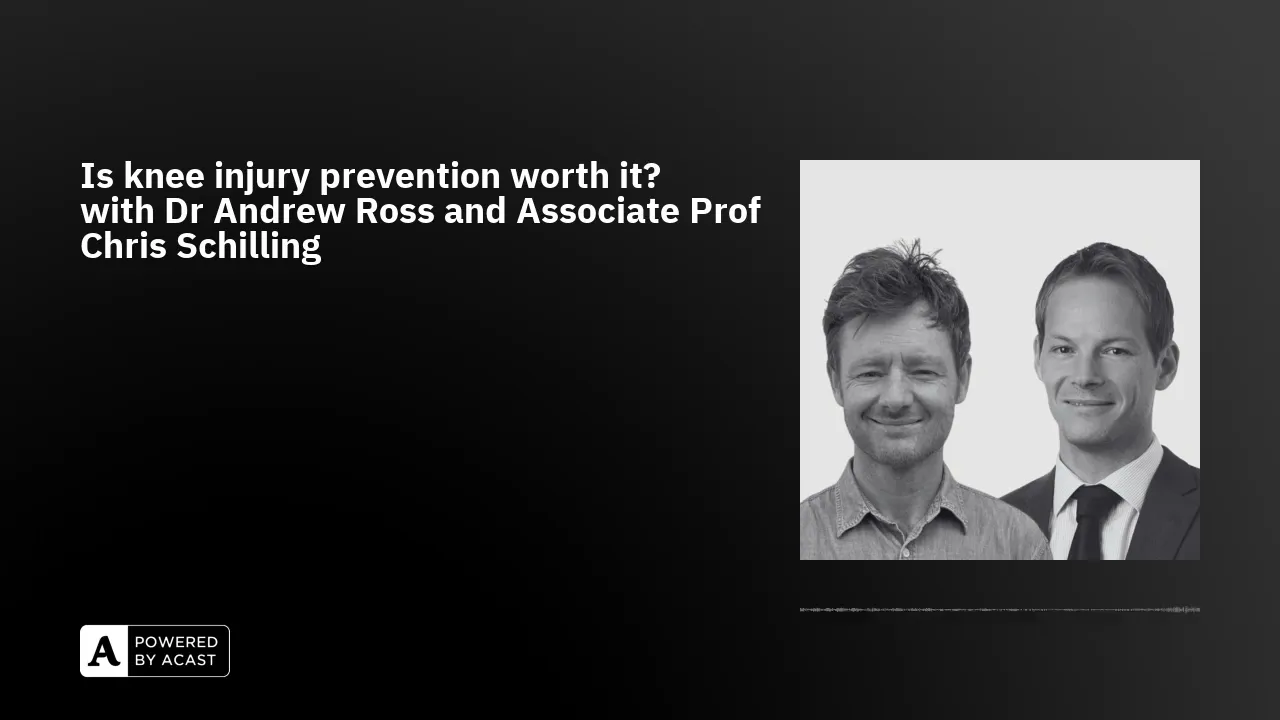
the people that participate in those injury prevention programs today we dig into this a little bit more why well in part because of two articles that have recently come out in the medical journal of Australia LED in the first instance by Andrew Ross who works in the physiotherapy Department specifically looking at the costs related to implementing knee injury prevention training program and the benefits in terms of quality of life and that was accompanied by an editorial that was written by Chris Schilling who's a health Economist specifically looking at the merits or otherwise of implementing a
program such as that it's a really technical edition of The Joint action podcast I do it in part because it's something that's near and dear to my heart it's something near and dear to what ideally politicians and policy makers should be listening to because most of the studies have specifically looked at this topic the return on investment is substantial and we shouldn't just be looking at it in terms of cost but that's ultimately the reality when you're talking to politicians we're coming up towards an election cycle in Australia and I know a number of other
countries around the world that don't currently have injury prevention programs that are provided nationally are similar in election years so we're really pleased to have Andrew Ross and Chris Ling come along to talk about their next steps for ACL injury prevention hello Andrew and Chris welcome to the show hi David thanks for the invitation great to be here thanks David yeah it's absolutely my pleasure it's a topic that's very near and dear to my heart and so it's a wonderful opportunity to dig into it a little bit further but without further Ado really in an
effort to get to know both of you a little bit better Andrew what I might get you to do is to go first if that's okay can you just share with the listeners a little bit more about your background and what a typical day looks like sure yeah no problem thanks David I'm a physiotherapist by profession so currently I'm working at Victoria University as a physio lecturer and researcher as suppose I'll share a little bit about my journey about how I came to writing a paper on the primary prevention of ACL injuries I worked as
a clinical physiotherapist for about 12 years I run my own physiotherapy business worked with amateur footballers as a coach and as a physiotherapist and played the game myself as well but what ended up sort of happening was I did a Ms in public health and then from there I became a little bit more interested Ed in preventing these ACL injuries from ever occurring it was a sort of New Concept that came up during that study and then sort of started to look at it a little bit more from an academic perspective and I ended up
doing my thesis on Nationwide Sports Injury prevention strategies and then not really fed into a PhD opportunity at Sydney University with associate professor krie Peak as my supervisor and looking really at amate footb boundaries in the state of New South Wales wonderful and Andrew just out of Interest you're still involved in doing some aspect of injury prevention yeah that's still really at the heart of everything I want to do is Sports Injury prevention so at the minute we're sort of looking a little bit at heading injuries and we sort of just started to look a
little bit at header prep program created by carry and some other researches so we're looking at that and also looking at really other ways of implementing these types of injury prevention programs into amateur clubs yeah wonderful now for the listeners out there you may not necessar have a perspective of what background I'm looking at behind Andrew but it's uh very red and I'm going to ask you Andrew when you're not doing your day job what do you enjoy doing and potentially it relates to your background yeah look well what David's talking about there is anfield
football club but Liverpool Football Club in the UK that's a team actually I've been supporting for quite some time really all my family well my kids anyway support it my wife is a man united fan but we won't go there and but I'm football mad I still play the game at a very amateur level when I can and I'll be involved in coaching H my daughter plays MPL so really if I'm not doing anything with regards to teaching and research I'm doing something else with regards to football whether it's listening to podcasts or coaching or
whatever superb and does your daughter um practice any injury prevention herself well that's the problem right her father is an injury prevention researcher so she's doing the perform plus and the FIFA 11 and haer prep she's doing everything really and you know when I can get her to do it as we know these things are hard to implement yeah so she does do stuff and her team does quite a bit actually so as we're probably going to get into yeah excellent and if you had to describe yourself in five words what words would you use
I did ask my wife this question I did ask my kids but I got a kind of strange response from them so my my first one would be devote I've got three kids and I'm a husband second one is an interesting one I would say draw which is kind of a Scottish word for oddly amusing and then the third one is fanatic so there's the football side of it the fourth one hyperfocused and the fifth one inquisitive so really leaning there on the kind of research side of things wonderful Chris over to you but if
you could share with us a little bit more about your background in a typical day oh lovely lovely to hear your background too Andrew I'm a health Economist and so basically that means that my job is to look at the costs and benefits of the interventions within our healthcare system government can't fund everything and so really what I do on a day-to-day basis is to try and help them think about well what works and what doesn't are the things that we're that we're making freely available to our population are they delivering good quality of care
and you know high level and high value of care and one of the ways that I do that and kind of one of the tools and techniques that I use is an application called simulation modeling and really that's where we build analysis tools that let us answer so what questions or what if questions like what if what if a new stem cell therapy could completely alter the trajectory of osteoarthritis what would that mean in terms of the costs and benefits and the trajectory of some 's life and the the health interventions that they might have
to have or not have and in the case of Andrew's paper what if we're able to actually Implement a population-wide injury prevention program what what would that mean in terms of reduced numbers of of surgeries and hospitalizations and Ed visits down the track and so we build those tools so that we can help government and decision makers to understand whether or not that that's going to be a good thing to do wonderful yeah I mean it's so so important because obviously as you both well know our resources are not Limitless and often times we just
pay attention to the efficacy of certain treatments but not necessarily the harms and more infrequently even the cost related to that and so it's really important to consider those Chris now when you're not doing your day job what do you like to do I'm also I'm very sporty so um I'm a terrible football player though so I I end up mostly on the tennis courts hitting some balls around and going for the odd run and and spending time with my family I've just had two twin baby girls so at the moment pretty much everything's on
hold and uh away from work is full-time dead wonderful congratulations and uh you getting any sleep a little bit so um when I saw the questions about you know how would you describe yourself in five words well I couldn't come up with five but I was thinking well um I'd like to think I'm kind and I'm sporty and I'm driven but um but definitely these last few months I'm pretty tired well as a father of four I'm hoping that slowly improves over time and I'm sure Andrew can attest to the fact that in time they
do end up sleeping a little bit more and then they change their body clocks to a point where you know they become teenagers and the the shift is such that you end up getting a bit Sleepless at the late end of the day as well it's fascinating the way it runs now for everybody who's out there you're probably wondering why I've got two different people talking about the same topic well I guess just firstly by where background Andrew wrote an article recently in the medical journal of Australia and that's really prompted this discussion and Chris
as good thoughtful academicians do wrote a response to that article called an editorial just really looking at the merits and other ways of that and so that's the benefit of having two guests who are wonderfully knowledgeable in this space to provide a perspective on this really really important topic but I guess just to kick us off Andrew we know that resources are not Limitless but I'm wondering if you can tell us in a little bit of detail about what your study found yeah sure thanks David and thanks for your um your introduction there Chris gives
me a little bit more insight after reading the editorial but in a kind of potted version the findings really showed that when we take a Cort of amateure football players um from what football Australia published so their participation reports at just over 300,000 footballers that if we were to implement at a national level in Australia that you could save 1.5 million each year in societal and medical costs and what that really means is 125 ACL injuries four reruptures 22 cases of neee osteoarthritis and three total knee Replacements every year could be averted from a primary
and prevention perspective and then we've mapped that and sort of like Chris was describing in an economic model so we've simulated it out over 35 years using a markof model that would be over 4,000 ACL injuries could be averted over 35 years if this was to continue to be implemented over that time and we did a reasonable job at it and that's important in in some ways to remember that we did take into consideration a real world context here that we understand that this is hard to be implemented widely and we thought about how many
coaches would adopt it would they continue to maintain doing it and things like that fantastic and just to dig back into a little bit of the detail for those of you that are particularly interested in the football soccer specificity of this program so your program was a perform plus which I think is derived from the FIFA 11 program can you just tell the listeners a little bit just about what that program contains how long it would take for people to do that on a regular basis just so they understand the practicality of what that might
involve yeah that's a really good question David the perform plus is essentially Australia's version of the FIFA 11 so we know the FIFA 11 takes around about 20 to 30 minutes to complete and that's the same really for the perform plus so all the perform plus materials can be found in football Australia website you know this type of program can be done at any football club it doesn't require any equipment and it's the first part is a little bit of running a little bit of a dynamic warmup and then the second part is more strength
and petric so things like planks side Bridges and Copenhagen exercise which is a a sort of a groin focused exercise and also Nordic hamstring exercises as well a lot of the exercises is focus on you know Landing with a soft knee so you're your really thinking a little bit about the biomechanics as well but also a focus on performance and not just about injury prevention because you know in general coaches they're more interested in the performance factors rather than than the injury risk reduction you know to get them on board if we if we sometimes
change the terminology that can be useful yeah and just a little bit more about how this might be implemented and the costs related to that so how would this be implemented is this targeted towards coach and trainers and what are the costs associated with implementing a program such as this so I think the L hanging fruit is that only a select amount of coaches would know about this in their coach training so if we were able to set up when coaches are trained and and the ones that are already got coach badges would need to
obviously do a little bit of extra training to to find out about this program so they they become aware of it so some research that I did in my PhD as well we looked at how many coaches were aware of this program and how many people used the program in Australia but we looked at the FIFA 11 this was really before the perform plus was rolled out and it's around about you know approximately only 18% of coaches were using the the FIFA 11 so we know it's quite low what was a good finding or I
suppose an interesting finding was that the coaches that were aware of it they were using it to high percentages so the way I see is that would be the first Port of Call really is that we get coaches aware of it and then we track the progress of their awareness over a period of time to see how that's going and Andrew who would make them aware of that is that soccer Australia is that sport Australia do they get trained and accredited in that and what does it cost the national body for example to roll that
out yeah so it would be football Australia that are doing their coach training they would obviously have to look at currently what their curriculum is and then how we would actually embed the perform plus into that it is embedded to a degree at the moment but to embed it into all coaching curriculum that would be a further exercise so obviously if we don't have a program we don't have costs so this really was a first step towards understanding that and the way we we got around the barrier of not knowing the cost were to use
the costs that New Zealand have gathered from 1999 to 2021 um they've tracked implementation costs so that's things like logistical costs to train coaches and logistical cost to pay staff to train those coaches so maybe some physiotherapists Community Champions that sort of thing so those costs were just under 1 million per year although that wasn't what New Zealand or the costs they gave us we projected those to Australian costs so they were just under 1 million per year um for doing something like this which sounds like a lot of money but when we did the
modeling the money you save is more than the cost of the program so I think that if New Zealand could do a good job of doing this for you know under a million then it's definitely within our sites if if we could get some funding for this um and how we do that's another conversation as well but it would obviously be a you know a Sound Investment yeah and so Andrew you've touched upon it but what is the return on investment here and how does that compare to other sports with similar programs I think you
you mentioned these in New Zealand in your article yeah so the return on investment is $351 for every $1 invested and in general when they've looked at because New Zealand's really the only country that's published some other return on investment data then it's anywhere between $250 right up to about $112 so $12 was netball and then it was a little bit lower for football but when I spoke to the New Zealand academics it's something that they're currently looking to publish I believe more data on and really they highlighted Sports such as football netball Rugby Union
and rugby league really is the main areas where they were getting good return on investments for the money that they were putting in for injury prevention yeah now you have obviously focused on football soccer why does this need to be Sports specific spefic so most of the time and sports will have a sports specific program for so if you take New Zealand again as an example they have net ball smart they've got soccer smart they've got Rugby Smart so they have different types of injury prevention programs so to implement and to train coaches and all
the different types of programs it it just adds that other level of complexity in so it's more likely that a a national or a state-based role Act would occur uh at football Sport and organization level to train the coaches and so forth so really that was the cracks of it and when you think about it that way it's just it's one way of doing it yeah so thanks for relaying the findings of the study and before I get Chris away in on this Andrew do you want to recognize any limitations of what you've done yeah
of course this is modeling and you know the data did come from Australian sources but there was some data from overseas so the effectiveness rates were taken from Sweden and Switzerland and then obviously as we touched upon before the cost came from New Zealand however about 75% of the other data from Australian sources so I would say that we've delved quite deeply into some of the systematic reviews and meta analyses that have been published in this area to try and get the best data possible for this modeling situation yeah no wonderful that's fantastic now Chris
any limitations that you want to highlight here as well I'll take a step back David to begin with and first say that look what we want to see as health economists is that that this type of analysis is done um that there is some work that goes into thinking about whether or not these interventions are going to be value for money and what Andrew and his team did was really to bring together a whole range of evidence and put all of that into a health economic model to see if this type of injury prevention program
would be a good idea for Australia now I firstly want to go on record to say that's a really good start and as we said to the mja we're really wrapped to see our National Journal actually publishing these type of things because they're really helpful for decision makers and thinking about not just does it work but is it cost effective and what Andrew's modeling really found was that really in all likelihood this type of prevention program would be cost effective because as Andrew has mentioned he was able to run a range of different sensitivity analyses
where we can change some of those assumptions and see well does it still deliver um a good return and in general it really did but as Andrew has noted there were some limitations and really the ones that we raised were that a couple of the the key inputs were sourced from international studies so as Andrew's mentioned the costs were extrapolated from New Zealand so we don't know exactly what it's going to cost here in Australia and some of that real world Effectiveness data was extrapolated from from Sweden and so as any kind of amateur sports
person would ATT test I'm sure that not everyone rocks up half an hour before the game and is ready to do their prevention um program it might be that they're running late they jump on court Etc so there's going to be some real world reductions in in how even the best program translates into into a population wide impact and what we really liked about Andrew's work was that they did include that kind of transition down that okay in the real world if 100% of sports people actually adhere to this this is what it might look
like but in the real world when okay not everyone knows about it and not everyone adheres to it and even if they do adhere to it they might do it correctly but there's actually a much lower level of Effectiveness and so by doing that and using the the model and running the sensitivity analysis is actually able to show the impact of some of these limitations and so what does all of that mean from a health Economist perspective well it means that hey there there is good evidence here but we should still be just a little
bit cautious because we don't have the perfect Australian data on particularly the cost and the Australian Effectiveness rates and so really that meant from our perspective and what we wrote in the MJ article was perhaps we should just think about how we should roll this out can we roll it out in a way that we can we can gather that information so just on the off chance that as we roll it out in Australia perhaps those benefits or or costs don't align that we can do something about it we can rectify before we roll it
out across the whole country if it's not working on we have so do you want to expand a little bit on that Chris because I think particularly in the editorial that you wrote you spoke about I guess a preemptive setup of a data collection strategy before you do a modified roll out but do you want to just expand a little bit upon that yeah absolutely so I guess as I've spoken about if we want to do a a pilot or a steep roll out to see if it's working we need to be measuring and capturing
some data to be able to to make that call and so what we highlighted was that we'd love to see some kind of data capture we listed a registry in paper in mja editorial but we'd be equally happy with some kind of administrative data capture whether that be run through the ahw but something that actually lets us capture what the rates of injury look like over time because then when Andrew's new interventions rolled out we can actually look at that and say well is it is it actually having a difference and making the impact that
we hope it would that's clearly not as straightforward injuries and particularly amateur sports injuries are are chronically kind of underreported but there are a range of things that we could potentially do and I know the aw's working group has been kind of systematically going through those to make sure that the reporting could be standardized and to use things around amateur sport to make sure we get that kind of capture rate that we'd be looking for things like making sure we could use Assurance data most people who go along and play um football on a Sunday
night or a Saturday would still actually be insured through that competition and so there should be some capture there so there's some things like that that we that from our perspective we need to invest in as a country to make sure we've got that Baseline so then we can see how things have improved yeah and I you know I'm really pleased to say that that's hopefully in the process of happening in the ahw that Chris is referring to is the Australian Institute of Health and Welfare and they're in the process of working with the sporting
codes to see if they can create a national data collection strategy specifically to Target that why and Andrew you may want to comment on this once Chris has why would we not want to specifically rely upon an ACL registry that's maintained by the surgeons that's presumably reliant on a person seeing the surgeon or what presumptively may be a reconstruction yeah and from my perspective if we look at registry versus admin data they've both got their pros and cons typically registry data can go deeper and get more information around a particular patient and so they're able
to um understand a little bit more about a patient's history and their comorbidities and some of those other things that we might not capture at the admin data level but conversely admin data typically gets us a much broader spread of the population so you're getting a better view across Australia and so really there's pros and cons and actually typically we see that they complement each other and we see that in joint replacement registry yeah Andrew do you want to comment on the proportion of Australians that are having their crucial ligament reconstructed and the increased number
of people that might be trying nonoperative strategies yeah I mean at the moment they currently really unknown that what that proportion would be that are going down the non-operative route I know there's some work being done from University of Melbourne that's currently looking at that a little bit more and I'm actually going to try and gather some data for the non-operative care side of things I could comment in football you know with you're probably looking at between two to 3,000 ACL injuries or ACL reconstructions uh from each year in amateur football that are being reconstructed
so it does seem to be a growing problem and it's a worldwide phenomenon as well that it's not just in Australia where numbers are going up it's going up in all other countries that have published in this area Sweden Switzerland have published in this area in America as well they're coming up with the same sorts of things and New Zealand in New Zealand are recent paper was published saying about 127% increasing costs over the last just over a decade as well a couple of decades actually so it's all going one way so I suppose it's
not a problem that's going to go away on its own and one other way to look at this I mean the big question here I suppose is is where does the responsibility lie so you know are we saying that this should be the players responsibility we saying it should be the coach's responsibility or the sports organization's responsibility or the sports Insurance responsibility or the government's responsibility yeah what it's everybody's responsibility right but you know there is that saying with a high hierarchy of responsibility should rest on the organization or the person that can have the
most effect so that would possibly be government right you would think that with policy but that's not easy to do and how do we then get it onto the agenda that's difficult as well so you know one thing that came out the paper and as someone that's played the game and has registered his fa I register my kids every year you know is there a way to get this going by saying well for less than a coffee this is how I would pitch it for less than a coffee you could decrease your child or your
ACL Risk by a large proportion if you were to at registration time pay an extra $273 which is what we found if everybody pays $273 that registers for football and that money is distributed to injury prevention we can have an effect you know that's one way of doing it I know that that's putting the cost to the players and to the parents but you know what if someone came to me and said your daughter would have a decreased risk of this if you paid less than a coffee I'd say there's my money maybe that's how
we have to pitch it fantastic I don't really like coffee but I like the argument Chris did you want to comment on that I also don't like coffee and but I love the argument too very succinctly put Andrew I just wanted to make one other comment about a limitation of registries some particularly ACL ones led by a surgeon is that they're capturing the treated those who actually get that particular treatment and what they miss is all the other treatments and the non- treatments that might have happened or the non-surgical treatments that might have happened and
that's a real immitation yeah yeah so Chris on that note obviously Andrew's spoken eloquently about the desire to have this pursued presumably by those who are highest in the hierarchy that's the public office we've seen a number of other pilot programs in other sports at least in Australia around Australian Rules netball and some other sports where they've run pilot programs but didn't have any longer term sustainable durable funding for programs to maintain those why do we need more pilots that's a great question ideally the pilot would be used as a some kind of decision point
to say yes it worked and if so we continue to fund but unfortunately sometimes in the real world that's not necessarily the case but nonetheless I think from a value for money perspective and from a health economic perspective given that we don't have that Australian specific data around some of the things that we we spoke about costs and Effectiveness it is important that we actually just take a cautious approach to Rolling this out and one of the ways that that we might get around some of those things that you've mentioned is kind of try and
Pitch it more as a stepped roll out where you're kind of still pitching fullscale roll out but you're allowing adjust on the go so it's not just that the program and the costs are just rolled out as is to everyone it's perhaps starting a particular region um learn from that and then continue that roll out and I think that's potentially one way to make sure that the pilot doesn't just become dead in the water like some in the past have yeah wonderful now Andrew any closing comments on that topic before I get to the closing
question no I I think what Chris had mentioned about a pilot project I I think it's a pragmatic approach it's something that I think it's really a good way of doing it and I know that aihw as you mentioned before David they're looking at a National Database but you know we've got to be collecting data from Community sport we've got to be collecting it from iide Health from possibly even GPS as well um and then maybe self report as well so yeah I think it's a it's a pragmatic approach that's for sure yeah and just
to really give a plug to the Australian insute of Health and Welfare and Sport Australia and the major sporting codes for trying to develop a National Data injury strategy around this Thea to really support that Foundation that we've been talking about Andrew any wonderful pieces of wisdom advice or knowledge that you'd like to share for people out there who have ostearthritis or maybe at risk of getting it yeah so what I would say would be because obviously we've been talking about primary prevention but if you already have Osteo arthritis or you've had an ACL Recon
or a rerupture and you think thinking oh well you know what are my chances of getting of arthritis at s quite High well there is hope because there are you know there countries at the minute looking at what we'd say secondary prevention or what could you do to decrease your risk of going from having a joint injury then to knee arthritis and the research is looking quite promising for doing selective type exercises to try and increase or decrease your risk of then going on to having knee arthritis so I think seeing a really good physiotherapist
that you trust and has looked at your knee and can give you the right type of exercises we have things like the Glad program and that has been rolled out in Australia for people that do already have arthritis but if you've not got arthritis and you've had an ACL Recon I think it's still worth looking at trying to strengthen that KNE up fantastic Chris any thoughts suggestions words of wisdom from you my thought is really just that joint replacement is not a feda complete and I'd really implore listeners out there to take that on board
I know there's been a really strong increase in the utilization of surgeries over the last decade or two but all of the things that Andrew is talking about all the things David that that you do are really highlighting that there are a range of different trajectories and definitely not all of them end in the need for a joint replacement wonderful Andrew Chris thank you both so much for your really thoughtful and insightful work in the space it's such an important area and thank you for spending a little bit of time with us today and sharing
those insights with the listeners no problem thanks David thanks David thanks Andre so again apologies was a very technical issue very complex issue but one that we really need to dig into to better understand and convey that to our policy makers and hopefully help you to understand the importance of injury prevention to the community at large it's not straightforward it costs money but there are huge consequences related to injury so if could prevent further injuries from happening it would have huge implications for the community of people who play sport as well as society as a
whole so should we do more undoubtedly how we do that we should be thoughtful about it and hopefully we've given you some understanding of some of the complexity related to this topic today so again thank you so much for your continued support of the join action podcast really looking forward to have an opportunity to interact with you very soon but between now and when we next have an opportunity to speak please do take care of yourself thanks for listening to Joint action with David Hunter if you like our show and want to know more visit
www.join action.in info if you have any questions you can email us at helljoint action.in and follow us on Twitter at joint action org this podcast was hosted by David Hunter edited by Vicky dwang music produced by Jordan Hunter the information posted on this podcast is not intended to diagnose treat cure or prevent disease anyone seeking medical advice should consult a health professional