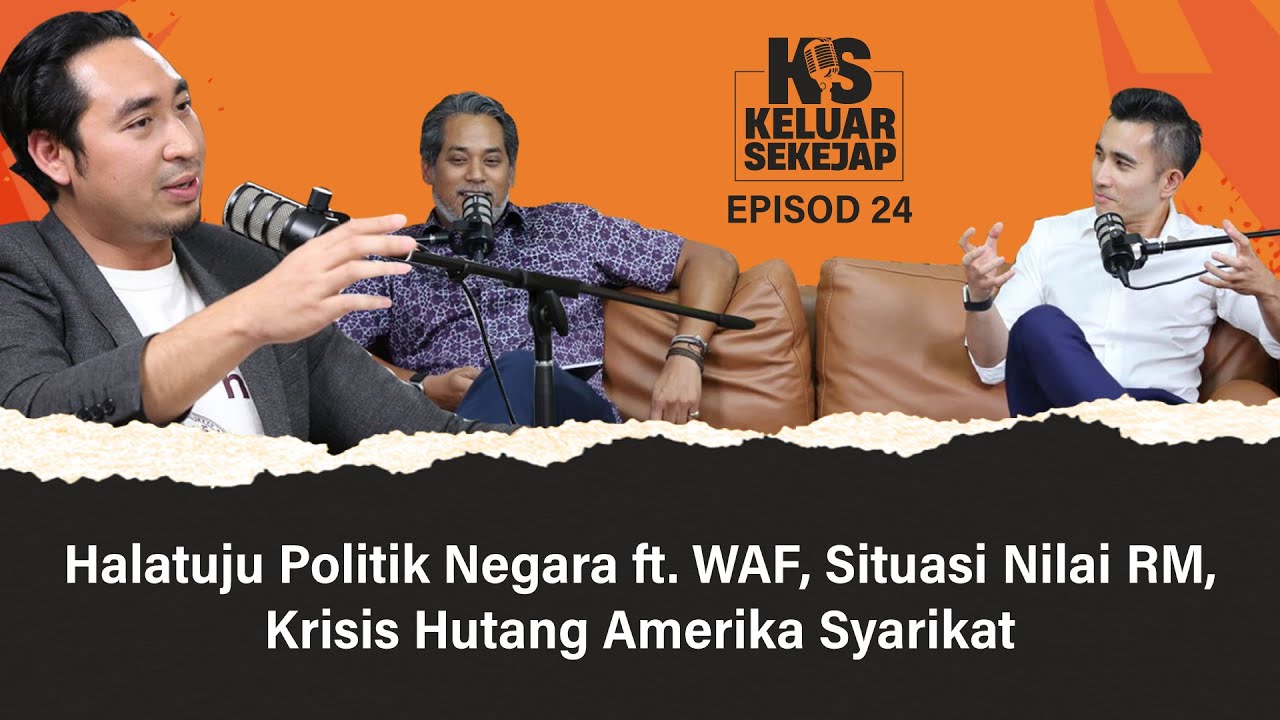
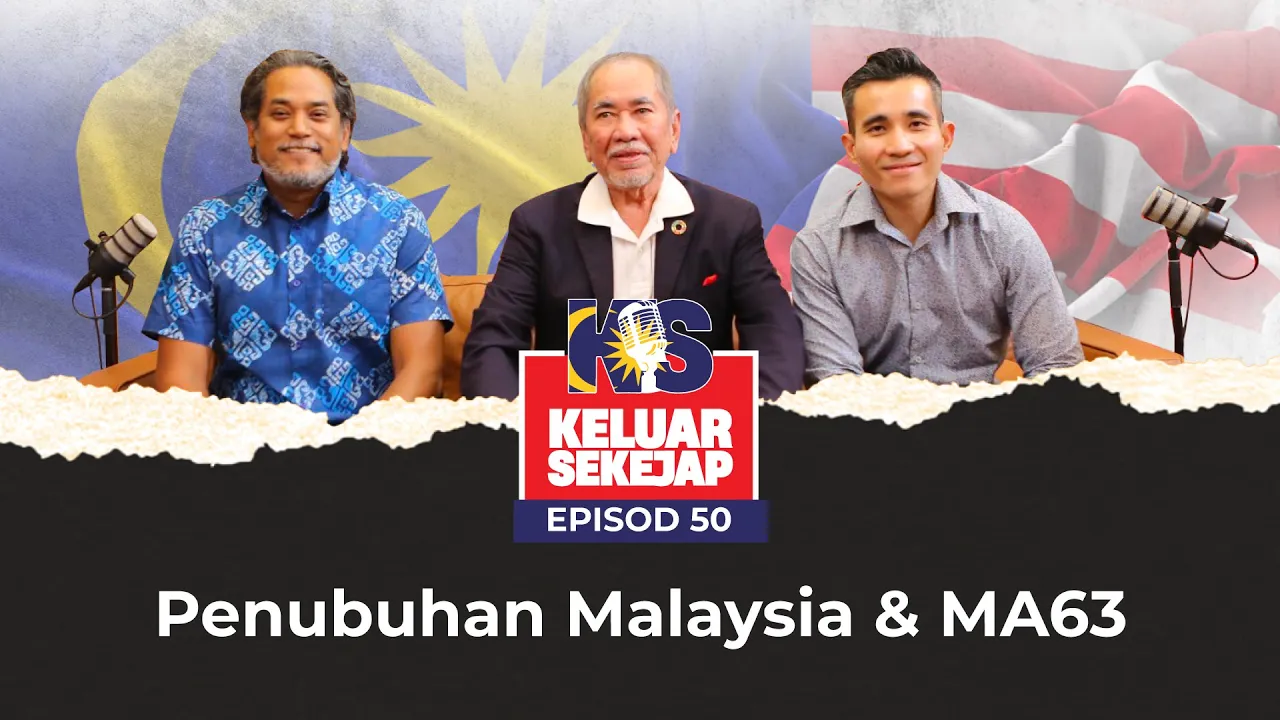
I said in the assembly, they said, what is this? We don't have the formula, how do you give? Just pluck from the one and give it to Sarawak, as if like we are asking. We are not asking, we are demanding. This is our right. The purpose is, Sarawak is large, for example, Sabah is large, compared to any other states in peninsular. So, we don't have infrastructure, we don't have water, we don't have roads, we don't have everything. What gives us the biggest advantage is, this is just Pan Borneo, Najib Time. Before that, there was nothing,
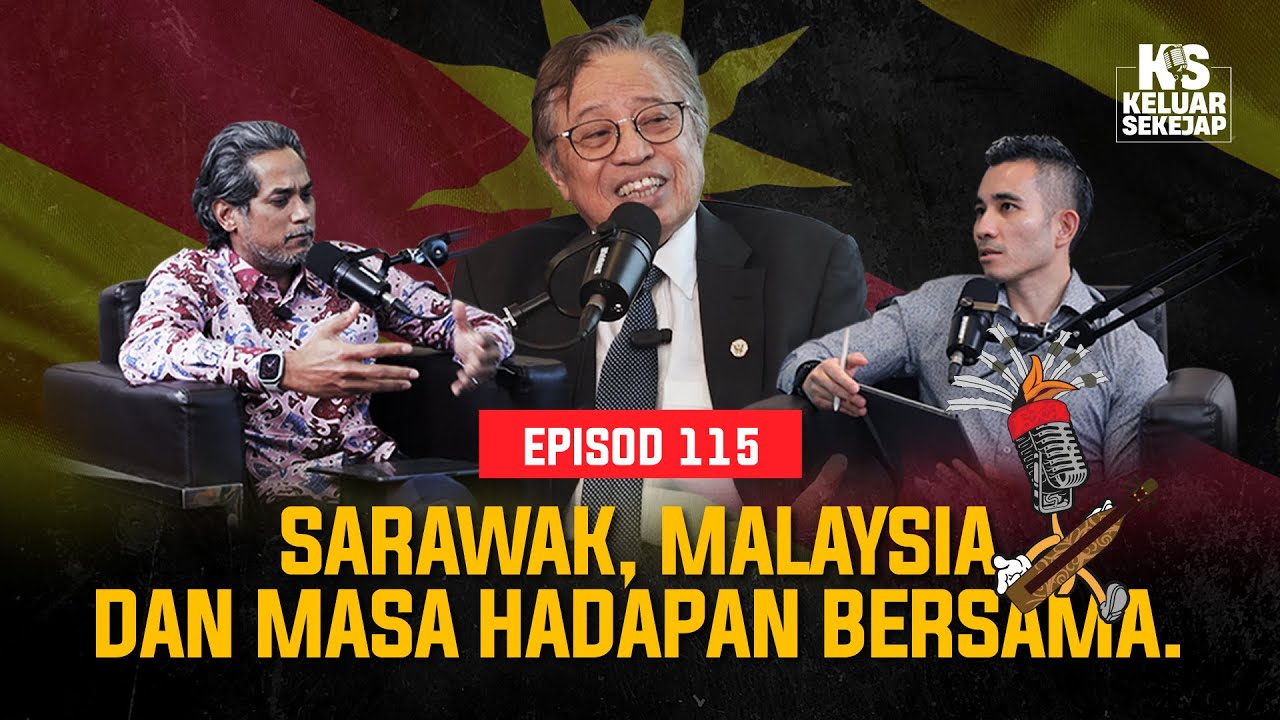
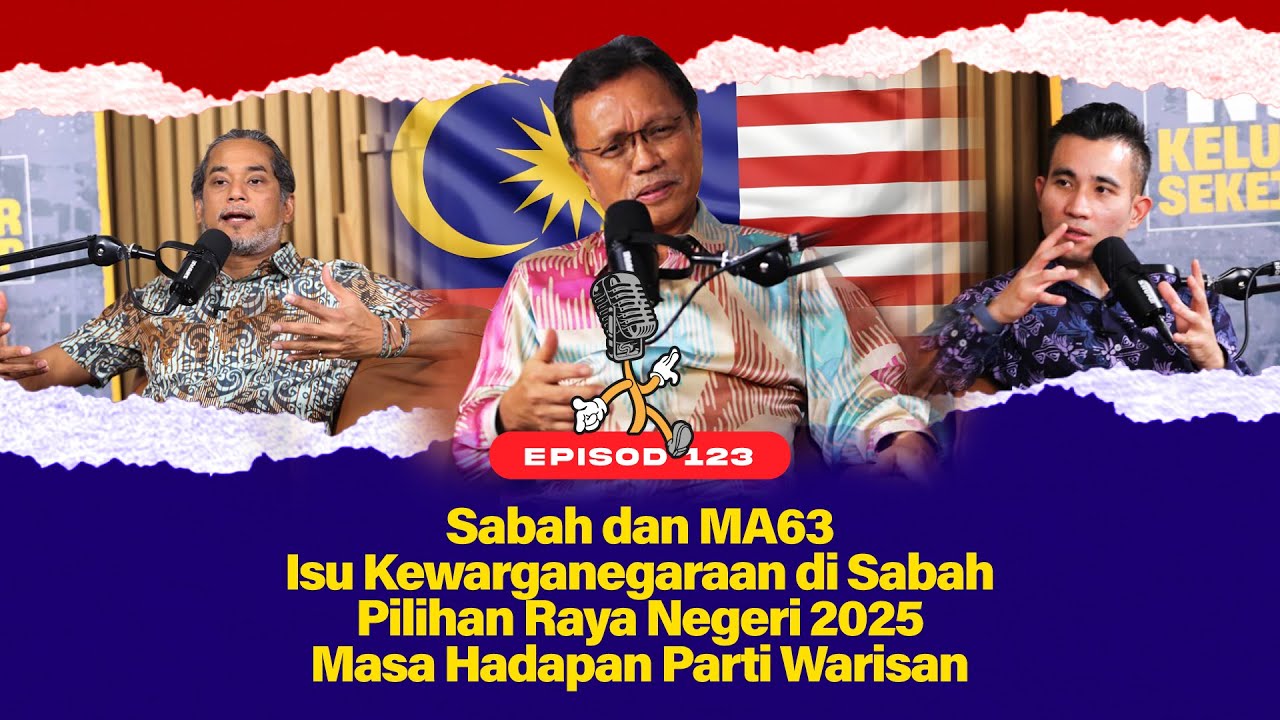
Which fulfills the desire under 11D. Peace be upon you. Welcome to Keluar Sekejap, a special edition of Hari Malaysia, with me, Shahril Hamdan. And I am KJ. KJ, this is the peak of the month of independence, our contry independence month. Yes. We have a guest. But before we talk about the guest for Hari Malaysia, KJ, 16th of September is an auspicious date, an important date. But maybe it is also a date for us to reflect and admit that many of the Malaysians have never really soul-searched the history of our country's federation. Maybe, maybe. And that
is what we want to cover in this episode, KJ. If we look at the history of our country, it was taught in school. About the federation of Malaysian in 1963 and so on. But I believe that this issue is very, very technical. And sometimes this issue is also quite emotive. Especially when we look at the aspirations of Malaysians throughout our country. And there are still things that I think are not finished. I always say that Malaysia is a work in progress. It is not completely finished. And there are still things that we need to deal
with in terms of our people's aspirations. And today But it starts with the soul-searching of history. Of course. Of course. That is why today, for the listeners and viewers, I discussed with Shahril. I said, let's do a special edition on independence. And we discussed extensively about how independence came about in 1957. I said, for Malaysia Day, on the 16th of September, it is good for us to dig deep into history. Deep dive. And wherever we go, we are honest today. We don't cover up anything. If there is something sensitive, let it be sensitive. Because we
want to discuss what actually happened in the years before 1963 that caused the birth of a nation state known as Malaysia. And I hope that the listeners are patient today because we are going to deep dive. And when we announce our special guest today, many who have followed his writings and speeches will understand that we are very serious today to discuss what we think is important in terms of the formation of the Malaysian Federation. And also for the future. Yes. History is history. And we really started from there. But we also want to discuss today
What is contained in the future of Malaysia. Yes. So, with that. With that. I think we can introduce and invite our special guest today, Yang Berhormat Tan Sri Datuk Sri Dr. Wan Junaidi, Tuanku Jaafar, who is President of the Senate and also a former Minister of the Federation. Thank you, Tan Sri, for joining us in Keluar Sekejap. Welcome. Thank you. Thank you for inviting me. Because I was also excited when I was invited. Because I always followed the podcast from afar. So, I watched KJ's shows. So, when he was invited yesterday, he sent a message.
I said, okay. Even though there is a program today, I said, cancel it first. I want to see KJ for a long time. Thank you, Tan Sri. Tan Sri, for the listeners, President of the Dewan Negara or Senator, in terms of the Federal Order of Presidents, is a very, very high position. If I'm not mistaken, Tan Sri, he is only one behind the Chief Justice of Malaysia, higher than the Speaker of Dewan Rakyat, and higher than the Ministers, in terms of the Federal Order of Presidents. And I actually know Tan Sri. I used to call
him Tok Wan. Tan Sri, it's been a long time. When I was a member of the Cabinet of Ministers during the time of Datuk Sri Najib, he was one of the most senior ministers. I was the most junior minister at that time. At that time, if I'm not mistaken, Tan Sri was the Minister of Natural Resources. And after that, under Tan Sri Mahyudin's government, he became the Minister of Entrepreneur Development. And after that, he became the Minister of Law under Datuk Sri Ismail Sabri. Before that, he was the deputy speaker of Dewan Rakyat. At that
time, I was also a backbencher. I learned a lot from Tan Sri at that time. And now, he is the YDP of the Senate. But before we go to the issue of the formation of the National State of Malaysia, September, 16th of September, and also years before that, I want to share a little bit. Because I've known Tan Sri for a long time. But aside from his extensive experience in politics as a minister, and now as the YDP Dewan Negara or the President of the Senate, One of the interesting things that some people know, but
some people don't know, is before Tan Sri got his education in the field of law, in the United Kingdom, he was a police officer. He was actually a police officer. So, Tan Sri, if I'm not mistaken, correct me Tan Sri, Tan Sri got stellar result in Sarawak Junior Certificate at that time. And he was chosen as a technical trainee at JKR. But he chose instead of joining JKR as a civil servant To join the police at the age of 20. And in 1968, Tan Sri decided to become a forest police officer. At that time, the
forest police were the ones fighting the communists. Fighting the communists. In the jungles of Borneo, of Sarawak. And he was involved in the operation Ngayau, Hantam, and was responsible for establishing the Rajang Security Command. Tan Sri, before we talk about the Malaysian formation, why did Tan Sri decide, as a top student, Who already had a job as a civil servant at JKR, to risk your life, to become a forest police officer? Okay. It's written in my book, it's called A Policeman. What happened was, I joined the police, Sarawak Constabulary at that time, in 1964. And
was given training at Kuala Lumpur in 1965. And when I returned from there, I served as a cadet commissioner in the police. I trained in JKR. What happened with the engineering section of JKR? My expertise was making roads. I was good at making road alignments from point A to point B using aerial photographs. And I could draw the road, alignments, length, distance. And I was good at costing, cutting, earth filling, Gradient, speed limit. I was taught all these knowledge to make roads. So, I had a special expertise to know how to make roads. At that
time, we didn't have many engineers in Sarawak. The road section of Sarawak was led by an Australian. And another one was from China. And the Malays were senior supervisors teaching us practical matters. So, in that situation, I found that the knowledge I learned Was enough for me. But I was only 17. After that, when I was 18, there were advertisements saying there was a chance for me to join the police force. And I was called to join the police force because one of us who was a road engineering designer from Sarawak was arrested by the
communists in Bintulu. When he said he was going to resign, I said, I'm not going to wait for that to happen to me. I'm going to resign first. Because next time I meet the communists, I'll carry a gun. Not the theodolite, not the stuff of road engineering. That's what I said. So, God blessed me. I joined the police force. I was trained in Kuala Lumpur. I returned from Kuala Lumpur as a commissioner cadet. I was promoted to inspector. In two years, in 1978, I was promoted to ASP. In Kuching, Sarawak, ASP is now scattered. Hundreds
of them. But in my time, there were only four of us. So, it wasn't a position that many people got. So, at that time, why did I choose to leave the police force? Even though I was the youngest officer, I was promoted to ASP. I was forced to be transferred to Kuala Lumpur. I was assigned as the deputy chief traffic officer of Kuala Lumpur. After I did my research, I found out that there were a lot of traffic offices at that time. I was the type of person who was on the straight road. People said
they wanted to unbend me. I told my wife, either I go to prison, or I'll become one of them. Or I'll become Serpico. Does anyone remember the story of Serpico? Serpico, yes. The story of Serpico. I became Serpico. So, I said, I'm not going to be any one of those. I didn't want to become Serpico. I wanted to self-exile in Europe. I didn't want to become a crook like them. I couldn't bear to see people committing corruption. So, the only choice, I had to quit. Before I became a traffic officer, I was in the jungle
for five years. During those five years, I was ambushed five or six times. My officers were shot dead. I once saw a war in the jungle. I was only 23 years old when I saw my officers being shot. Tan Sri, I want to ask, when you were in the jungle, watching Constable Jabu being killed, you were next to Constable Jabu when he was killed by the communists. This is the main question we're going to discuss today. Were you fighting the communists? Were you fighting for Sarawak or for Malaysia? I was defending Malaysia. Malaysia. Because I
understand that Malaysia was formed to enter Sarawak Sabah and Semenanjung. But the purpose of the communists in Sarawak The communists in Sarawak are not the same as the communists in Semenanjung. And they are not one organisation. The communists in Sarawak is an organisation that continues to report to Peking at that time. Not to the CPM in Semenanjung. So, they want to control the state of Sarawak to change it into a communist state. That was the main objective. So, I didn't defend Sarawak just to change it into a communist state so that Sarawak wouldn't be abuse
and become chaos and isolated from Malaysia. Separated from Malaysia. That was the agenda of the communists in Sarawak. To defend the state. The agreement agreed by the leaders of Sarawak at that time. Okay, Tan Sri. I had a chat with Shahril earlier in conjunction with Malaysia Day. I had a look at the map of our country. When you look at the map of our country, the most obvious characteristic is that our country is separated from the South China Sea. Between the countries in Borneo, the region in Borneo, Sarawak Sabah and the countries in Semenanjung. And
I thought that it is so unlikely that this will become a Malaysian state. When I re-examined the history, I found out that Malaysia is actually a political construct. Because at the time of Malaysian formation, when Tunku announced that there will be a greater Malaysia in 1961, this was not a historical or social construct. The situation in Sabah and Sarawak was very different from Semenanjung. You can even argue that Semenanjung and Singapore had a clearer construct compared to the Borneo territories. So, Tan Sri, is Malaysia a political construct? The common thing between Semenanjung and North Borneo
and Sarawak at the time was the British colonisation. And because of that, that is the common factor. And this became a political union. If we look at the history that goes way back, there is a small connection between the peninsula and Sarawak. The marriage of Sultan Tengah and the son of King Johor. And finally, the colonisation of Sarawak from Bintulu to Sambas. That colonisation was known as Sarawak colonisation. The ownership of the Johor-Riau Empire, when the marriage took place, the colonisation was handed over by the Johor to Sultan Tengah. And that area became part of
the sovereignty or the colonisation under Brunei. Sultan Tengah was the brother of Brunei's sultan at the time. So, his younger brother, who was appointed by his mother to be the sultan in Brunei, wanted Sultan Tengah to be the king in Sarawak. But what happened after that, after the marriage, Sultan Tengah did not come to Sarawak. But he spent a lot of time in Sambas. Because it was easier to live in Sambas than in Kuching. Where he was expected to establish his own sultanate. So, what happened after that, this area became Brunei. As we know, in
the 17th and 18th century, Brunei was from that area to Manila, which was part of Brunei's sultanate. Actually, Sulu, as we know, was the chieftain of the small sultanate In the Mindanao area, in the southern Philippines. So, it was not a dominant state. As how dominant Brunei was. So, there was a sub-king himself who might have sent tribute to Sultan Brunei. So, when this happened, it happened in the 17th century. So, after that, there was no longer any connection. The connection was severed. Moreover, when Sultan Tengah returned from Sambas, he wanted to come to Kuching.
Unfortunately, there was a power struggle in Sarawak. Because of Sultan Brunei, he couldn't depend on Sultan Tengah anymore. So, he sent a representative. There were many places in those areas. So, these representatives came from the descendants of the Arabs, our family. The descendants of the Arabs. That's what we saw during the times of Syarif Masyhor, Syarif Sahab, Syarif Osman, Syarif.. Various descendants of the Arabs were sent from Brunei to serve the Sultan. So, the locals didn't like this. There was also a representative of Brunei in Sarawak, in Kuching, Muda Hashim. He was a Brunei who
represented the Sultan in Kuching. This also caused complications in the local situation. So, in this situation, when Brooke came, they could exploit the situation. So, there was a separation of country that was 1000 km away, peninsular from Sarawak. It was cut off at that time. Since Sultan Tengah. After that, when he returned to Kuching, he was killed. And the place was returned to Brunei. So, Tan Sri, there is a history of the marriage of Sultan Tengah. There is a history but the relationship after that was severed. So, when we talk about Yes, Shahril. Yes, I
attentively listen to the history of Sarawak in the beginning. We know about the Sultanate of Brunei, then with Brookee and so on. We know the history. I just want to go back to what KJ Yes, the question that KJ asked. Why did it happen? It became a political construct. That's where we want to go, Tan Sri. But for me, as someone who is a bit younger, when we talk about the concept of construct, the formation of politics, there are two areas that may have been severed in terms of history. One is why this issue is
still alive today. Maybe it's because the history that Tan Sri told us is not known by everyone. To this day, there are people who question the importance of our education, KSSM compared to KBSM. Maybe some people say that during KBSM, it was not enough... pages given to the history of Sarawak and Sabah especially. And in Malaysia's political imagination, if we talk about political construct, to sustain this construct, we need to understand each other's stories. For example, compared to the stories of the fighters in Semenanjung, the stories of Rosli Dhobi, the stories of Rentap, the stories
of the soldiers or the heroes of independence and those who fought against the colonial rule in Sabah and Sarawak, maybe they are not as much observed by the people in Semenanjung. So, my question to Tan Sri, While you tell us how the formation of Malaysia took place, I also want you to tell us, why to this day, this historical issue is not solved yet? Before you answer. I will answer that first. Why did it happen? The formation of Malaysia itself took place. So, let's take the starting point, Tan Sri. Tunku's announcement in May 1961. I
will say that. We need to understand the background, what happened in Semenanjung, What happened in Sarawak especially. What happened at that time, when in Semenanjung, after World War II, and do you remember, 14 July 1945, when the communists came out of the forest, before the military came in as the state administration, the Malay land administration, and they held a kangaroo court in July 1945. How did they kill people? They didn't care who they were. They didn't care if they were Malay, Chinese, they just killed them. As long as the communists thought, they colluded with the
Japanese. So, they killed all of them. So, their goal was, and at that time, many areas throughout Semenanjung were taken over by the communists. Before the military government took over. So, in that situation, The communists had their own plan in Semenanjung. So, in that situation, Tunku had his own plan. Not in 1961, not on 27th of April, Actually, Tunku had his own plan in July 1959, when the Malay land administration held the first parliamentary election. Before the establishment of the parliament, which we now have two assemblies, before that, After 1957, there was only one Assembly.
Paddle Legislative Assembly. Which continued to govern the country, until 11th of April. Today is the birthday of the state assembly, the birthday of the Malaysian parliament. Two assemblies. At 10.30am, it was the first state parliament speaker was appointed. So, when Tunku thought about it in July 1959, he thought, If we let this happen, I won't let Singapore fall to the communists. Because Singapore also faced the communists. So, not allowing Singapore to fall to the communists. At that time, if Singapore and Malaya joined together, then the balance of Malay residency will be affected. Because Singaporeans are
mostly Chinese, not Malay. To make it simple, Tunku was worried that If Singapore joined Malaysia, Tunku wanted Singapore to join Malaysia. But the people's balance The people's balance will affect the Malay population. That's what Tunku thought at that time. So, at that time, Tunku thought about the Greater Federation of Malaysia. In July 1959. But Tunku didn't end there. There was a hearing in June to think about it thoroughly. To discuss it with his close friends. To think about it. It was an open discussion with his close friends but it wasn't made public. So, Tunku made
a trip to Singapore. At the luncheon in Singapore, on 27th April, Tunku made an announcement. That's what he thought. This is a thinking out loud. So, Tan Sri, from the beginning, either because of the common denominator of the British, The people of Sarawak and North Borneo, or because of the communist threat in all those regions, from the start, Malaysia was a political and compromise-forming country. Actually, many people thought, when the communists are in Vietnam, it's like the domino theory, the Huttington's theory. If that's the case, it will affect position of Malaya. And finally, when Vietnam
falls, all the countries in Indonesia will fall. The same goes for Thailand. When Thailand falls, Malaya will also fall. If Malaya can survive, because of the communist threat,// it's easy for them to survive. They can survive, but there's a backdoor. It's the communists in Singapore. So, Tan Sri, Tunku thought of thinking out loud. Thinking out loud. It's a test market. A test market. To form Greater Malaysia. To bring Sarawak, Sabah and Brunei together. With that, the balance of ethnicity. What was Britain's position, Harold MacMillan at that time? Did he support it? One, Britain, they thought
of it from the start. In the 1930s, the British had thought of one thing. The Malaya region was filled with the thought of administration. At that time, it wasn't Sabah. It wasn't Sabah yet. It was Labuan and Sarawak. Labuan and Sarawak. Brunei was never thought of by the British at that time. It wasn't the Crown Colony. They took the Crown Colony first. The North Borneo Chartered Company. From the East India Company. They put it aside. They took Labuan and Sarawak. They eventually thought Sarawak would fall to the British because Brookee has no money left to
govern. After the Second World War. So, they gave it to the Crown Colony. It was handed over to the Crown Colony. Under the government. Throughout Southeast Asia, there were several countries. Christmas Island, Cocos Keeling, all were under the British. So, they were divided. Cocos Keeling, Christmas Island, Singapore, Strait Settlement, you have Federated Malay State, Unfederated Malay State, then we have Sarawak, and Labuan. So, there were eight types of governance throughout Southeast Asia. So, in that situation, The British wanted to do away with it in the early 1930s, before the Japanese War. So, when Tunku announced
its plans for Grand Malaysia, actually, the offer was already with the British. It was already with the British. Okay. Tan Sri, we will take a break. We will be back after the Tunku's announcement. What was the response? In Sarawak and North Borneo? We will be back after this. Welcome back to a special episode of Hari Malaysia Keluar Sekejap with Tan Sri Datuk Sri Dr. Wan Junaidi, the President of the Dewan Negara and also a historian related to the development of Malaysia. We have discussed the history of before Tunku Abdul Rahman's historic announcement on the establishment
of the Greater Malaysia. Tan Sri, let's continue the story. After the announcement of Tunku in 1961 on the establishment of the Greater Malaysia involving Semenanjung, Singapore, Sabah, Sarawak and Brunei, That was the imagination at that time, this caused a shock in the Borneo territories because they were worried that they were not ready for this. For example, the Parti Negara Sarawak, PANAS, a party established in 1960 by Datuk Bandar Abang Haji Mustafa, was rather positive, but it was more of a view that these three territories should be combined first, Sabah, North Borneo and Brunei, before discussing
the merger with Semenanjung. It was the same with Steven Yong, a general secretary of the SUPP party, who thought that the merger with Semenanjung Should only be considered after Sarawak has achieved a large measure of self-government and independence. Also in North Borneo, Donald Stevens (Tun Fuad), was against it. He said that it is just switching their status as British colonies to become Malayan colonies. So Tan Sri, the rejection in 1961, was the rejection very severe towards Tunku? If we look at it from a factual point of view, the rejection was only towards certain parties. If
we look at Sarawak, I don't dig deep into the views of the Sabah party. But from the point of view of Sarawak, actually the majority of Malay people, we can say the majority of Malay people agreed. Because Malay people agreed based on one thing only. Because of the Malay name. Semenanjung, Malay. Sarawak, Malay. So this attracted the attention of Malay people. The Malay people wanted to merge. But there were three groups. Malay, including Melanau. And the second was Iban, including other Dayak. Iban was one group. But the Bidayuh was another group. Because they had their
own opinion. Most of the Bidayuh people, the Ulu people, thought that it was better to continue to be under the British. And the British had taken care of them. Very well. So in that situation, they still thought it was better to remain as, colony under the British. But Iban was more advanced in their view. They thought that they wanted, After several discussions among themselves, to call the head and leader of the Iban region, specifically from Kapit, where the 18 points came from. So they decided, this is what we want. That was one. The second was,
the leaders of Sarawak and Sabah, were invited to Semenanjung. And seeing the developments in Semenanjung, at that time, in 1963, That had a great impact on everyone. That became a key factor, a big driving force. The development of Semenanjung, the leadership shown by Tunku Abdul Rahman, among the people here, showed no significant difference. Meaning, there was nothing that Sarawak people didn't agree on. From the point of view of Sarawak people, from the point of view of religion, from the point of view of development, and how Tunku, Tunku's work at that time, to establish a country
with various people. So this was interesting for Sarawak people. Development. That's what was discussed. So if Tunku's work, can bring development and harmony, then it can also bring peace, harmony and development to Sarawak. That encouraged Sarawak people to support Malaysia. Tan Sri, is it because of the tour? Yes. Because before that, you said, let's take the example of Dayak, the leader, maybe SNAP at the time, Stephen Ningkan (Stephen Kalong Ningkan). His term for Malaya was foreign power. Foreign power. Was it just a tour, seeing all the good things in Kuala Lumpur? But if you look
at it, don't just look at it from the point of view of Kalong Ningkan (Stephen Kalong Ningkan). Kalong Ningkan (Stephen Kalong Ningkan) was not considered as a leader at that time. He was still young. He was still young. The person who had great influence was Tun Jugah. So Tun Jugah, to garner the support of all Sarawakians, especially Dayak, which we now know, including Bidayuh. Whereas Bidayuh didn't want it. Bidayuh said, we prefer to stay under the British colony. The same goes for the Ulu people. They wanted to stay under the British colony. But because of
the name, leadership, and Tun Jugah himself, who had great influence, this party supported it. Finally, along with the Malay people, they agreed. Tan Sri, can you tell us, at that critical moment, was there any other vision or imagination to form a nation state that was independent Along with other parties? For example, Indonesia, the Philippines, which might have their own logic. Here's the thing. If we look at what happened in Brunei, the Azahari rebellion in December 1962. The rebellion happened because they didn't agree with the Malaysian alliance. Actually, this matter had been discussed. It had been
known to many. That's when Brunei forfeited... ...after that, it was because of the internal elements. It wasn't because they didn't want to. In fact, there was a chance for Sultan Brunei to become YDPA. That wasn't important. What was important was that the Azahari elements want the merger between Sabah, Brunei, and Sarawak. They wanted to unite them first. Even if there was an merger, It wasn't with the Semenanjung, but with Indonesia. That's what they wanted. For your information, there was a rebellion in Brunei, the Azahari Revolt, where a man named M. Azahari rebelled against the merger
between Brunei, Sarawak, and North Borneo with the Semenanjung at the time. In the end, Brunei wasn't involved. But I understand that Azahari Received a lot of support from Indonesia and the Philippines. In fact, he fled to the Philippines after the British army had defeated his rebellion. The purpose of the Philippines getting along with Azahari was nothing else. The game was political because of the Philippines' claim to Sabah and North Borneo. That's why they didn't want To be united with the Semenanjung. If the three of them were united, we don't know what the Macapagal didn't see
at the time. Maybe they were more interested. If they could, they'd take Sabah out and become part of the Philippines. The other parties' views, if we look at Sarawak, why did Sarawak want to unite with Malaya? Whereas there was another system under the United Nations, The trust system. The trust system was that the Australians agreed that Sarawak ought to be independent under the trust system. Just like what was done in Namibia, Jordan, Transjordan, New Guinea, etc. If I may mention Tan Sri, there were a few months, between July 1963 and September 1963, where Sarawak had
a self-government status. What happened in those months? Was there any effort to cancel? That's not the question. We all know, during the talks with Cobol, during the talks in the Solidarity Committee, everyone demanded that Sarawak be given independence first, that Sabah be given independence first. The demands were the same. Sabah and Sarawak both demanded that we be independent first before we joined any other party. That was the third party. They said, join the three parties. That was another party. Most of them came from people who supported Azahari. They had their own thinking. But the local
leaders of Sarawak and Sabah wanted Sarawak and Sabah to be independent before joining Malaysia. That was the basis. But what the British did, just like what the British did in Malaya, remember that Malaya was not independent in 1957, on 31st August. Malaya was a protected country. The non-federated state was a protected state. Only those four federated states were under the British. So in those circumstances, Malaya was given self-government on 1st August 1955 by the British. Tunku Abdul Rahman became the first Prime Minister and the last Prime Minister of the Peninsular. So the British practiced that.
I'll go back to the Malaya story. Why did the British want to establish a Malayan Union? It's not an agenda. To me, it's not an agenda. To me, it's a common British thinking. If the British started to establish the Union of British, England, Scotland, Wales and Ireland in 1707, the Union wanted to use the example of how it was done in Australia, how it was done in Canada, and how it was done in Malaya too. But it didn't succeed because we want to preserve our sultanate in each country. So that's why the Malays opposed the
Malayan Union. Finally, the British practised the Federation. We negotiated. Finally, we established the Federation of Malaya in 1948. The Federation of Malaya in 1948 was the British plan to liberate Malaya. Even though in my first book, I said that the British might have a long plan in Malaya to manage the Federation of Malaya, the Federated Malaya State, the Unfederated Malaya State, and the Strait Settlement under one administration. So that it's easy to manage. So that Sarawak and Sabah can be managed in a different way together with Labuan, and Cocos Islands Christmas Island, one system. So,
the system will only have four instead of eight. So, it's a bit easier. But after that, I saw that there was no element The British only followed their own practices. After that, they gave their own Can you govern your own country? They gave the government. Can you control and face the communists? They did the same in Sarawak. On 22 July, they gave the government to Sarawak. So that Sarawak Can you govern your own country if you're given independence? Tan Sri, if I may, I'd like to go back to the chronology. On 19 August 1968, the
Commonwealth Parliamentary Association in Singapore established the Malaysia Solidarity Consultative Committee, MSCC. There were representatives from Malaya, Singapore, Sarawak, Brunei, and North Borneo, or Sabah. This was the first thing. The date was 1968. 1961. This was the beginning of the discussion towards Malaysia formation. I'll just take the milestone and we'll comment, Tan Sri. After that, in January 1962, if I'm not mistaken, the Sarawak government issued a white paper Which outlined in the white paper that, I quote, very difficult and very expensive for Sarawak with its small population to stand alone as an independent territory. The opportunity
of joining Malaysia was unlikely to recur and an independent Sarawak would be left with no alternative than a perilous existence as a small defenseless country in a large predatory world. It was stated there that the possibility of Sarawak surviving as an independent country was a low possibility and it was better to join Malaysia. That was the basis of our discussion. It came to the Cobbold Commission. Now, Tan Sri, maybe you want to tell us a little. Is Cobbold Commission a truly fair discussion? Its chairman, Lord Cobbold, former governor of the Central Bank, Bank of England.
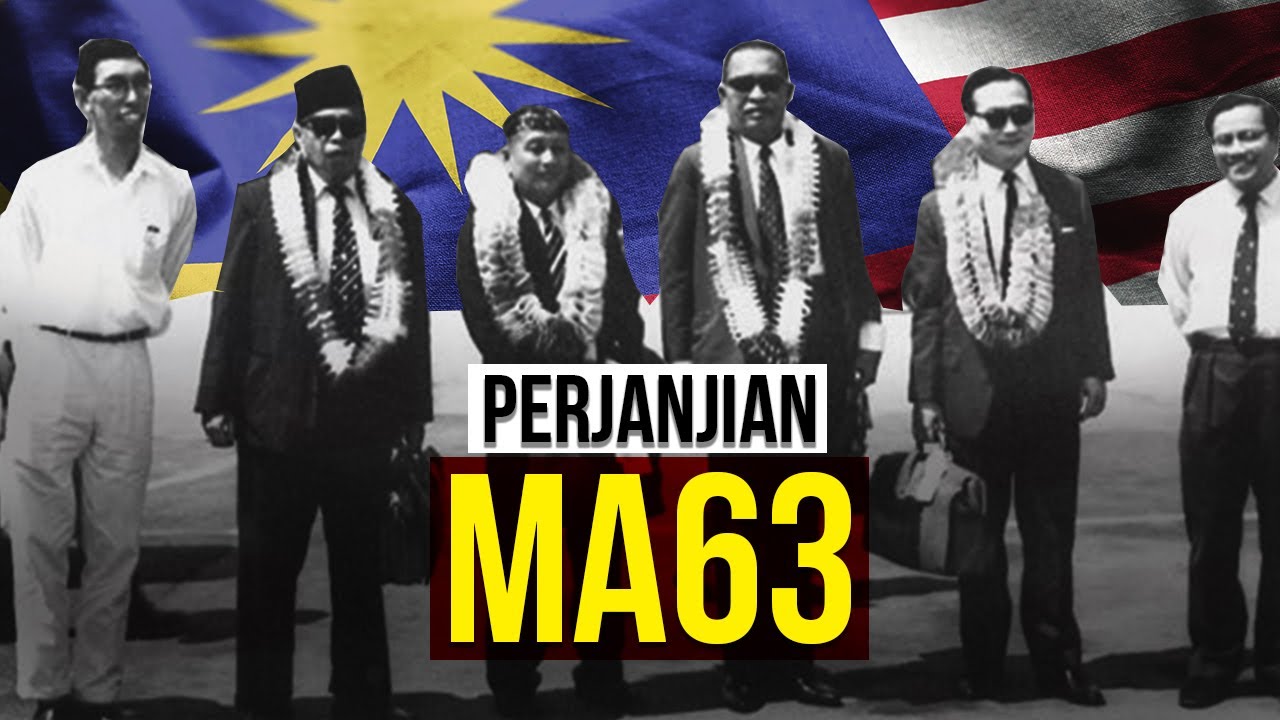
Then, its members, two more British members, the governor of Sarawak, Anthony Abell, David Watherston, former chief secretary of the Federation of Malaya and the other two are Tun Ghazali Shafie (King Ghaz) and Wong Pow Nee. No representative from Sarawak. So, what's the story, Tan Sri? Actually, it was an agreement between the British and Malay. Because, if the territory is a colonial territory, it has no voice in the world. In the agreement, it only took people with voice. So, I can explain why the MA63 agreement was legal or nullified right from the very beginning. So, to
me, that was the view of the British. When the Solidarity Committee held, if I'm not mistaken, five or six discussions, then they held a memorandum. The memorandum was very comprehensive. When Cobbold met with people in Sarawak, the members of the Solidarity Committee answered, we have brought in the Solidarity Committee, you see that one and we follow that one. We didn't have to comment to you anymore. That's what they said. So, the Common Role Parliamentary Association established a committee. This committee played a very important role in influencing the people of Sarawak. In fact, elements from that
were discussed in the House of Commons. They said, Sarawak couldn't do anything. They didn't even know how to make a needle. So, how can we be independent? Except if you're with a developed country like Malaya. That was the thinking of that time. So, the British influenced the Sarawak people's views and thoughts through those angles. But we also have to remember Sarawak. What was the struggle like after leaving Brooke and being handed over to the British colony in 1948? What was the Sarawak people's view of us? 338 Sarawak workers across all government departments resigned from the
government service due to Sarawak being handed over to the, what's it called? The Crown Colony. The Crown Colony. That means they didn't like being under the Crown Colony. So, another one being independent Sarawak under Malaysia is a much better option than under any colonial power. Any colonial power. The Crown Colony. Even though there were parties who said, okay, we want this. But the opportunity to arise as a result of a better offer. Sure. That's their view. So, that's why there was a lack of resistance from Sarawak compared to Sabah. That's the first. Second, Sarawak had
hopes of becoming a communist. Remember that. Did Sarawak have the ability to defend itself against the rise of communism in 1962? In the 60s, Sarawak had, in 1952, Sarawak had hopes of becoming a communist. Sarawak was very well informed about the communist subversive element in Sarawak at that time. And in 1962, more than 1,000 young people from Sarawak ran across the border to get training from the tani and together with volunteers from Indonesia, returned to Sarawak to attack Sarawak. Tan Sri, I have to ask this question because you fought the communists. If there was no
Sarawak together with Malaya at the time as Malaysia, Could you have defeated the communists on your own in Sarawak? I still remember. The members of Sarawak Constabulary were not many. We were just enough to take care of the city. The Police Field Force was not expanded yet when I joined the Police. In 1968, the Police Field Force was expanded to take over the place that was previously occupied by Gurka and green beret//. from Britain. When they left, the army from Semenanjung, the Police Field Force from Semenanjung, Entered Sarawak to help us guard the 1,100-kilometre border.
So, it was a border that was not that short. They saw that it was only 600 kilometres north of Semenanjung. We had a 1,100-kilometre border with Kalimantan. So, the volunteers from Kalimantan entered Sarawak. When the British left Sarawak, the army from Malaya and the Police Field Force from Malaya came to help us. Okay, KJ. Are we done with the history part? No. Just a little bit of history, then we take a break. I want to round off the history. Because after the Cobbold report, in July 1962, if I'm not mistaken, After the Cobbold report, correct
me if I'm wrong because Tan Sri is more experienced, there was an announcement that the Malaysian Army would be formed on 31 August 1963. So, you have between July of 1962 and August of 1963. Just slightly over one year. And during that one year, Lord Lansdowne became the chairman of the Inter-Governmental Committee. Tun Razak was the chairman of the committee. To thrash out the details of the formation, including the rights, the transfer to the institution, including all the requests that were contained in the original memorandum that was sent. This is the real work. Tan Sri,
don't you think one year is rushed? To gather all the requests of the Sarawakians, Sabahans regarding the status of the natives, immigration, sharing of financial resources, how to provide the financial resources to the Sarawakian, Sabahans. Some say it's too rushed. If we look at it from the multilateral or bilateral negotiation point of view, the period of time from the formation of the Cobbold Commission itself to the Cobbold Commission's report and the frequency of meetings between the Cobbold Commission with the Sarawakian people and the Sabahans, I see that it is indeed too short. There is an
element of rushing in that period of time. But we know why, especially the British during World War II, faced with a critical economic situation, and the British built themselves in all aspects, the military, social, physical development in Britain itself, needed finances, they were also pressured. So to build countries, areas outside of Britain, there was a great pressure on them. So if the opportunity was given, in principle, it was seen in the report from the Solidarity Committee, the opinion of the Sarawakian, Sabahans, before the Cobbold Commission entered Sarawak and the Sabahans, This idea was welcomed by
many as a principle, everyone agreed with it. So in that period of time, even though they interviewed 2,000 people, a group of 2,000, hundreds of memorandums were received. So if we look at all of that, the pattern of research was rushing. But at the same time, we cannot deny that the research was very comprehensive. So it was valid, even though it was rush, it still valid. I think this is important, Tan Sri, Because until today, there are people who are still fighting this issue as a basis. I'm just a devil's advocate, Tan Sri. I think
that this rush is what forced you to become a hero in 2022 to move the constitution. If not, the constitution should have already been there. Maybe it would have been in a better state if not rushed. I mean, devil's advocate, Tan Sri. To me, the constitution has a weakness from the point of view of the British law. We remember when the IGC, Inter-Governmental Report was established, After the research and acceptance, the Cobbold Commission report was handed over to the British side first. After that, it was handed over to the parliament. After that, the IGC was
established. When the IGC was established, the IGC established five legal authorities, including the Law Enforcement Authority. So, the administration, all of them, established five legal authorities. And every member of the IGC, there are many of them, There are almost 30 people in the IGC, the Inter-Governmental Committee. The legal studies, there is a weakness in the situation here. So, I don't see any other implications. Only the weakness of the legal studies because apparently, it doesn't look at the federal constitution. Because the IGC report, the IGC committee made the decision whether to adopt the Malaya constitution or
to enact a new constitution. So, the Inter-Governmental Committee, in the third meeting, in the third meeting, they decided to adopt the Malaysian constitution. So, you graph Sabah and Sarawak on top of the existing document. So, what happened was, when the first concept of accepting the Malaya constitution was adopted as the basis to establish the Malaysian constitution. That was the first. But they didn't study the implications, the definition and so on. What a big decision. If it wasn't for that decision, if it was the other way around. So, that's why, for 58 years, the Malaysian constitution
didn't accept the Malaysian 63 Agreement. Until I became the Minister of Law. So, if we look at what Nazri said in my presentation, we should be ashamed of ourselves. Did Nazri say this? Nazri Aziz. We should be ashamed of ourselves until Wan Junaidi sits there And makes this move so that the Malaysian constitution can accept the existence of MA63. Whereas, if we look at it, when the 57th agreement was drafted, which was signed by Duli-Duli Tuanku Sultan, to establish the Malaysian constitution with King George, on 5th August 1957, all the Pangkor Agreement, the Straits Settlement
Agreement, the 1948 Agreement, were absorbed by the Malaysian constitution. They were replaced. In the end, all the agreements, including the four initial agreements, the establishment of the Malaya, were absorbed by the Pangkor Agreement, the Straits Settlement Agreement, the Federal Agreement of 1948, and the Agreement of August 1957. But when the other federation was established, we had three federations, the Malaya Federation until 1963. On 16th September, the Malaysian Federation, including Singapore, Sabah, and Sarawak, after that, Singapore left in August 1965. When they left in August, there was another federation after that. So, the law was not
changed. It was not changed. In the end, from the perspective of the law, if we look at it carefully, We still used the 1957 agreement. We did not accept the Malaysian Agreement. Until 1963. So Tan Sri, we will take a short break and we will go forward into the future because I think we have discussed a lot. We will be back after this. Welcome back to a special episode of Hari Malaysia Keluar Sekejap with Tan Sri Datuk Sri Dr. Wan Junaidi. We are listening to the historical masterclass today. I think these are things that are
rarely discussed and will certainly open up new perspectives. Before, because we are too serious, Tan Sri, I want to lighten the mood a bit. Tan Sri, why do we have two important dates, 31 August and 16 September? Because this has become an issue of politics. Actually, one country is better off with just one date. Originally, 31 August 1963 was the plan to establish the Malaysian Federation. But why was it delayed until 16 September? Okay, we have to explain the history as well. Remember, in December 1962, Azahari rebelled. In the end, Brunei was not involved in
the establishment of Malaysia. The sentiment showed that Brunei did not want to be a part of Malaysia. So if we look at it, the Philippines and Indonesia did not agree due to certain reasons. Sukarno said it was a neo-colonialism. Philippines said the same thing but there were other reasons. Philippines did not want to. The Philippines. So, they were forced to do so. So, there was disagreement between the Philippines and Indonesia. When no agreement was reached by close neighbours, I usually answer the questions of my friends, including the questions of my children, who wanted to correct
this history. The same question was asked by my children. I said, actually, what happened was, Tunku Abdul Rahman was a very good human being. We had to continue to be neighbours. We couldn't run away from each other. The Philippines was our neighbour and so was Indonesia. We had to be good to each other. So, the Tunku speech on August 15, 1963, was still in the hansard. He said, if we were forced to delay, we would do so. We would wait for another date. That was why the opposition from Indonesia and the Philippines, in a strategic
manner, did not accept or recognise the Cobbold Commission's report. So, it was approved by the Malays, the Philippines and Indonesia to hold a summit. This summit was called the Manila Summit. The Manila Summit was held from 27 July to 3 August. This summit finally made a declaration and an agreement. One of them was to ask representatives from the United Nations To come to Sarawak and Sabah to assess for themselves whether or not the people of Sarawak and Sabah agreed with the Cobbold Commission's report. So, this question was very relevant at that time. It was very
meaningful for Indonesia and the Philippines. So, the Tunku said, we agreed. So, that was why another agreement was signed, 28 July 1963, a Supplementary Agreement was signed. The Supplementary Agreement was signed by Malaysia, MA63. The Malaysia Agreement was signed on 9 July. On 28 July, another agreement was signed. The Supplementary Agreement was signed on 9 July. The agreement was to postpone the date from 31 August 1963 to 16 September 1963. In fact, at that time, the Act of Malaysia was passed by Britain, Chapter 35 was passed. The date was 31 August. Likewise, the Act of
Malaysia was passed. It also stated 31 August. The 1963 agreement on 9 July stated 31 August. All relevant documents determined the date to be 31 August. It was a date. Everyone should know this. It was a date. Queen Elizabeth's sovereignty would be withdrawn. England's invitation would be withdrawn. I said it in English. That is the sovereignty and jurisdiction of Queen Elizabeth to be withdrawn. It also withdrew the lifting of the British Law from being enforced in Sarawak and Sabah. On 31 August 1963. However, due to opposition from Manila and Indonesia, Manila Summit was establihed. Manila
Summit wanted the U Thant to come to Sarawak and Sabah. Finally U Thant came to Sarawak and Sabah. The Secretary General of the United Nations was in the forest. He came to Sarawak and Sabah to discuss with the leaders of Sarawak. He didn't come to the ground. He didn't do a survey like Cobbold. He only had a discussion with the leaders of Sarawak. It happened. You have to remember the date. The date after approval of all the laws. The date was delayed. It was postponed. The Parliamentary Agreement was on 28 July. It was postponed. Even
though it was in the Law. Even though it was in the Agreement. It was postponed until 16 September 1963. It was postponed. After that, when it was postponed, the U Thant came to It came back. We knew it from New York. If he wanted to go to Singapore. he boarded a DC-10. It was like a kangaroo flight. It was transit at Guam and other places before it arrived. He wanted to report to the United Nations General Assembly. He wanted to report to the United Nations for the adoption of the U Thant report. That's why it
took a long time. From 31 August to 16 September. From 28 July. So, clear? History? Clear. Bring us to the future. Okay. We've been talking about the history of Tan Sri for an hour. If we can, we'll switch gears and ask Tan Sri to switch gears. From a historian that I've been listening to for an hour to a politician. You're still a politician. In a way. As President of the Senate. Recent Minister. We want to talk about the present and the future. I want to go back to what I tried to say for past half
an hour. It's about the soul. A diverse history. The history of Sabah and Sarawak. It may not be fully understood by the people, especially in Malaysia. If we talk about the Malaysia agreement that was only finalized in 2022 in terms of the amendments of the institution by the then Prime Minister, Dato' Ismail Sabri and Tan Sri as Minister of Law. These issues are still relevant to this day. But the question is why are these issues still relevant apart from the question of history, Tan Sri? Do the people of Malaysia as a whole Understand each other's
history? I mean, in Semenanjung do you think it's enough exposure as what you've said? And does Sabah and Sarawak understand each other's history? I'll give you both perspectives. If we look at it the MA63 agreement was only included in 2021. And gazatted in 2022. So, there are still many things that were promised in this agreement because people misunderstood. When people hear MA63, they think it's just an agreement. The agreement is just two pages. But in the IGC report, the content itself there are many agreements that haven't been implemented. That's one. Second, when the emergency happened
in 1969 the military administration used the emergency to encroach into the right of Sarawak and Sabah which was taken from here. So, the dissatisfaction of the people of Sarawak is because what was promised was not given. What was promised was given but it was withdrawn. If it's withdrawn, it's not just that. There are things that haven't been implemented yet. So, this makes the people of Sarawak feel dissatisfied. Can I explain? For example under Article 112D which is the contribution fund. What is it called? Development. The purpose is to fulfill the wishes of the people of
Sarawak and Sabah who visited Semenanjung. The visit. The visit was not fulfilled. That's the purpose of Article 112D. The contribution was never given. In 1965, it was given 4 million. In 1966, it was given 8 million. Double. In 1969, it was given 16 million. After that, it was stopped. It was stopped. For how many years? Until the Pakatan Harapan came in and offered 32 million. I spoke in the assembly and they said, what is this? We don't have the formula how you give. Just pluck from the one and give it to Sarawak. Like we're asking.
We're not asking, we're demanding. It's our right. The purpose is Sarawak is large. For example, Sabah is large. compared to any other states in peninsular. So, we don't have infrastructure. We don't have water. We don't have roads. We don't have everything. What gives us a lot is Pan Broneo, Najib Time. Before that, we didn't have anything to meet the needs under 11D. That's one. The second. I'm from JKR. JKR includes DID. In 1976, DID was established. Department 1 and DID 1. Two agencies. Under 112D, the central government gave us money To support us. How are
we going to pay for DID? There's no money given. So, if you look at it from that perspective, we've lost billions since 1969 until now. Only Dato' Sri Anwar Ibrahim became Prime Minister. Very generous. In my year as Minister of Law, he gave Sabah an offer of 186 million. I still remember that. Some people said Sabah agreed. But Sarawak said, no, you want the formula. How you give? If you get the formula, it doesn't matter whether you give the money or not. If you don't give the money, you're in debt. But we want the formula
And we know how much it costs. After that, when Dato' Sri Anwar came, he was very generous. He gave 300 million to Sarawak. How much did he give to Sabah? 200 million. So, it's a big deal. But if you look at it from the perspective of the formula, double, double. Every year, double, double. Every 8 years review. If every 5 years review, 8 reviews we don't do, double, double, double. Now, it's 1 billion a year. So, if it's 1 billion a year, that's a lot of money. So, this doesn't exist. That's just a small thing.
We haven't talked about other things. Below 112, which is, Sarawak has parts. Many areas in Sarawak don't have access to employees. We want to build parts. We want to hire residents. We want to hire DO. We want to hire SAO, Senior Administrative Officer in Sarawak. We can't. Because Sarawak's establishment is controlled by the federal government. I understand why the federal government didn't go through with it. Because in the end, these employees, 30 years down the road, become pensioners. And the pension is paid by the federal government. So, why can't Sarawak be built the positions can't
even be opened. positions So, the office can't be built. So, Sarawak is limited by the constitution. And for autonomy on health and education, it's stated in the IJC. Representatives of Sarawak and Sabah in the IRD, Inland Revenue Board, it was only approved during Ismail Sabri's time. During my time. It was approved by the central government to appoint. Representatives? Not yet. Sarawak's representative. But it's not in the law. It's on discretionary to authority of MOF only. MOF's minister. So, things like that. It can be withdrawn at any time. If the minister wants it, it can be
withdrawn. So, Sarawak can't get it. Sabah can't get it. So, it's in the IJC report. But why? It hasn't been implemented for a long time. It's an easy thing to do. Tan Sri, if I may, I want to ask a sensitive question. So, why do Sarawak and Sabah feel disappointed with this? Okay. So, for those in peninsular who don't understand what's in the agreement, why does Sarawak keep asking for it? So, Tan Sri, I want to ask a sensitive question. I understand the historical grievances of Sabah and Sarawak. But I want to change the perspective.
I want to ask why hasn't there been progress all this time? Is it because the political leadership of Sabah and Sarawak didn't push this before? Because we see this only happens after the BN hegemony ended in Semenanjung. That's when Dato' Sri Najib said, I better secure Sabah and Sarawak. We look at Pan Borneo. We recognize 16th of September. It was also a political move. We can't deny the fact that it was a political move. Because we need Sabah and Sarawak. But from the perspective of Sabah and Sarawak leaders, there might be some responsibility if I
may be a bit provocative, Tan Sri. Why is it only in the last few decades did this issue resurface as a live political issue? Before that, the leadership in Sabah and Sarawak was okay with the leadership in Semenanjung because they were part of the Barisan Nasional because they aligned. Only after the hegemony of BN was threatened After 2008-2013, then suddenly MA63 became a big Sorry, Tan Sri. It's a bit hot. This is not RTM. It's a bit hot. I'll divide the government into few stages. Before the 1980s, the second emergency in Semenanjung ended in 1989.
Emergency. The basis of the emergency was to give power for emergency laws to be implemented. Emergency laws were only abolished in 2009. Finally, it was passed by the Malaysian parliament in April or February 2011. During the Najib era. So, the pendulum was hanging with the people of Sarawak and Sabah. If you open your mouth a bit, maybe it will end up in Genting. No, in Kemunting. In Genting. But it ended up in Kemunting. We saw that James Wong and Wan Yusuf had entered Kemunting. Many of us entered Kemunting too. I don't know the basis. Maybe
it was under the ISA. So, these emergency laws became a pendulum that was hanging over Sarawak's thinking. So, we weren't afraid to enter Kemunting. But in the end, logically, what did we get? Only to enter Kemunting. That's all. But there was no result. The people of Sarawak were more logical in their thinking. So, it was useless to enter Kemunting. We didn't get any result. Whereas, if we look, since the 80s to the 90s almost 50% of the budget was from Petronas. While the oil from Sarawak and Sabah was the most. We only recently got it
from Terengganu. So, we saw why the money we got from our land was used to build twin towers that didn't even exist in Malaysia. Putrajaya was built but Sarawak didn't get it. Sarawak people said they didn't get it. KLA was built. Pulau Pindang Bridge was built. There is no Sarawak's Bridge. So, if we look at all this, but still, the pendulum is hanging overhead. We have to look at how many Sarawak leaders have entered the ISA. We don't know the reason. So, Sarawak was careful to talk about this openly. But the demand from the government
itself continued from that time. The demand from the government of Sarawak. But the people in Semenanjung, the administration, can show where in the papers is this thing. This demand. Because MA63 didn't even enter the agreement. // cannot be used as a reference. Because it wasn't in the constitution. It wasn't in the constitution. Until the constitution was accepted. In 2021. No effort has been made since 1963 to realise this. To accept the agreement. So, we don't have a basis. We just talk. Okay, Tan Sri. Now, we've fast-forwarded to today. Tan Sri has succeeded in ensuring the
transition of the institution and now MA63 is part of the institution. And there's a basis. And there's a basis. So, it's done. But what's not done is, of course There's still a lot. The reason is, the failure is since 1963, we haven't been able to implement it in stages. If it was implemented in stages from 1953, one thing would happen. That is, the development of Sarawak and Sabah even if it's not the same as Semenanjung is not that far behind. Because Sarawak and Sabah are vast. So, the infrastructure, The population is not as big as
Semenanjung. So, it can't be done like Semenanjung. But if you build a toll road in Semenanjung across the state all states can benefit. Two or three states can benefit. But what about in Sarawak? If you want to do it, just do it in Sarawak. That means you've got to use government property. Government money. Government funds. So, this is not done. So, the failure of the government since 1963 to do an implement of this agreement is not done. That is a major failure. Second, when the Petroleum Development Act was enacted there was a law. 11th ///,
1969. That is, ordinance number 10. That allowed the central government to extend the law to the use of Sarawak. Mining Act and Continental Surf Act was enacted for Semenanjung only. In 1966. But after the emergency happened it was extended to Sarawak and Sabah on the same full force as in Semenanjung. So, we used the emergency. We can't protect it. Actually, this law is in breach of the Article 2 of the Constitution. So, in the actual situation.. Now, the Sarawak people are smart. They know how to evaluate why this was done. In the past, we couldn't
talk. We were afraid of your ISA. Now, we can talk. When we talk, the government might not be able to do it anymore. The situation, the need is expensive. In the past, to build the North-South Highway, how much did it cost? But if you want to do it that long, now you can. It's a lot of money. Like the Pan Borneo in Sarawak, it's 16 billion. In Sabah, it's few more billions. So, in that situation, the failure was to fulfil the promise that was made in 1963. It was not carried out step by step. If
it was carried out in the past you don't deny this to Sarawak and Sabah. Sarawak will continue to be very, very solid behind the Federation of Malaysia. So, the mistake has happened. You mean, we don't look at this issue. And when we just want to look at this issue because of the political reality today the burden is too big. So, in other words, the federal government said, okay, we're aware of the historical grievances. We've moved the federal government. We've acknowledged the Malaysia agreement. But we're very sorry because of the current fiscal situation we can't do
it. I know where you're going with this. But before that, KJ, a lot has been given after the past few years. Maybe it's still far from what is the demand and right of Sabah and Sarawak. But there have been a few moments where I think we've seen the success of the MA63 demand, for example in the development of oil in Sarawak. The development of PETROS itself I think is a big source of wealth for Sarawak which can open a new chapter in the development of an economy That is more independent than Malaysia. So, I know
where you're going with this, KJ. But there have been some There have been quite ... Some good developments in the last few years. Since 2015 when Dato' Sri Najib started all these stages actually the committee was established in 2016. The committee was managed by Sarawak Sabah. The same as committee that was established during Pakatan Harapan and continued during Ismail Sabri's era The power of office still functions since 2015. Some are managed in levels. Some are managed administratively. Some are managed in a legal way. It's clear in the Malaysia agreement. It's like a commercial agreement between
the Sarawak government regarding the development of PETROS that is also managed administratively. Because PDA still exists. I understand. PDA is still there. The territorial act 012 is still there. But it can be managed administratively. This is recognised by the Malaysia agreement. So the Malaysia agreement doesn't demand you must change the laws as long as the outcome As long as The implementation is done. Don't forget that the agreement must be realised. Because the contribution of Sarawak to the federal... It's a huge contribution. It's based on PDA. Because the existence of petroleum in Sarawak that was made
in 1974 in Terengganu didn't happen. I know that. They were looking for not for oil in Terengganu. But in Sarawak and Sabah it was based on PDA. And I understand why PDA was enacted that year due to oil crisis since 1969. After the war between Israel and Arab. Tan Sri going back to my point there has been progress since a few years ago. But where do we go from here? Because we've moved Tan Sri has ammend the constitution and I was a member of parliament At the time. I was proud to support because I know
about historical grievance. I don't know if Tan Sri is aware my late father was the first GM of Bintulu Development Authority. So, he was a bit of a help to Sarawak. But where do we go from here? Because when you ask the young generation Of Sarawak and Sabah they still think that it's still not a fair deal. And it's not a done deal. It's still not at the required level. And with the current fiscal crisis what can be done now? For me it's up to the government. What can be given should be given first. The
government of Sarawak especially I'm quite sure the government of Sabah is the same. What the government can give first should be given first. For example on the independence of health independence of education Devolution. That's it. This is just a devolution of power. Yes. That's to do with fiscal. Britain and Scotland have done this. So, why are we so slow? This is just letter. So, the purpose is simple. Don't be too worried about the accountability of the money passed by the parliament. We can manage it in our budget So that the government of Sabah for the
development of education for the development of education in Sarawak can allocate this much and give it to the people of Sarawak to manage it. Tan Sri, I just want to explain to the listeners and the viewers of the podcast because this is a technical issue. I used to be the Minister of Health. And I know I sat down with Dr. Sim To discuss this particular issue because I wanted to bring to the ministerial committee at that time a memorandum to implement this issue. So, when we talk about education and health to be devolved to Sabah
and Sarawak my understanding with Dr. Sim at that time as the minister in charge in Sarawak And now the deputy Premier was that it is essentially for Sabah and Sarawak to give up all power and also to give up all responsibility to the state. Meaning, the state will have their own health's minister for Sabah and Sarawak. And it is no longer controlled by Putrajaya. And the allocation that was given to the KKM that was passed on to the health department in Sarawak was passed on to Sarawak. Is that correct? That's what it is, right? Yes.
Because when the federation In Kuala Lumpur enacted a policy sometimes the policy is not suitable for Sarawak. So, I did some research especially in education when a 1Malaysia clinic was introduced I said, 1Malaysia clinic is good for the city but it's not good for the rural area. We don't have shops We don't have stone buildings to rent to establish a clinic in 1Malaysia. Finally the concentration of health facilities was in the city. The people living outside the city are still in Sarawak. 45% of the people still live outside the city. They don't get the benefits
from the policy. So, that's why we want to enact our own policies And adjust it to our local condition. Sometimes the policy researchers in Semenanjung don't go to the rural areas in Sarawak which are more needed for the 45% of people who are still living outside the city. So, that's why the overall situation will be like that. But I'm quite sure This logical discussion can be given to the people of Sarawak so that we go into the middle ground to accept the acceptable autonomy for education and health. For example, one more thing. Education. Sarawak is
now establishing the Cambridge System of Education. Because Sarawak still believes in the use of English. The use of English is important to Sarawak because we've been delayed a bit to implement it. Now, our court is still using English for the discussion in court. So, in such a situation we can see that the knowledge from other countries Is not written in Malay but in English. Similarly, France or Japan was finally recognized by us through English. And this knowledge is still being read. So, we haven't reached the stage of using Malay to write the knowledge that can
be learned. We want to fast-track the development. But if our knowledge cannot be fast-tracked this is the view of the people of Sarawak as to why education must be made a bit different for the country of Sarawak and Sabah. Because of the confidence in the knowledge itself. So, in such a situation we need to allow Sarawak not to write an ad hoc letter To build the Cambridge System of Education in which my son is involved in managing the Cambridge System of Education in Sarawak. Tan Sri. Maybe due to the suitability in Sarawak and Sabah we
need to respect the original agreement. All of those are very valid points, Tan Sri. But Many among the Malaysian political observers and people in Malaysia especially in Semenanjung ask a fundamental question. Where is this ending? Is there a more autonomous movement in Sarawak and Sabah? Where is the final line? Will it eventually lead to if I may be provocative Is it going to be independence in everything but name? I mean to the audience before I was accused of sedition. This is just one concept. The question is will Sabah and Sarawak maybe I can say more
about Sarawak want a situation where there is so much governance power And management power that comes to the state of Sarawak itself even though you are part of the Malaysian government but you decide most of the things in Sarawak. Is that the end point? We see from now on we don't know the perspective of the government of Sarawak. I keep discussing with the leaders of Sarawak indeed We never thought we would divide this country. What we defended in the 60s this is what we still defend now. Autonomy is for the convenience of the country itself.
Implementing the policies that might not be as similar as what we see in Semenanjung. That's why we go back to this agreement. What can be implemented? If that can be given we can explain that the Malaysia agreement has been implemented. There are six or seven things. For example in the 80s in 1985 there was an ammendment to the constitution To appoint judicial commissioners to the federal. To be appointed from the federal for judicial commissioners to serve in Sarawak and Sabah. In the year when I became Minister of Law it was reinstated administratively. That is when
the judge wanted to appoint judicial commissioners He met with the minister to discuss with TYT to discuss with TYT so that the appointment is as similar as what Sarawak and Sabah want. This is administrative. Whereas we were short-changed. Because in the past in the Act of Malaysia 1963 it was made in Tanah Melayu In 1963. Now it is made administratively. Personally, I said you must put it back to the constitution. So, that is what we pulled previously. And the question of Territorial Act. We have two amendments. It has never been changed. Declaration of Queen Elizabeth
1954. About our territorial. But even though many people don't understand the territory of Sarawak is called Continental Sub 12 nautical miles from the lowest point at low tide. So This was changed by the Continental Sub 1966. But now it is under Territorial Act 2012. So we might not be able to change this. I think it might be hard to change because of one of the ratification for the law of the sea that gave us EEZ 200 nautical miles. So, if there is no law the EEZ will be a problem for China. So, our claim with
China, Vietnam and the Philippines might be hard to achieve. But I advised the AG that we can ammend the Territorial Act and create A regional agreement between Sarawak Sabah and Federal to do whatever Sarawak wants. Sarawak still says that the security and safety in the waters is taken care of by Federal. But the resources in Sarawak existed since 1958 and since Elizabeth who never ammend never abolished for the land and the waters. Above that is the law of the sea. So, the administration can so, to me Sarawak and Sabah can contribute to the funding of
the safety and security. So, if this can be realized you see during the negotiations Sarawak didn't want to take over Petronas. Petronas is a very well managed corporation. So, Sarawak didn't want that. So, PETROS was created and worked with PETROS. So, we can do that. But internal arrangement by agreement. So, in short, Tan Sri the spirit of nationalism or the spirit of nationalism is still strong in the context of Malaysia. In the context of Malaysia. Tan Sri that concludes our long discussion today. And I think I really recommend the listeners of this podcast listen to
the entirety of this podcast. I think we will learn a lot of things that we don't know. But this year, Tan Sri 60th year Of Malaysian formation. The 60th year for Malaysian this year. I want to know from you, Tan Sri as someone who has experience as a policeman, lawyer politician now statesman. After all that we've been through with all the weaknesses and mistakes is there a formation of Malaysia With the participation of Sabah and Sarawak and Malaysia as a whole? Participation as a whole, not Sarawak and Sabah, but participation as a whole. Despite everything
was it the right decision? Professor from University Sydney wrote in 84 Sarawak ought to have been placed under trustee system of the United Nation like how it was in Jordan like how it was di Namibia And few other countries I answered Throughout his writing almost 4,000 words on one page of Sarawak Tribune. I disagree. The trustee system gave Sarawak to Indonesia as the nearest independent state to oversee The development of Sarawak. So I said Rhodesia is a very, very powerful wealthy country. They can't develop Namibia. Namibia is a very rich country with minerals titanium, gold
diamonds, everything. All kinds. Watch the Hollywood movies With the actors. That's true. That's a rich country. But they can't develop. The wealthy are the ones who oversee them. So I said, my argument was I don't think Indonesia could develop Sarawak as fast as we are now doing with Malaysia. So I said, I disagree. Because as late as 2000 the year 2000 Pontianak is nothing as compared to Kuching. So the governor of Pontianak, my good friend used to come to Kuching to have a good time. So when the wife of Tan Sri Tun Zaidi from Semarang
once I met her in KLIA she said to me, Wan I feel like I'm back in heaven from my hometown in Semarang. Because there was no water to get into her house. There was a retired general's pump near her house. The pump was broken. The pump from her house because she can afford it. Because the general's pension was much lower than her office boy's pension. So she said coming to Malaysia is like coming back to heaven. That's what she said. So I think that Sarawak is not only related to Security at that time the importance
of security and safety and not the economic ability itself the choice together with Semenanjung to establish Malaysia was the right choice. Good note to end. Fantastic note to end. Thank you, Tan Sri. Tan Sri Wan Junaidi President of the Senate Who is the YDP Dewan Negara and our Statement. Thank you, Tan Sri. Because you told us everything regarding the establishment of Malaysia I hope that the audience will appreciate. And Shahril and I invited Tan Sri to document this, Tan Sri so that the next generation Will understand this. Thank you. If there's a video please share
it with me. Of course. We wish you a Happy Malaysia Day. Thank you. Happy Malaysia Day. Thank you. [ Selamat Hari Malaysia! - Hazwan ]
![[EPISOD PENUH] Maharaja Lawak Mega Terbaik 2012- JOZAN](https://img.youtube.com/vi/riT_L-PAQcU/maxresdefault.jpg)