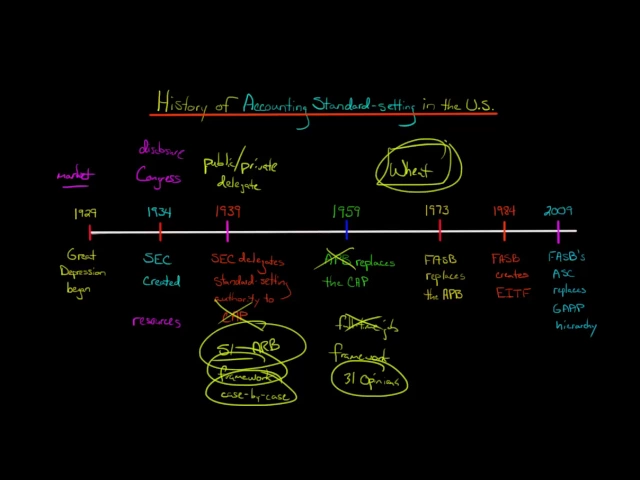
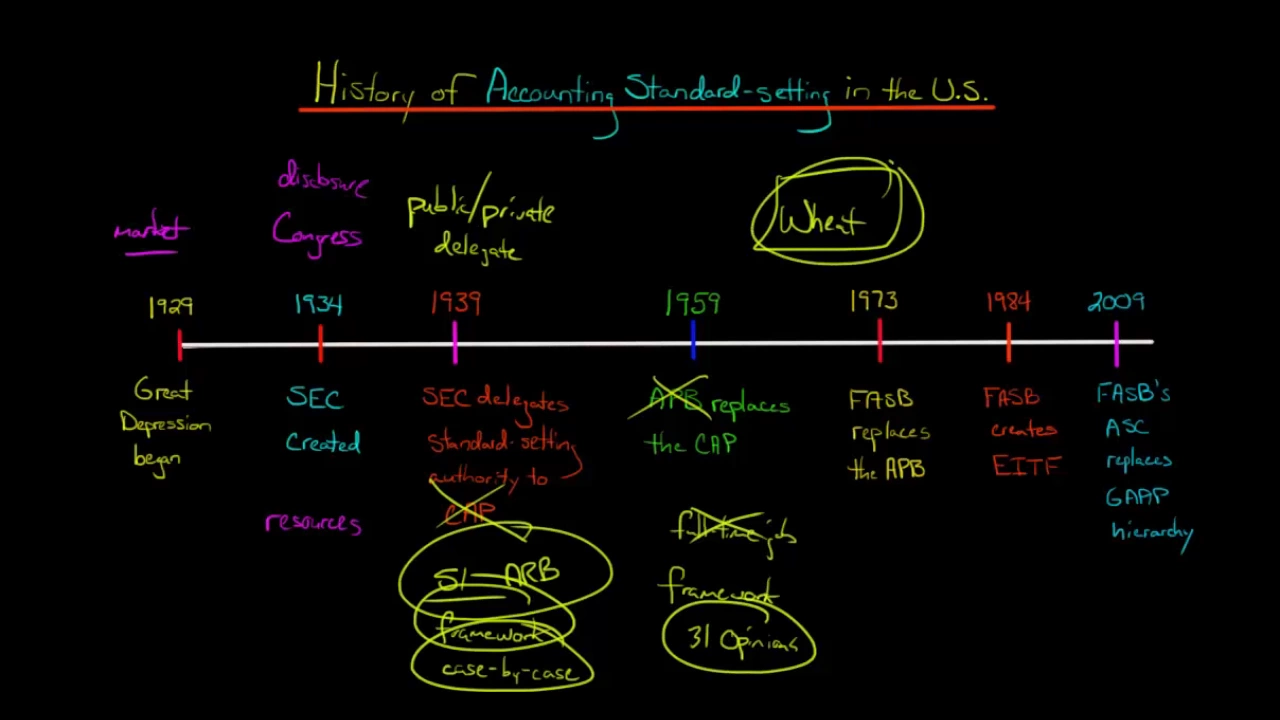
in this video we're going to talk about the history of accounting standard setting in the United States so it all begins with the Great Depression before the Great Depression we didn't have any authoritative accounting standards in the United States but when the Great Depression happened we had a stock market collapse from - the market collapsed and that really shook investor confidence you can imagine where investors like should I invest in these firms can I trust any of the financial information of these firms are giving me and so the government responded the US Congress passed two laws we have a Securities and Exchange Act of 1933 and 1934 in the Act of 1933 came up with new disclosure requirements and then the Act of 1934 created the Securities and Exchange Commission which is commonly known as the SEC to enforce the Act of 1933 and basically the new rules among other things companies that were publicly traded they traded their stock of trade on a stock exchange in the u. s. they're going to have to issue financial statements they're going to put out these these financial statements and they're going to have to send them to the SEC and if the SEC isn't happy with how the financial statements are created and they think that they're not faithful representations of the firm's financial dealings then the SEC could actually take action for example delist that firm from a US stock exchange CC has a lot of power and they have the authority to make the accounting rules in the United States however they don't have a lot of expertise they're underfunded they don't have the resources to be making the accounting rules and so the people the SEC they get the idea hey what if we created a public-private partnership you hear this phrase a lot public/private partnership and what we mean by that is that the public we've got the agency the SEC that's a public organization they're going to make an alliance with a private group right so a non-governmental organization and they're going to make it basically there's this kind of pact with them where they say look we have the authority as the SEC to make the accounting rules but we're going to delegate we're going to delegate that authority that responsibility to the private agency who their expertise is making the accounting rules right and that first agency that was delegated this respect to which this responsibility was delegated was called a committee on accounting procedure otherwise known as the c.
a. p right so c. a.
p was a group of practicing CPAs in the SEC and 1939 said look we're going to give you the right to or basically the authority to make these accounting standards now still the SEC still retains the right so it's still always up to the SEC they have that power delegated to them by Congress but they in turn say to the c. a. p okay we're going to basically pass it to you and you can you can make standards and so from 1939 to 1959 this EAP they issued what really call these accounting research Bolton's and they issued 51 of them so you could think about these as rules or however you want to think about it they're issuing these these accounting research bulletins which are effectively gap right so these are generally accounted a generally accepted accounting principles that firms have to follow right so they 51a are B's now the part of the issue what there are a couple problems with this C ap organization one was that they didn't have any kind of a framework right so they didn't have any overarching framework of what gap should be really what they did was they just on it on a kind of an ad-hoc case-by-case basis they tried to deal with emerging problems in in accounting okay so they didn't have any kind of framework they were just dealing with things on a case-by-case basis so people say you know what we need we can do better and so now we get this this new organization we get the APB okay so we get we get the APB the accounting principles board in 1959 they replace the C AP so now the AP is gone we've got the APB but we still have some of the same issues we still have some of the same issues because the APB they don't have a framework either they don't put together a framework and another issue of the APB is basically what you have with the APB is you have some people who work in industry you had something like that at the time the big 8 firms we have the largest 8 accounting firms and then you have people in private practice but this isn't their full-time job right so this isn't their full-time big job they have a full time job working for a large accounting firm so this isn't their full-time job there's some there's something they're doing on the side so there's kind of a lot of bickering when it came time to making the standards and then there were some issues of ok are these people really independent if they're still working in the industry are they independent and so they click that there was this group the study group called the the wheat the wheat study group and so this wheat study group says you know what the a P P a P B is no good so we need to get rid of the APB and by the way the APB had issued 31 APB opinions so we can think of those as gap right so we know now we have the 51 AR B's we have the 31 opinions and all that was gap but there's wheat study group says look we gotta get away from this we a PP is no good it can't be salvaged so we get the Financial Accounting Standards Board the FASB which is what we have in the u.
s. today this is the standard setting agency in the u. s.
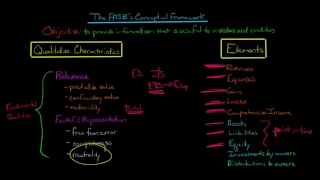
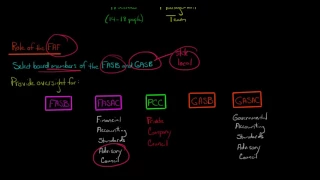
today and there was actually they created a lot more in 1973 they actually create this FAF the Financial Accounting Foundation and the FAA F actually they appoint people to the FASB and so they have a role as well the waiting an actual standard setting it's the FASB so they replace the APB so now we've got the FASB and now we've said we solve some of the issues with the FASB because now the people who are on the board of the FASB it says there's seven members of it they're full-time they're paid this is their job and they're required to sever any ties that they had with their accounting firm or something like that so that kind of addresses that issue of whether they're truly independent and then also they put together our framework they put together a framework so we have these statements on financial accounting concepts we have with seven of them and they're not technically GAAP but they they kind of establish the framework things like relevance the accounting information should be relevant what what do we want we want information faithfully uh faithfully represents the firm's activities and so forth right so put together this really nice framework and then so we saw the FASB today but but we have some additional changes that happen as well so they created this thing called the emerging issues task force the eitf and the IDF they don't make gap that they didn't replace the FASB we still have the FASB but ii ITF will do things like there'll be some kind of issue like some current issue that's being problematic how do firms address this how do i account for this and within the existing gap they will come up with some kind of a solution so so they're not actually making gap but they're an important organization as well okay so now is what and then one final thing I want to mention in 2009 and again we still have the FASB the FASB is if we're concerned so here we are in the present we still have the FASB they're making they're in charge of standard setting for it they make the accounting they make the gap for firms in us so that is still a thing so we got the FASB however one big change was in 2009 the FASB create this Accounting Standards codification this is ASC and that has replaced what was the previous gap basically think about it like this so the FASB they would issue standards so it'd have like standard number 161 standard number 162 okay we have these standards from the FASB and then we have these AP v opinions as 31 opinions and then we have the 51 AR B's and we kind of sometimes people call it a hierarchy of GAAP they said we have these different different hierarchy and what's what's stronger gapped and what what's most Authority most authoritative would be an F ASB standard but what they did is this accounting codification this is ASC it did away with this entire idea that there was a hierarchy or that there was really just a standard based GAAP and they they went to where its topic based so now we have different topics and you can look up any topic like you could look up receivables or something like that and then there'd be subtopics and so forth so it's really neat way of organizing gaps so today this codification that is effectively GAAP right and that's that's made it's updated we have these asu's accounting standard updates that are issued by the FASB but then again still remember that the SEC still technically has authority to make GAAP but they basically delegate at this point in time if the FASB does in charge of making accounting standards in the u. s.