Translator: Claudia Sander Reviewer: Themis Scalco How come a privileged upper-middle-class girl became a social activist at the age of 23? This is the 12th birthday card my parents gave me. I'll read it to you: "Camilla, we are very proud of you.
Continue to be studious, respectful and polite. Remember that it's by respecting people that we build an egalitarian society. We love you.
Happy Birthday. " The education my parents gave me was one of the aspects that helped me walk through my journey. But it was not the only one.
Today, I want to talk about a theme that, for many people, only brings negative feelings: politics. I know, it's a topic that may not interest most of you. And that's exactly why I came here today.
I believe that for our society and our politics to be better, this view must change. Many people think that social issues are a problem only for politicians and those who work in the public sector. If you are one of those people, I intend to bother you.
In fact, I came to poke the wound. And the wound is our inertia. We need to understand that politics goes far beyond the prejudices that most of us have, and that, deep down, each one of us can be political.
So today I hope to convince at least one of you to act. I grew up in the '90s. My parents are from the countryside of Alagoas and Rio Grande do Norte.
My mother was the first doctor in the family and my father worked as a merchant with his brother since their childhood. According to my mother, my father was so hippie-like when she met him, she thought, "I'd never date someone like him. " Here I am to prove how wrong she was, right?
And in fact he is here today, hearing this for the first time. As a child, I was always encouraged and loved stories. First there were the Monica's Gang comics, then Disney and Harry Potter films.
Raise your hand those of you who love at least one story of heroines or heroes. Great. Glad to know I'm not alone.
Even to this day, I have an unfulfilled willingness to practice martial arts because of movies like Karate Kid. But I am very clumsy, so the only time I tried muai thai, I sprained my ankle and spent a month in bed. I believe that, just like me, you must have felt this desire to be like heroines and heroes.
Because they fight against inequality, injustice, oppression . . .
Maybe that's why it's difficult for us to see ourselves as superheroes. We think that to save the world, we must have superpowers. Maybe that's why superhero films are blockbusters to these days.
I believe that in real life, it's all up to us to be superheroes. Despite all the changes in the world today, global connections, new technologies, when it comes to politics, we keep behaving in a passive way. We keep believing that our role is solely to vote and after that, each one takes care of their own life.
It's a vicious cycle: we believe politics is only for politicians and parties; as a result, we reduce our engagement as citizens and society; political decisions don't represent us and social issues persist. We become more dissatisfied and skeptical, and move away. This kind of behavior is always harmful to the group.
It's easy to realize this in teamwork. You must have been through this already, when that person from college or work didn't do their part, and at the end you or your team had to do everything. If in such a small group this behavior is so harmful, just imagine what happens in the whole of society when each of us is absent.
We forget that if our society is not working for everyone, it's our responsibility as well. We share responsibility with our politicians and representatives, as well as everyone working in the public sector. It's easy to point the finger and say it's their fault.
But what about us? Have we acted? Have we done our part or are we still anesthetized?
Citizenship is not a one-off action, it is continuous. It is a constant observation. It is done on a daily basis.
We observe our actions and those of others, and react when necessary. When someone jumps the line, do we remain quiet? Or we are the ones who jump the line?
When we see a broken sign on the street, do we tell the mobility department or do we think, "Oh, never mind, someone will inform them"? But who will inform? According to the dictionary, "public" is everything relative to population, people or collectivity.
Social issues are not just a problem of politicians, they are ours. They affect my life, your life, all the time. Poor health affects education.
Lack of education leads to less access to opportunities. And lack of opportunities perpetuates social inequality. These are complex and interdependent problems.
That's why our action, no matter how small it is, can resonate with the problems system. We can and should act through a new citizenship, a new citizenship where being a citizen means to stop outsourcing responsibility and take our part to make a positive impact in society. In 2016, I participated in a program called YLAI.
YLAI is a US government program to young leaders to increase the impact of their work in their communities. Until participating in the program, I considered myself a little weird. Too much of a dreamer, maybe.
And then I was in the same room with over 240 young people like me from different countries, backgrounds, races and beliefs, and then I felt the power of small actions. While I was there, I understood how small my role is, but how important it is that I continue anyway. Each one has their reason to start advocating for something.
But you don't have to be directly impacted to take action. As I said, I was and I am privileged. I studied in private schools, had health insurance, trips every year, and was encouraged to practice sports, although I wasn't very good at them.
I lived my whole life in a very comfortable position. And I could undoubtedly have followed my life without worrying about social issues. I could, if not for one detail: I realized, very young, my privilege before I even knew this word existed or understood its meaning; I was a child.
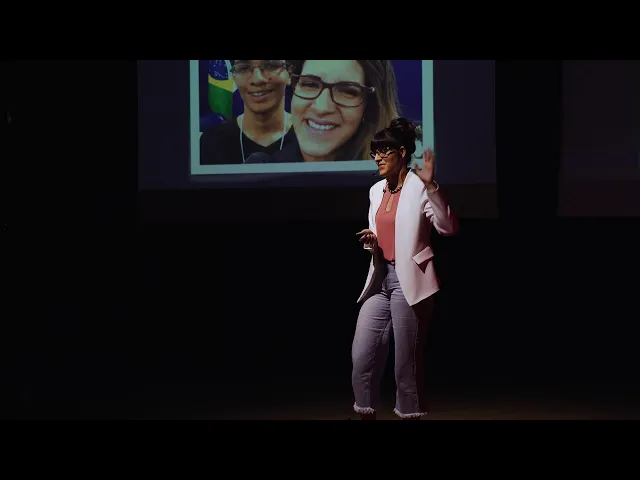
And with that, a feeling of responsibility was born in me. My parents have always had a foot in the public sector, and this made me have contact with realities and people from diverse backgrounds. Some of them became my family, like Mom Deta, the one in this picture.
Mom Deta is indigenous, born in the forest and left there to become a nurse. Years later, as a nurse, she became my nanny and then my mother. She could have stayed in the forest, as she says.
Just like her, there were also Grandma Irene, Nana, Ze, Luiz. They were like my second family. We had breakfast, lunch and dinner.
We laughed, joked, they scolded me. And it was through their narratives that I discovered my privilege. The difficulty of scheduling an appointment with the doctor; the lines at dawn they had to go through to enroll their children in school; the challenge to get to work, taking two, three buses.
I learned very soon the value of living with the different. And I also learned that we are all equal, although being different. Equal in our love for our families; in the dream of having our own house; in the pride of having a studious granddaughter; in the lightness of laughing instead of crying; and in the hope for better days.
Since that time, a restlessness began to arise in me. Over the years, I've learned to name what I felt as a child. I understood what inequality is, what privileges are, what prejudice is.
I lived other experiences and matured. In 2013, I had contact with entrepreneurship in the sense of leading, taking action, of being that brave person who dances alone while everyone looks at them and thinks they're crazy. For me, a crazy person is someone who's grown tired of waiting.
It was like this, tired of waiting, that I created Politiquê? . The idea of Politiquê?
is to broaden the understanding of what is politics and break this vicious cycle in which we move away from politics and become more and more isolated in our personal lives. Last year, lecturing to young college students, I talked about Politiquê? and one of them raised his hand.
It was Caio, this one. He said: "Politiquê? went to my school.
Their action changed my view of politics. Today, I follow the news and try to build an opinion about them. " We've worked with about 3,000 young people like Caio so far, but we know that our work has just begun.
After all, this is not just about an organization. It is about active citizenship that is missing in each one of us. It's about leaving the comfort of our private lives to understand what is happening around us.
About broadening our vision, and understanding that politics goes far beyond what we see in the news. It's to focus our attention on public issues and understand that we are the politics. And our lack of action is also political and conveys the message that we don't care.
When I started Politiquê? and I talked to people about it, they would ask me, "You created Politique? because you want to run for office, right?
" This still happens from time to time. When I say I have no plans to run for office, people get confused. As if politics was just that.
Politics is much more than that. Imagine that politics is this black circle. And the yellow circle is the institutional politics: politicians, political parties, everything that is seen as negative by most people.
And outside the yellow circle are the other ways of doing politics. And the logic of the yellow circle being inside the black one is quite simple: the yellow represents the black. That's what it means to be a representative democracy.
And the black circle is us, the citizens and the society. When we understand this, it becomes clear that our engagement can break this vicious cycle, and that our action matters. No one is prepared enough and there is no right time.
The truth is that you learn after you start, not before. I simply allowed myself to be guided by the discomfort I felt when I started. Because if you stop and think, the problem will seem too big.
You will feel powerless, you'll be afraid and you'll be paralyzed. We don't have time for this. It's urgent.
The right time has passed. We need to accept our humanity, our limitations, and act despite of them. The heroines and heroes are us.
Human, imperfect and full of fears. A few months ago, talking to another activist, she shared a frustration with me. She said, "We have to understand that engagement in one cause leads us to disengage in all others.
And that's okay! " She said that to me, but I believe it fits us all. We need to recognize our inability to change everything.
At this time, let's forget about the fiction movies and stories. If each one engages in one cause, we all win as a society. It's important to have disagreement, healthy debate.
This leads to a collective building. The differences need to get together. This is how we will strengthen our democracy.
The reality that exists today will not change on its own. And one thing is certain: as it is, it is working. It's not working for everyone, but it's working.
And when does a change happen? When a situation that is working but in some way is unfair or exclusionary is replaced by a new one, a new balance. To make this happen, 25% of the population must be engaged.
That was the conclusion of a recent research of Science Magazine. In other words, if 25% of Brazilians get involved, we have a real chance of change. It's not impossible.
If something bothers you and no one has tried to change it yet, maybe you are the one to change it. You need to stand up and act. I said that living with people different from me awakened in me a feeling of responsibility, to serve society.
We can fit our identity and our history in our way of acting. Because all spaces matter. Through NGOs, along with social business, by solving a challenge from our community, and at the academia, educating future professionals.
These are big decisions, but, as I said, every space matters. You can do what's within your reach through small actions: by looking for inclusion at your workplace, opening space and partnering with social projects, scrutinizing public expenses of your city or work area, and even practicing conscious consumption choosing the companies which you buy from, The idea is to build a network of different people in different spaces. This is the only way, the only way for us to overcome all the barriers, to get the support we need, and even work together to make changes happen.
And you have your space. You have your voice. And your space and your voice are your superpowers.
I hope we can build together this new citizenship, and with it, transform our society and our democracy for the better. After all, doing politics is not just about a term of office or being affiliated with a party, let alone voting every two years. Politics is much more than that.
It's about building bridges where there are differences; about breaking down walls where there is prejudice; about standing up where there's injustice; about creating opportunities where there's scarcity; about generating change where there's inertia. And above all, politics is about us looking into ourselves and asking, "Given what bothers me, what responsibility am I going to take and what superpower am I going to use to take action and make this change? " Thank you.