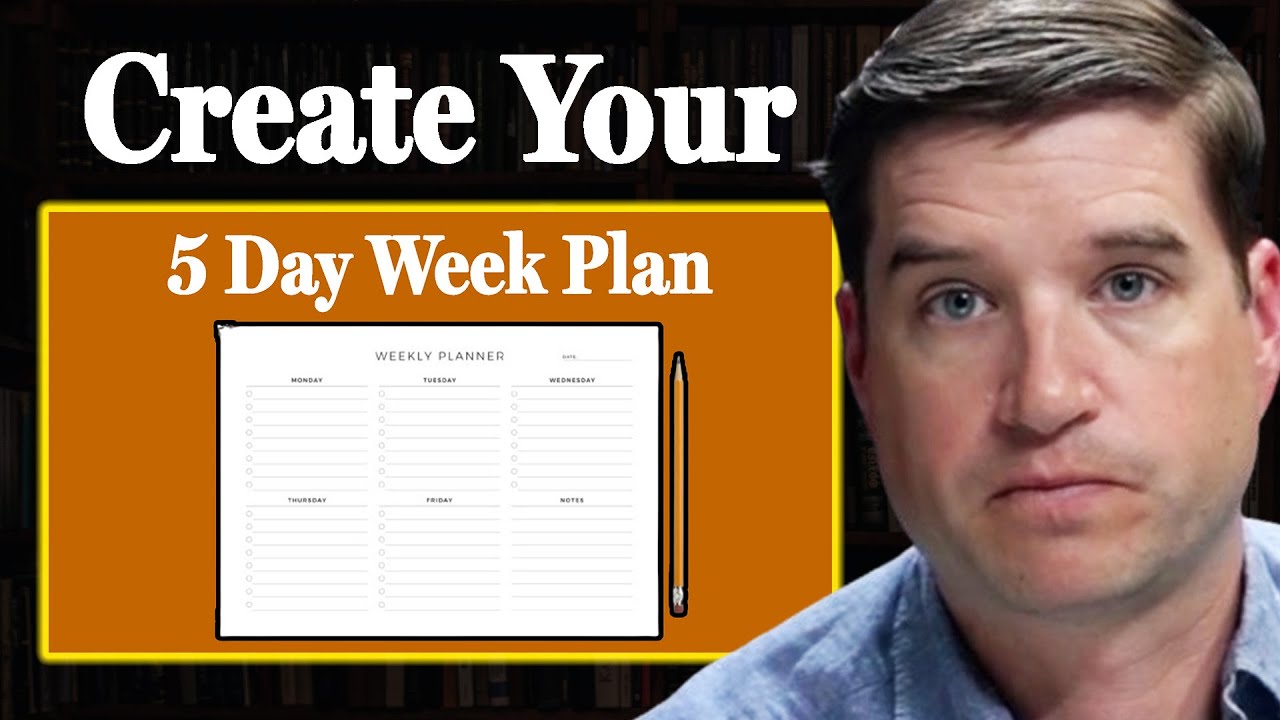
It’s that time of the year again. It’s time to review, plan, and prioritize for next year. I’ve realized that the problem isn’t in planning—putting our thoughts down on paper, having a direction.
Most of us generally know where we’re headed. But the problem is, how do we ensure we take the actions to make that plan happen? So, I’ve revamped how I plan.
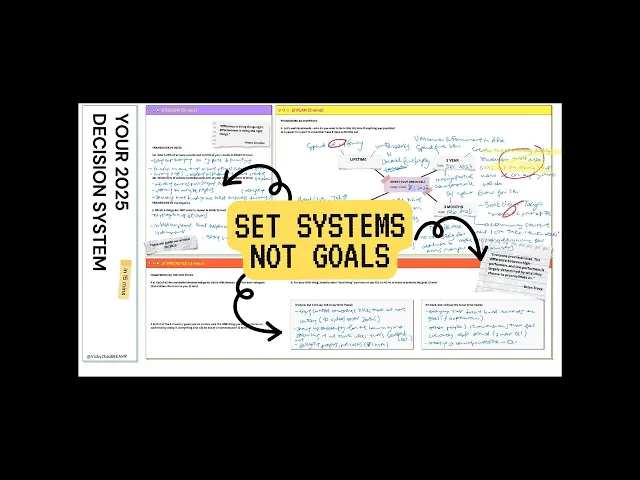
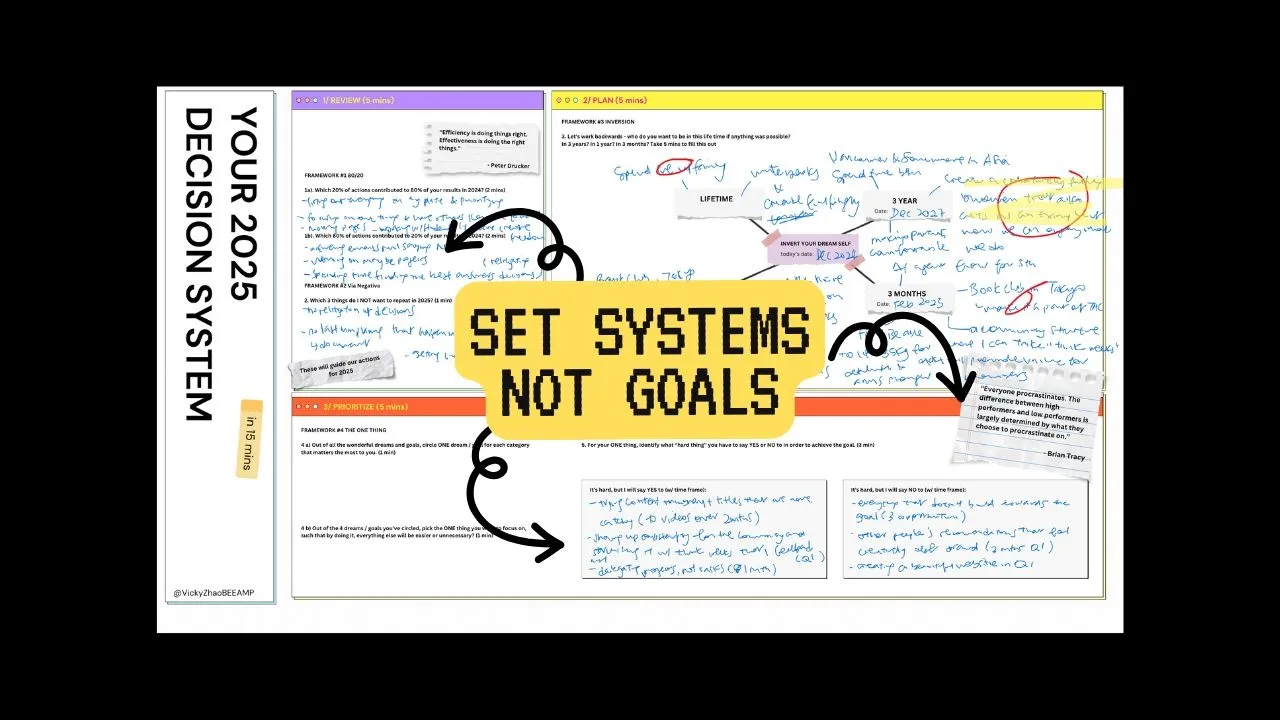
I will share with you the five frameworks I use to make sure I think about the actions and, more importantly, make sure I take those actions next year. The whole process only takes 15 minutes. We’ll spend 5 minutes on review, 5 minutes on planning, and 5 minutes on prioritizing.
For me, 15 minutes is the sweet spot. Timeboxing is also really important, and so many of you mentioned this last year, so we are doing 5-5-5. First box is review.
Let's use the first framework, the 80/20 rule: 20% of actions lead to 80% of the results, and 80% of actions lead to only 20% of the results. Let’s figure it out and see where the leverage is. First, let’s start with the 20% of actions that got us 80% of the results.
Now that I look at it, my 80/20 has two themes. Both involve me spending time with others, and both involve who I’m spending it with. This year, I realized that I need to spend time with people who love doing what I hate doing.
For example, this year I worked with Cecil, and we did an exercise where we mapped out every project I was working on—YouTube, writing, teaching courses, workshops, consulting work—all of it. We looked at everything and said, “Let’s prioritize. Let’s figure out how long each thing takes, how long the project is, and which one gives you more joy.
” I hate doing these types of tasks when I’m in the middle of creating content or writing my book, so it was so helpful to have someone who loved the process to take me through it. The second thing is who I spend time working with. Towards the end of the year, I did a low experiment, and you might have seen it in this video where I talked about wanting to work with people who I enjoy working with long-term—people who think about the things we both care about, who want to improve how we think and speak.
By making that shift, working with people one-on-one, having a closer connection with those I work with, I became so much more creative, I understood the problems better, and I enjoyed creating for people who were in it for the long haul. This for me was my 80/20. Now, let’s do the reverse.
What are 80% of the actions or time that we spent that led to only 20% of our results? Let’s brainstorm for 2 minutes. 80% of the actions that only led to 20% of the results are, surprise surprise, the things I should have just put my foot down and said “no” to.
They include things like emails where I tried to say “no” to a collaboration, but somehow I allowed the back-and-forth to continue. Or decisions I made, like, “Okay, I’m going to try this. I’m going to post videos now on not just ‘learn from me,’ but also ‘learn with me.
’” I kept going back and forth, wondering if I should do it or not. Eventually, I just realized, I need to move on. I think this is pretty clear for me now—what I’ve wasted my time on this year.
And that leads perfectly to the next thing we’re going to do, which is via negativa: describe something by what it is not. In this case, what are the things from 2024 that we’re not going to repeat in 2025? For me, three things are clear: No re-litigating decisions.
No last-minute planning where I do everything in my head, because I need to delegate and explain things properly. I will not leave things to the last minute. Stop getting hangry.
This came up last year too, but I know I’m going to get hangry, so I need to prepare for it. So that wraps up the review of the good and the bad actions. Now we have that in mind as we move on to the next part, which is planning.
For planning 2025, we’ll use the mind map from Passion Planner. I’ve been using this for several years now, and I can tell you that every single person I know who uses it always says 100% of their goals get achieved. For me, it’s the same.
So that’s why we’ll use this. We are going to invert: if anything were possible, what would you be doing in 3 months, 1 year, 3 years, and a lifetime? Let’s spend 5 minutes brainstorming.
[Music] Planning is always my favorite part. It’s so generative, there are endless possibilities, and 5 minutes never seem like enough. Out of all the things you’ve written, you’re now ready for the next step: prioritizing.
We’re putting our feet back on the ground for a second and using “The One Thing” method to make sure we bring it back down to earth. With our limited time and resources, which one thing will we focus on first? We’ll do this in two steps.
The first step is to pick our prioritization for each time frame: 3 months, 1 year, 3 years, and a lifetime. Circle one thing in each time frame that you want to prioritize. Then, once you’ve done that, you have to pick only one out of the four.
You have 2 minutes to do it. Let’s see how it goes. [Music] I’ve never been good at picking “the one thing” until I realized that if I pick something that allows me to do multiple things I love, and they all funnel their energy towards one direction, then that’s the right thing to pick.
For example, I’m doing YouTube, and that’s the right one thing to focus on because it allows me to learn new things, talk about them, distill ideas, and talk to people who also love to learn and communicate their ideas. So, the one thing for me was YouTube. And now, as I was doing this exercise, instead of picking “spend time with family” (which I feel bad not picking), I picked creating a career where I have the creative freedom to make money.
Even though I didn’t pick family, I think by creating that career, I will actually be present when I’m with my family, instead of complaining about this and that. I will be there for them, and I can create opportunities and experiences for us all to enjoy together. So that’s my one thing.
With the one thing in mind, here’s the next step: In order to achieve it, there are hard things we need to do. This goes back to what I was talking about earlier. You know it’s good to have a plan, but how are you going to get there?
The key lies in doing the hard things that we always try to procrastinate on. In this exercise, we are going to identify the things that are hard, but that we will say “yes” to, and the things that are hard, but that we will say “no” to. This will give us a decision-making tool, and we’ll put it into a time frame.
For example, I hate waking up at 5 AM, but maybe I need to do it to pursue this creative goal. So, I’ll say yes to waking up at 5 for two months, just to see what happens. In 60 days, can I do it?
Does it help me? If it doesn’t, I can remove it and try something else. If it works, I’ve proven to myself I can do it for two months, and I could probably continue for another two.
[Music] Looking at the frogs I need to eat (which, by the way, Cecil taught me this), I realize they’re my excuses. The “I’m like this, therefore it’s impossible for me” kind of thinking. That’s such a fixed mindset, so I’m going to put those aside, usually for a month to three months, and just let myself see how I actually feel about the things I think I hate doing.
I might not even hate them, I just don’t know yet. I’ll give myself enough time to see it. If I really do hate it after 3 months, I can always change it.
You can get this worksheet for free in the link below, and let me know in the comments what you learned about yourself. What will you be focusing on next year? I’ll see you in the next video.
Bye!