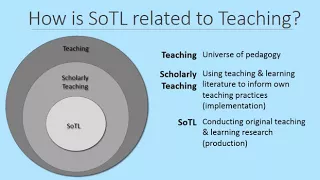
The most basic definition of scholarship of teaching and learning that I use is that it is faculty undertaking systematic inquiry of learning in his or her own classroom. Every time a professor or a teacher teaches a course they're engaged in an experiment; the syllabus is a hypothesis that if I teach the class this way, if I teach this material in this order, and if students do these things then I hypothesize that something will happen. Students will learn, they'll grow, they'll benefit, and that's how we play out every single time we teach.
What's missing is that that final step of what an experimental mode would be, which is this is my hypothesis, this is the unfolding, and now I have to look very closely at the results and reexamine my hypothesis. So that loop closing happens always in some informal way -- that didn't work, I'll never do that again, that was great, I'm always good on that day, students love this -- but we often don't undertake that loop in a very systematic way, so for me the scholarship for teaching and learning is about taking that last step in the hypothesis testing that every act of teaching is and picking some dimension, looking at it systematically, looking sensitively and rigorously at the evidence of student learning, and asking if the assumptions that are going into this learning design are correct and if there are things that I might do differently. The key characteristic of SoTL work for me is that it's a form of inquiry.
Some people like the term research, some people prefer inquiry. It is certainly based on notions of reflective practice and reflecting on your teaching; that's the starting point. For me personally, SoTL involves not just an inquiry into your teaching practices, but it has to have focus on students' learning.
So student learning is the actual focus of inquiry in SoTL, thats that's my personal understanding of it. A definition that I like is sort of as follows. .
. It's faculty bringing their habits and skills as scholars to their work as teachers. So habits of asking questions, gathering evidence of all different kinds, drawing conclusions or raising new questions, and bringing what they learn through that to the thing they were looking at in the first place, which is students' learning -- and their own teaching, of course.
So it's a kind of cycle, but it's essentially behaving as they do as a scholar in other settings and bringing that to their work as teachers. The key characteristics of SoTL really are bringing your research to your teaching in a systematic way so that what you plan to do for your students you carry out and you test and you figure out exactly their response and what might make their learning better. So it's about really addressing your teaching with the research knowledge that you have.
In the root metaphor of scholarship of teaching and learning is inquiry, and that's what differentiates that kind of teaching from regular teaching is that you are continually asking a question. . .
It doesn't have to be a cosmic question about whether education in some theoretical way is working as a model, but it's more a question that could be relayed simply to, "Are students achieving what I hoped for, or what they hoped for? " And so the central feature is that you're asking a question. What that means is that when you're doing scholarship of teaching and learning, you are looking for an answer, and that brings into play a second key idea, which is that involves evidence.
Some scholarship of teaching and learning work is purely conceptual, but much of it is asking a question, observing something to see if you can find an answer to that question, and then framing what you learn from it. The key characteristics of SoTL have probably changed over the past 20 years since the term entered the vocabulary in higher education. To me the key element is for faculty and those who are working with them to look closely and critically at student learning.
But in fact you can elaborate that because it involves what you do with that knowledge. First of all, to look closely and critically, it helps to have a really good question, so having a question would be the first step, and its typically the way in which people enter the scholarship of teaching and learning, by thinking about something that troubles them in their classroom or something that pleases them, something they'd like to know better. So it's developing that sense of.
. . inquiry in what you do in the classroom, or as we'll probably talk a little later about in your program or some larger unit in which you are a part.
So asking that question is very important and then you get to devising ways of answering a question. How you go about answering that question -- that is one where it's very helpful to have colleagues to work with and think about. Sometimes you can answer your question just by a careful look at student work for your class, but sometimes you have to be thinking about you question before you even devise and design your assignments for your class so that you'll have work that will more readily answer it.
Many people go further than that and they look at. . .
they do some other things too -- interview students, they'll do surveys, they'll do other things, and. . .
kinda depends what you asked and what you want to know and what you're comfortable with methodologically. Frequently taking comfort in procedures you're familiar with from your discipline. So there you have a question, you have a way of going about answering it, and for some people, the most important part is what you do with that information and that is where you redesign, reboot.
. . your course or assignment, an assessment, or even a whole program based on many things that you're learning about what your students are thinking and what they are doing.
And for some people the really critical piece after that is going public with what you are learning. We've tried to think of going public frequently in programs for the scholarship of teaching and learning in a wide. .
. with a wide range of. .
. speaking with your colleagues about it at the most informal level all the way up to publishing papers or books, as a result of the whole program of work, but people shouldn't start the scholarship of teaching and learning with that as their only idea about what it means to public. There are many ways in between that are fruitful and that help move the discussion about teaching and learning forward.
Key characteristics of SoTL work. . .
I think focus in some part, anyway, not just on the nature of the work but who is doing the work. I have been asked a few times about the difference between educational research, which we've been doing for centuries, and SoTL, which appears to be a relatively new thing on the landscape. My answer is it's not so much about necessarily the research questions or even some of the methods, but it is about who -- who's doing the work, and when SoTL is going well, the number of people doing the work is greatly expanded, the range of people, the diversity of people is greatly expanded, and what that's supposed to do is increase the impact of the work, because more of it is being conducted, as we might say, at the coal face.
I think the key characteristics for SoTL work begin with asking interesting questions, and those interesting questions typically but not always come from a challenge that someone is having with their teaching or with their students' learning or the interface between the two. So I think asking those interesting questions begins with the characteristics of good SoTL work, and then working out a methodology, a way of gathering answers to the question -- the evidence from the students, the teachers' reflections -- all the relevant evidence. .
. Finding a design and methodology that not only reflects the nature of the question but in many ways, sometimes more importantly, the nature of the expertise of the researcher or researchers. Now I know that's a slightly contested response because some people say that the the research design and methodology should come specifically from the question and the question alone, but to avoid what some have called amateur work in SoTL, I think we have to bring our expertise to the table, and I think there's plenty room in SoTL for a variety of ways to answer questions, and so I think a methodology grounded in.
. . a methodology for answering questions grounded in a question and the researchers' expertise, and then finely, I think a key characteristic would be going public in some way -- sharing the findings, whether they're positive or negative findings, whether I found that my students' learned greatly or revealed many misconceptions that make me have to go back to the starting point.
Whatever those findings are, sharing them publicly beyond just one's institution, to a larger audience, to build knowledge on whatever the question is because chances are many people have asked the same question or wondered the same thing or dealt with the same challenge but to build on that conversation, to build that knowledge, to continue the conversation, and to enter that kind of broader audience beyond one's institution. So for me those three characteristics are essential for SoTL: beginning with an interesting question, having a methodology that's grounded in the question and the researcher's expertise, and then going public in some broad way. I think of SoTL in four ways.
It's a perspective on teaching and learning; it's a set of practices that we use to investigate teaching and learning; it's a product that comes about from that investigation; and it's also something that has an impact. So I would start by saying that the most important part of SoTL work for me is the fact that it's a perspective; it says that teaching and learning are areas where we can ask intelligent, consequential questions. We start there, I don't think we can go very far wrong.
When you're doing it yourself, two things happen. One is that you get to look at the questions that you really care about. So I'm often looking when I'm reading people's articles at whether what they're talking about is useful to me.
Can I apply it? Can I adapt it? Can it inform my teaching?
But when I'm asking my own questions, it's a much more direct process. The other thing that happens when you do your own is that you have to think much more carefully about what I think student learning looks like because you have to define it. You have to look at the work that somebody did and say "yeah that's what learning looks like, right there," and that process I think makes me a better teacher in ways that reading other people's articles doesn't, because it gets me closer to it.